
Table of Contents
Table of Contents
Every e-commerce platform has a traffic pattern that looks irrational from the infrastructure side. For most of the week, the platform runs at a predictable baseline. Then a campaign goes live, a coupon window opens, or a Black Friday sale starts, and the system has to process a burst of orders, inventory updates, payment callbacks, recommendation signals, logs, and risk decisions. The spike may define the business day, but it does not define the whole year.
Kafka sits in the middle of that pressure. It is the buffer between customer behavior and internal systems that cannot all move at the same speed. That makes Kafka for e-commerce a natural fit, but it also makes capacity planning uncomfortable: under-size the cluster and customer-facing workflows degrade; size it for peak every day and idle capacity becomes normal.
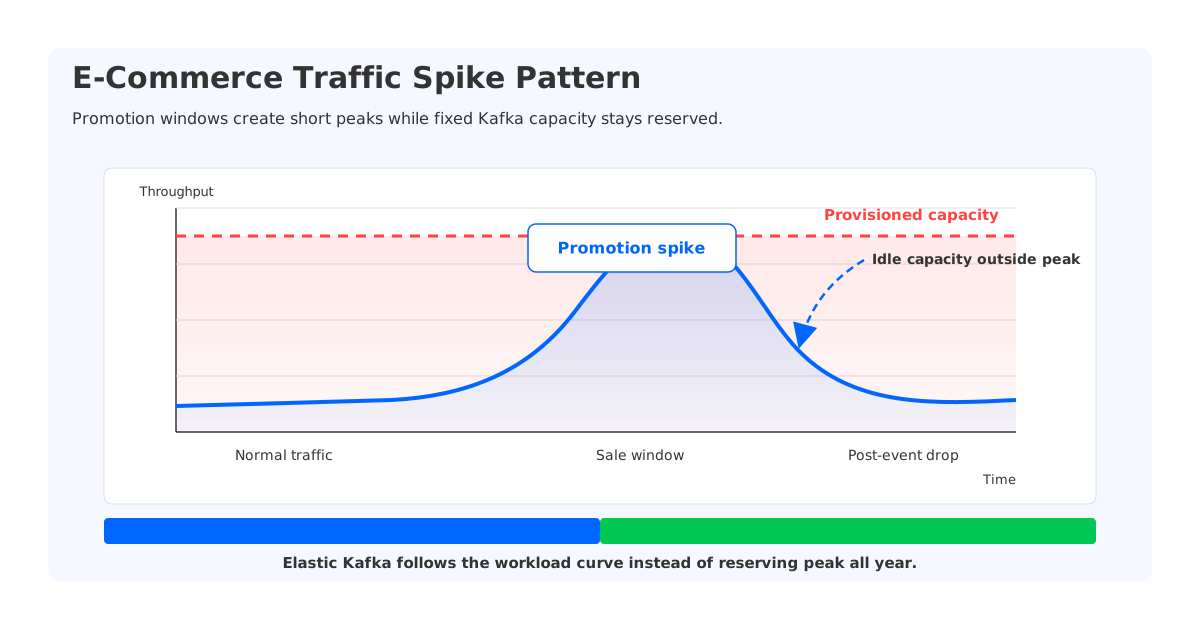
The usual answer is conservative provisioning. Teams reserve brokers, disk, network, and partition headroom for the promotion peak, then carry that footprint through normal traffic. The exact multiplier depends on the business. The pattern is what matters: a short-lived peak drives a long-lived infrastructure bill.
1Why E-Commerce Kafka Traffic Spikes Are Different
Traffic spikes in e-commerce are not a single stream getting louder. They are related streams amplifying each other. A promotion increases page views, page views trigger recommendations, recommendations influence cart activity, cart activity triggers inventory reservation, and inventory changes feed back into search ranking, availability, pricing, and risk checks. A small delay in one stream can become a customer-visible inconsistency.
That is why Kafka often becomes the central event backbone for commerce systems:
- Orders and carts. Checkout events, cart mutations, order state changes, cancellations, and returns need durable replay for downstream systems.
- Inventory and fulfillment. Stock reservations, warehouse allocation, delivery promises, and marketplace updates need near real-time propagation.
- Payments and risk. Payment authorization, fraud scoring, chargeback signals, and account risk events need low-latency fan-out with auditability.
- Recommendations and personalization. Clickstream events, product impressions, search interactions, and purchase intent signals feed ranking loops.
- Logs and observability. Application logs, API traces, checkout metrics, and promotion dashboards expand because every service is busier.
These streams are operationally connected even when they live in separate topics. During a promotion, the platform team cannot scale only the order topic and ignore the rest. Checkout depends on payment and risk, the customer promise depends on inventory, and the business team depends on live dashboards. Kafka has to absorb the combined event graph, not a single neat throughput line.
2The Conservative Capacity Trap
Traditional Kafka capacity planning starts from a reasonable place: protect the peak. Brokers are stateful, partitions live on broker-attached disks, and data movement during scaling is not free. When a team adds brokers, it still has to move partition data, balance leaders, protect client latency, and watch replication lag. Nobody wants to learn during checkout that a rebalance plan was too aggressive.
That caution is not operational weakness. It is a rational response to Kafka's shared-nothing storage model. A broker is compute plus partition ownership, local log segments, and replica state. Scaling Kafka is therefore not like scaling a stateless API deployment. Additional brokers become useful only after they receive partition assignments and data.
This is where over-provisioning becomes a tax rather than a mistake. Teams keep extra brokers, disk, and network headroom because replication, consumers, and rebalancing can all compete for bandwidth. The waste is visible during normal traffic, but the alternative looks worse: overload during a revenue event.
| Planning Question | Traditional Kafka Answer | Operational Consequence |
|---|---|---|
| How much capacity should we reserve? | Peak plus safety headroom | Low utilization during normal weeks |
| When can we scale out? | Before the event, with planning | Capacity arrives early and stays late |
| What happens when brokers are added? | Partition reassignment and data movement | Rebalance risk during busy windows |
| Can we scale down after the sale? | Carefully, often after traffic stabilizes | Idle brokers remain longer than needed |
The table is not a cost calculator; real cost depends on cloud region, broker type, retention, read fanout, replication factor, and operational policy. But the shape is stable: stateful brokers make capacity sticky. Once peak capacity is provisioned, removing it safely takes planning, so teams often leave the cluster larger than the workload needs.
3Why Auto Scaling Alone Does Not Fix Stateful Kafka
Cloud platforms already provide auto scaling primitives. Kubernetes has the Horizontal Pod Autoscaler. AWS has Auto Scaling Groups. For stateless services, these tools work well because an instance can start, receive traffic, and disappear later with little ceremony. Kafka is harder because the broker's usefulness is tied to data locality and partition ownership.
If a checkout API scales from a few pods to many pods, each pod is immediately interchangeable. If a traditional Kafka cluster scales from a few brokers to many brokers, the added brokers begin empty. They help only after partitions are reassigned, leaders are moved, and traffic is balanced. The auto scaler can create compute, but it cannot remove the storage coupling that makes Kafka scaling heavy.
This is the difference between elastic infrastructure and elastic Kafka. Elastic infrastructure means nodes can be created quickly. Elastic Kafka means the cluster can use those nodes quickly, then give them back when traffic drops. E-commerce workloads need the second definition: a sale does not wait for a long rebalance cycle, and finance does not enjoy paying for peak capacity after the campaign ends.
4A Diskless Kafka Architecture Changes the Unit of Scaling
The architectural fix is to separate Kafka broker compute from durable storage. In a diskless Kafka design, brokers do not own the durable log on local disks. Data lives in object storage or shared storage, while brokers handle protocol processing, request serving, and partition leadership as stateless compute. Scaling becomes a metadata and traffic-balancing operation rather than a data-copying event.
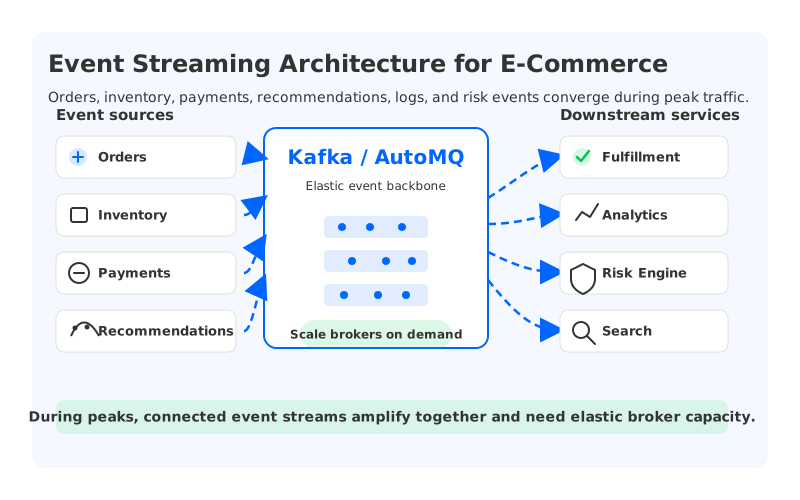
AutoMQ takes this approach while staying Kafka compatible. Producers, consumers, Kafka Connect jobs, and stream processing applications continue to use the Kafka protocol. The important change is below the API: broker capacity can be treated more like elastic compute because the durable log is no longer trapped on individual broker disks.
That changes the capacity conversation for e-commerce teams:
- Promotion ramp-up becomes compute scale-out. Additional brokers can absorb producer and consumer load without first copying large volumes of historical data.
- Post-event cleanup becomes scale-in. When traffic drops, brokers can be removed without draining durable data from local disks.
- Hot topics are easier to rebalance. Partition movement focuses on traffic ownership and metadata instead of moving log segments.
- Kubernetes becomes more useful. Auto scaling tools can create and remove broker pods because brokers behave closer to stateless services.
AutoMQ's public documentation describes scale-out and scale-in in seconds, with partition reassignment often completed within ten seconds when paired with ASG or Kubernetes HPA workflows. The mechanism matters more than the stopwatch: shared storage makes reassignment lightweight because it avoids the traditional data copy step.
5What This Looks Like in a JD.com-Like Scenario
JD.com's public AutoMQ case study is useful because it is not a toy e-commerce architecture. JDQ, JD.com's Kafka-based real-time data platform, supports more than 1,400 business lines across more than 40 departments, including search recommendations, advertising, clickstreams, and real-time dashboards. The case study describes thousands of nodes, high message volume, Kubernetes deployment, and the familiar challenge of making Kafka fit a cloud-native operating model.
The interesting part is not that JD.com had a large Kafka deployment. Large retailers often do. The interesting part is the failure mode: Apache Kafka's shared-nothing architecture made scaling on Kubernetes high risk, because expansion required partition reassignment planning, impact evaluation, off-peak execution, and post-reassignment checks.
After adopting AutoMQ with CubeFS-compatible object storage, JD.com reported lower storage and bandwidth cost and improved Kubernetes scaling efficiency from hours to minutes. The same write-up connects elasticity to large-scale promotions and flash sales, where dynamic capacity avoids provisioning around the peak.
The lesson for other e-commerce teams is not "copy JD.com's exact deployment." Their internal storage, Kubernetes platform, and operating constraints are specific to JD.com. The transferable lesson is simpler: when Kafka storage is decoupled from broker compute, promotion traffic becomes a scaling problem rather than a data migration problem.
6Over-Provisioning vs Elastic Brokers
With stateful Kafka, capacity planning usually asks: how much can this cluster safely handle before we touch it again? With diskless Kafka, the better question is: how quickly can broker compute follow traffic without turning scaling into a data movement project?
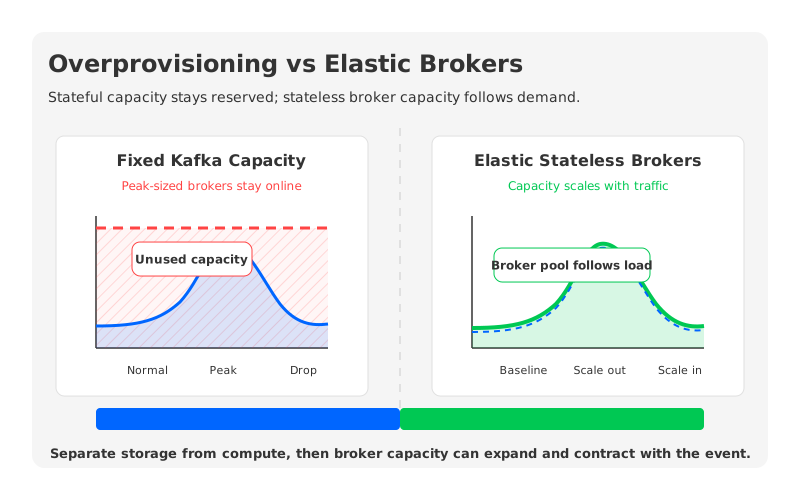
The chart above is conceptual, but it captures the economic difference. A fixed-capacity cluster reserves broker capacity for the peak window and carries unused capacity outside the event. An elastic broker pool follows the workload curve more closely: baseline capacity during normal hours, extra compute during the promotion, and a scale-down path after the drop. The savings come from avoiding idle compute, and the reliability gain comes from scale-out no longer waiting on full partition data movement.
This does not remove capacity planning. E-commerce teams still need load tests, partition design, producer quotas, consumer lag alerts, failure drills, and rollback plans. Diskless Kafka changes the failure domain: instead of planning every peak around stateful rebalancing, teams can plan around elastic broker capacity, downstream backpressure, and application limits.
7A Practical Checklist for E-Commerce Teams
Before the promotion calendar locks, platform teams should separate workload questions from Kafka architecture questions. The workload questions define expected traffic; the architecture questions determine whether the infrastructure can follow that shape without waste.
For the workload, document the streams that spike together, not only the order topic. Capture normal throughput, promotion throughput, read fanout, retention, partition counts, consumer lag tolerance, and downstream bottlenecks. Expensive Kafka mistakes often come from treating streams separately when the sale makes them move as one system.
For the Kafka architecture, ask harder questions:
- Can new broker capacity become useful without moving retained data?
- Can scale-in happen after the event without a long drain window?
- Does the platform support AZ-aware routing and storage-compute separation?
- Are auto scaling decisions tied to real traffic metrics or manual runbooks?
- Can the team test scale-out and scale-in before the promotion, using production-like data volume?
If the answer to the first two questions is no, over-provisioning will keep looking like the safest choice. That may be acceptable for a stable workload. For e-commerce peaks, it is expensive insurance against a problem created by the storage model itself.
8The Better Goal: Pay for the Spike When the Spike Exists
Black Friday, Singles' Day, flash sales, and campaign launches should not force a Kafka cluster to behave as if every day is peak day. Traditional Kafka makes that hard because brokers are stateful and scaling involves data movement. Conservative provisioning is the result, not the root cause.
Elastic, diskless Kafka attacks the root cause by making broker capacity separable from durable storage. AutoMQ's shared storage architecture, seconds-level scaling capability, and production references such as JD.com show what that model looks like for e-commerce-scale event streaming. The business still gets the buffer, replay, and Kafka ecosystem it depends on; the infrastructure team gets a cluster shape that can follow the promotion curve more closely.
The point is not to run Kafka with no headroom. The point is to stop buying peak headroom as a permanent fixture. For e-commerce teams, that is the difference between preparing for the next traffic spike and funding it all year.


