
Table of Contents
Table of Contents
Financial services teams rarely get to optimize Kafka for a single goal. A trading workflow wants tight tail latency. A risk workflow wants fresh positions with traceable inputs. An audit workflow wants retention, immutability controls, and reviewable access paths. If every stream is forced into the same architecture, the platform either overpays for cold data or under-engineers the hot path.
That tension is why "Kafka for financial services" is not one architecture question. It is a classification problem. Which streams participate in the transaction path? Which streams need replay for investigation? Which streams are governed by data residency, encryption, private networking, or segregation-of-duty requirements? Kafka can serve all of these workloads, but the storage, networking, and operating model should not be identical for all of them.
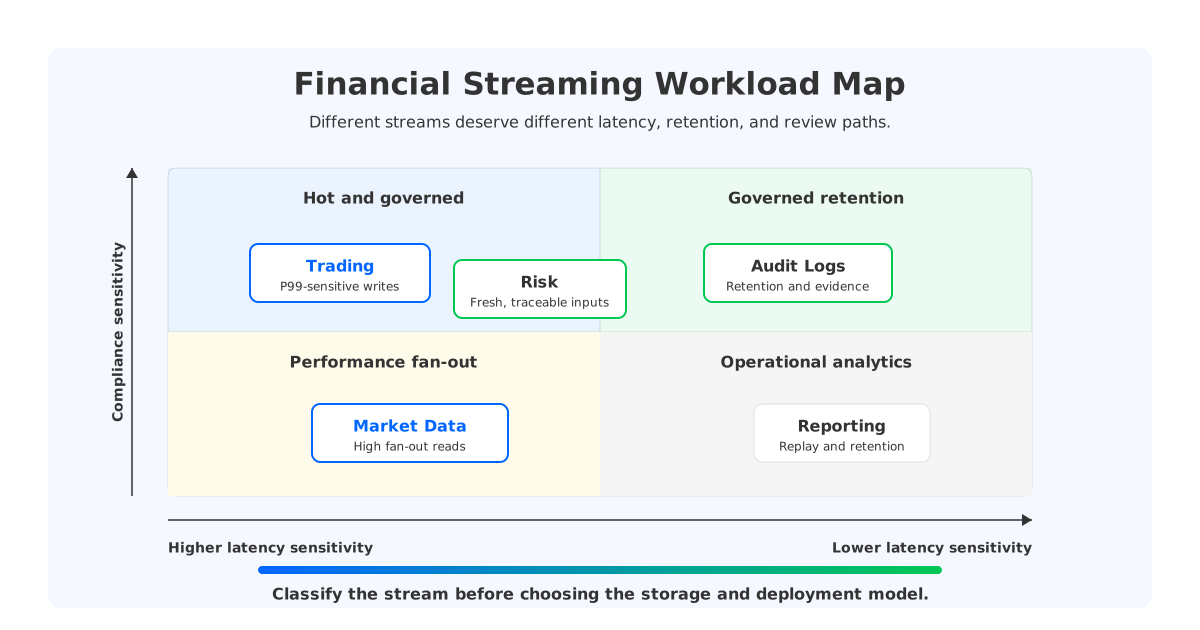
The map above is intentionally not a vendor checklist. It is the first pass a platform team should run with application owners, SREs, security architects, and compliance reviewers. This article discusses architecture patterns, not legal advice. Regulatory interpretation, evidence requirements, and control ownership should always be reviewed with your security, risk, and compliance teams.
1Start With Workload Classes, Not Cluster Names
Financial services platforms often say "the Kafka cluster" as if it carries a uniform workload. In practice, the same Kafka estate may serve market data distribution, payment events, fraud signals, customer activity streams, security logs, and regulatory reporting. Each stream has a different failure mode.
- Trading and execution paths need predictable producer acknowledgment, stable P99 latency, and careful blast-radius design. Retention may be short compared with audit data, but any delay in the hot path can surface as business risk.
- Risk, fraud, and AML pipelines often sit close to the transaction path without being the transaction path itself. They need low latency, but they also need reproducible inputs, clear lineage, and access controls that auditors can understand.
- Market data and reference data may have high fan-out and bursty reads. The main risk is not always write latency; it can be consumer lag, replay pressure, and the cost of serving many downstream systems.
- Audit logs, surveillance, and regulatory reporting tend to value retention, durability, governance, and data location over the lowest possible write latency. These streams punish architectures that keep large histories on high-cost broker storage.
- Internal analytics and operational reporting need replayable data and flexible retention, but they should not inherit the infrastructure profile of latency-sensitive trading topics.
Once the workload classes are visible, the architecture conversation becomes more grounded. The question changes from "Which managed Kafka service should we buy?" to "Which streams require a low-latency write path, which streams require long retention, and which deployment model preserves the compliance boundary?"
2The Compliance Boundary Is Part of the Data Plane
Kafka compliance is often discussed as encryption, ACLs, and audit logs. Those controls matter, but they are not the whole boundary. In a regulated industry, reviewers may also care where event data is stored, where metadata is stored, who can access diagnostics, whether operators can reach the broker network, and how data moves during backup, replication, support, and incident response.
This makes data residency a data-plane design issue, not a procurement checkbox. A SaaS Kafka service can be well secured, but it usually places the service boundary in the provider's environment. A self-managed cluster gives the customer control, but it also places all patching, scaling, rebalance, storage, and recovery responsibilities on the internal team. BYOC, short for Bring Your Own Cloud, is attractive in finance because it can place the Kafka data plane in the customer's cloud account while keeping much of the managed-service operating experience.
| Requirement area | Architecture question | Review focus |
|---|---|---|
| Data residency | Where do event data, metadata, backups, and replicas live? | Account, region, storage bucket, and replication path ownership |
| Network isolation | Can producers, brokers, storage, and consumers communicate through private paths? | VPC design, private endpoints, routing, firewall policy, and DNS |
| Access control | Who can administer clusters, topics, credentials, and storage? | IAM, Kafka ACLs, break-glass workflows, and role separation |
| Auditability | Can operational actions and data access be reconstructed? | Logs, control-plane events, change history, and evidence retention |
| Operational resilience | What happens during broker failure, AZ impairment, or control-plane loss? | Recovery path, runbooks, and customer-owned observability |
The table is deliberately written as questions because compliance evidence is organization-specific. A financial institution may accept one deployment model for market-data redistribution and require a different model for customer transaction events. The architecture needs to preserve those options.
3Low Latency and Long Retention Pull Storage in Opposite Directions
Traditional Kafka stores partition logs on broker-attached storage and replicates them through Kafka's ISR mechanism. That model is familiar and effective, but it couples the hot write path, retention capacity, broker lifecycle, and partition movement into one storage design. When the topic needs very low latency, that coupling can be acceptable. When the topic needs long retention and replay, it becomes expensive and operationally heavy.
Tiered storage reduces part of the pressure by offloading older data to object storage, but the primary Kafka storage layer still exists. The broker remains a storage owner for the hot tier, and scaling or rebalancing can still involve partition data movement. For financial platforms with mixed workloads, this creates a quiet mismatch: audit and reporting topics pay for infrastructure shaped by the hot path, while hot-path topics inherit operational complexity created by large historical data.
AutoMQ's architecture takes a different route. Its Shared Storage architecture replaces Kafka's broker-local log storage with a shared storage layer. Brokers become stateless, data is stored in object storage as the primary repository, and a WAL layer handles durable write acknowledgment before data is uploaded to object storage. The useful part for financial services is not a slogan about storage separation; it is the ability to choose the write path based on workload requirements.
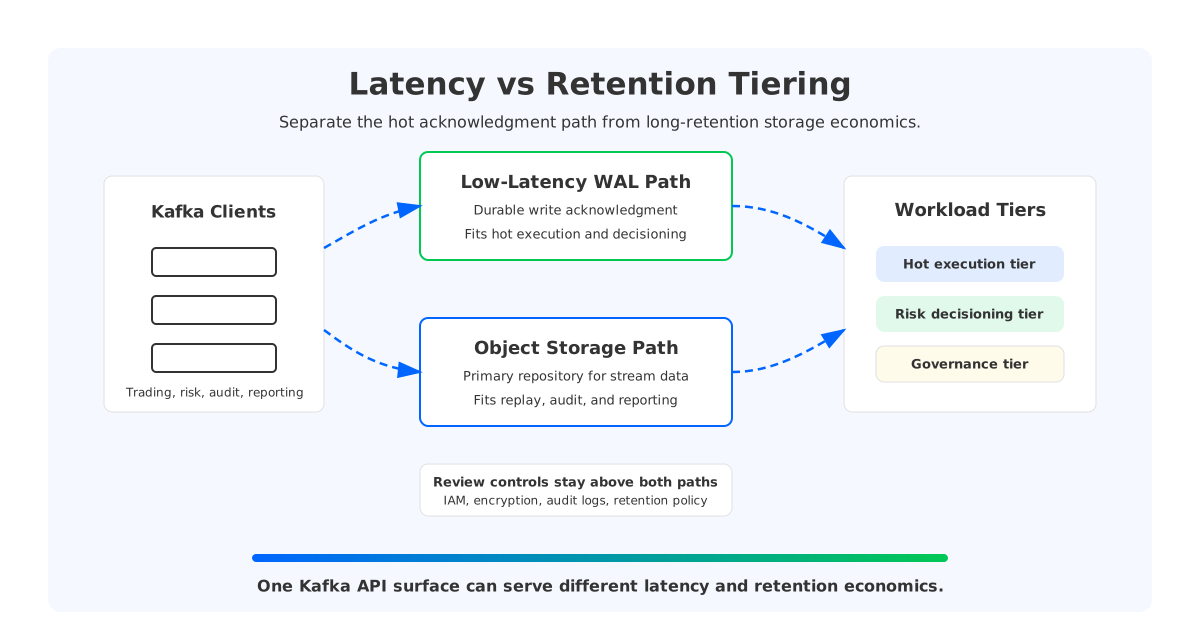
With this design, latency-sensitive streams can use a low-latency WAL path, while retention-heavy streams can lean into object storage economics. AutoMQ's WAL storage is pluggable across storage media, including block storage, object storage, and file storage options depending on the deployment environment and workload profile. That does not remove the need for performance testing. It gives the platform team a cleaner set of knobs than treating every topic like a trading topic.
4A Tiered Selection Framework for Finance Kafka
The strongest financial Kafka designs usually separate topics by business criticality and evidence requirements before they separate them by team ownership. That sounds mundane, but it prevents a common failure: a platform chooses the most conservative architecture for every stream, then discovers that cost and operations do not scale.
Use a simple tiering model during design review:
- Hot execution tier. Topics in this tier participate in order routing, payment execution, fraud intervention, or other paths where producer acknowledgment and tail latency are central design constraints. They deserve the lowest-latency write path, strict capacity testing, and conservative change management.
- Risk and decisioning tier. These streams may not directly execute the transaction, but they influence business decisions quickly. They need strong freshness targets, reproducible inputs, and audit trails that connect decisions back to event history.
- Governance and retention tier. Audit logs, surveillance events, customer communication events, and reporting feeds need data residency, retention, encryption, and access review more than aggressive write latency. Object-storage-centered designs are often a better fit here.
- Analytics and replay tier. Downstream analytics, model features, and operational reports need replay and broad access patterns. They should be isolated from hot-path resource contention and designed for cost-effective reads.
This framework also clarifies when to split clusters, accounts, namespaces, or storage classes. The split should follow the control boundary. If two workloads have different data residency rules, different operator access rules, or different incident response procedures, putting them in the same cluster may create more risk than reuse.
5BYOC and Air-Gapped Patterns
For many financial services teams, the deployment model is as important as the Kafka engine. The reason is straightforward: data location and operational access are review topics. A platform that satisfies functional requirements but moves sensitive event data into a vendor-controlled environment may still be rejected.
In AutoMQ BYOC, the data plane runs in the customer's cloud account and VPC. Event data remains in customer-owned storage, while AutoMQ provides managed lifecycle automation. For environments that require private cloud, on-premises, or disconnected deployment, AutoMQ Software is the self-managed path.
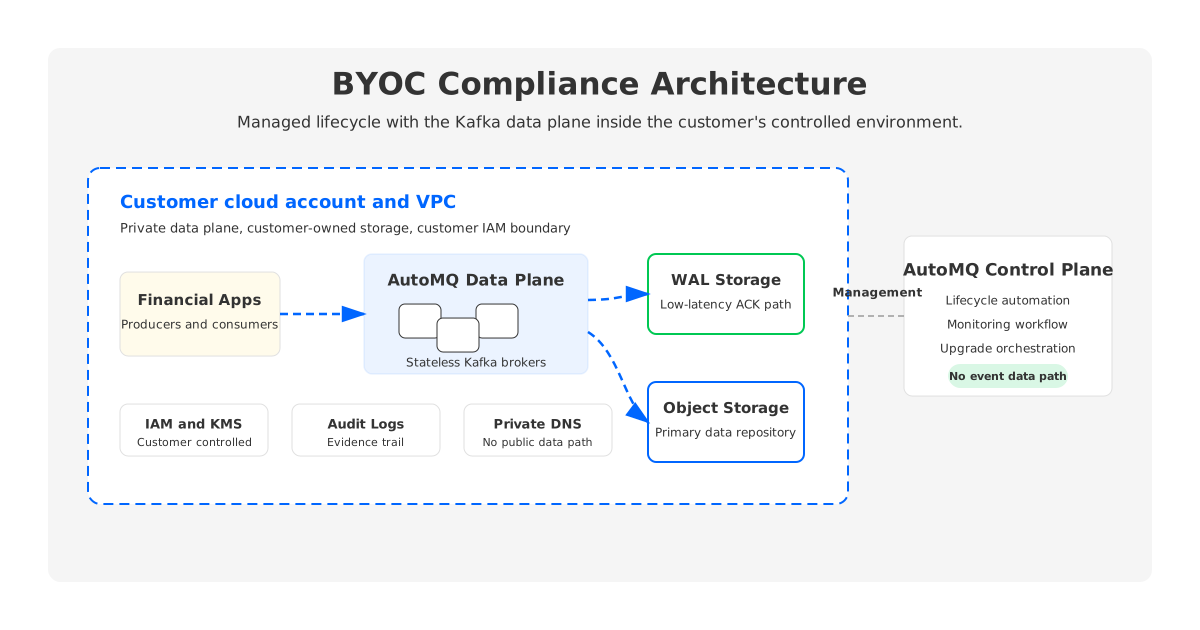
The important design pattern is separation of responsibilities. The customer controls the account, network, storage, IAM, and evidence collection. The Kafka platform still benefits from automation around broker lifecycle, scaling, and balancing, but the sensitive data plane remains inside the customer boundary. For air-gapped environments, the review becomes stricter: package distribution, upgrade approval, observability export, support workflows, and emergency access need explicit runbooks.
6The Evaluation Checklist That Actually Matters
Feature lists can make financial Kafka evaluations feel broader than they are. In practice, a few questions decide the architecture:
- Can customer data and Kafka metadata remain inside the customer-controlled environment?
- Can the broker network, storage access, and client paths use private networking without public data exposure?
- Can the platform prove who changed topics, credentials, ACLs, retention, and cluster configuration?
- Can latency-sensitive topics choose a different write path from retention-heavy topics?
- Can the team scale brokers or recover from broker failure without long partition data movement?
- Can security and compliance teams review the operating model alongside the product evidence?
These questions do not point to a single universal answer. A market-data platform, a retail banking ledger stream, and an audit archive should not be forced into the same trade-off. The point is to make the trade-off explicit enough that platform engineers, application owners, and reviewers can agree on it before production traffic arrives.
7Where AutoMQ Fits
AutoMQ is relevant to financial services because it separates decisions that traditional Kafka tends to bind together: compute from storage, hot writes from long retention, and managed operations from vendor-hosted data. Its Kafka compatibility keeps the application-facing surface familiar, while the shared-storage design gives platform teams more room to align each workload with its latency, residency, and retention profile.
That does not make architecture review disappear. Teams should still run workload-specific benchmarks, validate private networking, review IAM and audit evidence, and document the operational boundary with internal security and compliance owners. The practical gain is that the Kafka platform no longer has to choose between "low latency everywhere" and "low cost everywhere." Finance needs both, but not for every stream at the same time.
The starting point is the same map from the beginning: trading, risk, market data, audit, and reporting do not ask Kafka for the same thing. Once the platform treats them as different workload classes, compliance and latency stop fighting each other and become design inputs for the same streaming architecture.


