
Table of Contents
Table of Contents
Kafka governance usually starts as a people problem. A team needs a topic, another team needs consumer access, a data product owner wants a schema change reviewed, and the platform team wants every request to arrive with an owner, retention policy, naming convention, and rollback plan. That process works when the Kafka estate is small. It starts to collapse when dozens of application teams share clusters across environments, regions, and business units.
The failure mode is not that Kafka lacks controls. Kafka has mature primitives for topics, consumer groups, access control, quotas, client configuration, and operational visibility. The problem is that those controls are often applied through tickets, console changes, scripts, and tribal knowledge. Governance becomes a queue, teams route around it, and platform owners inherit an estate full of drift.
Policy-as-code is the practical answer to that pattern. It means expressing governance intent in reviewable artifacts, validating those artifacts before they reach production, and applying them through a repeatable control loop. For Kafka, that loop needs to cover topic lifecycle, ACLs, schema compatibility, ownership metadata, capacity boundaries, cost exposure, and recovery behavior.
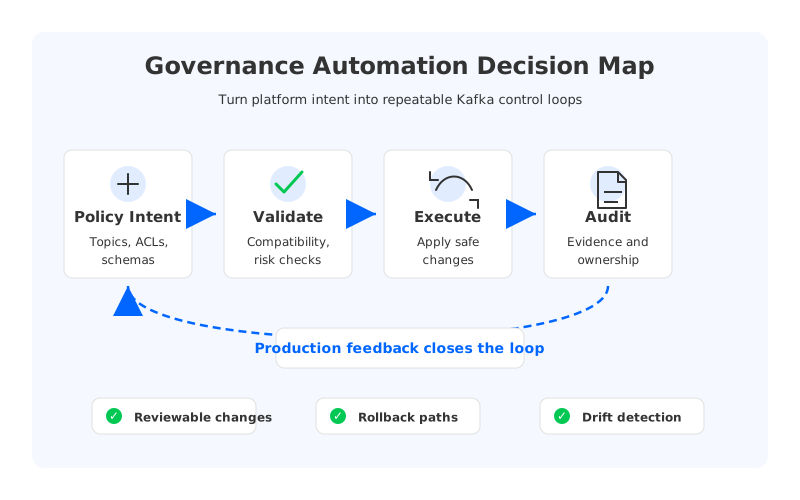
1Why teams search for kafka governance automation
The search term kafka governance automation usually appears after the first generation of Kafka self-service has already worked. Teams can create topics faster than before. They can request access without waiting days. They may even have a portal that hides some of the broker details. The resulting problem is that speed without policy creates a different kind of operational debt.
In a shared streaming platform, small local choices have platform-wide consequences. A topic retention change can multiply storage consumption. A permissive ACL can expose event streams to the wrong application boundary. A schema update can break consumers outside the review. A connector deployed for one team can become a production dependency for many others.
That is why the governance conversation has moved away from static documentation. The useful question is no longer "Do we have a standard?" The useful question is "Can the platform enforce the standard before a risky change reaches production, and can it prove what happened afterward?"
A serious Kafka governance automation program usually has a few concrete goals:
- Reduce manual approval work without removing accountability. Platform teams should review exceptions and high-risk changes, not retype routine topic and ACL requests.
- Make ownership visible. Every durable stream should map to a service owner, data domain, retention expectation, and operational contact.
- Catch unsafe changes before apply time. Validation should reject naming violations, incompatible schema moves, over-broad ACLs, and capacity requests that exceed agreed boundaries.
- Create audit evidence by default. A merged policy change, validation output, apply result, and rollback record are stronger evidence than a ticket comment.
- Keep developers moving. Governance loses authority when it is slow enough that teams create shadow paths around it.
The last point matters most. Governance automation is not the opposite of developer experience. It is the mechanism that lets platform teams offer self-service without turning the cluster into an unbounded shared resource.
2The governance pressure behind shared streaming platforms
Kafka makes shared infrastructure attractive because its abstraction is clean: producers write records to topics, consumers read at their own pace, and consumer groups track progress independently. The abstraction hides machinery that platform teams still manage: partition placement, replica storage, ACL scope, client defaults, retention boundaries, and connector recovery.
Traditional Kafka architecture adds another layer to this governance pressure because brokers are not only compute processes. They also own local persistent log data. That coupling makes many governance actions operationally heavier than they appear. Increasing partitions, changing retention, replacing brokers, expanding capacity, or rebalancing storage is not only a metadata decision; it can trigger data movement and affect broker health.
Policy-as-code works best when the system underneath it has predictable change boundaries. If a routine governance action creates a large operational side effect, automation needs more guardrails, more scheduling logic, and more rollback planning. The policy layer can still help, but it cannot fully hide the cost of broker-local state.
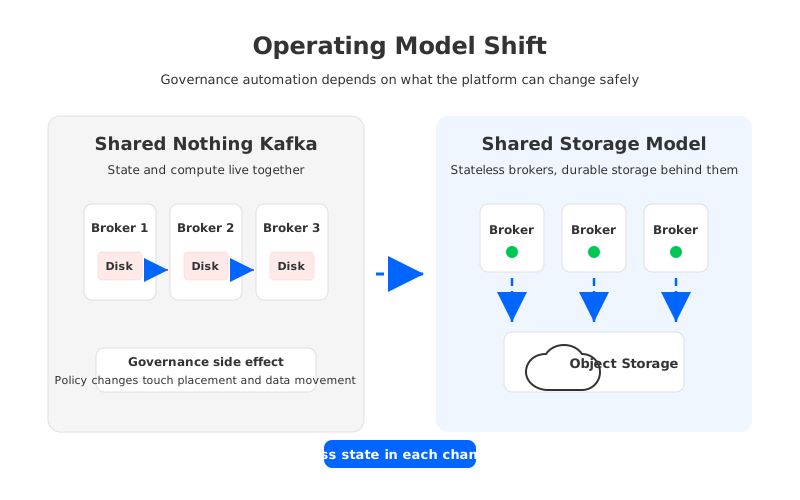
The architectural question is therefore part of the governance question. A platform team evaluating governance automation should ask how much of its Kafka estate can be changed through metadata and policy, and how much still depends on moving data between stateful brokers. Traditional Kafka is governable, but the governance model has to be honest about placement, disk utilization, replication traffic, and maintenance windows.
3Contracts, ownership, access, and audit trade-offs
Good Kafka governance starts with contracts. A contract is broader than a schema. It describes ownership, data meaning, compatibility rules, access scope, retention, availability tier, and operational signals. The schema is one part of that contract; the operational envelope is the rest.
A useful policy-as-code model treats governance as a layered control system:
| Layer | What policy should define | What automation should prevent |
|---|---|---|
| Topic lifecycle | Name, domain, owner, retention, partition baseline, environment | Anonymous topics, unbounded retention, ad hoc production changes |
| Schema and contract | Compatibility mode, required fields, deprecation path, consumer impact | Breaking changes without review, undocumented semantic changes |
| Access control | Producer and consumer principals, group scope, service identity | Wildcard access, stale privileges, cross-domain reads without approval |
| Cost and capacity | Retention tier, expected throughput, partition growth, traffic class | Capacity requests that exceed budgets or create hidden network costs |
| Operations | SLO tier, alert routing, rollback owner, disaster recovery expectation | Streams with no support path or untested recovery plan |
The table looks straightforward, but the trade-offs are real. Stronger access boundaries can slow onboarding if service identity is messy. Strict schema gates can frustrate teams that move quickly. Cost controls can feel arbitrary when platform teams cannot show the relationship between retention, partition count, storage, and network traffic. Separate defaults from exceptions: defaults should be fast and automated, while exceptions should be explicit, reviewable, and rare.
4Evaluation checklist for platform teams
Policy-as-code projects are quick to start and surprisingly common to overbuild. A team can spend months designing an elegant approval model and still miss the production behaviors that decide whether the system will be trusted. The evaluation should begin with the workflows that actually create risk.
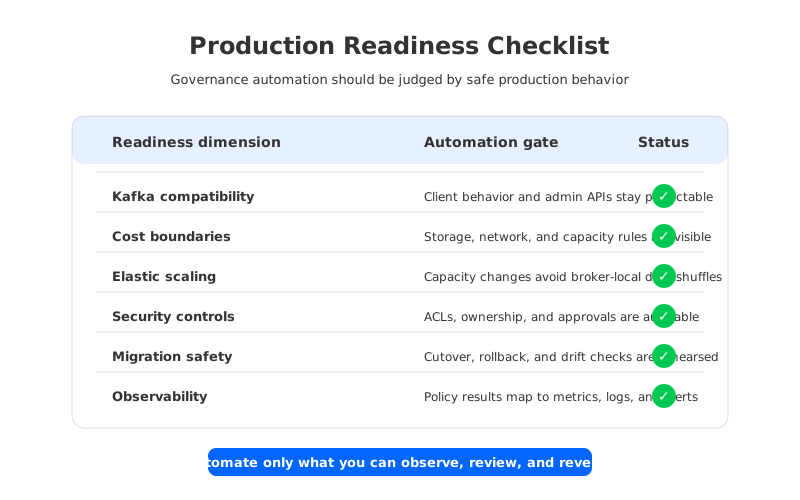
The first workflow is topic lifecycle management. A self-service request should not only create a topic; it should capture the owner, domain, data classification, retention expectation, and operational tier. The policy engine should reject missing ownership, invalid names, environment mismatches, and retention settings that exceed the approved class.
The second workflow is access. Kafka ACLs are powerful, but broad grants accumulate quickly when access is managed reactively. Policy should tie principals to services, limit permissions to expected topics and consumer groups, and make temporary access visibly temporary.
The third workflow is schema and contract evolution. Compatibility settings reduce one class of breakage, but they do not capture every semantic contract. Governance automation should combine machine-checkable compatibility with human review for domain-level changes, especially where multiple consumer groups depend on the same topic. Capacity, cost, migration, and rollback deserve the same discipline because retention, partitions, traffic shape, ACLs, schemas, and client impact all affect production risk.
Platform teams can use a simple readiness scorecard before expanding automation:
| Question | Weak signal | Strong signal |
|---|---|---|
| Are risky changes blocked before production? | Review happens after a human notices a problem | CI validation rejects unsafe requests before apply |
| Is cost part of governance? | Cost is reviewed after the cloud bill arrives | Retention, partitions, traffic, and storage class are visible at request time |
| Can the team audit past changes? | Evidence is split across tickets and chat | Merge history, validation logs, and apply results form the audit trail |
| Is rollback designed? | Rollback depends on whoever made the change | Rollback path is captured with the policy and tested for high-risk classes |
This checklist keeps the governance program grounded. The goal is not to build the most elaborate control plane; it is to make common Kafka changes fast, safe, reviewable, and reversible.
5How AutoMQ changes the operating model
Once the governance framework is clear, the infrastructure question becomes easier to evaluate. A Kafka-compatible platform should preserve the client and operational semantics teams depend on, but it should also reduce the amount of broker-local state that makes routine changes expensive. That is the architectural category where AutoMQ fits: a cloud-native streaming system compatible with Apache Kafka APIs that separates compute from storage by using shared object storage as the durable foundation.
The difference matters because governance automation improves when the platform has fewer stateful side effects per change. In AutoMQ's shared storage architecture, brokers are designed to be more stateless while durable stream data lives in object storage. Compute and storage can scale more independently than in a broker-local disk model. That does not eliminate governance work; it changes which problems the governance layer has to manage.
For example, a traditional broker-local model forces platform teams to think about how capacity requests map to disk placement and future rebalancing. A shared storage model moves more of the durability concern into the storage layer, so broker scaling can be treated more like compute elasticity. Policy-as-code can then focus more directly on ownership, compatibility, access, cost class, and operational tier instead of encoding a long list of broker maintenance assumptions.
This is also where cloud cost belongs in the governance conversation. In multi-AZ deployments, network paths and replica placement can become material cost drivers. AutoMQ's architecture is designed around object-storage-backed durability and cloud-aware traffic behavior, including documented work on reducing cross-AZ data transfer fees. For platform teams, the important point is that cost controls become more meaningful when the architecture exposes clearer boundaries between compute, storage, and traffic.
There is still a compatibility bar. Governance automation is only useful if it does not force every application team into a migration project. Before adopting any Kafka-compatible platform, teams should test the exact clients, security model, connector patterns, schema tooling, and failure modes they run in production.
AutoMQ should enter the decision at that point, after the neutral evaluation is already done. If the platform team needs Kafka API compatibility, shared-storage elasticity, customer-controlled deployment boundaries, and clearer cost levers, AutoMQ is a serious architecture to evaluate. If the team only needs a lightweight topic request form for a small cluster, policy-as-code may deliver value long before the infrastructure changes.
6A practical implementation path
The safest way to start is not a big-bang governance platform. Start with the changes that are frequent, risky enough to matter, and structured enough to validate automatically. Topic creation, topic configuration changes, ACL grants, schema compatibility settings, and ownership metadata usually meet that bar.
Put those policies in a repository that application teams can contribute to. Use code review for human judgment and CI for deterministic checks. The CI stage should validate naming conventions, required metadata, retention limits, ACL scope, schema compatibility mode, and environment boundaries. The apply stage should produce logs that connect the merged change to the Kafka-side result.
The first version can be modest:
- A
topics/directory that declares owner, domain, environment, partitions, retention, and SLO tier. - An
access/directory that maps service principals to producer and consumer permissions. - A
schemas/directory or registry integration that records compatibility policy and review ownership. - A validation job that rejects missing owners, wildcard access, invalid retention classes, and production changes without approvals.
- An apply job that writes a durable audit record and supports dry-run output before production.
Resist the urge to automate exceptions first. Exceptions are where human context matters most. Automate the default path, make exceptions explicit, and use exception data to improve the default policy later. If half of requests need exceptions, the policy model is teaching you something.
Migration deserves its own phase. If the governance program spans existing Kafka clusters and a Kafka-compatible platform such as AutoMQ, define the policy layer above the cluster implementation. The policy should describe the desired stream contract, while adapters apply that contract to each environment during compatibility testing, traffic mirroring, rollback rehearsal, and workload selection.
7What to measure after rollout
Governance automation should change observable behavior. Track the time from request to approved standard change, default-path adoption, exception volume, validation failures by category, stale owners, unused ACLs, unreviewed schema changes, and topics with retention outside their declared class. Track cloud cost drivers that map to Kafka decisions, especially storage growth, cross-zone traffic patterns, and connector resource usage.
The most useful metric is often drift. If the desired state lives in policy and the actual state lives in Kafka, drift tells you whether automation is the source of truth or only another interface. A platform that cannot detect drift cannot reliably prove governance.
To explore how a Kafka-compatible shared storage architecture fits policy-driven operations, start with the AutoMQ documentation after defining your governance requirements and compatibility tests.
8References
- Apache Kafka Documentation
- Apache Kafka Authorization and ACLs
- AWS Amazon S3 User Guide
- AutoMQ Documentation: What is AutoMQ
- AutoMQ Documentation: Architecture Overview
- AutoMQ Documentation: Native Compatibility with Apache Kafka
9FAQ
9.1What is Kafka governance automation?
Kafka governance automation is the practice of turning topic lifecycle, access control, schema policy, ownership metadata, audit evidence, and operational guardrails into repeatable workflows. The strongest implementations use policy-as-code so changes can be reviewed, validated, applied, audited, and rolled back consistently.
9.2Is policy-as-code only useful for large Kafka deployments?
Small deployments can benefit from policy-as-code, but the return is highest when multiple teams share Kafka infrastructure. The more teams, environments, topics, schemas, and access paths you manage, the more manual governance becomes a bottleneck and a source of drift.
9.3Should Kafka governance automation start with schemas or topics?
Start where risk and repetition overlap. Many teams begin with topic lifecycle and ACLs because those requests are frequent and straightforward to validate. Schema governance should follow closely because compatibility and semantic contract changes affect downstream consumers.
9.4How does architecture affect governance automation?
Architecture determines how expensive and risky a policy-driven change can be. In broker-local storage models, some routine changes can interact with disk placement, rebalancing, and maintenance windows. Shared storage architectures reduce some broker-local state concerns, which can make standard governance workflows easier to automate safely.
9.5Where does AutoMQ fit in a Kafka governance strategy?
AutoMQ fits when a team wants Kafka-compatible APIs with a cloud-native shared storage architecture, more independent compute and storage scaling, and clearer cost boundaries. It should be evaluated after the team defines its governance requirements and tests compatibility against real clients, security settings, and operational workflows.


