
Table of Contents
Table of Contents
Teams searching for kafka government regulated workloads are rarely asking whether Apache Kafka can move events. They are asking a harder question: can a Kafka platform fit inside a control model that auditors, security architects, procurement teams, and incident responders can actually inspect? The answer depends less on a product label and more on where the control plane runs, where the data plane runs, who owns durable storage, how support access is authorized, and what evidence the platform can produce under pressure.
Kafka is a strong foundation for regulated event streaming because the client contract is mature and well understood. Producers, consumers, topics, partitions, offsets, consumer groups, access controls, and encryption patterns give platform teams a familiar operating vocabulary. That familiarity can also hide risk. A Kafka service can look compatible at the API layer while placing logs, metadata, telemetry, support paths, or network endpoints outside the boundary your compliance team expects.
The useful question is not "managed or self-managed?" The useful question is "which responsibilities cross which boundary, and can we prove it?"
1Regulated Kafka Starts With Boundaries, Not Features
Regulated environments force architecture teams to separate convenience from control. A fully managed service can reduce toil, but it may move part of the runtime into a provider-controlled environment. A self-managed cluster gives more direct control, but also expands the tasks the customer must harden, monitor, patch, and document. A bring your own cloud model sits between those extremes: runtime resources live in the customer's cloud account, while the vendor automates selected lifecycle tasks.
That distinction matters because most compliance reviews are evidence-driven. The reviewer is not satisfied by "private Kafka." They want to know where records are stored, who can assume administrative roles, which logs show access, which keys encrypt data, which network paths are reachable, and which procedures apply during an incident. If the diagram cannot answer those questions, the deployment model is not ready.
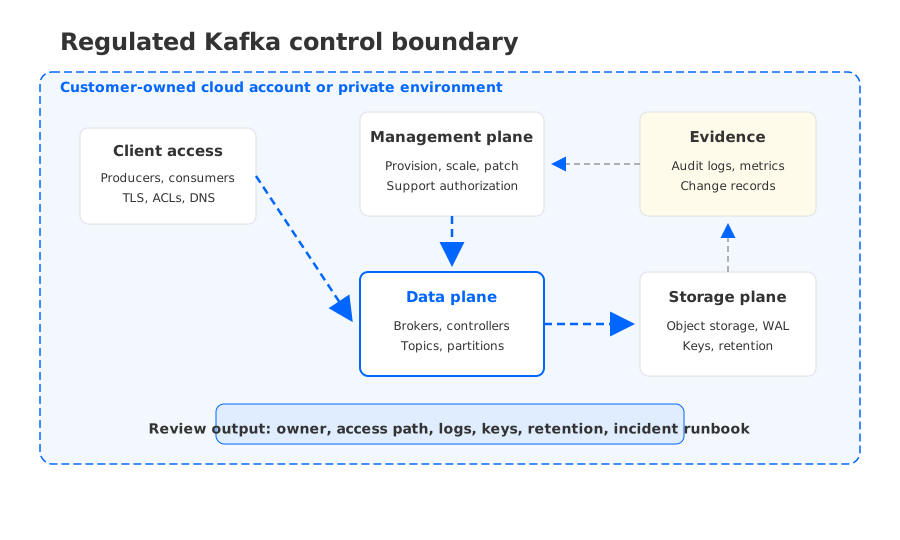
The first practical step is to map the Kafka platform into four planes:
- Client access plane. Producer and consumer connections, bootstrap endpoints, mutual TLS or SASL settings, DNS, private connectivity, and client identity lifecycle.
- Data plane. Brokers, controllers, partition leadership, request handling, local caches, durable write paths, and consumer reads.
- Storage plane. Broker-local disks, attached volumes, object storage, encryption keys, backup paths, retention settings, and deletion controls.
- Management plane. Cluster creation, scaling, upgrades, monitoring, alerting, support access, audit logs, and emergency break-glass workflows.
This model turns a vague platform choice into a reviewable design. Each plane has an owner, an access path, a logging source, and a failure mode. The more regulated the workload, the more dangerous it becomes to bundle those planes behind a single product name.
2The Production Constraints Behind Government Kafka
Government and regulated workloads often combine two pressures. The platform team needs Kafka because applications depend on Kafka semantics and tooling. The security team needs a narrow operating boundary because data classification, residency, encryption, privileged access, and evidence collection are non-negotiable. When those teams talk past each other, the platform says Kafka is standard while security says the deployment model is not reviewable.
Apache Kafka itself provides security primitives that help with this review. The official Kafka documentation covers authentication, encryption, authorization with ACLs, and quota controls. Those primitives are necessary, but they do not answer the whole boundary question. A Kafka cluster can require TLS and ACLs while still storing data on resources outside the customer's account, sending telemetry to a provider environment, or depending on support paths that are hard to audit.
The cloud shared responsibility model adds another layer. AWS, Microsoft Azure, and Google Cloud each document a split between provider and customer responsibilities. The wording differs by provider and service, but the pattern is consistent: customers still own configuration, identity, data classification, workload design, and many operational controls. Kafka platform decisions should be reviewed through that lens.
For Kafka, the most common regulated-workload failure points are concrete:
- The data path is private, but management APIs or support access cross a broader boundary than expected.
- Durable log data is encrypted, but the key ownership and rotation model does not match internal policy.
- Audit logs exist, but they are split across a cloud account, vendor portal, broker logs, and application logs with no single evidence workflow.
- Scaling and rebalancing behavior is acceptable during normal operations, but emergency replacement requires moving large amounts of partition data across zones or networks.
- The migration plan preserves Kafka clients, but it does not test ACL behavior, transactional producers, consumer group offsets, schema dependencies, and rollback under real conditions.
Those issues decide whether a Kafka platform can pass design review, survive an incident, and remain operable after the original team moves on.
3Three Architecture Patterns Teams Usually Compare
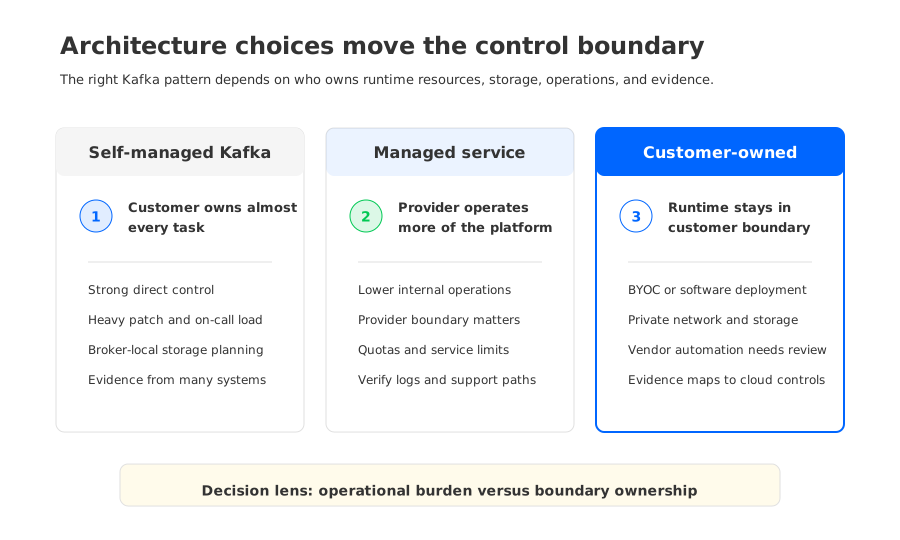
Once the control model is explicit, the architecture comparison becomes less emotional. Most regulated Kafka evaluations fall into three patterns. Each moves work and evidence to a different place.
| Pattern | What the customer usually controls | What must be verified |
|---|---|---|
| Self-managed Kafka | Compute, disks, network, keys, patching, scaling, monitoring, and incident response | Operational maturity, upgrade discipline, disk growth, partition reassignment, security hardening, and on-call capacity |
| Managed Kafka service | Service configuration, client access, identity integration, and some network controls | Provider boundary, data storage location, logs, key model, private connectivity, quotas, and support access |
| BYOC or customer-owned deployment | Cloud account, VPC, storage resources, private endpoints, and selected runtime controls | Exact role delegation, management-plane access, automation scope, evidence sources, and upgrade responsibility |
Self-managed Kafka can satisfy strict control requirements when the organization has the engineering capacity to operate it. The trade-off is that every operational risk remains local: broker failures, disk expansion, partition reassignment, controller health, certificate rotation, and upgrade sequencing. In regulated environments, "we control everything" also means "we produce evidence for everything."
Managed Kafka services reduce that operational burden, which helps teams that need a mature service boundary more than infrastructure ownership. The review should not stop at "managed." It should ask whether provider account, network path, support workflow, metadata handling, and storage location satisfy control requirements. Private connectivity helps, but it is not the same as customer-owned runtime resources.
BYOC and customer-owned deployment models preserve more of the customer's cloud boundary while avoiding a full return to hand-operated Kafka. This pattern is attractive when the workload must run inside an approved cloud account, use existing VPC design, integrate with customer-managed identity and logging, and keep durable data in customer-controlled storage. BYOC is a deployment model, not a compliance guarantee.
4Why Traditional Kafka Storage Makes the Boundary Heavier
Kafka's original storage model binds partition data to broker-local storage. That design is proven, but it makes regulated operations heavier in cloud environments. When brokers own local logs, scaling and recovery often involve moving partition data, keeping spare disk capacity, managing replica placement, and planning rebalancing windows. These are control events because they create data movement, operational access, and failure-recovery evidence.
Apache Kafka Tiered Storage allows older log segments to move to remote storage. That can help retention economics and broker disk pressure, but it does not fully remove broker statefulness because the active write path and local log layer still matter. Remote storage can improve retention without fully simplifying the compute, storage, and recovery boundary.
A Shared Storage architecture changes the review question. If durable Kafka data is placed in shared object storage and brokers act more like stateless compute, platform teams can reason about storage ownership, encryption, retention, and evidence using native cloud controls. The data plane still needs Kafka semantics, low-latency writes, cache behavior, observability, and recovery testing. The benefit is that durable storage becomes a first-class boundary rather than an implementation detail behind broker disks.
This is where AutoMQ becomes relevant after neutral evaluation. AutoMQ is a Kafka-compatible, cloud-native streaming platform built around Shared Storage architecture. AutoMQ BYOC is designed for customer cloud environments, while AutoMQ Software is intended for private data centers. The narrow point is that Kafka-compatible clients can be evaluated alongside customer-controlled runtime boundaries and shared object storage.
A shared-storage Kafka architecture does not replace a security review. It changes what the review can inspect: VPC placement, bucket policy, encryption, WAL storage choice, broker replacement behavior, audit logging, monitoring, support authorization, and migration rollback. That is useful because the evidence maps to infrastructure controls regulated teams already understand.
5A Control-Boundary Checklist for Platform Teams
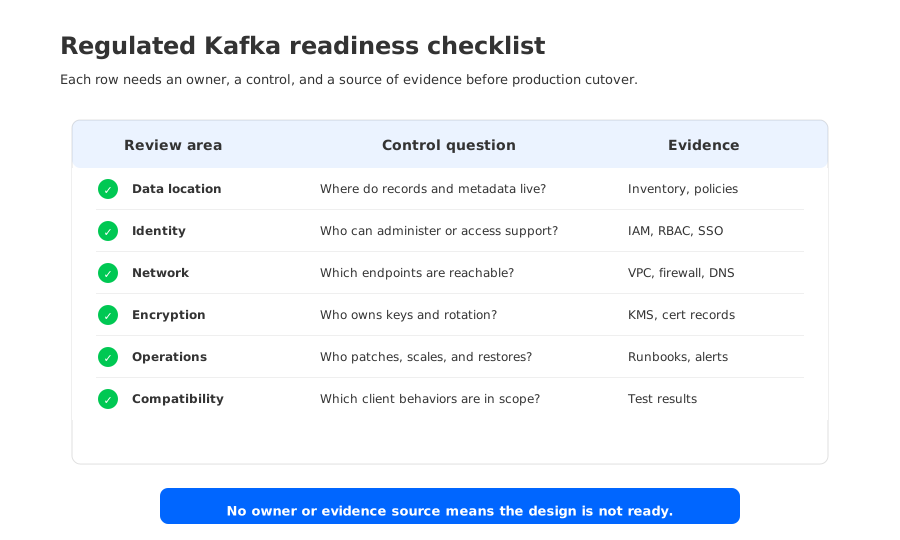
A regulated Kafka decision should end with a design record, not a slide that says "approved." The design record should name each boundary, state the owner, and list the evidence source. If a row has no owner, the architecture is not ready. If a row has an owner but no evidence source, the architecture is still not ready.
| Review area | Questions to answer | Evidence to collect |
|---|---|---|
| Data location | Where are Kafka records, metadata, snapshots, and backups stored? | Cloud resource inventory, storage policies, retention config, deletion procedures |
| Identity and access | Who can administer clusters, assume roles, access support tooling, and rotate credentials? | IAM policies, RBAC config, SSO groups, privileged access logs |
| Network reachability | Which endpoints are reachable from client VPCs, admin networks, and vendor support paths? | VPC diagrams, firewall rules, PrivateLink or peering config, DNS records |
| Encryption | Which keys protect data in transit and at rest, and who controls rotation? | TLS config, KMS policies, certificate lifecycle records, storage encryption settings |
| Operations | Who patches, upgrades, scales, restores, and responds to incidents? | Runbooks, alert rules, change tickets, support access workflow |
| Kafka compatibility | Which client behaviors and APIs are in scope for migration? | Client inventory, ACL tests, transactional producer tests, consumer group offset tests |
| Evidence workflow | Can the team produce proof during an audit or incident? | Log retention plan, dashboard links, export procedure, named evidence owner |
This checklist exposes the real decision. If the organization can operate Kafka well and wants maximum local control, self-managed Kafka may work. If it prioritizes service maturity and accepts provider-side boundaries, managed service can fit. If it needs Kafka compatibility while keeping runtime resources and durable data near its own cloud or data center boundary, BYOC or software deployment deserves proof.
6Migration Risk Is Part of the Control Boundary
Regulated Kafka projects often underestimate migration risk because Kafka compatibility sounds binary. It is not. Compatibility includes client protocol behavior, Admin API support, topic configuration, ACL semantics, transactional producers, idempotent producers, offsets, consumer groups, Connect, Streams, Schema Registry dependencies, monitoring, and runbooks. A migration that keeps the protocol stable can still fail review if it changes evidence collection or breaks rollback.
The safer path is to treat migration as a controlled change program:
- Build a client and dependency inventory. Include producers, consumers, Kafka Connect jobs, stream processors, schema dependencies, ACLs, quotas, and monitoring integrations.
- Test the security contract before the performance contract. TLS, authentication, authorization, key ownership, and audit logs should pass before throughput tuning begins.
- Rehearse dual-running and rollback. Consumer group offsets, replay windows, and topic-level configuration need proof, not assumptions.
- Run failure tests that match the architecture. Broker replacement, storage unavailability, control-plane outage, network isolation, and support access should all have expected evidence.
- Document the operating split. The final runbook should say who owns each action during normal operations and during an incident.
This order feels slower than a benchmark, but it prevents the worst surprise: discovering after cutover that the platform can process events but cannot satisfy the control model.
7Decision Table
The right architecture depends on which constraint is hardest to relax. This table is a starting point.
| If this is your strongest constraint | Favor this direction | Watch for |
|---|---|---|
| Maximum local control and an experienced Kafka operations team | Self-managed Kafka or private software deployment | Operational load, patch discipline, rebalancing, and staff continuity |
| Minimum internal operations and accepted provider boundaries | Managed Kafka service | Data location, support access, quotas, logs, and provider-side metadata handling |
| Customer-owned cloud account, private networking, and Kafka-compatible clients | BYOC Kafka or customer-owned cloud deployment | Role delegation, automation scope, storage ownership, and evidence workflow |
| Private data center or disconnected environment | Software deployment in the customer environment | Hardware planning, object storage compatibility, support model, and upgrade process |
| Long retention, bursty traffic, and frequent scaling under regulated controls | Shared Storage architecture with stateless brokers | WAL choice, object storage policy, latency testing, and failure-mode validation |
If your regulated Kafka discussion keeps circling data location, private access, and audit evidence, the next step is not another feature matrix. Map your current Kafka estate against the checklist, then test any target platform against the same rows. AutoMQ's technical materials can help teams evaluate a Kafka-compatible shared-storage and customer-controlled deployment path: review AutoMQ deployment options.
8References
- Apache Kafka documentation: Security
- Apache Kafka documentation: Tiered Storage
- AWS Shared Responsibility Model
- Microsoft Azure shared responsibility in the cloud
- Google Cloud shared responsibility and shared fate
- AutoMQ architecture overview
- AutoMQ BYOC environment overview
9FAQ
9.1Is Kafka suitable for government or regulated workloads?
Kafka can be suitable when the deployment model, security configuration, operating procedures, and evidence workflow match control requirements. The protocol is only one part of the review. Teams must also verify data location, encryption, identity, network reachability, audit logs, support access, and incident procedures.
9.2Is BYOC Kafka the same as self-managed Kafka?
No. Self-managed Kafka means the customer owns the full lifecycle: infrastructure, deployment, patching, scaling, monitoring, and incidents. BYOC Kafka means runtime resources run in the customer's cloud account while a vendor automates selected lifecycle tasks. Verify the exact split for each provider.
9.3Does private connectivity prove that a Kafka service meets regulated requirements?
Private connectivity helps reduce network exposure, but it does not prove data ownership, key ownership, support access controls, logging coverage, or storage location. Treat it as one item in a broader control-boundary review.
9.4How does Shared Storage architecture help regulated Kafka deployments?
Shared Storage architecture can make durable data ownership easier to inspect because Kafka data is stored in shared object storage rather than broker-local disks. In a customer-controlled deployment, that can align Kafka storage with bucket policy, encryption, logging, and retention. It still requires latency, WAL, recovery, and access-control validation.
9.5When should a regulated team evaluate AutoMQ?
Evaluate AutoMQ when Kafka compatibility matters, but the organization also needs customer-controlled cloud or private data center boundaries, shared object storage, elastic broker operations, and clearer evidence around durable Kafka data. Test it with the same proof-of-concept discipline.


