
Table of Contents
Table of Contents
Healthcare Kafka projects rarely begin with Kafka. They begin with a workflow that cannot wait for the nightly batch: a patient-facing app needs appointment status, a care team needs device telemetry, a payer needs claims events, or a pharma team needs real-world data for safety and research.
Kafka fits because these are not single-consumer integrations. The same event may feed operations, analytics, audit, care coordination, customer support, and data science. But healthcare and pharma add a constraint that ordinary streaming diagrams often hide: data control matters as much as throughput. A technically elegant event pipeline is not useful if it pushes protected data across a boundary the security, privacy, or compliance team cannot defend.
The architecture question is therefore sharper than "Should healthcare use Kafka?" Many teams already do. The better question is which streaming workloads need broker-attached Kafka, which ones can use object-storage-backed Kafka, and how to keep data, metadata, access, and audit boundaries clear while the event volume grows.
1Healthcare Streaming Use Cases Are Not One Workload
Healthcare has always been an integration-heavy industry. EHRs, labs, claims platforms, patient portals, pharmacy systems, medical devices, and partner networks all produce state changes. FHIR helps by giving teams a widely used API-focused standard for representing and exchanging health information, but an API standard does not make downstream operational data flows disappear. It gives the event platform cleaner inputs and better semantics.
Kafka becomes useful when a healthcare organization wants the same change to be durable, replayable, and independently consumable. That may be an admission-discharge-transfer event, a lab order status update, a medication fulfillment event, a device alert, or a claim adjudication state. The stream is valuable because it decouples producers from consumers without forcing every team to poll the source system directly.
The important distinction is workload shape. A patient notification stream, an audit log, a claims-event feed, and a medical-device telemetry stream may all use Kafka APIs, but they have different latency, retention, privacy, and cost profiles:
- Clinical workflow events need predictable delivery, strong ownership, and clear semantics because they influence operational workflows around patients and clinicians.
- Device and remote monitoring streams can be high volume and bursty. Some events require fast action, while others are retained mainly for analytics, quality review, or trend detection.
- Claims and payer events often cross organizational boundaries and need careful identity, authorization, audit, and data-minimization controls.
- Pharma and real-world-data pipelines may ingest EHR-derived data, claims data, registries, and digital health signals for research, safety, and lifecycle evidence programs.
FDA's real-world evidence program defines real-world data as data relating to patient health status or care delivery routinely collected from sources such as EHRs, medical claims, registries, and digital health technologies. That definition explains why streaming matters in pharma: the value is controlled, repeatable movement from operational systems into evidence, safety, quality, and analytics workflows.
2Data Control Is an Architecture Boundary, Not a Marketing Claim
HIPAA language needs care. A Kafka platform does not make an organization satisfy HIPAA obligations by itself, and this article is not legal advice. In the United States, HHS describes the HIPAA Security Rule as requiring appropriate administrative, physical, and technical safeguards for electronic protected health information. That framing is useful for architects because it makes compliance a system property, not a product sticker.
For streaming architecture, the practical boundary questions are concrete:
- Where do brokers, metadata, object storage, logs, metrics, keys, and backups live?
- Which identities can produce, consume, create topics, alter ACLs, or inspect payloads?
- Which network paths are private, and which ones depend on public endpoints?
- Who controls encryption keys and operational support access?
- Which logs and metrics leave the environment, and can they reveal sensitive context?
These questions are not anti-cloud. They are cloud architecture hygiene. A fully managed Kafka service can be the right answer if the data boundary, contract terms, access model, and risk profile fit. A self-managed cluster can also be the wrong answer if it lacks patching discipline, auditability, or operational maturity. BYOC sits between those models: the platform can be automated while runtime resources remain in the customer's cloud account or VPC.
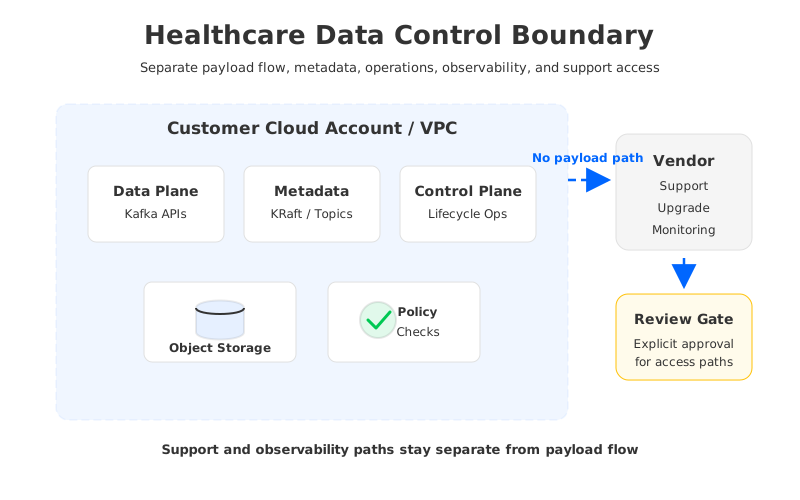
AutoMQ's BYOC documentation describes an environment where the control plane system and Kafka service cluster are deployed in the user-defined network environment, with data plane access limited to private network access. Its product materials also state that data, KRaft metadata, and the control plane stay inside the customer's VPC. Healthcare teams should ask every vendor to map the data, metadata, control, observability, and support-access planes separately.
The same discipline applies internally. A hospital platform team should not let every application publish raw patient context into a shared topic namespace because Kafka makes fan-out convenient. Topic design, schema governance, access control, retention, and deletion policy all become part of the data-control boundary.
3Traditional Kafka Cost Drivers Hit Healthcare in Predictable Places
Kafka's original storage model is reliable and familiar. Apache Kafka replicates partitions across brokers, with one leader and follower replicas for fault tolerance. This shared-nothing design works well for many systems, but it couples broker compute, durable storage, partition placement, and replication traffic. In cloud environments, that coupling becomes expensive when workloads combine high volume, long retention, multi-zone resilience, and many consumers.
Healthcare and pharma often hit that combination. Audit logs accumulate, device telemetry can be large, and claims or EHR pipelines may need replay as schemas evolve. The more the platform becomes shared memory for the organization, the less it looks like a transient message bus.
The cost drivers are usually mechanical rather than mysterious:
| Cost driver | Why it appears in healthcare and pharma | Architectural pressure |
|---|---|---|
| Retention | Audit, troubleshooting, safety, quality, and analytics workflows often need historical streams. | Broker-attached storage grows with retention and replica count. |
| Replication | Production Kafka commonly uses multiple replicas across failure domains. | Durable bytes multiply at the Kafka layer. |
| Cross-zone movement | Multi-AZ clusters may move replica traffic and consumer reads across zones. | Network charges and latency variance can become material. |
| Replay | Schema evolution, backfills, investigations, and model development turn old events into active load. | Brokers must serve historical reads while handling live traffic. |
| Peak sizing | Flu season, enrollment windows, device bursts, claims cycles, or incident response can create traffic spikes. | Stateful brokers are harder to scale without data movement. |
None of these costs means traditional Kafka is bad. They mean traditional Kafka forces a particular economic model. If the workload is high-volume, retained, replayed, and spread across cloud zones, storage architecture becomes a first-order design decision.
This is also where healthcare teams should be skeptical of universal savings claims. A platform cannot promise the same reduction for a hospital audit stream, a remote monitoring pipeline, a payer event backbone, and a pharma RWD feed. The credible approach is to model each workload with measured ingress, retention, consumer fan-out, peak-to-average ratio, availability-zone placement, and observability overhead.
4Diskless Kafka Is Useful When Retention and Control Collide
Diskless Kafka does not mean storage disappears. It means Kafka-compatible brokers are no longer the long-term home of the durable log. In AutoMQ, Kafka's native log storage is replaced by S3Stream, with data written to WAL storage and uploaded to object storage in near real time. AutoMQ documentation describes object storage as the primary data repository and broker nodes as stateless after the storage-layer replacement.
That architectural shift matters in healthcare because the hardest workloads often want two things at the same time: strong data control and lower-cost retention. Object storage is already central to many cloud data platforms because it is elastic, durable, and well integrated with access policy, encryption, lifecycle management, and analytics services. A Kafka-compatible layer built around object storage can retain event history without scaling every broker around local log segments.
The difference from tiered storage is worth spelling out. Kafka tiered storage usually keeps local broker storage as the hot primary tier and offloads older segments to remote storage. A diskless or shared-storage design moves the center of gravity: durable data is in shared object storage, while brokers serve protocol, caching, coordination, and traffic handling.
For healthcare and pharma, the strongest fits are usually the streams where data volume, retention, replay, and boundary control dominate:
- Audit and access-event streams that need durable retention and controlled investigation workflows.
- Claims and eligibility event streams that feed payer operations, analytics, and partner integrations.
- Device telemetry history where only a subset requires immediate alerting, while the long tail is valuable for quality, product, and analytics teams.
- Pharma operations and RWD pipelines that need repeatable ingestion into data platforms without rebuilding every source integration.
- Patient app and digital health events that have bursty usage patterns and multiple downstream consumers.
AutoMQ fits this zone because it preserves Kafka protocol compatibility while changing the storage model behind the API. Existing Kafka clients, connectors, ACL patterns, and operational concepts remain recognizable, so the platform discussion can focus on data boundaries, storage economics, and operational behavior instead of a full application rewrite.
5A Reference Architecture for Healthcare Kafka
A good healthcare streaming architecture starts by separating domains before choosing cluster sizes. Clinical operations, patient engagement, claims, device telemetry, audit, research, and platform observability should not be dumped into one topic namespace. Each domain needs owners, schema rules, retention classes, access groups, and approved consumers.
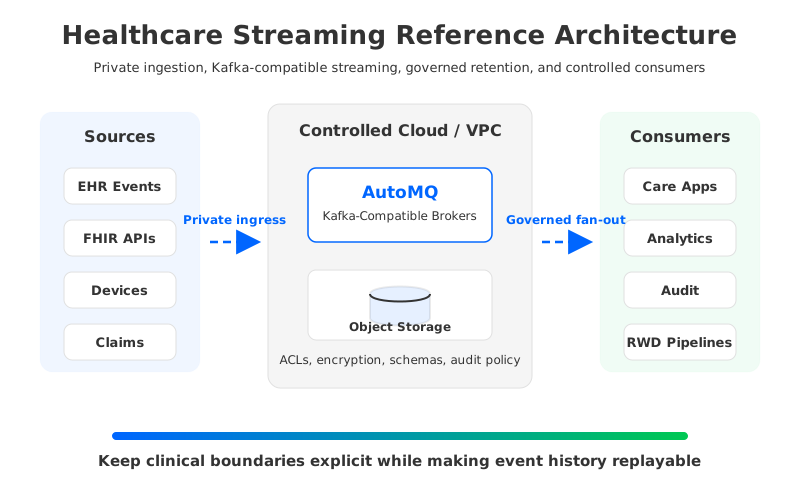
The data path often looks like this: source systems publish standardized events into a private streaming layer; stream processors normalize, mask, or route events; object storage keeps durable history; analytics, operational apps, audit systems, and data-lake tables consume through explicit contracts. Kafka is the event backbone, not the system of record for every clinical fact.
In a BYOC model, the reference boundary can be kept tight:
- Private ingestion: Producers connect over private network paths from EHR integration services, FHIR servers, device platforms, payer systems, or internal applications.
- Kafka-compatible streaming: AutoMQ brokers serve Kafka APIs in the customer's VPC or controlled network, using ACLs, encryption, and private listeners.
- Shared object storage: Durable stream data lands in customer-controlled object storage through the platform's storage layer.
- Governed consumers: Downstream apps, lakehouse jobs, audit tools, and analytics systems consume with least-privilege access and documented data contracts.
- Separated operations: Control-plane actions, observability exports, and vendor support paths are reviewed separately from message payload flow.
This separation also helps with multi-cloud and hybrid decisions. Some hospitals still run critical workloads in private data centers, while some pharma teams use public cloud for analytics but keep source systems in controlled networks. Kafka-compatible architecture gives these teams a common application surface, while BYOC and shared storage give platform teams more control over where durable data lives.
The main caution is latency. "Real time" in healthcare can mean bedside monitoring, clinician workflow notifications, payer API updates, fraud detection, safety surveillance, or next-hour analytics. Do not route a hard clinical response loop through a remote cloud path because the architecture looks clean. Place the latency-critical path close to the system that acts on it, then stream durable events into the broader platform for fan-out and replay.
6Workload Fit Matrix for Healthcare Teams
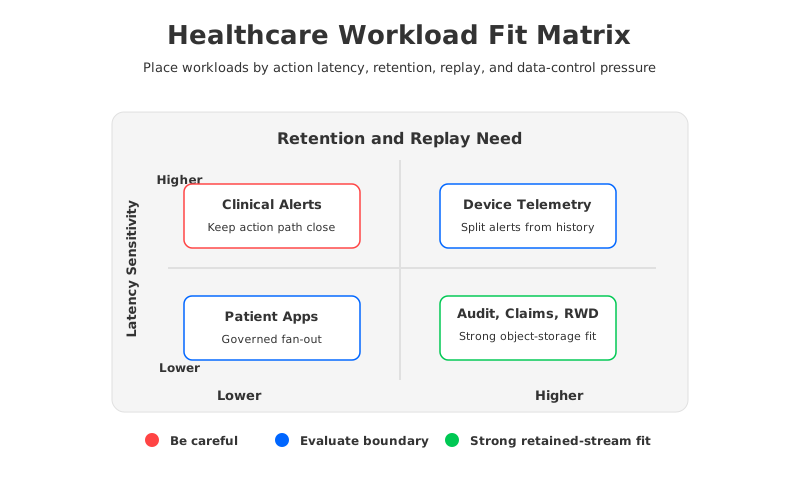
The fastest way to make Kafka architecture useful is to classify workloads honestly. The matrix below is a starting point, not a substitute for a risk review.
| Workload | Latency sensitivity | Retention and replay | Data-control sensitivity | Good fit for object-storage-backed Kafka? |
|---|---|---|---|---|
| Bedside or clinical alert path | High | Usually selective | Very high | Be careful. Keep the action path close to the clinical system. |
| EHR event distribution | Medium | Medium to high | Very high | Often, if private networking, governance, and access controls are strong. |
| Audit and access logs | Low to medium | High | Very high | Strong fit because retention and investigation replay matter. |
| Claims and eligibility events | Medium | High | High | Strong fit when partner boundaries and schemas are well governed. |
| Device telemetry history | Mixed | High | High | Strong fit for retained history; evaluate alerting paths separately. |
| Pharma RWD pipelines | Medium | High | High | Strong fit for controlled replay and analytics ingestion. |
The point is not that every green cell should move at once. Healthcare teams often need a portfolio: tightly controlled clusters for action paths, BYOC cloud clusters for controlled environments, and object-storage-backed Kafka where retention and replay dominate.
7Checklist Before You Build
Before choosing a Kafka platform for healthcare or pharma, write down the boundary before writing Terraform. The questions are simple, but they prevent expensive mistakes.
- Classify the data. Identify whether the stream can contain ePHI, identifiers, device data, claims details, research data, audit events, or operational metadata.
- Define the action path. Separate streams that trigger clinical or operational action from streams used for analytics, audit, reporting, or model development.
- Map the planes. Document data plane, metadata plane, control plane, observability plane, backup plane, and support-access plane.
- Model retention cost. Use real ingress, retention, replicas, consumer fan-out, and cross-zone placement.
- Set topic ownership. Every topic should have a domain owner, schema owner, retention class, access group, and deprecation path.
- Test replay. Healthcare teams often discover replay problems during audits, investigations, or model backfills. Make replay a normal acceptance test.
- Review compliance with specialists. Architecture can support safeguards, but legal and compliance teams decide whether the overall process, contracts, policies, and controls meet requirements.
AutoMQ should enter the conversation where these questions point to Kafka compatibility, private deployment boundaries, elastic operations, and object-storage-backed retention. The strongest argument for AutoMQ is that healthcare teams can keep the Kafka ecosystem while changing the part of Kafka that becomes painful in the cloud: stateful broker storage tied to retention, scaling, and data movement.
8What Good Looks Like
A mature healthcare streaming platform is not the biggest Kafka cluster in the organization. It is the one whose boundaries are boring to explain. Security knows where data lives. Compliance knows which controls are technical and which ones are procedural. Platform teams know which streams are latency-critical and which are replay-heavy. Application teams know how to publish and consume without building private point-to-point integrations for every workflow.
Cost efficiency matters because healthcare and pharma data volume keeps expanding. FHIR APIs, digital health, remote monitoring, payer interoperability, audit requirements, and real-world evidence workflows all create more event history. If every retained byte has to be replicated and served from broker-attached storage, the platform becomes harder to scale precisely when more teams depend on it.
The architecture answer is not "put everything on diskless Kafka." It is more disciplined than that: keep clinical action paths close, keep data boundaries explicit, and use object-storage-backed Kafka where durable fan-out and replay are the real workload. When the boundary is clear, Kafka can become a shared healthcare event backbone without becoming a compliance mystery or a storage budget trap.
9FAQ
9.1Is Kafka a good fit for healthcare data streaming?
Kafka is a good fit when healthcare events need durable ingestion, fan-out to multiple consumers, replay, and integration with analytics, audit, claims, patient engagement, or operational systems. It is not a replacement for EHRs, FHIR servers, systems of record, medical-device control systems, or compliance processes.
9.2Can Kafka satisfy HIPAA requirements?
Kafka by itself does not satisfy HIPAA requirements. Compliance depends on the covered entity or business associate's safeguards, contracts, policies, risk analysis, and operations. Kafka architecture can support safeguards through encryption, private networking, access control, auditing, retention policy, and controlled deployment boundaries, but healthcare teams should validate requirements with legal and compliance specialists.
9.3Where does BYOC Kafka help healthcare teams?
BYOC Kafka helps when teams want managed-service-like automation while keeping runtime resources inside their own cloud account or VPC. For healthcare and pharma, this can make data-control reviews clearer because brokers, storage, metadata, and control-plane components can be mapped to the customer's environment.
9.4What is diskless Kafka in healthcare architecture?
Diskless Kafka is a Kafka-compatible architecture where durable stream data is stored primarily in shared object storage instead of long-lived broker-local disks. Brokers still serve Kafka clients, but storage and compute are separated. In healthcare, this is useful for retained, replay-heavy streams such as audit logs, claims events, device telemetry history, and pharma analytics pipelines.
9.5Should medical device telemetry use diskless Kafka?
It depends on the action path. If telemetry triggers immediate clinical or safety-related action, keep that path close to the device platform and clinical workflow. Diskless Kafka can still be useful for retained device history, analytics, quality review, and downstream fan-out.
9.6How should healthcare teams estimate Kafka cost?
Start with real workload measurements: ingress, egress, retention period, partition count, consumer fan-out, replication factor, availability-zone placement, peak-to-average ratio, encryption overhead, and replay frequency. Compare broker-attached Kafka and object-storage-backed Kafka under the same durability, retention, and data-control assumptions.
10Sources
- HHS: Summary of the HIPAA Security Rule
- ONC: Health Level 7 Fast Healthcare Interoperability Resources
- HL7 FHIR Specification
- FDA: Real-World Evidence
- CDC: What is Data Modernization?
- CMS: Patient Access API
- Apache Kafka Documentation: Operations
- AutoMQ Documentation: Architecture Overview
- AutoMQ Documentation: S3Stream Overview
- AutoMQ Documentation: BYOC Environment Overview
- AutoMQ BYOC Kafka


