
Table of Contents
Table of Contents
Kafka high load protection usually becomes urgent at the worst possible moment: a traffic spike is already forming, consumer lag is already visible, and the fastest answer on the table is to add more brokers. That answer works often enough to become muscle memory. It also turns a load-control problem into a permanent capacity bill, because the cluster keeps the extra compute, disk, replication headroom, and operational complexity after the spike is gone.
The harder question is not whether Kafka can handle high load. Well-operated Kafka clusters handle serious workloads every day. The question is how much unused capacity you must keep on standby to protect the cluster when writes, reads, retention, connector activity, and broker recovery all compete for the same local resources. A protection strategy that depends only on over-provisioning is easy to explain, but it hides the actual failure path.
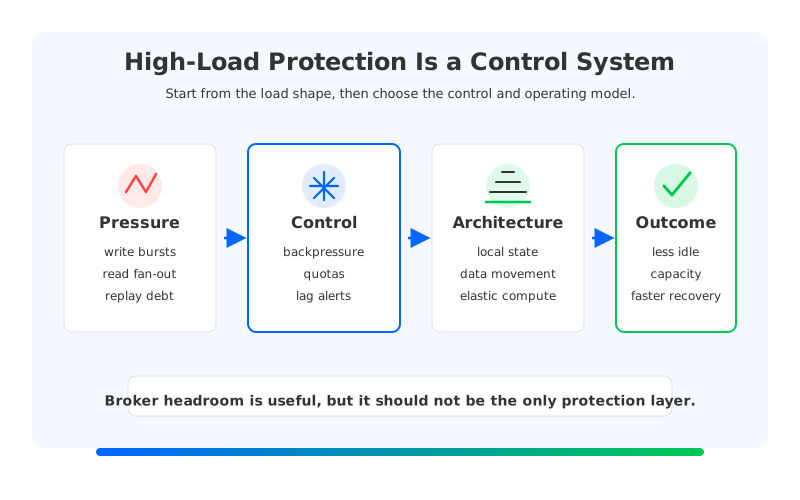
High-load protection is a control problem. The platform needs to absorb burst traffic, prevent local disks from becoming the bottleneck, keep consumers from amplifying recovery pressure, and preserve a clear rollback path when operations go wrong. Once you see the problem that way, broker count becomes one input in the design, not the whole design.
1Why High Load Hurts Before the Cluster Is Full
The surprising part of Kafka overload is that clusters often feel unhealthy before any single graph says "100%." Disk utilization may be below the alarm threshold, CPU may have spare cores, and network may not be saturated. The trouble is the coupling between these resources. A producer burst increases broker append pressure, but it also increases replication traffic, page cache churn, cleaner activity, index updates, and downstream lag that later turns into catch-up reads.
Traditional Kafka was designed around a Shared Nothing architecture. Each broker owns local partitions, persists local log segments, and participates in leader/follower replication. That model is powerful because it is explicit and predictable. It also means a broker is not a disposable compute unit. When the platform adds a broker, it usually has to move data or leadership. When a broker fails, the system must protect availability while data and traffic are redistributed across the remaining brokers.
For high-load protection, that local ownership matters more than the raw broker count. If one broker has hot partitions, adding another broker does not automatically remove the heat. If retention grows faster than expected, more compute does not make local disks less stateful. If a consumer group falls behind during a peak, the recovery read path can compete with fresh writes for the same broker I/O budget.
There are four common overload paths:
- Write bursts push append throughput, replication, and acknowledgement latency at the same time. Raising producer retries can mask symptoms, but it can also add more pressure if backoff and quotas are not tuned.
- Read fan-out turns one write stream into multiple broker egress streams. Consumer lag recovery is especially expensive because the cluster serves both hot tailing reads and historical catch-up reads.
- Storage growth reduces operational room for error. A broker with heavy local state is harder to replace, rebalance, or drain under pressure.
- Operational recovery can become its own workload. Partition movement, leader election, broker restart, and connector recovery consume capacity when the cluster has the least spare capacity.
The pattern is consistent: the dangerous state is not "high throughput" by itself. The dangerous state is high throughput combined with stateful recovery work.
2Over-Provisioning Is a Control, Not a Strategy
Extra brokers are useful. They provide more network sockets, more page cache, more local disk bandwidth, and more places to distribute partition leadership. For a steady workload, a conservative capacity buffer is part of responsible operations. The mistake is treating that buffer as the whole protection model.
Over-provisioning has three limits that show up in production. First, it is coarse. You buy capacity in broker-sized chunks even when the bottleneck is a subset of partitions, a connector job, or one retention policy. Second, it is slow to unwind. Once the team has tuned the cluster around the buffer, reducing it feels risky. Third, it does not remove the local-state problem. More brokers can reduce average load, but they also increase the surface area for placement, replication, and rebalancing decisions.
That is why a better high-load plan separates protection into layers. Some layers belong in Kafka configuration, some in client behavior, some in traffic governance, and some in the storage architecture.
| Protection layer | What it controls | Typical failure if ignored |
|---|---|---|
| Client backpressure | Producer retries, timeouts, batching, and consumer pacing | Retry storms and unstable latency |
| Traffic governance | Quotas, isolation, tenant limits, and topic-level guardrails | One workload steals capacity from the rest |
| Broker operations | Leader placement, partition count, rolling changes, and recovery windows | Recovery work collides with peak traffic |
| Storage architecture | Local disk pressure, retention growth, and data movement | Scaling requires heavy partition relocation |
| Observability | Lag, produce latency, disk pressure, and recovery progress | Operators add capacity without knowing the bottleneck |
The table is a way to keep the team honest. If the active control is only "add brokers," the cluster may survive the next spike, but the operating model will keep getting more expensive.
3The Architecture Trade-Off Behind Broker Headroom
Kafka's local log model creates a tight bond between compute and storage. The broker accepts writes, persists log segments, serves reads, tracks indexes, and owns the local replica. During normal operation, that tight bond keeps the data path direct. During load spikes or recovery, it means compute scaling and storage movement are entangled.
Tiered Storage changes part of this equation by moving older log segments to remote storage while keeping recent data local. That is useful for long retention and can reduce pressure on broker disks for historical data. It does not make brokers stateless. The active segment, local cache, partition leadership, and recovery path still depend on broker-local behavior. For teams searching for Kafka high load protection, Tiered Storage should be evaluated as a retention and cold-data tool, not as a complete answer to burst absorption or fast broker replacement.
Shared Storage architecture takes a different route. Instead of treating each broker as the owner of durable local data, the system stores durable stream data in shared object storage and makes brokers closer to stateless compute. This changes the scaling discussion. Adding compute capacity no longer has to imply moving a large amount of partition data from one local disk to another. Replacing a broker becomes less about reconstructing its local state and more about reconnecting compute to the shared data layer.
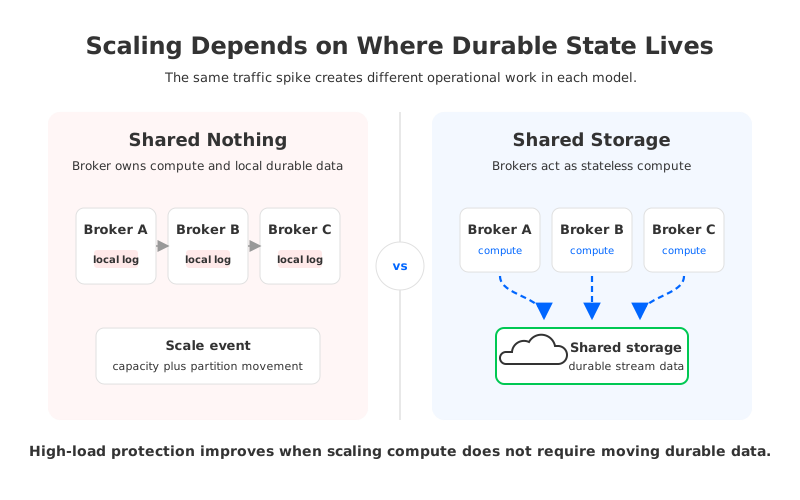
The distinction matters because high-load protection is mostly about time. How long does it take to add capacity? How much background data movement does that action create? How long does the system stay in a degraded state after a broker failure? How much extra capacity must be kept idle because recovery is too slow to trust during a peak?
Apache Kafka's own documentation is useful here because it makes the baseline mechanics visible: producers have durability and retry controls, consumers have offset and fetch behavior, and Kafka's replication model depends on leader and follower replicas. Those controls remain important. The architectural question is whether the platform can reduce the amount of broker-local state those controls must protect.
4A Practical Evaluation Framework
The clean way to evaluate high-load protection is to start with failure modes, then map each mode to a control. This avoids a common procurement trap: comparing platforms only by maximum advertised throughput while ignoring how they behave when one component is slow, hot, or being replaced.
Use the following questions in a design review:
- What is the primary high-load shape? A write-heavy event stream, a read-heavy analytics fan-out, long retention with occasional replays, and connector-heavy ingestion all stress different parts of the platform.
- Where does backpressure land? If clients retry aggressively and brokers have no tenant-aware limits, overload moves from one layer to another instead of being controlled.
- How much state moves when capacity changes? Scaling that triggers large partition relocation can protect the future while hurting the present.
- Can recovery work be scheduled away from peak traffic? If not, the platform needs enough isolation to prevent maintenance from competing with production writes.
- What is the rollback path? A high-load change without rollback is a bet. A production platform needs the ability to pause, reverse, or isolate the change.
- Which costs grow with protection? Compute, block storage, object storage, network egress, cross-Availability Zone traffic, and operational labor behave differently.
The strongest designs usually combine several controls. Producer settings handle local retry behavior. Consumer group monitoring catches lag before it becomes a replay storm. Quotas prevent a single tenant from dominating shared brokers. Broker placement reduces hot spots. Storage architecture determines whether scaling and recovery require heavy data movement.
This is where FinOps enters the discussion. A platform owner may justify extra brokers for resilience, but the finance team will ask whether those brokers are busy. The answer should separate active workload, safety buffer, recovery reserve, and capacity that exists because the architecture cannot scale compute independently from storage.
5Where AutoMQ Fits in the Framework
If the root constraint is the coupling of broker compute and broker-local durable storage, a Kafka-compatible system with separated compute and storage deserves a serious look. AutoMQ is a cloud-native streaming platform that keeps Kafka protocol compatibility while using a Shared Storage architecture backed by S3-compatible object storage. In practical terms, the design goal is to keep Kafka-facing behavior familiar while changing the operational model underneath.
This does not remove the need for load governance. Producers still need sane retry behavior. Consumers still need lag monitoring. Platform teams still need quotas, dashboards, and deployment discipline. The difference is that stateless brokers and shared durable storage can reduce the amount of local data movement tied to capacity changes and broker replacement.
For high-load protection, that creates several useful properties:
- Independent compute and storage scaling. Broker capacity can be treated more like an elastic compute pool because durable stream data is not bound to each broker's local disk.
- Lower recovery coupling. Broker replacement does not require the same style of local replica reconstruction, which can reduce the operational penalty of failures during high load.
- Cleaner retention economics. Object storage is a better fit for large retained data than over-sized broker disks, especially when retention grows faster than steady-state compute demand.
- Kafka client continuity. Compatibility matters because high-load protection should not require every application team to rewrite producers and consumers before the platform team can improve the infrastructure.
The important point is not that architecture replaces operations. It is that architecture determines how much punishment operations must absorb. A team can tune quotas and clients forever, but if every scaling action is also a storage relocation project, high-load protection will keep leaning on large idle buffers.
6A High-Load Protection Checklist
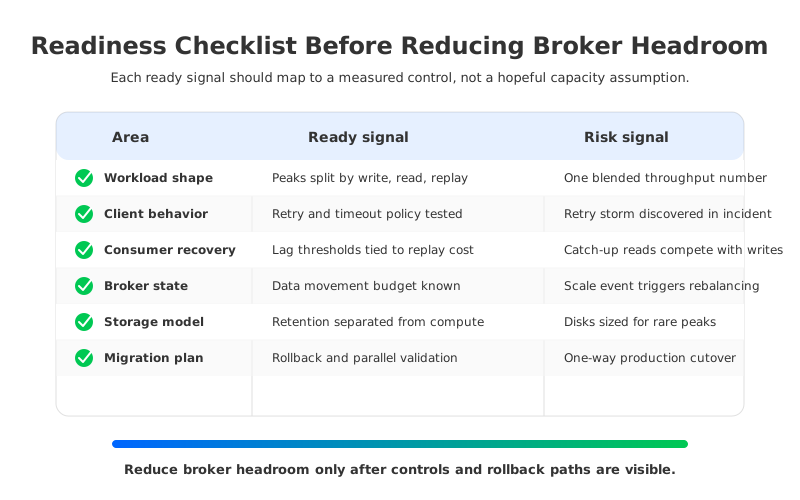
A useful readiness review should be specific enough to change an operating plan. The checklist below is designed for platform teams that run Kafka and want to reduce over-provisioning without gambling on resilience.
| Area | Ready signal | Risk signal |
|---|---|---|
| Workload classification | Peak write, read, replay, and connector patterns are measured separately | All throughput is treated as one number |
| Client behavior | Producer retry, timeout, batching, and idempotence settings are reviewed per workload | Retry storms are discovered only during incidents |
| Consumer recovery | Lag thresholds distinguish short bursts from dangerous replay debt | Catch-up reads compete with peak writes without isolation |
| Broker state | Capacity changes have a known data-movement budget | Adding brokers triggers unpredictable rebalance work |
| Storage model | Retention growth does not force compute over-sizing | Broker disks are sized for rare retention peaks |
| Cost model | Compute, storage, network, and operations are separated in TCO | Extra brokers are justified as a single blended cost |
| Migration plan | Compatibility, rollback, and parallel validation are tested | The platform cutover depends on a one-way change |
The checklist also reveals when over-provisioning is still the right short-term choice. If the team has no traffic classification, no reliable lag alerts, and no rollback plan, removing broker headroom is premature. After visibility improves, the team can decide which headroom is needed and which headroom exists because the architecture makes elasticity too expensive.
If your team is trying to protect Kafka under high load without turning every spike into permanent broker spend, review the AutoMQ BYOC path and test a bounded workload through AutoMQ Cloud.
7References
- Apache Kafka documentation: replication design
- Apache Kafka documentation: Tiered Storage
- Apache Kafka documentation: producer configuration
- Apache Kafka documentation: consumer configuration
- AWS S3 storage classes
- AWS PrivateLink documentation
- AutoMQ overview
- AutoMQ migration guide
- AutoMQ benchmark and cost documentation
8FAQ
8.1What does Kafka high load protection mean?
Kafka high load protection is the set of controls that prevent traffic spikes, replay pressure, broker recovery, and storage growth from degrading the cluster. It includes client backpressure, quotas, consumer lag management, broker operations, storage architecture, and observability. It is broader than adding brokers.
8.2Is over-provisioning Kafka brokers always wrong?
No. A capacity buffer is part of responsible production design. The problem is using broker over-provisioning as the sole protection mechanism. That approach can hide hot partitions, recovery bottlenecks, local disk constraints, and cost growth.
8.3Does Apache Kafka Tiered Storage solve high-load protection?
Tiered Storage helps with long retention and historical data placement. It does not make brokers stateless, and it does not remove every scaling or recovery bottleneck tied to local broker behavior. Treat it as one useful layer in the design, not as the complete protection model.
8.4How can teams reduce broker headroom safely?
Start by measuring load shape separately: write peaks, read fan-out, replay pressure, connector activity, and retention growth. Then add controls where the pressure originates. Client settings, quotas, consumer lag alerts, and storage architecture changes should be evaluated before reducing capacity buffers.
8.5Where does AutoMQ help most?
AutoMQ is most relevant when the limiting factor is the coupling between broker compute and broker-local durable storage. Its Shared Storage architecture and stateless brokers can reduce data movement during scaling and recovery while keeping Kafka protocol compatibility.
8.6Should a team migrate every workload at once?
No. Start with a workload that is important enough to prove the model but bounded enough to control. Validate compatibility, run parallel checks, define rollback criteria, and move traffic in stages.


