
Table of Contents
Table of Contents
Kafka horizontal scaling looks easy from far away: add brokers, spread partitions, increase throughput. The trouble starts when the cluster is already carrying production traffic and those new brokers need to become useful. Kafka does not route requests through a generic load balancer. Producers and consumers interact with partition leaders, replicas live on brokers, and in traditional deployments those replicas are durable log data on broker-local disks.
That is why Kafka scaling is really a three-way negotiation between partitions, brokers, and storage. Partitions define how work can be split. Brokers provide CPU, memory, network, and disk capacity. Storage determines how expensive it is to move the work from one broker to another. If one of those layers is treated as an afterthought, scale-out becomes a rebalance project instead of a capacity event.
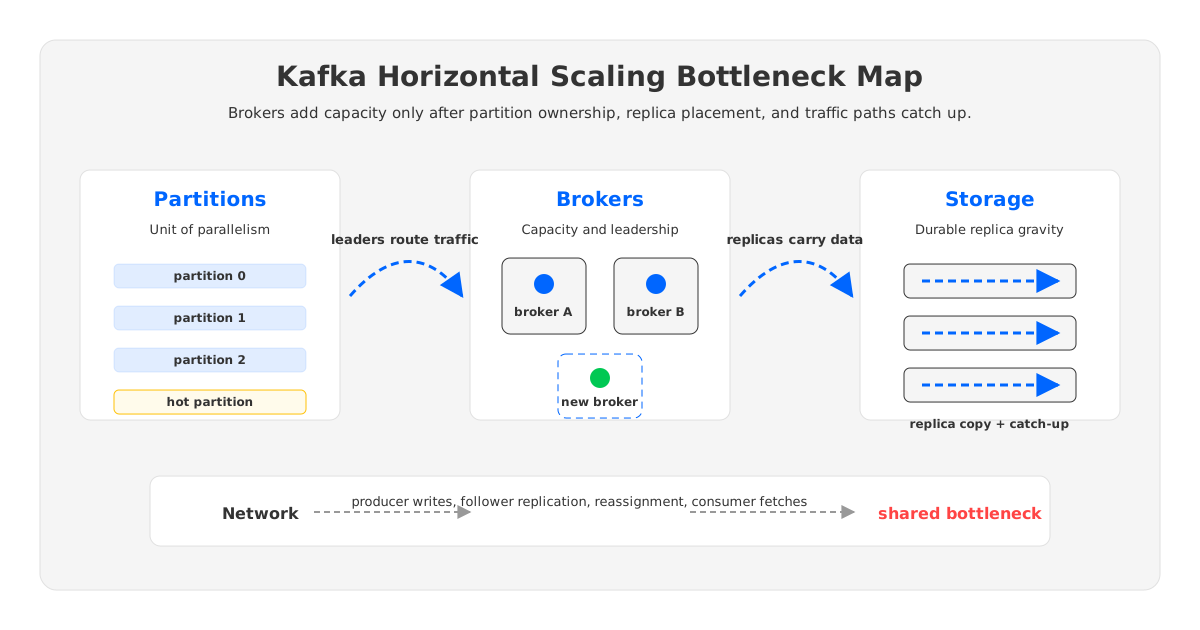
The useful mental model is not "How many brokers do we need?" It is "What is the smallest unit of work Kafka can move, how much data follows that unit, and what else competes for resources while it moves?" That question keeps platform teams out of the common trap where a cluster has more servers on paper but the same hot partitions and disk pressure.
1What Horizontal Scaling Means in Kafka
Horizontal scaling in Kafka means adding capacity across more brokers and using that capacity through partition placement, leadership balance, and client traffic distribution. A broker can be added to the cluster, but it does not automatically take over an equal share of traffic. Existing partition replicas and leaders have to be reassigned or newly created there.
This differs from scaling stateless services. If an API deployment grows from 10 pods to 15 pods, a load balancer can usually begin sending requests to the new pods quickly. Kafka has durable placement: a partition leader serves writes for a specific ordered log, follower replicas need to remain in sync, and consumers read according to partition assignment. The added broker is potential capacity until Kafka's internal layout changes.
Several scaling dimensions can point in different directions at the same time:
- Throughput scaling depends on partition-level produce and fetch rates, broker network, request handling, and storage throughput.
- Storage scaling depends on retention, replica count, log segment layout, local disk capacity, and background maintenance such as compaction.
- Availability scaling depends on replica placement across brokers, racks, or zones, plus in-sync replica health during movement.
- Operational scaling depends on how quickly the cluster can add, remove, or replace brokers without making the rebalance itself the incident.
This is why Kafka horizontal scaling cannot be reduced to an instance-count formula. The same broker count can behave differently depending on partition skew, message size, retention, replication factor, consumer fan-out, and failure-domain rules. A cluster with balanced average load can still have a hot leader.
2Partitions Are the Unit of Parallelism
Kafka partitions are the unit that gives a topic parallelism. A topic with more partitions can spread leaders across more brokers, let more consumers in the same group process in parallel, and reduce the amount of traffic pinned to one ordered log. If the topic has too few partitions for its traffic pattern, adding brokers cannot create more independent lanes for that topic by itself.
Partitions also carry overhead. Each partition has metadata, leader and replica state, log segments, indexes, and operational behavior during reassignment or leadership changes. More partitions can improve parallelism, but they also increase the amount of state the cluster has to track and the number of files and logs brokers may manage. The right count is workload-specific, which is why fixed universal limits are dangerous without context.
The most practical way to reason about partitions is to map them to bottlenecks:
| Scaling symptom | What partitions control | What partitions do not solve alone |
|---|---|---|
| Producer throughput is capped by one ordered lane | More partitions can create more write leaders | Key skew can still make one partition hot |
| Consumer group cannot use more consumers | Consumer parallelism is bounded by partition count | Slow downstream systems still create lag |
| Broker traffic is uneven | Leader distribution can spread traffic | Replica data movement may be required |
| Disk pressure is uneven | Replica placement can move stored data | Movement consumes disk and network resources |
| Metadata or file overhead is high | Fewer partitions reduce per-partition overhead | Larger partitions can reduce parallelism |
The tension is real. Increasing partitions can give future scale-out room, but it is not free capacity. More partitions can mean more leader elections to manage, more metadata to propagate, more consumer group assignment work, and more files for brokers to maintain. For high-retention topics, each partition also represents durable data that may need to be replicated, backed up by remote storage, or reassigned.
This is also why partition planning is easier before traffic arrives than during an emergency. Once a topic is hot, repartitioning can affect key ordering, consumers, producer routing, and operational risk. If message ordering relies on a specific key distribution, the scaling decision is no longer only an infrastructure decision.
3Brokers Add Capacity, But Data Must Move
Adding a broker gives the cluster more CPU, memory, network, and storage capacity. In traditional Kafka, it does not move existing partition replicas automatically into a perfect new layout. Operators use reassignment workflows, broker tools, Cruise Control-like automation, or platform-specific operators to move replicas and leadership toward the desired placement.
The operational cost is that reassignment is itself a workload. When a replica is placed on a new broker, that broker has to fetch data until it catches up. This consumes network bandwidth and disk I/O while normal producers, followers, consumers, and background tasks continue to run. Kafka provides throttling controls for reassignment because moving data too aggressively can harm the workload the cluster is supposed to protect.
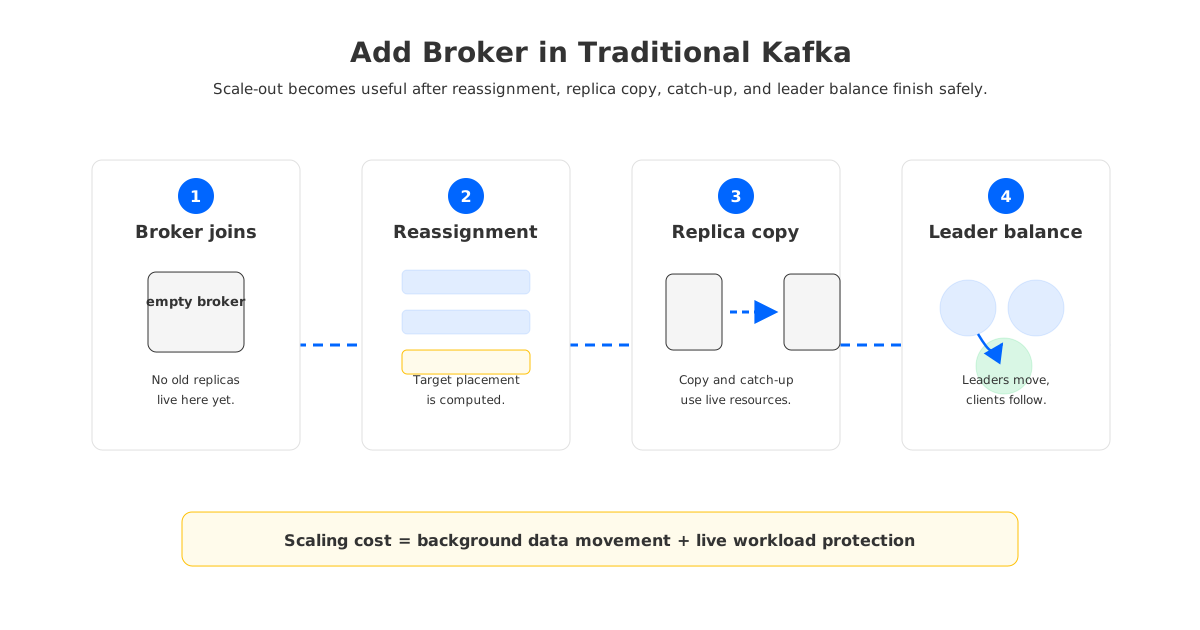
Three pieces matter during scale-out.
3.1Replica Movement
Replica movement is the visible part. A new broker is empty. To make it useful for existing data, partition replicas must be copied or caught up there. If the topic has long retention or high write throughput, the movement plan can run for a meaningful window while competing with live traffic.
This is where the Kafka storage bottleneck becomes concrete. Local storage ties capacity to placement, so a broker cannot serve as the durable local replica for a partition until it has the relevant log state. The larger the retained data set, the more scale-out feels like a migration.
3.2Leadership Balance
Replica placement and leader placement are related but not identical. A broker may host many replicas but lead only a subset of them. Producer writes and most consumer reads follow leaders, so an apparently balanced replica layout can still create uneven traffic if leaders concentrate on a few brokers.
Leadership balancing can reduce hot brokers, but it also changes client traffic paths. Producers and consumers discover new leaders through metadata and adjust connections. A healthy Kafka client ecosystem handles this, but repeated movement can still add churn.
3.3Consumer Impact
Consumer impact is often indirect. Broker scaling can reduce request latency or fetch pressure, but it does not automatically increase consumer parallelism beyond the number of partitions assigned to a group. If lag comes from a slow sink database or a hot key, adding brokers may improve the infrastructure envelope while leaving application lag mostly unchanged.
4The Storage Bottleneck Is Really Data Gravity
"Storage bottleneck" can sound like a disk performance complaint, but in Kafka scaling it is broader. It is the gravity created when durable logs are pinned to broker-local storage. In a stable cluster, local disks are a strength: Kafka's append-only log model is well suited to sequential I/O, and colocating compute with data makes the data path explicit. During scaling events, the same coupling becomes a constraint because every compute-layout change may require a storage-layout change.
This shows up in several operational patterns:
- Scale-out delay: new brokers exist before they carry a useful share of existing partition data and leadership.
- Scale-in friction: removing brokers requires evacuation, which can erase the expected savings from elastic capacity if the evacuation window is long or risky.
- Recovery pressure: replacing failed brokers can trigger replica rebuild and catch-up traffic while the cluster is already degraded.
- Network contention: reassignment traffic shares links with producer writes, follower replication, catch-up consumers, and sometimes cross-zone replication.
- Disk contention: copying logs, serving fetches, writing new records, compaction, and retention cleanup can collide on the same storage devices.
None of this makes traditional Kafka a bad architecture. It explains why Kafka scaling feels different from ordinary compute scaling: when brokers are also storage homes, horizontal scaling has to respect data gravity.
5How Shared Storage Changes the Bottleneck
If the root constraint is that durable data moves with broker-local replicas, the architecture-level alternative is to separate durable storage from broker compute. In a shared-storage Kafka design, brokers still implement the Kafka protocol, serve producers and consumers, maintain runtime state, and own partition responsibility. The durable log is externalized into a shared storage layer rather than being permanently pinned to each broker's local disk.
That does not remove the need for partition assignment, metadata consistency, leader fencing, cache management, or traffic balancing. It changes what has to move during a scaling event. Instead of copying large local replicas to make a new broker useful, the system can focus on ownership, metadata, cache warmup, and traffic scheduling.
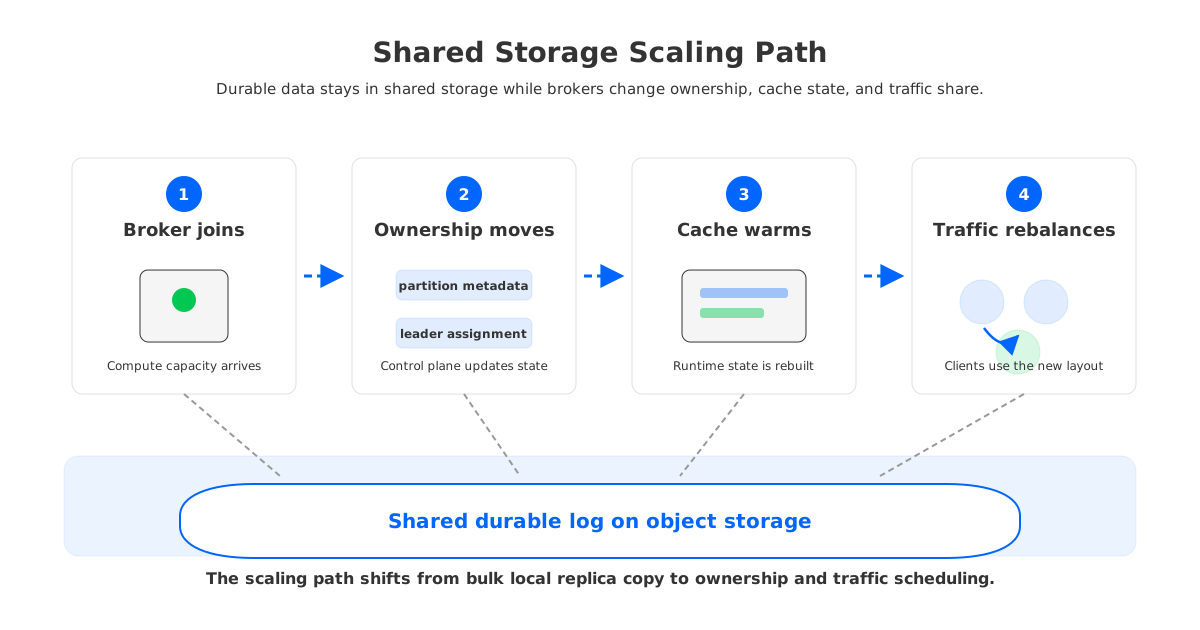
AutoMQ is one example of this model: a Kafka-compatible streaming system that uses object-storage-backed shared storage and stateless brokers. Its public documentation describes stateless brokers, continuous self-balancing, and partition reassignment in seconds. The important point is that the scaling bottleneck shifts from "copy durable log replicas to the new broker" toward "safely reassign ownership and steer traffic while preserving Kafka semantics."
That shift matters most when clusters need elasticity. In traditional Kafka, adding brokers often starts a data movement project. In a shared-storage design, adding brokers can be closer to adding schedulable compute over an already durable log. There is still cache warmup, request routing, and failure-domain design, but those are different problems from bulk replica migration.
This is also where shared storage differs from tiered storage. Tiered storage can move older log segments to remote storage while brokers still own local active segments. Shared storage aims at a deeper separation: durable log state is no longer the long-lived property of one broker's disk.
6Planning Checklist
Kafka horizontal scaling plans should start with the workload shape, not with the broker SKU. Use this checklist before changing a production cluster:
- Measure partition skew. Look at per-partition produce rate, fetch rate, request latency, and leader distribution. Average broker metrics hide hot partitions.
- Validate partition count against application semantics. More partitions may improve parallelism, but they can change ordering behavior and increase metadata, file, and reassignment overhead.
- Model reassignment bandwidth. Budget for replica copy, follower catch-up, consumer reads, producer writes, and cross-zone paths.
- Separate replica balance from leader balance. Disk distribution and traffic distribution need related but distinct checks.
- Plan scale-in as carefully as scale-out. If broker removal requires long evacuation, elastic capacity may not be economically or operationally elastic.
- Watch consumer lag by cause. Broker scaling helps only when the broker layer is the limiting factor.
- Choose the storage model deliberately. Broker-local storage, tiered storage, and shared storage create different scaling envelopes. Do not treat them as interchangeable uses of cloud storage.
- Test failure and rebalance together. A scaling plan that works only when the cluster is perfectly healthy is not a production plan.
For teams evaluating Kafka scaling or kafka autoscaling, the architectural question is direct: should brokers remain durable storage homes, or should brokers become schedulable compute over shared storage? The answer shapes how quickly the cluster can use new capacity, how safely it can remove capacity, and how much operational risk sits inside every rebalance.
If your current Kafka bottleneck is the movement of broker-local replica data, study AutoMQ's shared-storage architecture and test it against your own traffic skew, retention window, and failure-domain requirements. The useful proof is a drill where broker capacity changes and the cluster keeps serving Kafka clients without turning data movement into the critical path.
7References
- Apache Kafka documentation for Kafka partitions, replication, operations, quotas, and reassignment behavior.
- AutoMQ stateless broker documentation.
- AutoMQ partition reassignment in seconds.
- AutoMQ continuous self-balancing.
8FAQ
8.1What is Kafka horizontal scaling?
Kafka horizontal scaling means adding brokers and distributing partition replicas, partition leadership, and client traffic across the larger cluster. The cluster has to rebalance partition responsibility so the new capacity is actually used.
8.2Do more partitions always make Kafka scale better?
No. More partitions can increase parallelism, but they also add metadata, files, reassignment work, and consumer group coordination overhead. The right count depends on throughput, ordering requirements, retention, key distribution, and operational limits.
8.3Why does adding Kafka brokers take time to help?
In traditional Kafka, existing partition replicas live on broker-local storage. A new broker starts without that data, so operators typically need reassignment and replica catch-up before it carries a meaningful share of storage and traffic.
8.4What is the Kafka storage bottleneck during scaling?
The storage bottleneck is the operational cost of moving durable log data when broker placement changes. Replica copy, catch-up reads, disk I/O, network bandwidth, and throttling all compete with production traffic.
8.5How does Kafka shared storage help horizontal scaling?
Shared storage decouples durable log data from broker-local disks. During scaling, the system can focus more on ownership, metadata, cache warmup, and traffic balance instead of bulk local replica migration.
8.6Is AutoMQ a replacement for Kafka clients and tools?
AutoMQ is Kafka-compatible, so the intent is to preserve Kafka clients, APIs, and ecosystem integrations while changing the storage architecture underneath the broker layer. Teams should still validate behavior against their own workloads before migration.


