
Table of Contents
Table of Contents
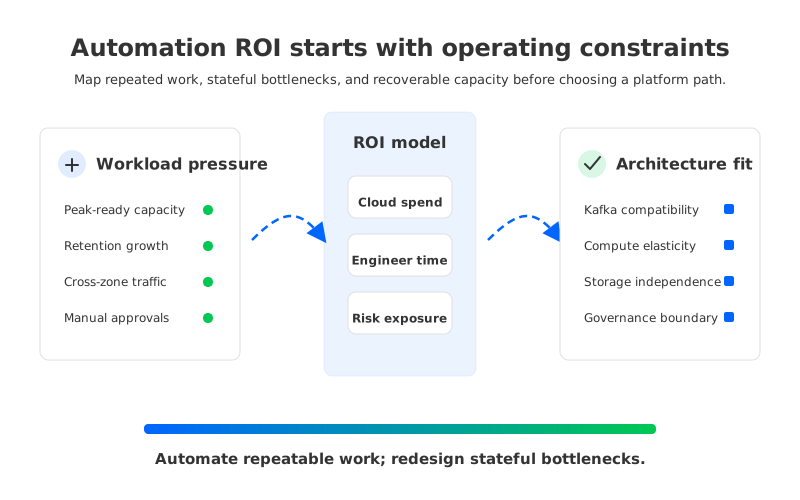
The search for kafka infrastructure automation roi usually starts after a platform team has automated the obvious work. Topics are created through Terraform or an internal portal. ACLs flow through GitOps. Yet the team is still spending too much time on capacity reviews, partition movement, failed-broker recovery, storage forecasting, and cloud bill explanations that do not fit cleanly into self-service.
That gap is the real ROI question. Kafka infrastructure automation is not valuable because it removes a few console clicks. It is valuable when it changes the operating model enough that engineers stop treating every capacity change as a risk event. If automation wraps a storage architecture that still requires careful broker-local data movement, the savings are limited by the same constraints that made the manual process slow.
Platform teams need a model that separates two questions: what work can be automated, and what work disappears because the architecture no longer requires it. The second question is where the largest ROI usually hides.
1Why Teams Search for Kafka Infrastructure Automation ROI
Kafka has become shared infrastructure inside many companies. One cluster may support CDC pipelines, payment events, fraud detection, search indexing, observability, and AI feature pipelines. That shared role makes Kafka a natural target for platform engineering: create a standard service, expose self-service workflows, and control governance centrally.
The hard part is that Kafka is not a stateless platform primitive. A topic change affects partitions and retention. A broker change affects replicas, leaders, and local disks. A client change may affect consumer groups, offsets, transactions, and replay. Automation has to respect these boundaries because the blast radius is real.
The ROI conversation therefore has more dimensions than "how many tickets did we remove?" The better questions are:
- How much engineer time is spent approving, sequencing, and watching Kafka operations that could become routine?
- How much cloud spend is locked into overprovisioned brokers because scale-in is operationally uncomfortable?
- How much risk comes from ad hoc scripts, tribal runbooks, and manually coordinated maintenance windows?
- How much product velocity is delayed because workload teams wait for capacity, topics, access, or connector changes?
Those questions connect automation to business outcomes without pretending Kafka is a generic database service. They also prevent a common mistake: counting visible toil while ignoring the architecture that creates it.
2The Production Constraint Behind the Problem
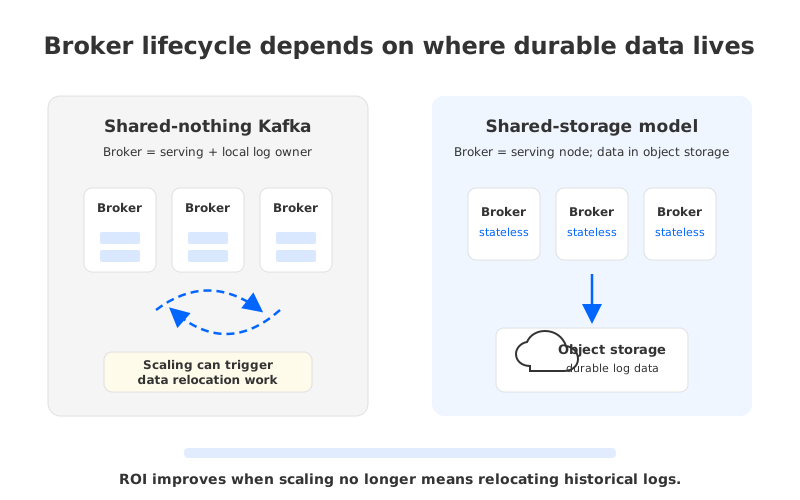
Traditional Kafka uses a shared-nothing architecture. Brokers own local log segments for assigned partitions, and Kafka handles replication between brokers. This design is mature, predictable, and deeply integrated with Kafka's semantics. It also means that a broker is both a serving node and a storage owner.
That dual role is where automation hits friction. Adding brokers can be automated, but making them useful may require partition reassignment. Replacing brokers can be automated, but recovery still depends on copying data from replicas. Increasing retention can be automated, but broker-local storage has to be sized and monitored. Reducing brokers can be automated, but draining local data safely is the part operators worry about.
The issue is not weak automation tools. Many Kafka operations are stateful by design. A workflow engine can submit reassignment plans, apply quotas, watch under-replicated partitions, and pause when lag grows. It cannot make broker-local data ownership disappear.
This is why automation ROI is often weaker than expected in mature Kafka estates. The team successfully standardizes the control plane, but the data plane continues to require careful human judgment. The result is partial automation: self-service for low-risk requests, review gates for capacity changes, and expensive overprovisioning when the team does not trust scale-in.
3Architecture Options and Trade-Offs
The architecture discussion should start with constraints rather than product categories. A platform team wants Kafka protocol compatibility, predictable failure behavior, cost control, and governance boundaries that match the company's cloud and security model. Those goals can be met in different ways, but each path moves risk to a different place.
Compare options before making a vendor or build decision.
| Option | What automation can improve | What still needs careful evaluation |
|---|---|---|
| Self-managed shared-nothing Kafka | Provisioning, topic workflows, ACLs, monitoring, reassignment orchestration, upgrade sequencing | Broker-local storage sizing, data movement, recovery load, cross-zone traffic, operational ownership |
| Managed Kafka service | Control-plane work, upgrades, basic capacity operations, service-level guardrails | Cost model, client compatibility edges, networking, governance boundary, migration lock-in |
| Kafka with tiered storage | Retention economics and pressure on local disks for older data | Hot data ownership, scale-in behavior, recovery path, feature maturity, operational tuning |
| Shared-storage Kafka-compatible platform | Independent compute and storage scaling, faster broker lifecycle, lower data movement during recovery | Compatibility validation, migration plan, cloud storage design, observability integration |
The important distinction is between automating a task and removing the reason the task exists. A managed service can reduce the operational surface by taking responsibility for parts of the platform. Tiered storage can improve retention economics by moving older segments away from local disks. A shared-storage design changes the broker lifecycle more directly because durable log storage is no longer tied to a specific compute node.
None of these choices is universally correct. A stable workload with modest retention may get strong ROI from better Infrastructure as Code and standard runbooks. A variable workload with long retention and frequent capacity changes may need a deeper architectural shift before automation can recover meaningful spend.
4Evaluation Checklist for Platform Teams
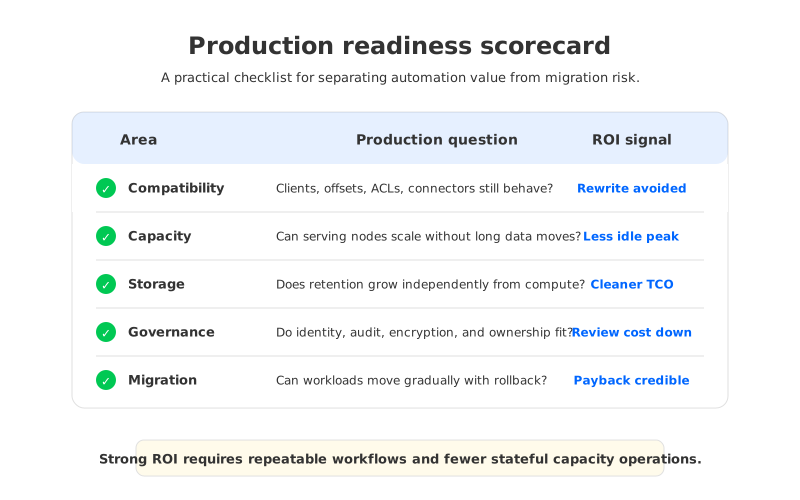
A useful ROI model includes engineering time, risk, and cloud-unit economics. If it counts infrastructure spend but excludes migration effort and operational drag, it will look precise and still mislead the buyer. If it counts every engineering hour as savings, it may overstate value because some governance review should remain.
Start with a scorecard that maps automation goals to measurable signals:
| Evaluation area | Questions to ask | ROI signal |
|---|---|---|
| Compatibility | Do existing producers, consumers, transactions, offsets, ACLs, connectors, and monitoring tools continue to work? | Lower migration cost and fewer application rewrites |
| Capacity elasticity | Can compute capacity change without long data relocation steps? | Less peak overprovisioning and faster recovery after bursts |
| Storage economics | Does retention grow with broker disks or with an independent storage layer? | Clearer separation between retained bytes and serving capacity |
| Network control | Can traffic stay zone-local where possible, and are cross-zone paths predictable? | Fewer surprise network charges and cleaner FinOps attribution |
| Governance | Can access, encryption, audit, cloud account ownership, and deployment boundaries match company policy? | Lower security review cost and cleaner platform ownership |
| Failure recovery | What happens after broker, disk, zone, or controller failure? | Reduced incident risk and less manual intervention |
| Migration and rollback | Can workloads be moved gradually, verified, and rolled back with known procedures? | Lower adoption risk and more credible payback timing |
This scorecard prevents the conversation from collapsing into a feature checklist. The platform team is buying a shorter path from workload demand to safe infrastructure change.
5A Practical ROI Model
The simplest model starts with three buckets: cloud spend, engineering time, and risk exposure. Cloud spend is the easiest to measure, but it is rarely the full story. Engineering time captures operational review, repetitive changes, incident response, and post-change validation. Risk exposure captures delayed changes, fragile scripts, and conservative capacity plans.
For cloud spend, separate baseline capacity from peak-ready capacity:
recoverable_capacity_value =
  peak_ready_capacity_cost
  - baseline_required_capacity_cost
  - fixed_storage_and_network_cost
The fixed portion matters. In a broker-local architecture, storage and recovery headroom may remain tied to brokers even when CPU demand falls. In a shared-storage architecture, more of the capacity delta can become compute-specific, which makes automation economically cleaner. The exact value depends on workload shape, retention, consumer fan-out, zone layout, and cloud pricing.
For engineering time, focus on recurring operations rather than one-off projects:
operational_savings =
  monthly_operations
  x average_human_review_time
  x loaded_engineering_cost
This number should be conservative. Some review steps are intentional controls, not waste. Savings come from turning well-understood operations into platform workflows while keeping human review for exceptions.
Risk exposure is harder to quantify, but ignoring it makes the model incomplete. A manual broker replacement during an incident does not appear in a normal cloud bill. A delayed retention increase can block a compliance requirement. A failed reassignment can create lag that downstream teams experience as product risk. A credible ROI case should name these failure modes without forcing false precision.
6How AutoMQ Changes the Operating Model
Once the evaluation framework is clear, AutoMQ fits into a specific architectural category: a Kafka-compatible streaming system that uses shared storage and stateless brokers. It keeps the Kafka API surface familiar for applications while changing where durable log storage lives. Instead of treating each broker as the permanent owner of local log data, AutoMQ places persistent data on object storage and uses brokers primarily for serving traffic.
That change affects automation in a practical way. Broker lifecycle operations become less entangled with historical data placement. Scaling compute capacity is closer to adding or removing serving nodes. Recovery relies less on copying large local datasets between brokers because durable data is already outside the failed compute node. Retention planning can be modeled around object storage rather than broker disk expansion.
AutoMQ also gives platform and FinOps teams a clearer set of levers. Compute can be planned around request handling and throughput. Storage can be planned around retained bytes and lifecycle policy. Network placement can be analyzed separately, including patterns designed to reduce cross-zone traffic. The platform still needs governance, observability, and migration discipline, but automation is no longer fighting the same broker-local storage constraints.
The practical takeaway is not "replace every Kafka cluster." The better takeaway is that ROI improves when automation targets an architecture with fewer stateful capacity operations. If the largest cost driver is overprovisioned compute, slow recovery, or repeated reassignment work, shared storage deserves a serious evaluation.
7Migration Readiness: Keep the Business Case Honest
Kafka migration risk belongs inside the ROI model because an unrealistically fast migration can turn a good architecture into a weak business case. Compatibility testing should cover more than producing and consuming a few messages. It should include consumer group rebalances, offset behavior, transactions where used, ACL expectations, connector workloads, monitoring signals, quotas, and failure drills.
A responsible adoption path usually starts with a representative but bounded workload. Mirror traffic or run a dual-write test where the blast radius is controlled. Compare latency, throughput, lag, error behavior, and operational visibility. Then rehearse rollback before moving a higher-value workload. This sequence may look slower than a spreadsheet payback period, but it protects the credibility of the ROI case.
The same discipline applies to governance. A platform is not production-ready because the data path works once. It is production-ready when identity, encryption, audit, incident response, cost allocation, dashboards, alerts, and runbooks all fit the organization's operating model. Automation should make these controls repeatable instead of bypassing them.
8Decision Matrix: When the ROI Is Strong
Kafka infrastructure automation produces strong returns when the workload has enough variation to create waste, enough operational complexity to create toil, and enough business criticality that reliability improvements matter. A small static cluster may not need a major architecture change. A large estate with long retention, multi-zone deployment, frequent capacity events, and strict recovery expectations should be modeled more aggressively.
Use this decision matrix as a quick screen:
| Current condition | Likely implication |
|---|---|
| Cluster capacity is sized for peaks that last a small portion of the month | Compute elasticity may recover meaningful spend |
| Retention growth forces broker or disk expansion faster than throughput growth | Storage architecture is part of the ROI case |
| Broker replacement or partition reassignment regularly needs human supervision | Automation alone may be masking a stateful data-movement problem |
| Cross-zone network charges are difficult to explain by team or workload | Placement and architecture should be evaluated together |
| Teams wait on topic, access, or capacity tickets | Platform workflows can improve developer velocity |
| Migration requires extensive client rewrites | Savings may be delayed or outweighed by adoption cost |
Back at the original search query, the answer is not a single ROI percentage. The answer is a framework: identify which Kafka operations are repeatable, which ones remain risky because of local state, and which architecture changes can remove work rather than automate around it. For teams evaluating that category, AutoMQ's shared-storage architecture is worth comparing against the scorecard. A practical next step is to review the deployment model here: explore AutoMQ for Kafka-compatible streaming infrastructure.
9References
- Apache Kafka documentation: https://kafka.apache.org/documentation/
- Apache Kafka consumer position and offsets: https://kafka.apache.org/documentation/#design_consumerposition
- Apache Kafka transactions configuration: https://kafka.apache.org/documentation/#producerconfigs_transactional.id
- Apache Kafka KRaft documentation: https://kafka.apache.org/documentation/#kraft
- Apache Kafka Connect documentation: https://kafka.apache.org/documentation/#connect
- Apache Kafka KIP-405 tiered storage proposal: https://cwiki.apache.org/confluence/display/KAFKA/KIP-405%3A%2BKafka%2BTiered%2BStorage
- AWS architecture guidance on data transfer costs: https://aws.amazon.com/blogs/architecture/overview-of-data-transfer-costs-for-common-architectures/
- AWS S3 pricing: https://aws.amazon.com/s3/pricing/
- AutoMQ overview: https://docs.automq.com/automq/what-is-automq/overview?utm_source=blog&utm_medium=reference&utm_campaign=aivk-0027
- AutoMQ shared storage documentation: https://docs.automq.com/automq/architecture/s3stream-shared-streaming-storage/s3-storage?utm_source=blog&utm_medium=reference&utm_campaign=aivk-0027
- AutoMQ inter-zone traffic documentation: https://docs.automq.com/automq-cloud/eliminate-inter-zone-traffics/overview?utm_source=blog&utm_medium=reference&utm_campaign=aivk-0027
10FAQ
10.1What does Kafka infrastructure automation ROI measure?
It measures the value of making Kafka operations repeatable, safer, and less capacity-heavy. A useful model includes cloud spend, engineering time, operational risk, migration effort, governance overhead, and developer wait time.
10.2Why is Kafka harder to automate than stateless infrastructure?
Kafka brokers often own local log data, partition leadership, replicas, and recovery responsibilities. That means capacity changes can involve data movement and failure-domain decisions, not only instance provisioning.
10.3Does Infrastructure as Code solve Kafka platform operations?
Infrastructure as Code helps standardize provisioning, access, topics, and configuration. It does not remove every operational constraint, especially when broker-local storage, partition reassignment, and recovery traffic remain part of routine operations.
10.4When should a team evaluate shared-storage Kafka-compatible infrastructure?
Evaluate it when ROI is limited by overprovisioned brokers, long retention, slow scale-in, repeated rebalancing work, or recovery processes that depend on copying large amounts of data between brokers.
10.5How should FinOps participate in Kafka automation planning?
FinOps should map Kafka cost to workload drivers: retained bytes, baseline and peak throughput, consumer fan-out, cross-zone traffic, and operational effort. That view makes savings attributable and prevents automation from being judged only by broker count.


