
Table of Contents
Table of Contents
A marketplace commitment can make a Kafka purchase look finished before the platform team has agreed on what it is actually buying. Procurement sees an approved cloud channel, FinOps sees spend that may fit an existing commitment program, and the vendor sees a signed term. The Kafka operators still have to run the workload through peak traffic, retention growth, replay, failures, and the next architecture review.
That gap is where a Kafka procurement checklist earns its place. The discount is only one term in the deal. The harder questions are whether the commitment matches changing Kafka usage, whether unused entitlement creates pressure to keep workloads on the platform, and whether the contract leaves a route out. A marketplace invoice can simplify the buying path while leaving runtime cost and data boundaries spread across several accounts and services.
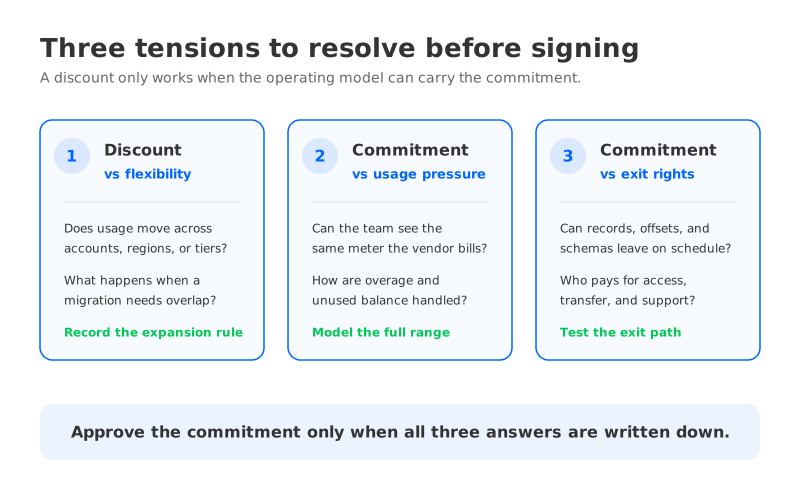
The review should therefore connect the commercial commitment to the operating model. Three tensions deserve an explicit answer before signature: discount versus scale flexibility, committed spend versus use-it-or-lose-it pressure, and a lower-friction purchase versus a credible exit right.
1A discount is not the same as a lower Kafka cost
The first question in a Kafka marketplace deal is not “What percentage discount did we get?” It is “What usage pattern does the discount assume?” Kafka consumption rarely moves as one clean meter. Broker capacity, retained data, partitions, consumer fanout, connectors, network paths, observability, and recovery activity can all change at different rates. A private offer can lower the vendor line item while the architecture still requires spare capacity for the next traffic burst or retention increase.
Ask the vendor and your FinOps partner to show the commitment against a workload model that includes:
- Traffic shape: Separate ordinary production load, predictable peaks, seasonal events, backfills, and replay. A commitment built from an average can hide the capacity needed to protect the busiest window.
- Storage behavior: Model retention growth, compaction, tiering or shared storage, and recovery copies. A platform may add data faster than it adds compute, or the reverse.
- Read fanout: Count independent consumer groups and historical reads. A consumer that replays a long window can change the platform bill and the operational load without changing producer volume.
- Topology: Record regions, Availability Zones, private connectivity, connector placement, and disaster recovery paths. The vendor charge is only one part of the resulting cloud bill.
The useful output is a range of expected usage and a list of assumptions that sit outside the commitment. If the quote only works when every workload stays close to its current shape, the discount is buying forecast confidence that the team may not possess.
This is also the point where a Kafka enterprise agreement needs technical language. Define the billable unit, the measurement window, the treatment of burst usage, the handling of overage, and whether one environment or account can use entitlement purchased by another. If the offer uses a platform unit rather than raw Kafka throughput, require a mapping from that unit to the metrics your operators can observe. FinOps cannot govern a commitment whose consumption model is invisible to the people running the clusters.
2Three tensions to resolve before signing
2.1Discount versus scale flexibility
A commitment rewards predictability. Kafka platforms are often purchased because teams expect more workloads, more regions, and more retention. Those goals can coexist, but only when the contract makes the growth path explicit. A commitment that covers one cluster does not automatically cover an additional environment, a second region, a migration overlap, or a temporary validation cluster.
Put the expansion rules beside the discount in the negotiation record. Ask whether unused entitlement can move to another cluster, region, account, or product tier. Ask how quickly an increase takes effect, whether a decrease is possible at renewal, and whether a platform change preserves the commercial credit.
The buyer should also define a stop condition: who can reduce the commitment when traffic falls, a business unit is retired, or a data product moves elsewhere? “We expect growth” is a planning assumption, not an exit clause.
2.2Committed spend versus use-it-or-lose-it pressure
Prepaid or committed usage changes the decision during an incident. An operator may know that a workload no longer fits, yet moving it creates unused entitlement. That pressure can extend a technical relationship after the platform has stopped being the right fit. It can also encourage teams to place unrelated workloads on the platform to consume a balance.
Treat that pressure as a risk to measure. Add unused entitlement, migration overlap, and the internal cost of keeping a poor-fit workload in the commitment model. Ask whether the agreement supports credit transfer, reallocation, a grace period, or prorated treatment at termination.
The contract should describe what happens when usage exceeds the commitment as well. Is the excess charged at a published rate, a negotiated rate, or a different tier? Can the buyer cap or alert on overage? Does an overage change the renewal baseline? A team that models only the discount has left the most volatile part of the purchase outside the spreadsheet.
2.3Commitment versus exit rights
Exit is not a legal paragraph that can be checked after architecture approval. It is a technical path with a commercial clock. Kafka teams need to know how to preserve records, schemas, consumer progress, ACL intent, connector configuration, and operational evidence when the agreement ends. Procurement needs to know the notice period, data access period, support obligations, termination fees, renewal mechanics, and treatment of prepaid value.
Put the following questions into the term sheet or an attached service schedule:
- Can the customer continue to read and export data during a termination or non-renewal window?
- What data formats, APIs, and metadata are available for export?
- Are schemas, offsets, ACLs, connector settings, and audit records included in the handoff?
- Who pays for data transfer, temporary storage, and support during the exit period?
- Does the vendor delete data immediately after termination, or is there a documented retention and deletion process?
- Can the buyer run a parallel destination while the commitment is still active?
An exit plan that depends on a special vendor-side export process is a dependency. Assign an owner and test it before renewal becomes urgent.
3What a Marketplace invoice tells you, and what it does not
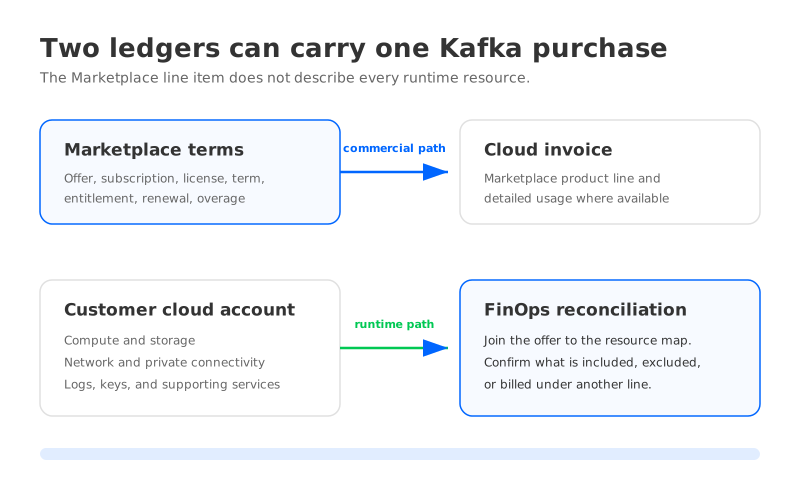
Marketplace billing is a transaction boundary. It tells you how a software or service purchase is charged, which account accepted the offer, and which negotiated terms apply. It does not, by itself, tell you where Kafka brokers run, where durable data is stored, who controls the network, or which cloud resources remain on your account.
For AWS Marketplace private offers, AWS documents that the seller creates the offer for a designated AWS account and that the accepted product appears as an AWS Marketplace product on the monthly bill. Detailed billing can expose line items for the marketplace product. The commercial record is useful, but it still needs to be joined to the runtime inventory.
Make the finance review reconcile three views:
| View | What it answers | Question to carry into procurement |
|---|---|---|
| Marketplace subscription or private offer | What software or service terms were accepted, by which account, and for what term | Which entitlement, unit, minimum, renewal, and overage rules are binding? |
| Vendor service usage | What the vendor measures and charges under the offer | Can operators observe the same meter and forecast it from workload data? |
| Customer cloud account | Which compute, storage, network, logging, key, and support resources run in the buyer environment | Are these costs included, excluded, or merely billed through a different line? |
The third view is where many Kafka procurement reviews become incomplete. A vendor-managed SaaS service may keep more of the data plane outside the buyer’s cloud account, so the cloud bill will not show every resource behind the service. A BYOC or software deployment can place brokers, object storage, disks, networking, and logs in the buyer’s account. The Marketplace charge may still cover only the software entitlement. The two models can use the same purchasing channel while creating different cost visibility, IAM duties, incident boundaries, and exit mechanics.
Do not assume that a marketplace purchase consumes every cloud commitment or that every underlying resource is covered by the private offer. Eligibility can depend on the cloud provider, account hierarchy, offer type, and enterprise agreement. Ask the cloud finance owner to verify the exact treatment in the buyer’s account structure, then save that answer with the approval record.
4The Bring Your Own Cloud (BYOC) question changes the contract review
Once the billing paths are separated, deployment boundary becomes a procurement requirement. A buyer that needs its own VPC, IAM controls, storage policies, and cloud cost allocation should ask whether the data plane can run in the buyer’s cloud account. That requirement changes the contract in concrete ways. The agreement must identify who supplies the cloud resources, who grants access, who owns the logs and keys, who responds when a cloud resource fails, and which vendor actions require customer approval.
This is where AutoMQ provides a factual comparison point. AutoMQ’s BYOC documentation describes a deployment in the customer’s cloud environment. Its AWS Marketplace subscription documentation also separates the prepaid AutoMQ subscription license from the cloud resource fees paid to the cloud provider. That distinction gives procurement a concrete model to test: a marketplace or direct software entitlement can govern the vendor relationship while the customer retains the cloud account, VPC, storage, and resource billing boundary.
The result is not an automatic contract advantage. It moves questions into the agreement and the operating runbook. A buyer still needs to confirm support access, upgrade authority, data export, license behavior after termination, cloud resource cleanup, and the permissions required for support. The benefit of the BYOC model is that these boundaries can be named and inspected before signature rather than inferred from a SaaS invoice.
If the desired exit is “keep the data in our account and change the software relationship,” the contract must make that path possible. Ask whether customer-owned cloud resources remain usable after the subscription ends, whether the data format remains readable, and whether a license grace period supports a controlled migration. Those clauses matter more than a headline commitment discount when the platform becomes a dependency for many application teams.
5A procurement checklist you can attach to the approval record
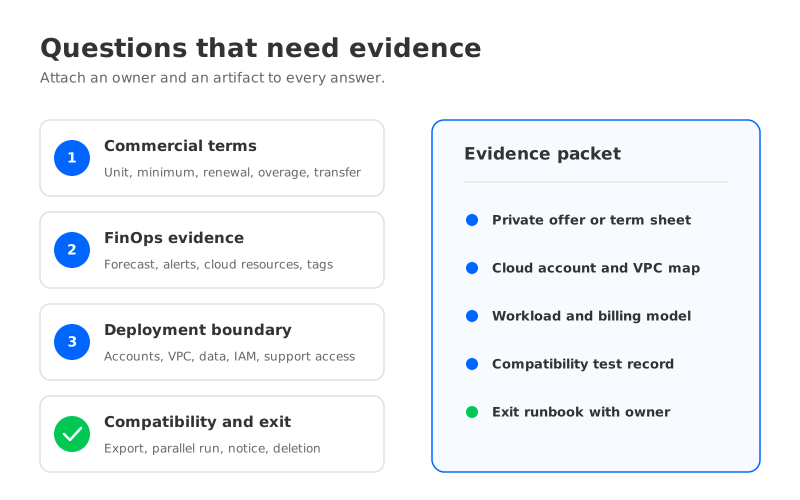
Use the questions below as a final gate. Each answer should name an owner and an evidence source, such as the private offer, service description, architecture diagram, billing export, or tested runbook.
5.1Commercial terms
- What exactly is committed: a platform unit, throughput, storage, cluster capacity, subscription license, or a broader spend category?
- What are the term, start date, renewal rule, price changes, minimums, overage rates, and cancellation conditions?
- Can entitlement move across accounts, environments, regions, business units, or product tiers?
- What happens to unused prepaid value, credits, and negotiated rates when a workload is retired or moved?
5.2Workload and FinOps evidence
- Which metrics predict the bill, and can the team observe them without a vendor support request?
- Does the model include retention, consumer replay, connectors, network paths, observability, disaster recovery, and migration overlap?
- What alerts protect against both unused commitment and unplanned overage?
- Which cloud resources stay on the customer bill, and how will they be tagged, allocated, and reviewed?
5.3Deployment and responsibility
- Where do the brokers, durable data, metadata, control plane, logs, and support channels run?
- Which account and VPC own the data plane, and which identities can change it? Confirm the Identity and Access Management (IAM) roles involved.
- Who owns upgrades, backups, incident response, capacity changes, and cloud resource cleanup?
- What customer approvals are required for vendor access, maintenance, or data movement?
5.4Compatibility and exit
- Which Kafka clients, transactions, consumer groups, connectors, schemas, ACLs, and admin workflows are production-critical?
- What is the tested export path for records, schemas, offsets, configuration, and audit evidence?
- Can the buyer run a parallel destination and validate cutover before the commitment ends?
- What notice, support, access, retention, deletion, and data-transfer terms apply after termination?
The approval should be conditional when any answer is still a verbal promise. A private offer cannot substitute for evidence about the workload, account boundary, or exit path.
6References
- AWS Marketplace private offers
- Apache Kafka documentation
- AutoMQ BYOC environment documentation
- AutoMQ AWS Marketplace subscription documentation
- AutoMQ BYOC billing instructions
7FAQ
7.1Is buying Kafka through AWS Marketplace the same as running Kafka in my AWS account?
No. Marketplace describes the commercial route for a product or service. The data plane may run in the customer account, in a vendor account, or across a documented combination of boundaries. Confirm the broker, storage, network, logging, and control plane locations before treating the Marketplace line item as the full cost or ownership model.
7.2What should a Kafka procurement checklist include?
It should cover the committed unit, measurement rules, overage, renewal, entitlement transfer, workload variability, cloud resource charges, deployment ownership, support access, compatibility evidence, export, termination, and deletion. Every answer should be tied to a contract term or a tested operational artifact.
7.3How should FinOps evaluate a Kafka commitment discount?
Compare the discount with a workload range rather than a single forecast. Include peaks, retention growth, replay, connectors, network paths, disaster recovery, and parallel migration time. Then model unused entitlement and overage as separate risks. A lower vendor rate can still produce a poor result when the commitment forces the team to retain an unsuitable architecture.
7.4Does BYOC remove Kafka procurement risk?
No. BYOC can make the cloud account and data plane boundary clearer, but the buyer still has to negotiate licensing, support access, upgrades, data export, termination, and cloud resource cleanup. It changes which questions are inspectable; it does not answer them automatically.
7.5What is the most important contract question before signing?
Ask what happens when the workload no longer fits. The answer should cover unused commitment, account and region changes, parallel operation, data access, export, and support. If the response is “renew or lose access,” the technical and commercial exit path is incomplete.
The next Kafka purchase should be able to survive a skeptical question from both finance and engineering: what are we committing to, where does it run, and how do we leave? Use the checklist against the private offer, cloud account map, workload forecast, and exit runbook. If a customer-account deployment is part of the target architecture, start a workload-specific AutoMQ BYOC evaluation with those same documents in hand.


