
Table of Contents
Table of Contents
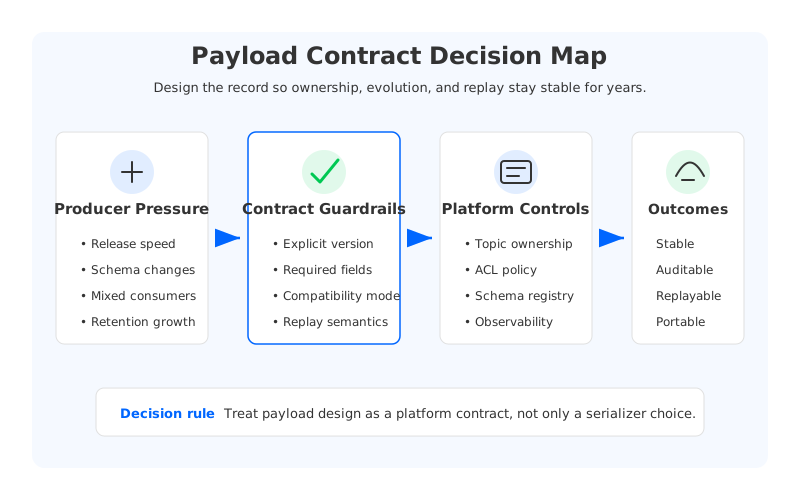
Teams search for kafka message payload design after the first version of an event stops being easy. A producer team wants to rename a field. A downstream analytics team replays months-old data. A risk service needs stricter validation. The Kafka cluster is doing its job: it preserves the stream. The hard part is that the payload has become a contract between teams, tools, and recovery workflows.
That contract is longer lived than most application code. A Kafka record may be retained, compacted, mirrored, replayed, transformed through Kafka Connect, read by Flink jobs, and audited after the producer team has moved on. Good payload design is an operating model question: who owns change, how consumers survive evolution, and whether the streaming platform can absorb the cost and recovery behavior that long-lived events create.
The practical rule: design Kafka payloads as durable event contracts first and byte containers second. The serializer matters, but the governance boundary matters more.
1Why Teams Search for kafka message payload design
The first payload usually reflects the producer's internal model. Producers know the business action best. A payment service emits PaymentCompleted, an order service emits OrderUpdated, and a telemetry service emits device readings with the fields it has. The trouble starts when the event attracts consumers the producer team does not control.
At that point, every payload decision becomes a platform decision. A field name becomes a query dependency. A missing event time becomes a replay ambiguity. A nullable field becomes a compatibility promise. A key choice becomes a partitioning and compaction decision. Headers matter when they carry correlation IDs, schema identifiers, tenant boundaries, or trace context.
Three pressures tend to appear together:
- Consumer diversity. Operational services, data warehouse pipelines, fraud models, search indexes, and audit jobs do not consume events in the same way. Some need low latency, some need complete history, and some need repeatable replay.
- Schema evolution. A field may be added, deprecated, split, or reinterpreted while older records remain in Kafka. The question is not whether change will happen, but whether change can happen without coordinated downtime.
- Platform cost and recovery. Retention, replay, backfill, mirrored topics, and connector duplication are infrastructure behaviors. Payload design can increase or reduce how much storage, network traffic, and operator time those behaviors consume.
That is why payload design belongs in the same conversation as Topic ownership, schema governance, access control, observability, and migration planning.
2The Payload Contract Has More Parts Than the Value Field
A Kafka record is not only its value. The key, value, timestamp, headers, Topic, Partition, Offset, and producer semantics all shape how the event behaves. Apache Kafka's documentation frames records as ordered within partitions and consumed through offsets and Consumer groups, so the payload contract must be understood together with ordering, replay, and consumer coordination.
The most durable event contracts usually make five choices explicit.
| Contract area | Design question | Failure mode when ignored |
|---|---|---|
| Event identity | What business fact does this event represent? | Consumers infer meaning from producer internals. |
| Key and ordering | Which entity needs ordered processing? | Replays produce inconsistent state or hot partitions. |
| Schema evolution | Which changes are backward or forward compatible? | Producers and consumers require coordinated releases. |
| Time semantics | Which timestamp drives business logic? | Backfills and late events corrupt analytics windows. |
| Ownership | Who approves schema, ACL, and retention changes? | Governance becomes ticket-driven and inconsistent. |
Notice what is not in the first column: Avro, Protobuf, JSON, or another encoding. Those formats influence type safety, schema validation, compatibility checks, and storage overhead. But they are tools for enforcing the contract, not the contract itself.
The producer still owns the business meaning of the event. The platform team owns the shared rules that keep the event usable by many consumers over time. When producer teams own every downstream concern, they slow down. When platform teams define payloads without domain context, they create generic events that nobody trusts.
3Design the Event Around Change, Not the First Release
The safest payload design starts by assuming that the first release is incomplete. That assumption changes the shape of the event. It encourages additive fields, explicit optionality, stable identifiers, and separate fields for business time and processing time. It also discourages embedding producer database rows as events. Database rows describe state storage. Events describe something that happened or a fact that became true.
For long-lived contracts, schema compatibility rules should be written before the first production producer ships. The exact rule depends on the consumer pattern. A strict operational workflow may require backward compatibility so later producers can write records older consumers can still read. A migration may need both backward and forward compatibility for a period of time. Compatibility is a policy, not a best-effort convention.
Headers deserve similar discipline. They are useful for metadata that should not be part of the business value: trace IDs, schema IDs, source system identifiers, tenant markers, or encryption context. They are a poor place to hide fields that consumers need to make business decisions.
Keys require the most architectural judgment. A key is not only a lookup handle. It drives partition placement, ordering, and log compaction behavior. If the key is too broad, one Partition can become hot. If it is too narrow, consumers may lose the ordering they need for state reconstruction.
The payload should also make replay predictable. Replays are stressful when events depend on hidden producer state, external side effects, or processing-time assumptions. They become manageable when the event contains enough information to reconstruct intended state and consumers can distinguish event time from ingestion time.
4The Governance Pressure Behind Shared Streaming Platforms
Kafka succeeds in part because it creates a shared log that many systems can use. The same property creates governance pressure. Once a Topic becomes shared infrastructure, a single payload change may affect application deployments, analytics tables, fraud models, and compliance exports.
Governance does not need to mean a central committee approving every field. It needs clear defaults that let teams move quickly without breaking shared assumptions:
- Topic ownership. Every Topic has an accountable owner, a business purpose, and an escalation path for incompatible changes.
- Schema review. Producers publish schemas through a registry or equivalent workflow, with compatibility checks applied automatically.
- Access boundaries. ACLs and data classification rules match the payload's sensitivity, not only the Topic name.
- Retention policy. Retention reflects replay, audit, and cost requirements. It is not set once and forgotten.
- Deprecation path. Field and Topic deprecation include timelines, consumer discovery, and rollback plans.
These rules are easier to maintain when the platform can show who produces, who consumes, which schema versions are active, and how lag or error rates change after a payload release. Without that visibility, governance becomes social memory.
Kafka Connect and stream processing jobs raise the stakes because they materialize events into databases, search indexes, object storage, or lakehouse tables. A field that is harmless to a Java consumer may break a sink connector's table evolution or a downstream warehouse schema.
5Infrastructure Turns Payload Choices Into Cost and Risk
Payload design feels abstract until it changes the shape of the infrastructure bill. Larger payloads increase storage and network use. Longer retention increases disk or object storage requirements. Backfills increase cold reads and consumer lag. Parallel Topics used for migrations can temporarily double write and connector volume.
Traditional Kafka's Shared Nothing architecture makes some of those effects more visible. Brokers own local data, and replicas are distributed across brokers for durability. When retention grows, local broker storage grows. When broker capacity changes, teams may need partition reassignment. When a cloud deployment spans Availability Zones (AZs), replication and client placement can create cross-AZ traffic.
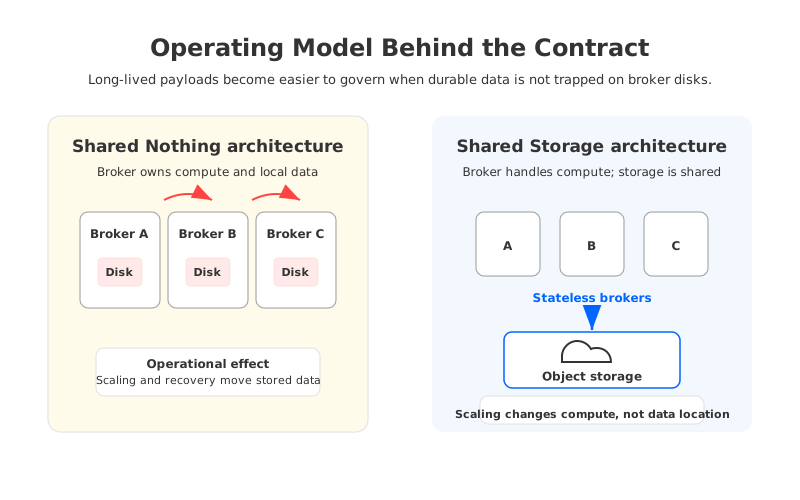
Tiered Storage moves older log segments to remote storage while keeping the active Kafka write path tied to brokers. It helps retention-heavy workloads, but it does not remove every operational effect of broker-local ownership, especially around active partitions, scaling, and recovery.
The payload review should therefore include infrastructure questions. If a contract requires longer retention, can the platform model the storage impact? If a schema migration requires a parallel Topic, can the team absorb duplicated producer and connector traffic? If a replay scans months of data, will it contend with hot traffic? If a consumer group rejects a later schema version, can operators see that quickly enough to stop the rollout?
6Evaluation Checklist for Platform Teams
A useful evaluation checklist separates payload quality from platform readiness. The payload can be well designed and still fail operationally if the platform cannot enforce, observe, or migrate the contract.
Use this checklist before approving a long-lived contract:
- Compatibility. Which schema changes are allowed, and are they enforced before the producer deploys?
- Ownership. Who owns the event meaning, the Topic settings, and the consumer communication path?
- Replay. Can consumers rebuild state from retained records without relying on hidden producer state?
- Ordering. Does the key match the entity that requires ordered processing, and has the team checked skew risk?
- Retention and cost. Does the review include retained bytes, read fanout, connector volume, and backfill behavior?
- Security. Are sensitive fields classified, encrypted where required, and protected through ACLs or equivalent controls?
- Migration and rollback. Can producers, consumers, offsets, and schema versions move in stages without a single cutover window?
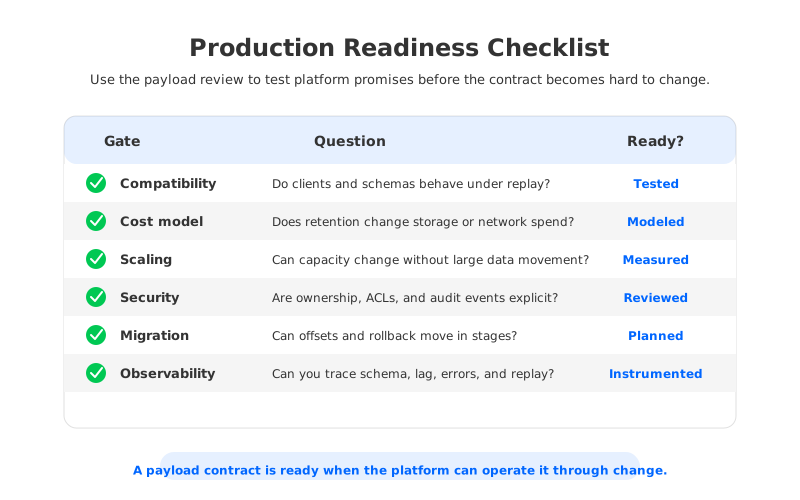
The migration question is often the most revealing. Teams that design only for the first deployment tend to rely on a breaking change window. Teams that design for a long-lived contract build escape hatches: versioned fields, consumer readiness dashboards, offset tracking, and a rollback path.
7How AutoMQ Changes the Operating Model
After that neutral evaluation, the role of a Kafka-compatible platform becomes clearer. The platform does not decide the business meaning of a payload. It changes how risky it is to operate that payload through retention growth, replay, migration, scaling, and recovery.
AutoMQ is relevant because it keeps Kafka compatibility while changing the storage model underneath the broker. AutoMQ uses Shared Storage architecture with stateless brokers and object-storage-backed durability. The durable stream is not tied to a specific broker's local disk in the same way as traditional Kafka. That changes the platform conversation from "how do we move data when the cluster changes?" to "how do we operate compute around shared durable data?"
For payload contracts, that matters in several ways. Longer retention can be evaluated against object storage and request patterns rather than only broker-local disk headroom. Broker replacement and scaling are less entangled with moving large volumes of partition data.
This does not remove the need for careful payload design. A bad key can still create skew. A vague schema can still break consumers. A sensitive field can still create a governance problem. The difference is that Kafka-compatible clients and ecosystem tools can remain while storage and scaling become less dependent on broker-local data.
AutoMQ BYOC is also worth evaluating when deployment boundaries matter. The control plane and data plane run in the customer's cloud account and VPC, which can fit teams that need Kafka compatibility, cloud account control, and explicit data residency boundaries.
8A Practical Payload Review Template
The fastest way to improve payload quality is to make the review concrete. Put the following template next to the schema proposal.
Event name:
Business fact represented:
Producer owner:
Primary consumers:
Key and ordering reason:
Schema compatibility policy:
Required fields:
Optional fields and defaults:
Event time field:
Retention requirement:
Sensitive fields:
Replay expectation:
Migration and rollback plan:
Dashboards:
The template forces a conversation about meaning, change, and operation before the payload becomes a durable interface. Different event types have different semantics, but they all need an owner, a key, a compatibility policy, and a replay story.
If payload contracts drive retention growth, replay work, schema governance, and platform cost reviews, validate the contract and operating model together. Start with the checklist above, then test the same workload on a Kafka-compatible Shared Storage architecture. To evaluate AutoMQ in your own cloud boundary, start from AutoMQ Cloud and run a proof of concept with one event contract that is painful enough to be realistic.
9References
- Apache Kafka documentation — Kafka records, Topics, Partitions, Offsets, Consumer groups, producer configuration, consumer configuration, transactions, Kafka Connect, and MirrorMaker2.
- KIP-405: Kafka Tiered Storage — Apache Kafka proposal for remote storage of log segments.
- KIP-1150: Diskless Topics — Apache Kafka proposal exploring diskless Topic architecture.
- AWS S3 storage classes — Object storage durability, storage classes, and retrieval characteristics.
- AWS EC2 On-Demand pricing — Cloud instance pricing and data transfer notes that platform teams should check by Region.
- AutoMQ Kafka compatibility — Kafka API and protocol compatibility guidance.
- AutoMQ architecture overview — Shared Storage architecture and separation of compute and storage.
- AutoMQ WAL storage — WAL storage concepts and deployment trade-offs.
- AutoMQ cross-AZ traffic optimization — Configuration model for reducing cross-AZ data transfer in supported deployments.
10FAQ
10.1What is the most important rule for Kafka message payload design?
Design the payload as a durable event contract, not as a snapshot of the producer's internal data model. That means stable event meaning, explicit ownership, a clear key, schema compatibility rules, event time semantics, and a replay plan.
10.2Should Kafka payloads include schema version fields?
Often yes, but a version field is not a substitute for compatibility policy. A schema registry or equivalent workflow should still enforce which changes are allowed.
10.3Are headers or payload fields better for metadata?
Use headers for transport and operational metadata such as trace IDs, schema IDs, tenant hints, or correlation IDs. Put business facts that consumers need for decisions inside the payload value. If a consumer must inspect private header conventions to understand the event, the contract is too implicit.
10.4How does payload design affect Kafka cost?
Payload size, retention, read fanout, replay frequency, connector materialization, and parallel migration Topics all influence infrastructure cost. In broker-local architectures, those choices can increase disk pressure, network traffic, and partition movement work.
10.5Does AutoMQ change how I design Kafka payloads?
AutoMQ does not remove the need for good payload contracts. It changes the operating model around those contracts by keeping Kafka compatibility while using Shared Storage architecture and stateless brokers. That can reduce the operational friction of retention growth, scaling, and broker replacement, but schema meaning, key choice, access control, and replay semantics still need careful design.


