
Table of Contents
Table of Contents
Teams usually start searching for kafka metadata at scale after the cluster has already become politically important. The issue may surface as slow topic creation, controller failover anxiety, partition reassignment windows that no one wants to touch, or a change-review meeting where a small application team asks for hundreds of additional topics and the platform team hesitates. Nothing about that request looks dramatic in isolation. The trouble is that Kafka metadata is not one thing; it is the control-plane map for topics, partitions, replicas, consumer coordination, ACLs, quotas, and the operational state that lets a streaming platform act like one coherent system.
That map grows with every product team that treats Kafka as shared infrastructure. More topics mean more ownership boundaries. More partitions mean more scheduling choices. More replicas mean more state transitions during maintenance and recovery. At platform scale, these details become the difference between a streaming service that absorbs change and one that needs a maintenance calendar for ordinary operations.
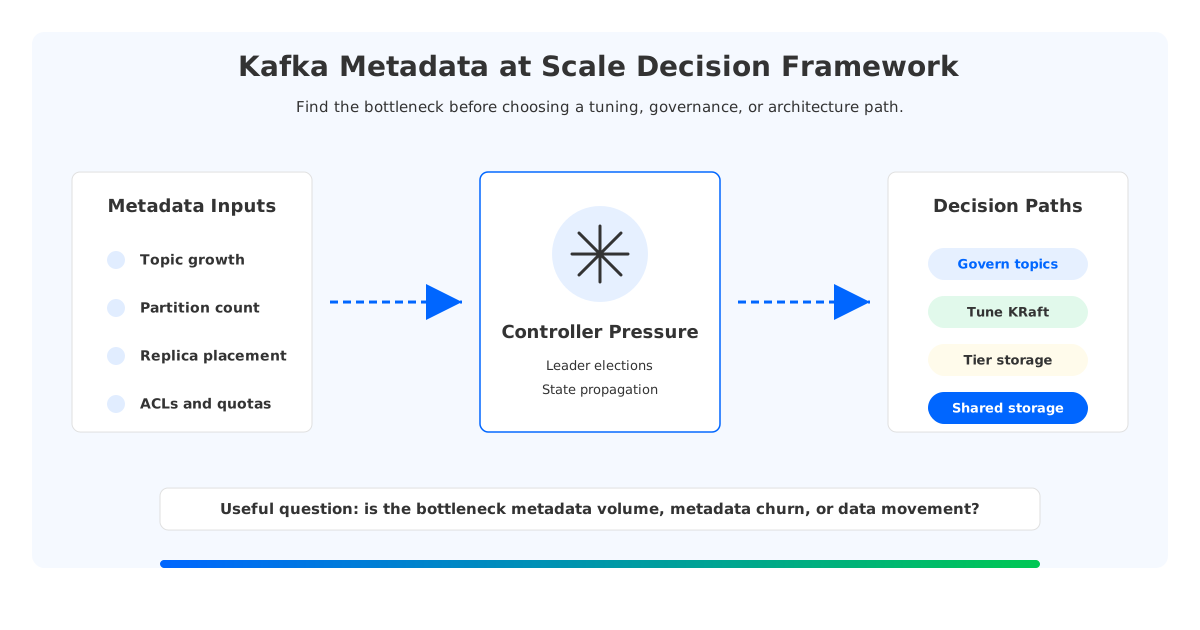
Metadata pressure rarely has a single root cause. A platform team can tune topic policy, reduce partition sprawl, add controller capacity, improve automation, or change the storage architecture underneath the brokers. Each option helps a different part of the system. Treating them as interchangeable is how teams end up solving a governance problem with hardware, or solving a storage-movement problem with another naming convention.
1Why Kafka Metadata Becomes a Platform Problem
Kafka exposes a simple abstraction to application teams: write records to topics and read them back by partition and offset. Platform teams live underneath that abstraction. They manage topic catalogs, partition counts, replica assignments, leader placement, retention settings, client permissions, consumer group state, and broker lifecycle. As the platform grows, these responsibilities converge on the controller path.
Apache Kafka's KRaft mode removes the ZooKeeper dependency and stores cluster metadata in an internal Kafka topic managed by the controller quorum. That is a major simplification, but it does not make metadata free. The controller still processes cluster state changes, elects partition leaders, tracks broker liveness, and keeps other brokers up to date. KRaft changes where the control plane lives; it does not erase the operational cost of a huge topic and partition estate.
The pressure tends to arrive through familiar production patterns:
- Topic growth follows organizational growth. Microservices, data products, CDC pipelines, and regional deployments all create legitimate reasons for additional topics. Without lifecycle rules, the metadata catalog becomes an archaeological record of every integration the company has ever built.
- Partition growth follows throughput planning. Teams over-partition to protect future throughput or under-partition and later need reassignments under load. Both choices matter because partitions are the unit Kafka schedules, replicates, and moves.
- Replica placement follows availability requirements. Multi-AZ production clusters replicate data for durability and availability. That means metadata changes often imply leader movement, follower catch-up, and capacity questions across failure domains.
- Governance follows shared ownership. ACLs, quotas, retention policies, and naming standards decide whether the platform can remain self-service without letting one team create risk for everyone else.
Metadata scale is not only a controller tuning topic. It is a design problem across control plane, data placement, storage movement, and governance.
2Topics and Partitions Are Control-Plane Load, Not Just Names
The easiest mistake is to treat topics as labels and partitions as a throughput dial. A topic name is easy to create, but a topic has configuration, ownership, retention, access policy, observability, and deletion semantics. A partition is a schedulable unit with a leader, followers, log segments, offsets, and state transitions during reassignment or recovery.
That distinction matters during change. Increasing a partition count may be harmless for one topic and risky for another, depending on consumer ordering assumptions. Reassigning partitions can look like placement cleanup but trigger data movement from broker-local storage. Deleting unused topics reduces clutter, but it still needs retention, audit, and owner coordination.
Platform teams need two lenses at the same time:
| Question | What It Reveals | Typical Signal |
|---|---|---|
| Is the topic estate intentional? | Whether topic growth is governed by ownership and lifecycle policy. | Orphaned topics, duplicate naming patterns, unclear retention classes. |
| Are partitions aligned to workload shape? | Whether partition count reflects throughput, ordering, and consumer parallelism. | Many low-traffic over-partitioned topics or hot partitions on critical topics. |
| Is placement easy to change? | Whether broker maintenance and scaling require heavy data movement. | Long reassignment windows, uneven disk use, cautious maintenance. |
| Can the controller absorb churn? | Whether metadata changes remain routine during failures and deployments. | Slow admin operations, delayed leadership changes, controller saturation warnings. |
Configuration comes after diagnosis. If topic growth is unmanaged, controller tuning gives temporary relief. If partition movement is expensive because storage is tied to brokers, stricter topic policy will not make scaling painless. If governance is clean but the data plane is rigid, the platform can be well organized and still slow to evolve.
3Controller Pressure in the KRaft Era
KRaft deserves careful treatment because it can be misunderstood in both directions. Teams coming from ZooKeeper-based Kafka may overestimate the migration risk and miss the simplification. Other teams may assume that removing ZooKeeper removes control-plane bottlenecks entirely. The useful position is in the middle: KRaft makes Kafka's metadata architecture more self-contained, while leaving the platform team responsible for metadata scale and churn.
Controller pressure shows up when the cluster has too much to track or too much to change at once. Topic creation, broker failure, partition leadership movement, reassignment, ACL changes, and large administrative scans all add control-plane work. Health is not only a question of CPU. It is also a question of operational rhythm: how often metadata changes happen, how many objects they touch, and whether data-plane recovery creates long feedback loops.
Separate metadata volume from metadata churn. A large but stable estate is easier to run than a smaller estate that constantly creates topics, changes partition counts, rebalances placement, and rotates brokers. Many incidents are caused by churn rather than raw object count. The cluster has enough capacity for steady traffic, but change operations pile up when every change also implies disk movement, follower catch-up, and manual balancing.
Good KRaft-era operations therefore combine technical and governance controls:
- Keep controller nodes isolated from noisy data-plane workloads where possible, and monitor controller latency, quorum health, and request handling.
- Define topic classes with default retention, partition ranges, replication policy, ownership labels, and deletion workflow.
- Make partition increases an explicit design review for ordering-sensitive topics, not a routine self-service field.
- Schedule heavy reassignment and broker replacement work with the same care as schema or database migration, because both can change production behavior.
These controls make metadata change visible, reviewable, and reversible.
4The Storage Architecture Behind Metadata Operations
Kafka's traditional shared-nothing model keeps log data on broker-local disks. That design has served Kafka well because brokers directly control local logs and replication. It also means the metadata decision "this partition should live over there" can become the data-plane operation "move these bytes from here to there." At high partition counts, that coupling is one reason platform teams fear routine changes.
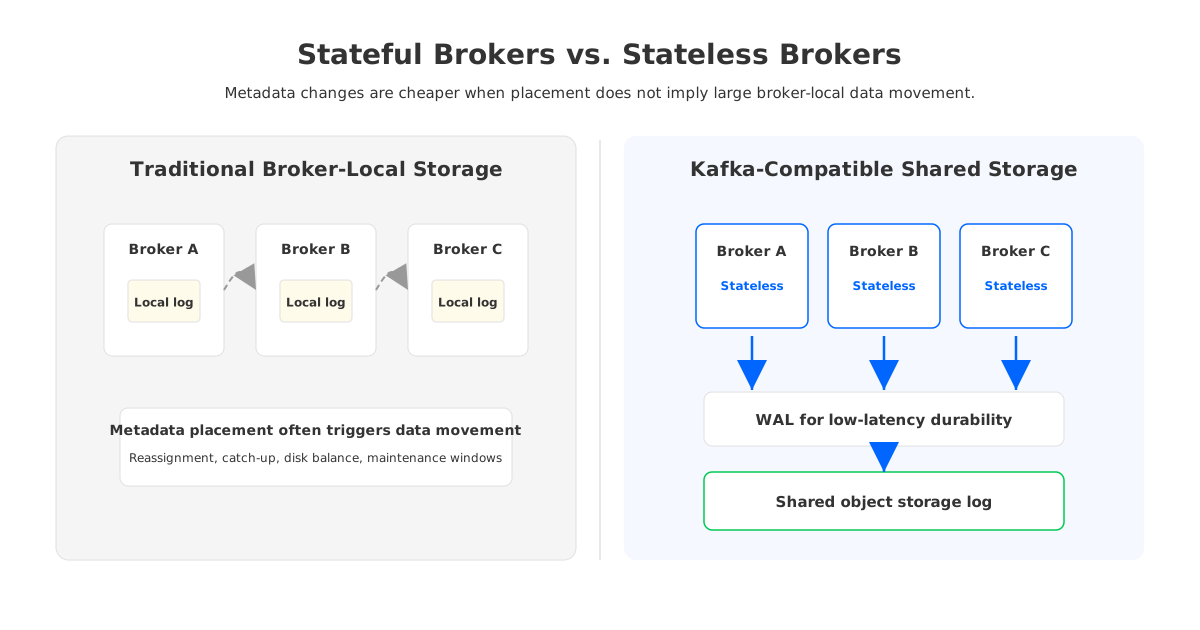
Apache Kafka's Tiered Storage work addresses part of this problem by letting older log segments move to remote storage while active segments stay local. That can reduce local disk pressure and improve retention economics. Tiering changes where older data can live. It does not automatically make brokers stateless, remove all partition data movement, or turn reassignment into a metadata-only operation.
This distinction matters because the expensive part of a change is often not the metadata update itself. It is the recovery, replication, and data movement that follow. If broker identity, local disk, and partition ownership are tightly coupled, a clean control-plane decision can still create a slow data-plane operation. If storage is decoupled from compute, metadata can behave more like a placement decision than a disk migration trigger.
The architecture comparison is less about ideology than operating model:
| Architecture Pattern | What Gets Easier | What Still Needs Discipline |
|---|---|---|
| Traditional broker-local storage | Predictable Kafka behavior, mature operational knowledge, direct disk control. | Reassignment windows, disk balancing, broker replacement, partition sprawl. |
| Kafka with tiered storage | Longer retention and less local storage pressure for older segments. | Hot data placement, controller hygiene, active partition movement. |
| Kafka-compatible shared storage | Faster compute elasticity and less broker-local data gravity. | Object storage design, WAL choice, cloud permissions, migration validation. |
A stable, moderate-size Kafka estate may need better governance more than an architecture change. A fast-growing platform with frequent broker changes, uneven partitions, and cloud cost pressure should evaluate whether the storage model is making metadata operations heavier than they need to be.
5A Vendor-Neutral Evaluation Framework
Before evaluating any Kafka-compatible platform, build a metadata readiness review around the failure modes your team sees. Include controller health, topic governance, partition policy, storage movement, cloud networking, and migration rollback. That breadth is necessary because platform teams have to preserve compatibility, keep applications running, control cost, and make future operations less fragile.
The following checklist is a useful starting point for architecture review:
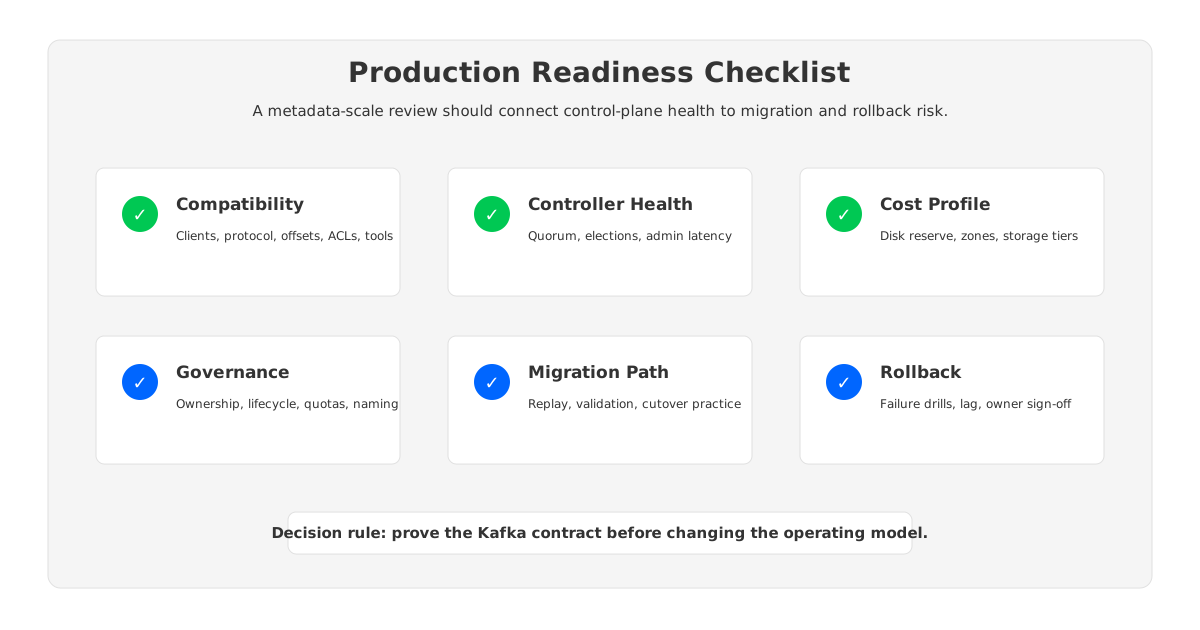
Start with compatibility because it protects application teams. Kafka clients, protocols, consumer groups, offsets, transactions, ACLs, and operational tools define the migration surface. A platform can have a strong storage design and still be expensive to adopt if clients need invasive changes. Test compatibility with the real client versions, serializers, admin workflows, observability tools, and failure-handling patterns already in production.
Then evaluate the change path. Ask how the platform behaves when you add brokers, remove brokers, increase partitions, change retention, recover from a zone failure, or migrate a large topic. The answer should describe both the metadata operation and the data-plane consequence. Cost belongs in the same review because storage patterns create different compute, disk, and network profiles.
6Where AutoMQ Changes the Operating Model
Once the evaluation reaches storage coupling, AutoMQ becomes relevant as an architectural option rather than a product detour. AutoMQ is a Kafka-compatible, cloud-native streaming platform that separates compute from storage and uses shared object storage as the durable log foundation. Its public documentation describes Kafka API compatibility, stateless brokers, shared storage, WAL options, and self-balancing.
AutoMQ does not make topics or partitions vanish. Kafka-compatible semantics still have topics, partitions, offsets, and client-visible behavior. The operating model changes because broker compute is no longer the long-term owner of local log data in the same way. When brokers are more stateless, scaling and replacement can become less dominated by local disk gravity.
This matters most for teams with rapid topic growth, frequent capacity changes, and cloud cost pressure. Those teams often discover that their metadata problem is really an elasticity problem. They can govern topic creation and tune controllers, but still hesitate before adding or removing broker capacity because partition movement is slow or risky.
AutoMQ's fit should still be tested, not assumed. Platform teams should validate client compatibility, operational tooling, cloud identity boundaries, object storage configuration, observability, disaster recovery, and migration workflows. The neutral question is: "Which parts of our current operating model are expensive because data is tied to broker-local storage?"
7Decision Table for Platform Teams
A simple decision table can keep the discussion grounded:
| Situation | Likely First Move | Why |
|---|---|---|
| Topic sprawl with unclear owners | Governance cleanup and topic lifecycle policy. | The fastest improvement is reducing unmanaged metadata growth. |
| Many idle partitions but stable brokers | Partition policy review and workload consolidation. | The issue is estate hygiene, not necessarily architecture. |
| Frequent broker changes with long reassignments | Evaluate storage/data-plane coupling. | Metadata operations are slow because data movement follows placement changes. |
| Cloud costs dominated by replication and reserved disk | Model shared storage and tiered storage options. | Cost pressure may come from architecture rather than utilization alone. |
| Migration risk is the top blocker | Run compatibility and rollback tests before architecture selection. | Kafka-compatible behavior must be proven with real clients and operations. |
The table prevents a common mistake: choosing another platform before naming the bottleneck. Metadata at scale can be a governance problem, a controller health problem, a partition modeling problem, a storage architecture problem, or several of these at once. Mature teams identify which layer is failing before they decide whether to tune, refactor, or migrate.
If your Kafka estate is healthy but messy, start with policy. If it is stable but expensive, model the storage and network profile. If it is hard to scale because every broker change turns into a data movement project, evaluate shared-storage Kafka-compatible systems such as AutoMQ alongside Kafka tiered storage and managed Kafka options. The winning architecture reduces the specific pressure you have while keeping the Kafka contract your applications depend on.
For teams that want to test this path, the practical next step is not a broad platform rewrite. Pick one representative workload, capture its topic and partition shape, replay the key admin operations, and compare how much work happens in the control plane versus the data plane. That experiment tells you more than another round of generic best-practice debate.
8References
- Apache Kafka Documentation
- Apache Kafka 4.0 Documentation: KRaft
- Apache Kafka 4.0 Documentation: Tiered Storage
- AutoMQ Documentation
- AutoMQ: Compatibility with Apache Kafka
- AutoMQ: Shared Storage Architecture Overview
- AutoMQ: Stateless Broker
- AutoMQ: Difference with Tiered Storage
9FAQ
9.1Is Kafka metadata scale mostly a KRaft sizing issue?
No. KRaft is central to Kafka metadata management in KRaft-era clusters, but metadata scale also depends on topic lifecycle, partition policy, broker churn, storage movement, and governance. Controller sizing helps only after the platform team understands which of those forces is creating pressure.
9.2Does reducing partitions always improve Kafka operations?
Reducing unnecessary partitions can lower metadata and scheduling overhead, but partition count is also tied to throughput and consumer parallelism. The goal is not the smallest possible number. The goal is a partition model that matches workload shape, ordering requirements, and operational capacity.
9.3How is tiered storage different from shared storage?
Tiered storage generally keeps active data local while moving older segments to remote storage. A shared-storage architecture uses external storage as a more central part of the log durability model, which can reduce broker-local data gravity. The distinction matters when scaling, replacing brokers, or reassigning partitions.
9.4When should a team evaluate AutoMQ?
Evaluate AutoMQ when Kafka compatibility remains important but broker-local storage is making scaling, reassignment, cloud cost, or operations harder than expected. It is most relevant when the team wants a cloud-native shared-storage model while preserving Kafka APIs and client behavior.


