
Table of Contents
Table of Contents
Kafka migration rarely fails because a team could not copy records from one cluster to another. It fails because the migration plan treats Kafka as a set of topics while production treats Kafka as a dependency graph. Producers have retry behavior, consumers have offset assumptions, connectors own side effects, schemas evolve independently, ACLs encode security policy, and dashboards define operational truth.
That is why a production-safe Kafka migration checklist has to start before data replication. The first question is not "Which tool moves the bytes?" It is "What must remain true when traffic moves?" If the answer is vague, the cutover becomes a live discovery exercise.
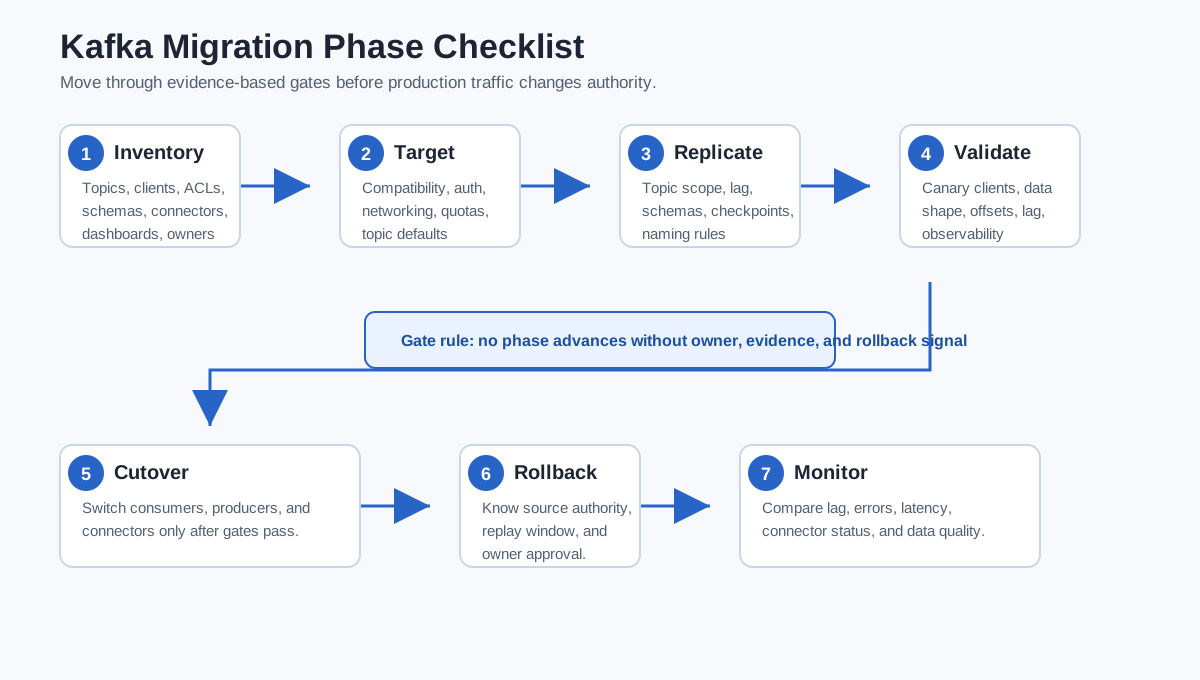
The safest migration projects turn the work into phases with explicit gates: inventory, target design, replication, validation, cutover, rollback, and monitoring. Each gate should have an owner, evidence, and a stop condition.
1What Makes Kafka Migration Risky
Kafka looks easy to migrate at the API boundary because clients connect to bootstrap servers, produce records, and consume from topics. Under that boundary, production behavior depends on cluster-local details. Partition counts affect ordering and parallelism. Retention, cleanup policy, message size, ISR behavior, quotas, and ACLs all shape what applications can do.
Consumer offsets are a common source of surprise. An offset is a position in a specific topic partition log, not a portable event identifier. If records are replicated to a target cluster, destination offsets may differ depending on replication method, topic naming, compaction, retention, and timing. A consumer cutover plan that says "resume from the same offsets" is incomplete unless offset translation or checkpointing has been validated.
Connectors add another layer of risk because they often create side effects outside Kafka. A sink connector may write to a warehouse, search index, object store, or database. Running both source and target connectors at the wrong time can duplicate writes. Moving only the topic without moving connector configuration, secrets, dead-letter topics, and task state can make the target cluster look healthy while downstream systems drift.
The operational risk is also social. Kafka clusters sit between platform teams and application teams. Platform engineers can replicate topics, but they may not know which producer has a hardcoded bootstrap address or which consumer cannot tolerate replay. A good checklist makes those dependencies visible before the cutover window.
2Inventory Checklist Before Moving Data
Start with a dependency inventory that is boring enough to be trusted. It should cover the cluster, applications, and operational controls around them. The goal is not a perfect architecture diagram. The goal is a list that can be tested and signed off before traffic moves.
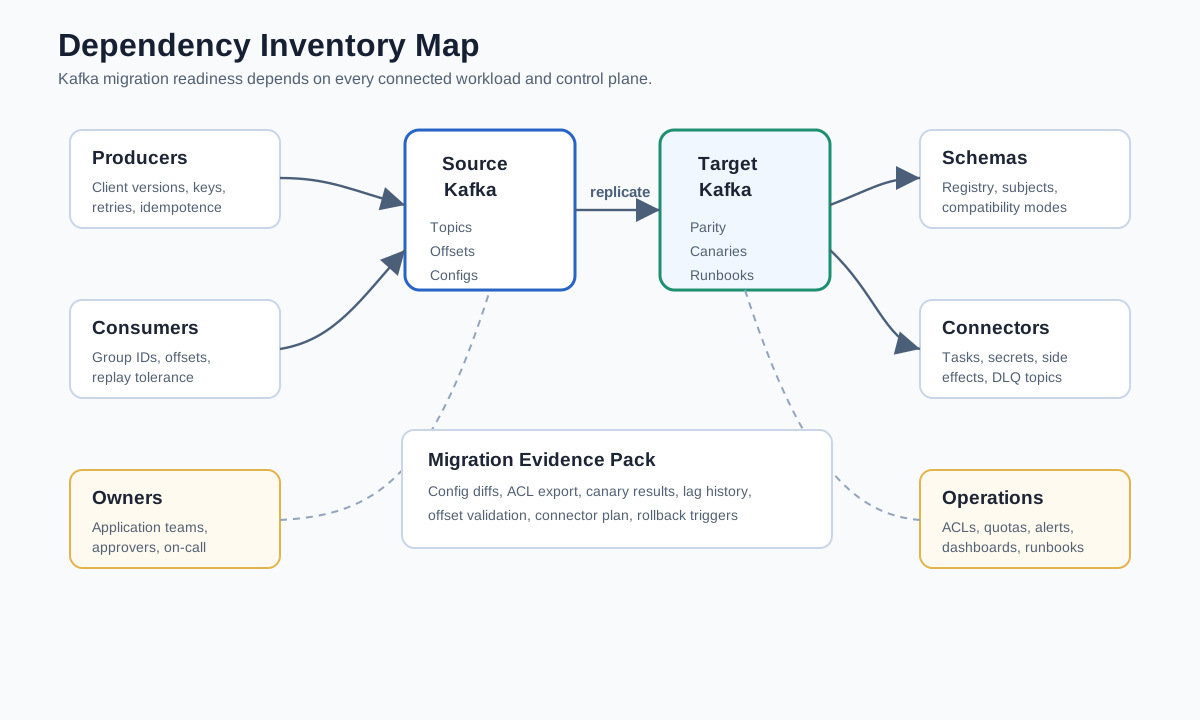
At minimum, inventory these areas:
- Topics and configurations: partition count, replication factor, retention, cleanup policy, compression, max message size, min ISR, topic naming conventions, and ownership.
- Producers: client library versions, bootstrap configuration, authentication, idempotence, transactions, keying strategy, retry policy, linger settings, and deployment owner.
- Consumers: group IDs, offset reset policy, processing semantics, replay tolerance, lag alerting, deployment owner, and stateful dependencies.
- Schemas and contracts: registry location, compatibility mode, subject naming strategy, schema evolution ownership, and rollout process.
- Connectors and stream processors: connector class, source or sink side effects, task count, internal topics, dead-letter topics, secrets, and restart behavior.
- Security and governance: ACLs, SASL or TLS settings, certificates, network allowlists, quotas, audit requirements, and data residency constraints.
- Operations: dashboards, alerts, SLOs, incident contacts, runbooks, backup procedures, and on-call approval path.
The inventory should separate what must be copied from what must be re-created. Topic configs and ACLs can often be exported and applied to the target. Dashboards may need new labels or cluster identifiers. Client bootstrap addresses may need a deployment change. Certificates may need new trust relationships. Each item should have a validation method rather than a note that says "done."
Use the inventory to classify topics by migration risk. A replay-tolerant analytics topic can move differently from a payment command topic with strict ordering and low duplicate tolerance. A compacted state topic needs different validation from an append-only audit log. One global cutover rule is convenient, but rarely production-safe.
3Target Cluster Design and Compatibility Checks
Before replication begins, treat the target cluster as production, not as a temporary destination. Name the Kafka version or compatibility level, authentication method, network path, quotas, topic defaults, monitoring labels, and owner. Also define whether topic names remain identical, receive prefixes, or move through a temporary namespace.
Compatibility testing should include protocol behavior and application assumptions. Producers may rely on idempotent writes, transactions, custom partitioners, compression codecs, or large records. Consumers may rely on cooperative rebalancing, static membership, exact group IDs, or offset reset behavior. Admin tooling may rely on APIs for topic creation, ACL management, or consumer group inspection.
A practical compatibility gate includes:
| Check | Why it matters | Evidence to collect |
|---|---|---|
| Client versions | Older libraries may behave differently against the target | Version list and canary results |
| Authentication and TLS | Clients fail before producing any useful migration signal | Successful connection tests from real runtime networks |
| Topic configuration parity | Defaults can change retention, compaction, and record limits | Source-to-target config diff |
| Producer semantics | Idempotence and transactions affect duplicates and ordering | Canary produce tests with failure injection where possible |
| Consumer group behavior | Rebalances and offset resets shape cutover risk | Canary consume tests and lag behavior |
| Connector behavior | External side effects can duplicate or stall | Dry run or isolated target connector test |
Teams considering a Kafka-compatible target such as AutoMQ should put this compatibility work early in the plan. AutoMQ is designed to keep Kafka APIs and ecosystem integrations familiar while changing the storage architecture behind the brokers. That can reduce application rewrite pressure, but it does not remove the need to test client behavior, security, offsets, and operational workflows in the target environment.
4Replication, Offsets, and Validation
Data replication is the phase where the migration becomes observable. The source cluster continues serving production traffic while selected topics are replicated to the target. The approach may use MirrorMaker 2, a managed linking feature, a connector-based approach, or application-level dual writes, depending on volume, offset needs, tooling, and rollback design.
The replication plan should specify topic scope, naming, direction, filtering, and lag expectations. It should also define what happens to compacted topics, internal topics, dead-letter topics, schema subjects, and connector state. If target names differ, consumers and dashboards need to know whether they are reading production topics or a migration namespace.
Offset validation deserves its own gate. If the migration uses synchronized checkpoints, verify them with real group IDs and production-like traffic. If offsets are not preserved, define the restart policy: earliest, latest, timestamp-based seek, application checkpoint, or controlled replay window. Each option changes risk.
Validation should combine data checks and behavior checks:
- Record flow: source produce rate, target consume availability, replication lag, error rate, and throttling.
- Data shape: schema compatibility, key distribution, headers, timestamps, tombstones, and compaction behavior.
- Ordering assumptions: per-key ordering for topics where the application depends on it.
- Consumer readiness: canary consumers read from the target without unexpected rebalances, authorization failures, or offset resets.
- Operational visibility: target dashboards, alerts, logs, and runbooks show the same kind of truth operators use on the source.
The important discipline is to define pass and fail thresholds before the cutover window. If the team argues about acceptable lag while the migration is already underway, the gate is not a gate. It is a meeting.
5Producer, Consumer, and Connector Cutover
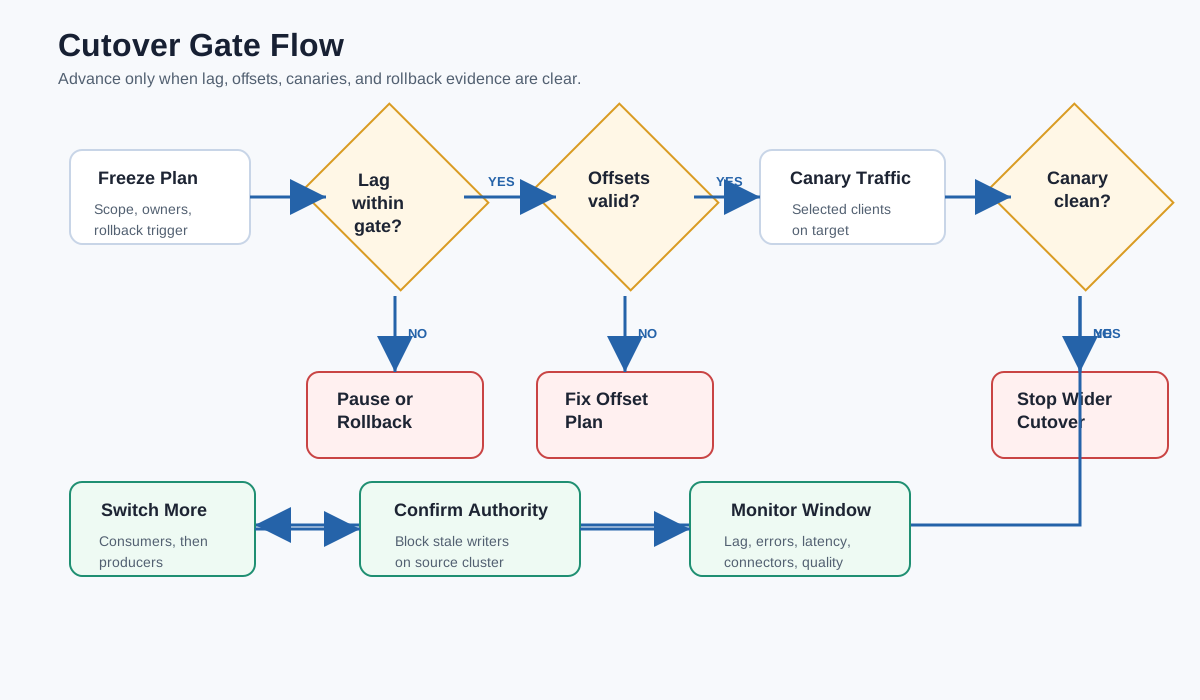
Cutover moves the migration from infrastructure work to production behavior. A safe sequence often starts with read-only validation, then canary consumers, then a small producer or tenant, then broader traffic.
For consumers, decide whether they switch by configuration rollout, DNS, service discovery, feature flag, or redeployment. Avoid split-brain behavior where instances in the same logical workload read from different clusters and create confusing lag or duplicate processing.
For producers, the key question is write authority. A migration that allows source and target to accept writes at the same time needs a deliberate dual-write design and duplicate handling. Many migrations are safer when one cluster is authoritative at a time: drain producers, confirm replication catch-up, switch bootstrap configuration, validate target writes, and block stale producers from writing to the source.
Connectors should be cut over with special care. Source connectors that ingest from external systems can create duplicate events if both old and new connectors run without partitioned ownership. Sink connectors can duplicate side effects if the same logical records are processed twice. Before cutover, document which connector is stopped, which one is started, how task state is handled, and how downstream idempotency is verified.
The final cutover gate should include a rollback decision point. A clean gate asks four questions:
- Is replication lag within the agreed threshold?
- Have selected consumer groups validated offsets or restart policy on the target?
- Did canary producers and consumers pass functional and operational checks?
- If the next step fails, can the team restore source-cluster authority without data ambiguity?
If any answer is uncertain, pause. A delayed migration window is cheaper than a cutover that creates two partial histories.
6Rollback and Post-Migration Monitoring
Rollback is not a paragraph at the end of a migration document. It is part of the design. Before production cutover, the team should know which cluster is authoritative at each step, how long the source remains writable or readable, what data may need to be replayed, and which applications must be redeployed to reverse the change.
The rollback plan should include clear triggers. Examples include target produce error rate above threshold, consumer lag that does not converge, authorization failures for critical clients, connector side effects that cannot be reconciled, or missing monitoring signals. Triggers should be measurable and visible to the migration commander, application owners, and on-call teams.
After cutover, keep the source cluster in a controlled state long enough for verification, but avoid leaving it as an accidental second production system. Stale producers should fail fast or be redirected. Source readers should be tracked as exceptions with owners and deadlines. Dashboards should show both clusters during stabilization.
Post-migration monitoring should focus on behavior, not only infrastructure. Watch consumer lag, produce errors, request latency, rejected requests, authentication failures, health signals, schema errors, connector restarts, and downstream data quality. Also schedule a short retrospective while the evidence is fresh. The best migration teams turn every exception into a future checklist item.
7Using AutoMQ as a Kafka-Compatible Migration Target
Many Kafka migration projects are not trying to leave the Kafka ecosystem. They are trying to leave the operational pain that came from broker-local storage, slow scaling, recovery tied to data movement, and infrastructure sized around peak traffic plus retained data. That distinction matters because it changes the target category. The goal may be a Kafka-compatible architecture change rather than an application rewrite.
AutoMQ fits this path as a Kafka-compatible streaming platform that uses object-storage-backed shared storage and stateless brokers. From a migration perspective, the important point is interface continuity: teams can evaluate a target that preserves Kafka protocol behavior and familiar ecosystem patterns while changing the long-term storage and scaling model. That can make the migration business case less about rewriting applications and more about validating compatibility, cutover, and operational improvements.
This does not make migration automatic. The same checklist still applies: inventory dependencies, validate clients, plan replication, test offsets, define cutover gates, and document rollback. AutoMQ changes the target architecture after the migration by decoupling durable data from broker-local disks, which can reduce the ongoing pressure around storage-heavy brokers, partition movement, and capacity planning. The migration itself still needs disciplined engineering.
For teams evaluating a move from self-managed Kafka, managed Kafka, or an older Kafka cluster, run the checklist against a small but representative slice of production. Choose topics with real producers, consumers, schemas, ACLs, and dashboards. Prove the path there before turning the full estate into a single cutover.
8References
- Apache Kafka documentation: Topic configuration
- Apache Kafka documentation: Consumers and consumer groups
- Apache Kafka documentation: Security
- Apache Kafka documentation: MirrorMaker 2
- Kafka Connect documentation
- AutoMQ documentation
9FAQ
9.1What is the most important item in a Kafka migration checklist?
The most important item is dependency inventory. Replication tooling can move records, but production safety depends on knowing the topics, producers, consumers, schemas, connectors, ACLs, dashboards, quotas, and owners that must move with those records.
9.2Can Kafka migration be done without downtime?
It can be done with little or no application-visible downtime only when the design supports it. The plan needs continuous replication, validated offset handling, compatible clients, controlled producer switching, canary testing, and a rollback path. Without those pieces, "zero downtime" is an aspiration rather than an engineering property.
9.3Should producers or consumers move first?
Many teams validate consumers first because reading from the target is lower risk than changing write authority. Producers should move only after replication lag, offsets, canary behavior, security, and rollback conditions are understood. The final order depends on whether the application can tolerate replay, dual reads, or dual writes.
9.4How should connectors be handled during Kafka migration?
Treat connectors as stateful applications, not as topic decoration. Inventory connector configuration, secrets, internal topics, dead-letter topics, task state, and downstream side effects. Avoid running old and new sink connectors against the same logical records unless the downstream system is idempotent and the duplicate-handling plan has been tested.
9.5When does AutoMQ make sense as a Kafka migration target?
AutoMQ is relevant when the team wants to keep Kafka-compatible clients and ecosystem behavior while moving to an object-storage-backed architecture with stateless brokers. It is most useful when migration is driven by scaling, storage cost, recovery, or operational pain rather than a desire to replace the Kafka API.


