
Table of Contents
Table of Contents
A team searching for kafka migration planning is usually past the whiteboard phase. The current cluster is carrying production traffic, the target platform has a business reason behind it, and the hard questions are no longer about whether Kafka clients can connect. They are about when producers move, how consumers resume, what happens to offsets, and how the team gets back out if the cutover exposes a bad assumption.
That pressure is healthy. Kafka migrations fail less often because teams forgot to copy topic data and more often because they underestimated the control surface around the data: client configuration, group coordination, transactional semantics, observability, topic ownership, security policy, and rollback timing. A migration plan that treats these as afterthoughts becomes a long outage rehearsal.
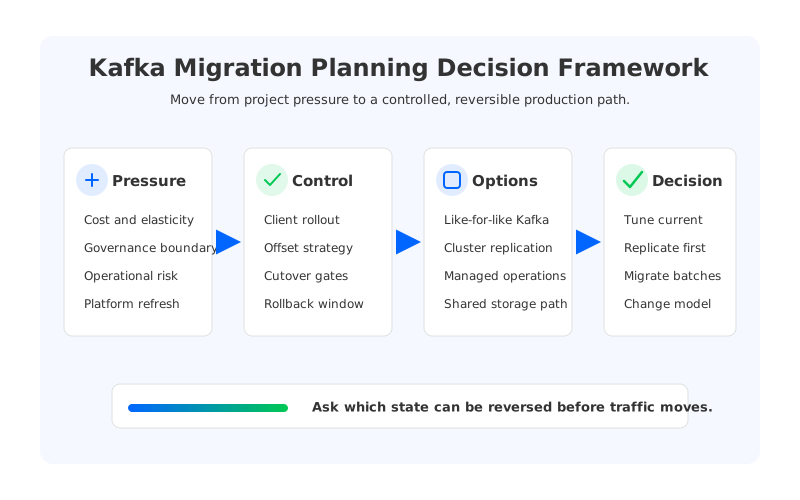
The safer frame is to design the migration as a sequence of reversible operating states. Each state should have a clear owner, measurable readiness signal, and rollback boundary. The architecture choice matters, but it should be evaluated through that operating model instead of through a vendor checklist.
1Why Kafka Migration Planning Is Really Cutover Planning
Moving Kafka is not the same as moving a database snapshot. The platform is a live log with producers advancing offsets, consumers committing progress, and applications encoding their own ordering, retry, and idempotency assumptions. A target cluster can be fully deployed and still be unusable if consumer groups cannot resume at the intended point or if clients cannot roll forward in controlled batches.
The word "migration" also hides several different workstreams. Infrastructure teams care about networking, storage, quotas, authentication, encryption, and monitoring. Application teams care about bootstrap endpoints, client libraries, retries, transactions, and schema compatibility. SREs care about lag, duplicate processing, cutover windows, alert routing, and rollback drills. Finance and architecture teams care about whether the target platform changes the operating cost curve rather than moving the same constraints into a different bill.
That is why the first deliverable should not be a tool choice. It should be a control plan:
- Workload scope: which topics, producers, consumers, connectors, schemas, ACLs, quotas, and dashboards are in the migration batch.
- Data movement: how records are replicated, how topic configuration is preserved, and how the team validates ordering and completeness.
- Offset strategy: whether target offsets remain identical, are translated, or are re-established by application-level checkpoints.
- Client rollout: how producers and consumers change endpoints, credentials, and runtime configuration without forcing a fleet-wide restart.
- Rollback boundary: which state can be reversed, which state creates duplicate processing risk, and which state makes rollback more expensive than forward recovery.
These items should be decided before any production traffic moves. A migration tool can automate parts of the plan, but it cannot decide what duplicate processing means for a payment service, how long a feature store can tolerate stale events, or who owns a connector that was deployed years ago and never documented.
2The Production Constraints Behind Offsets and Clients
Kafka's consumer model is powerful because consumption progress is externalized through committed offsets. That design lets a group resume after rebalance or failure, but it also makes migration sensitive to how the target cluster represents the same stream. If records land in the target cluster with different offsets, a consumer group cannot blindly reuse source offsets. The migration layer must translate progress, accept a controlled replay window, or rely on the application to resume from an independent checkpoint.
This is where many plans get too optimistic. "A little replay" is harmless for some analytics workloads and unacceptable for others. Idempotent writes, compaction keys, deduplication tables, and transactional boundaries can make replay safe, but those guarantees belong to the application architecture. Kafka can preserve ordered records inside a partition; it does not automatically make every downstream side effect idempotent.
Client migration has a similar trap. The technical change may look like a bootstrap server update, yet the operational change touches deployment pipelines, secret distribution, DNS behavior, security protocols, client library versions, and connection pools. Older clients may behave differently under metadata refresh, retry storms, or certificate rotation. A clean plan treats the client fleet as part of the platform, not as a last-mile configuration task.
The most useful readiness evidence is therefore concrete:
| Readiness Area | Evidence to Collect | Failure Mode It Reduces |
|---|---|---|
| Producer cutover | Batch list, deployment owner, retry policy, idempotency setting, rollback route | Split writes, ordering gaps, unbounded retries |
| Consumer resume | Group inventory, offset mapping rule, replay tolerance, lag baseline | Duplicate processing, skipped records, stalled groups |
| Client compatibility | Library versions, auth protocols, TLS settings, metadata refresh behavior | Runtime surprises after endpoint change |
| Connector and stream apps | Source/sink ownership, state store behavior, checkpoint strategy | Hidden dependencies and state drift |
| Observability | Source and target lag, replication delay, produce/fetch errors, business SLOs | Flying blind during the highest-risk window |
The table does not assume a specific platform. It forces the team to explain how production will behave under transition. If the answer is "we will know during the cutover," the plan is not ready.
3Architecture Patterns Teams Usually Compare
Most Kafka migrations fall into three broad patterns. The first is a like-for-like move: self-managed Kafka to another Kafka cluster, often with different hardware, a different cloud account, or a managed operating layer. The benefit is familiarity. The risk is that the migration may preserve the same broker-local storage model, partition movement cost, and capacity planning constraints that triggered the project.
The second pattern uses replication between clusters. Tools based on Kafka Connect and MirrorMaker-style pipelines can move records while source and target run in parallel. This is practical for phased adoption because teams can validate topic batches and application groups before broad cutover. The offset question becomes the center of the plan: if offsets differ between clusters, consumers need translated progress or controlled replay.
The third pattern changes the storage architecture underneath a Kafka-compatible API. Instead of treating brokers as long-lived owners of durable log segments, the platform separates compute from storage and uses shared storage as the durable layer. This does not eliminate migration planning, but it can change the operational end state: scaling, broker replacement, retention, and recovery are less tied to copying broker-local data.
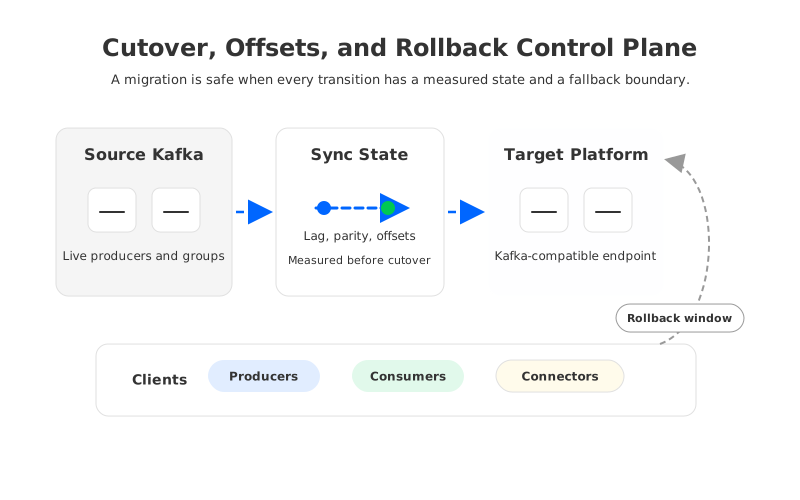
The right comparison is not "managed versus self-managed." It is whether the target operating model reduces the constraints that made migration worth considering. If the current pain is client sprawl, a managed service may help less than an endpoint strategy and compatibility test matrix. If the pain is retention cost, broker replacement, or partition movement, the storage model deserves more weight. If the pain is governance, deployment boundary and data ownership may matter as much as feature parity.
4A Practical Migration Control Sequence
A production plan should make each transition explicit. Teams can name the phases differently, but the sequence usually needs five gates.
-
Inventory the source estate. List topics, partitions, retention, compaction, ACLs, quotas, schemas, connectors, producers, consumers, and ownership. Remove abandoned topics before migration; every unnecessary stream becomes extra replication, validation, and rollback surface.
-
Build the target compatibility envelope. Verify Kafka protocol compatibility, client versions, auth methods, listener configuration, observability, and operational runbooks. The target should accept representative producers and consumers before historical data movement becomes the focus.
-
Start data synchronization and validation. Replicate topic data for the selected batch, compare lag, sample records, topic configuration, and business-level counters. This is also where offset strategy becomes real: identical offsets, offset translation, or application checkpointing need different consumer procedures.
-
Cut over producers before final consumer migration when ordering requires it. If both clusters accept writes for the same logical stream, the team needs a precise split-brain prevention rule. Many teams stop source producers, wait for synchronization to drain, then move producers and consumers in a narrow window. Others design per-topic or per-application batches where the blast radius is smaller.
-
Hold rollback open until the forward path is proven. Rollback is not a button; it is a state with prerequisites. The source cluster must retain enough data, source clients must still have valid credentials and configuration, and downstream systems must tolerate the chosen replay or compensation path.
These gates should be rehearsed on a low-risk workload before critical systems move. The rehearsal is not mainly about speed. It is about discovering missing owners, alert gaps, undocumented client behavior, and rollback assumptions while the business impact is small.
5Where AutoMQ Changes the Operating Model
After the neutral control plan is clear, the platform choice becomes easier to evaluate. AutoMQ is a Kafka-compatible cloud-native streaming system that preserves Kafka protocol and ecosystem semantics while using a Shared Storage architecture built around S3Stream, WAL, cache, and object storage. For migration planning, the interesting part is not that applications can keep using Kafka APIs; it is that the target platform changes what brokers are responsible for after the migration.
In traditional Kafka, brokers are both compute nodes and durable storage owners. That coupling affects day-two operations after the cutover: retention growth expands broker-local storage, scaling can require partition movement, and broker replacement is also a data placement event. AutoMQ moves durable stream data to shared object storage and lets brokers focus on request handling, leadership, caching, and coordination. WAL absorbs durable writes before data is organized into object storage, while stateless brokers make compute changes less dependent on retained local log segments.
For a migration team, this shifts the evaluation from a one-time cutover to the operating model that follows it:
- Compatibility can be tested at the Kafka API, client, connector, and observability levels before production cutover.
- AutoMQ's Kafka Linking capability is relevant when the project requires byte-to-byte synchronization with consistent offsets across source and target streams.
- Stateless brokers reduce the long-term penalty of scaling and replacement after the migration, which matters when the current platform is expensive because state moves with brokers.
- BYOC and software deployment models give teams a way to keep the data plane in their own cloud account or private environment, which can simplify governance reviews for regulated workloads.
- Shared storage and zone-aware traffic design can change the cost model for multi-AZ Kafka deployments where inter-broker replication and cross-zone paths are material.
None of these points remove the need for planning. They change what the plan should prove. Instead of asking whether the target can mimic every operational habit of the source cluster, the team can ask whether the target preserves Kafka semantics while removing the architectural coupling that made the source difficult to operate.
6Decision Table for Platform Teams
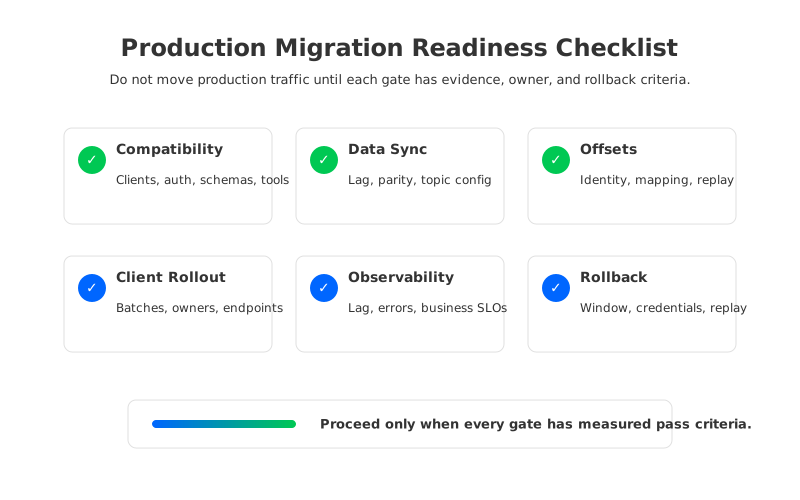
The decision table below helps separate tuning, migration mechanics, and architecture change. It is intentionally conservative because a production Kafka estate should not move unless the team can name the risk it is reducing.
| Current Pressure | Better First Step | When to Evaluate a Shared-Storage Kafka-Compatible Target |
|---|---|---|
| Unknown topic ownership | Inventory, retention cleanup, business owner mapping | After abandoned data is removed and the remaining workload still creates structural cost or operations pressure |
| Client sprawl | Version matrix, endpoint abstraction, staged deployment process | When compatibility and rollout control are required across many applications |
| Offset uncertainty | Replay tolerance review, idempotency checks, checkpoint design | When consistent-offset migration or smaller replay windows materially reduce risk |
| Broker-local capacity limits | Partition balance, disk review, producer and consumer tuning | When retained data and recovery headroom keep compute and storage locked together |
| Cross-AZ or replication cost | Rack awareness, placement review, traffic measurement | When the replication model itself drives recurring cloud cost |
| Governance constraints | Data boundary, IAM, audit, network review | When target deployment must keep customer data in a controlled account or private environment |
The table also clarifies a common misunderstanding: zero downtime is not a single feature. It is the result of compatibility, synchronization, offset control, client rollout, monitoring, and rollback design working together. A platform can make those tasks easier or harder, but the migration plan still owns the state transitions.
7References
- Apache Kafka Documentation
- Apache Kafka Consumer Configuration
- Apache Kafka Exactly-Once Semantics
- Apache Kafka KRaft Documentation
- AutoMQ Migration Overview
- AutoMQ Compatibility with Apache Kafka
- AutoMQ S3Stream Shared Streaming Storage
- AutoMQ Stateless Broker Architecture
- AutoMQ Inter-Zone Traffic Guidance
- AWS Data Transfer Pricing
8FAQ
8.1What is the hardest part of Kafka migration planning?
The hardest part is coordinating live state. Topic data, producer writes, consumer offsets, client credentials, connector state, and observability all change at different speeds. A strong plan defines reversible operating states so the team knows when to proceed, pause, or roll back.
8.2Can Kafka migration be done without downtime?
It can be designed for near-zero or zero application downtime, but the result depends on synchronization lag, offset strategy, client rollout, application idempotency, and rollback design. Treat downtime as an engineering outcome, not as a label attached to a tool.
8.3Why do offsets matter so much during Kafka migration?
Offsets are how consumer groups remember progress. If the target cluster preserves identical offsets, consumers can resume more directly. If offsets differ, the team needs offset translation, controlled replay, or an application-level checkpoint strategy.
8.4When should a team consider AutoMQ during migration planning?
AutoMQ is worth evaluating when the migration goal is not only to move clusters but to change the long-term operating model. It is especially relevant when Kafka compatibility, consistent-offset migration options, stateless brokers, shared object storage, elastic scaling, and customer-controlled deployment boundaries are part of the decision.


