
Table of Contents
Table of Contents
Someone searching for kafka migration readiness scorecard is usually past the point of casual research. The current Apache Kafka estate has become expensive to scale, awkward to govern, hard to recover, or misaligned with the cloud architecture the rest of the platform already uses. The migration sponsor wants a cleaner target state, but the platform team has to protect the parts that application owners feel immediately: offsets, ordering assumptions, client behavior, replay windows, security rules, and alerting. That is why a scorecard is more useful than a vendor comparison grid. It turns a vague migration desire into evidence that can survive production pressure.
Kafka migrations are rarely blocked by record copying alone. They are blocked by the gap between "the target accepts Kafka protocol requests" and "every workload can move without surprising the business." A serious readiness review has to inspect the source cluster, the target architecture, the migration path, and the operating model after cutover. Otherwise, the team can complete a technically successful move and still inherit the same broker sizing, retention, network, and recovery problems in a different environment.
The practical question is not whether migration is possible. It is whether the platform team can prove, before cutover, that the migration preserves application semantics while changing enough of the infrastructure model to justify the work.
1Why kafka migration readiness scorecard matters now
Kafka has become part of the application contract. Producers depend on batching, partition keys, retries, idempotent producer behavior, and transactional producer settings. Consumers depend on Consumer group coordination, committed Offset progress, ordering within a Partition, and replay semantics. Stream processors and connectors add another layer: checkpoints, Schema Registry dependencies, sink idempotency, dead-letter topics, and operational dashboards. When a platform team migrates the cluster, it is moving shared time for many systems, not a replaceable message queue.
That contract explains why migration readiness has to be scored across several dimensions at the same time:
- Compatibility: client versions, APIs, Topic configuration, ACLs, quotas, ecosystem tools, and operational integrations must behave as expected against the target.
- Progress continuity: Consumer group offsets, stream processor checkpoints, and replay windows need an explicit plan instead of a hopeful restart.
- Data movement: historical records, active writes, lag, ordering, and duplication behavior must be measured under representative traffic.
- Governance: network boundaries, encryption, IAM, audit trails, Terraform ownership, and procurement constraints can shape the migration path as much as code does.
- Steady-state operations: scaling, retention, recovery, monitoring, and cost allocation after cutover determine whether the migration actually solved the original problem.
These categories are intentionally broader than migration tooling. A replication pipeline can move records. It cannot, by itself, tell you whether the target platform removes the capacity planning issue that triggered the project.
2The production constraints behind the score
Traditional Kafka uses a Shared Nothing architecture. Each Broker manages local or attached storage, each Partition has replicas placed on Brokers, and durability is achieved through ISR (In-Sync Replicas) replication. This design is mature and well understood. It also means retained data, Broker capacity, network replication, and recovery behavior are tightly coupled. During a migration, that coupling shows up as more than a source-cluster concern. It also defines what the target cluster will feel like after the first successful cutover.
Consider the migration team that wants longer retention. In a broker-local model, longer retention usually increases the storage footprint that must be placed, monitored, balanced, and recovered across Brokers. Consider the team that wants elastic capacity. Scaling out a stateful Kafka cluster still requires thinking about Partition placement, leadership, disk headroom, and data movement. Consider the team trying to reduce cross-Availability Zone (AZ) traffic. Multi-AZ durability and client locality can be improved with careful design, but replica movement and cross-zone paths remain part of the operating discussion.
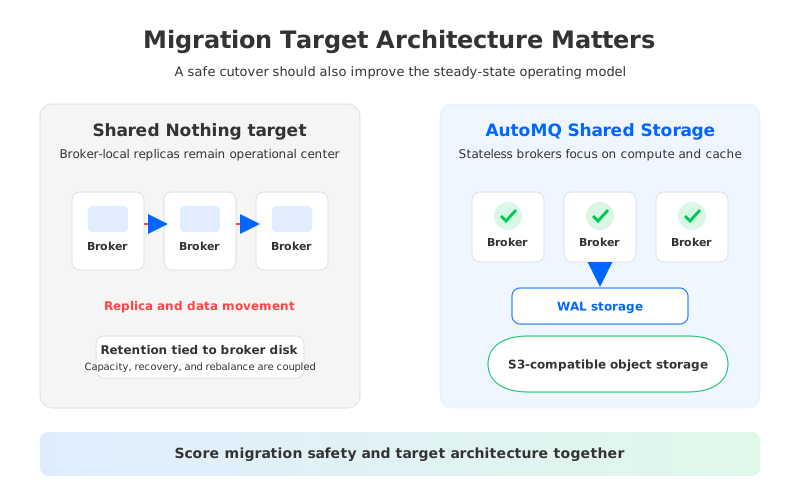
The scorecard should therefore separate migration safety from target architecture quality. A migration can be safe but not worth doing if the target repeats the same bottlenecks. A target architecture can be attractive but not ready if the team cannot prove compatibility, offset continuity, observability, and rollback. The strongest plan earns both scores: it lowers cutover risk and moves the platform toward a better operating model.
That distinction also keeps the conversation honest. A team escaping an aging self-managed cluster may accept a conservative first migration if its main problem is lifecycle risk. A team moving because storage cost, recovery time, and scaling delays keep coming back should evaluate whether the target changes the storage and compute relationship. The reason for migration should drive the scorecard weights.
3A vendor-neutral readiness scorecard
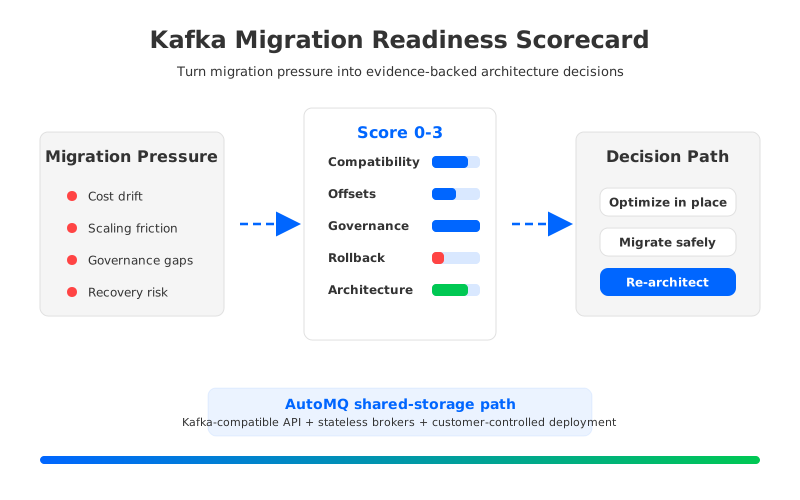
Use the scorecard as a working review document, not a decorative checklist. Score each category from 0 to 3: 0 means unknown, 1 means identified but untested, 2 means validated in staging with gaps, and 3 means validated with production-like traffic, rollback evidence, and an owner. The absolute number matters less than the shape. One zero in rollback or progress continuity can be more dangerous than several twos in lower-risk categories.
| Category | What to inspect | Evidence that deserves a high score |
|---|---|---|
| Kafka compatibility | Client versions, Producer settings, Consumer group behavior, transactions, Connect, Streams, schemas, ACLs, quotas, and monitoring integrations | Representative applications pass integration tests against the target without code changes or documented exceptions |
| Data and Offset continuity | Historical records, active writes, committed offsets, checkpoint stores, replay tolerance, and duplicate handling | Cutover rehearsal shows where each workload resumes and how much replay or duplication is acceptable |
| Network and governance | VPC or VNet routing, private connectivity, encryption, IAM, audit logs, Terraform, ownership, and deployment boundary | Security and platform teams can explain which account owns the data plane and how access is controlled |
| Cost and capacity model | Storage, compute, cross-AZ traffic, duplicate run period, observability, and steady-state headroom | Migration-period cost and steady-state cost are modeled separately with assumptions that finance can review |
| Operations and rollback | Lag alerts, SLOs, runbooks, support ownership, rollback authority, and incident paths | The team has rehearsed failback while the source of truth is still clear |
| Target architecture | Broker state, storage model, scaling path, retention strategy, balancing, and recovery behavior | The target removes at least one structural constraint that made the source painful |
The scorecard often exposes uncomfortable truths early. For example, a team may discover that Kafka clients are compatible, but the deployment boundary is not acceptable because the data plane would move outside an approved account. Another team may find that record replication is stable, but Consumer group checkpoints are not aligned with how Flink jobs recover. Those findings are good news before production. They are incident material after cutover.
4How to read the score
The scorecard should produce a decision, not a feeling. If compatibility and progress continuity are weak, stay in discovery and build a workload inventory. If data movement is working but rollback is vague, delay cutover until authority over writes and offsets is explicit. If migration safety is strong but the target architecture score is low, treat the project as an endpoint move rather than a platform modernization program. That may still be a valid choice, but it should be funded and messaged as one.
There are three common decision paths:
- Optimize in place: choose this when the current platform can meet the next planning horizon with better governance, monitoring, capacity cleanup, or client configuration. Migration effort should not be spent because the word migration sounds more decisive.
- Migrate conservatively: choose this when the main goal is lifecycle, account, region, or service ownership change. The target may use a familiar architecture, and the readiness bar should focus on application semantics and rollback.
- Re-architect during migration: choose this when the source pain is structural: retained data is hard to scale, Broker recovery is operationally heavy, cross-AZ traffic is material, or capacity planning keeps blocking product teams.
This is where many scorecards become too polite. A platform migration is disruptive enough that it should pay back in operational clarity. If the target does not improve the capacity, recovery, governance, or cost model, the team should be able to say so before the project becomes irreversible.
5Where AutoMQ changes the operating model
After the neutral evaluation is complete, AutoMQ belongs in the shortlist for teams that want Kafka compatibility but do not want the next platform to revolve around broker-local storage. AutoMQ is a Kafka-compatible cloud-native streaming platform that keeps Kafka protocol semantics while replacing Kafka local Log storage with S3Stream, a shared streaming storage layer built on WAL (Write-Ahead Log) storage and S3-compatible object storage. Durable data is no longer owned by an individual Broker, and AutoMQ Brokers operate as stateless compute and cache nodes.
That architectural shift changes the migration target. In a Shared Nothing target, longer retention and scaling still point back to Broker storage placement and replica movement. In AutoMQ's Shared Storage architecture, durable data sits in shared storage, while Brokers focus on request handling, caching, leadership, and scheduling. Scaling and recovery become more about compute capacity and metadata ownership than moving retained log segments between machines.
The migration feature to evaluate in that context is Kafka Linking. AutoMQ commercial editions provide Kafka Linking for zero-downtime Kafka migration, with byte-level message synchronization and Offset consistency. AutoMQ Open Source recommends MirrorMaker2 for cluster migration, which can be appropriate when the team accepts the usual asynchronous replication trade-offs and validates duplicate or replay behavior. The right comparison is not "tool A versus tool B" in isolation. It is whether the migration path and target architecture match the workload's tolerance for Offset movement, replay, rollback, and future operations.
Deployment boundary also belongs in the score. AutoMQ BYOC runs both the control plane and data plane in the customer's own cloud account VPC, while AutoMQ Software is designed for customer-operated private environments. For regulated or platform-owned Kafka estates, that boundary can make the security review more concrete: customer data stays inside the environment the organization governs, while the platform still evaluates a Kafka-compatible target with stateless brokers and shared storage.
AutoMQ should still be tested like any other production platform. Validate client versions, Topic configuration, Producer behavior, Consumer group progress, Kafka Connect and Kafka Streams dependencies, monitoring, IAM, network routing, and rollback timing. The architecture reduces certain classes of operational coupling; it does not remove the need for migration discipline.
6Decision table for platform teams
The final migration decision should connect the search intent to a concrete next step. A team that typed how to migrate kafka without downtime may need migration choreography first. A team searching for a scorecard is probably ready to judge whether the move is justified at all.
| If the scorecard shows... | Likely decision | What to do next |
|---|---|---|
| Strong compatibility, weak rollback | Keep testing | Rehearse failback before allowing production writes to move |
| Strong data movement, weak Offset evidence | Narrow the first batch | Start with workloads that can replay safely and document the duplicate window |
| Strong migration safety, weak target architecture | Treat it as an endpoint move | Avoid overselling the project as modernization |
| Strong governance concerns | Revisit deployment boundary | Compare SaaS, BYOC, and self-managed models against data-control requirements |
| Strong source pain from storage, scaling, or recovery | Evaluate shared-storage Kafka-compatible targets | Test whether stateless brokers and shared storage change the steady-state score |
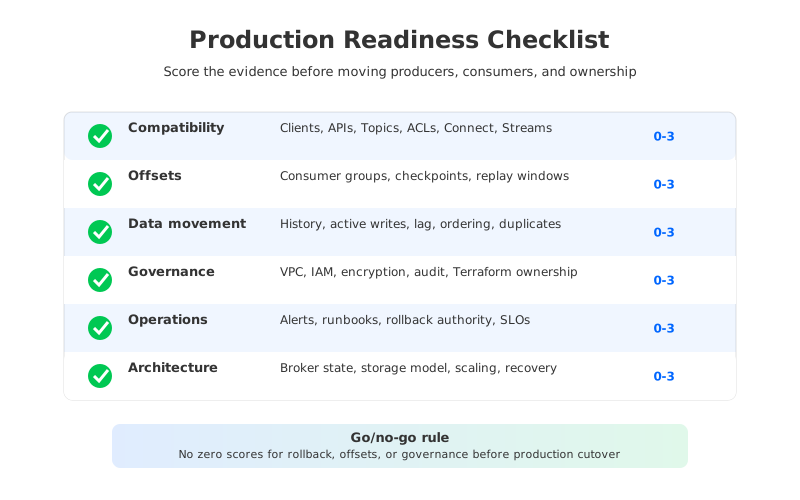
A good migration cutover should feel boring because the scorecard made the risky parts visible earlier. The team has already mapped workloads, tested representative traffic, measured lag, rehearsed rollback, aligned security review, and decided what the target architecture must improve. If AutoMQ fits that target state, test it as part of the same evidence loop: Kafka compatibility first, migration continuity second, and operating-model improvement third.
For teams evaluating Kafka-compatible shared storage as the next platform boundary, the practical next step is a proof of concept that uses real Topic shapes, client versions, retention settings, and Consumer group behavior rather than a synthetic happy path. The scorecard gives that proof of concept a spine.
7References
- Apache Kafka Documentation: Core concepts and terms
- Apache Kafka Documentation: Consumer configuration and Offset behavior
- Apache Kafka Documentation: Replication design
- AutoMQ Documentation: Compatibility with Apache Kafka
- AutoMQ Documentation: Shared Storage architecture overview
- AutoMQ Documentation: Migrate to AutoMQ overview
8FAQ
8.1What is a Kafka migration readiness scorecard?
A Kafka migration readiness scorecard is a structured review of compatibility, data movement, Offset continuity, governance, cost, operations, rollback, and target architecture. It helps platform teams decide whether to optimize the current Kafka estate, migrate conservatively, or use the migration to re-architect the streaming platform.
8.2Can Kafka migration happen without downtime?
Kafka migration can be designed for zero downtime when producers, consumers, offsets, lag, network routing, and rollback are rehearsed before production cutover. The migration tool matters, but the operational choreography around that tool usually determines whether application teams notice the move.
8.3Which workloads should move first in a Kafka migration?
Start with workloads that have clear owners, manageable throughput, known Consumer group behavior, safe replay semantics, and limited downstream blast radius. Avoid making the first batch a stateful stream processing workload with unclear checkpoint recovery.
8.4How should teams score Consumer group offsets?
Score offsets by evidence. A high score means the team has demonstrated where each Consumer group resumes on the target, what duplicate or replay window exists, and who approves the cutover. A low score means the plan depends on assumptions about offset translation, reset behavior, or application checkpointing.
8.5When should AutoMQ be evaluated?
Evaluate AutoMQ when the migration is also an architecture decision. It is most relevant when the team needs Kafka compatibility, wants to reduce broker-local storage constraints, cares about elastic scaling or long retention, and prefers BYOC or self-managed deployment boundaries that keep the data plane under customer control.


