
Table of Contents
Table of Contents
Teams usually search for kafka migration readiness scorecard after the migration conversation has become political. The platform team sees broker disk planning, manual failover runbooks, cross-Availability Zone (AZ) traffic, or an awkward cloud boundary. The executive sponsor hears risk, timeline, duplicated run cost, governance exposure, and the possibility that application teams will blame the platform if consumer progress moves incorrectly.
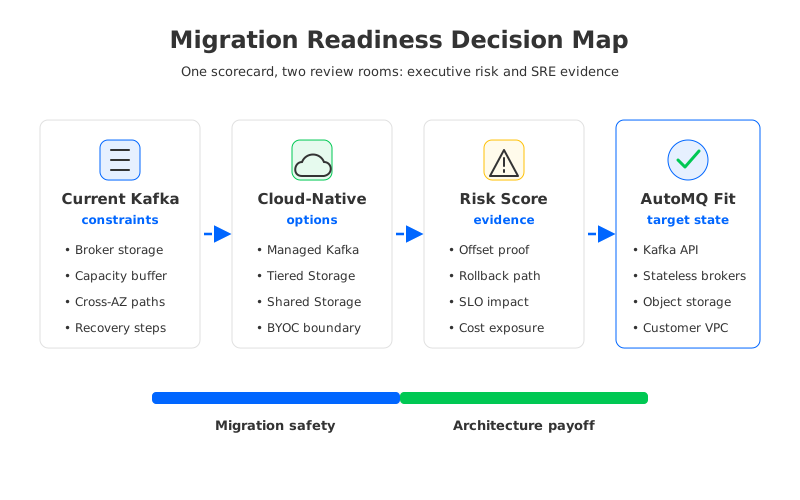
That is why a useful scorecard is not a prettier migration checklist. A checklist tells the SRE lead whether tasks are done. A scorecard tells executives and SREs whether the same evidence supports the same decision. If the business case says migration reduces operational drag, the SRE evidence must show how the target changes recovery, scaling, and ownership.
The practical goal is simple: build one review artifact that can survive both rooms. Executives should be able to read the scorecard and understand why the migration is worth doing. SREs should be able to read the same scorecard and see which workloads, offsets, runbooks, and failure modes still need proof.
1Why Teams Search for kafka migration readiness scorecard
Kafka migrations rarely fail because nobody can copy records. They fail because the migration touches application contracts that have accumulated over years. Producers depend on partition keys, retry behavior, idempotent producer settings, transactions, batching, and client library assumptions. Consumers depend on Consumer group coordination, committed Offset progress, ordering inside a Partition, replay windows, and downstream idempotency. Kafka Connect, stream processors, schema rules, ACLs, and alert routing add more dependencies.
Executives do not need every broker configuration, but they do need to know whether those dependencies have owners. SREs need to know whether the project can pause, roll back, or narrow scope when evidence is weak. A migration readiness scorecard turns technical proof into a decision model without flattening engineering reality.
The first mistake is scoring only the migration tool. Replication, linking, or dual-running can move data, but the tool does not decide whether the target improves the operating model. A migration can be technically successful and still leave the same storage headroom, broker recovery, and capacity-planning cycle. The scorecard should answer two questions at once: can we move safely, and does the target state justify the move?
2The Production Constraint Behind the Problem
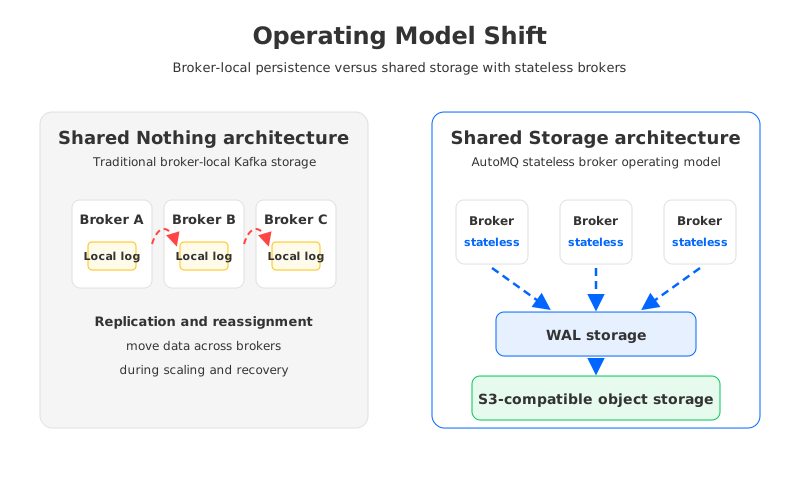
Traditional Kafka uses a Shared Nothing architecture. Each Broker owns local or attached storage, Partitions are placed on Brokers, and durability is achieved through replica placement and ISR (In-Sync Replicas) replication. The model is proven and deeply integrated into the Kafka ecosystem. It also couples storage, compute, placement, and recovery in ways that become visible during migration planning.
The coupling shows up as cost and timeline uncertainty. Longer retention means more storage planning. More throughput means more broker and disk headroom. Multi-AZ durability can add network cost and traffic-engineering work. A failed Broker is not only a compute event; it can become a storage placement and leadership event. These are consequences of a stateful broker-local design running where compute, object storage, block storage, and network pricing are separate economic units.
For SREs, the same constraint appears as operational surface area. Before cutover, they must prove that offsets are handled, lag is bounded, alerts are meaningful, and rollback does not create a split-brain ownership problem over writes. After cutover, they inherit the target platform's steady-state behavior. If the target is another broker-local Kafka service, the migration may reduce lifecycle burden but still require careful partition movement, retained-data placement, and broker sizing. If the target changes the storage model, the review has to test a different set of assumptions.
3Architecture Options and Trade-Offs
A good scorecard should compare architecture choices without pretending they are interchangeable. Self-managed Kafka gives teams direct control over versions, deployment topology, storage, and network design. That control helps teams with strong operational depth, but it also means they own broker failure recovery, capacity planning, upgrades, and cost optimization.
A managed Kafka service can reduce lifecycle work, but it does not remove every stateful-broker concern. The team still needs to understand storage limits, scaling mechanics, retention cost, private networking, client compatibility, and the provider's operational boundary. Tiered Storage can move older log segments to object storage, but it does not make brokers stateless; hot data and broker lifecycle still matter. A Kafka-compatible platform with Shared Storage architecture changes a different layer: it separates durable data from broker compute.
That distinction is what executives and SREs should score. The review should not ask, "Which option has the most features?" It should ask, "Which option changes the constraint that made this migration necessary?"
| Option | What it can improve | What still needs proof |
|---|---|---|
| Optimize current Kafka | Governance, monitoring, topic cleanup, client tuning, and capacity discipline | Whether the existing architecture can support the next planning horizon |
| Move to managed Kafka | Lifecycle operations, patching, service ownership, and standard deployment patterns | Cost model, scaling behavior, recovery boundary, and migration semantics |
| Use Tiered Storage | Historical retention pressure and cold data placement | Hot data, broker-local operations, recovery, and target-state complexity |
| Adopt Shared Storage architecture | Broker statelessness, elastic compute, retained-data placement, and recovery model | Compatibility, WAL choice, object storage behavior, migration path, and rollback |
The point is not to force every migration toward re-architecture. Some migrations are account moves, region moves, or lifecycle-risk reductions. In those cases, a conservative target can be the right answer. When the source pain is structural, such as retained data that is hard to place or broker recovery that dominates incidents, a conservative endpoint move may not produce enough return for the disruption.
4Evaluation Checklist for Platform Teams
The scorecard works best when each category has both an executive question and an SRE question. The executive question frames risk and value. The SRE question defines the evidence. A score from 0 to 3 is usually enough: 0 means unknown, 1 means documented but untested, 2 means tested with gaps, and 3 means proven with representative workload behavior, rollback evidence, and an owner.
Start with compatibility because teams often confuse "Kafka-compatible" with "production-compatible." Apache Kafka exposes a large contract surface: Producer and Consumer APIs, Consumer groups, offsets, transactions, Topic configuration, ACLs, Kafka Connect, stream processing integrations, and monitoring conventions. A high score requires representative applications, not a synthetic producer and consumer.
Then score progress continuity. This is where SRE teams often find the real migration boundary. It is not enough to know that records exist on the target. The team must know where each Consumer group resumes, what duplicate or replay window is acceptable, how stream processors restore state, and which team approves any offset reset. The executive version of that same question is sharper: can the platform team prove that customer-facing behavior will not depend on guesswork?
Cost and governance need the same discipline. Migration-period cost differs from steady-state cost because both platforms may run in parallel while data is copied and clients move. Governance is not only encryption or IAM. It includes cloud account ownership, VPC (Virtual Private Cloud) boundaries, audit logs, Terraform ownership, and security approval.
The final categories are operations and architecture payoff. Operations covers alerts, runbooks, lag thresholds, rollback authority, incident routing, and support ownership. Architecture payoff asks whether the target platform removes a root constraint rather than hiding it behind a different interface. If the migration began because storage growth, broker recovery, and scaling delays keep recurring, the scorecard should explicitly reward targets that change those mechanics.
5How AutoMQ Changes the Operating Model
After the neutral evaluation is complete, AutoMQ becomes relevant for teams that want Kafka compatibility without making the next platform revolve around broker-local storage. AutoMQ is a Kafka-compatible cloud-native streaming platform that keeps Kafka protocol semantics while replacing Kafka local log storage with S3Stream, a shared streaming storage layer built on WAL (Write-Ahead Log) storage and S3-compatible object storage. Durable data is not owned by one Broker's local disk, and AutoMQ Brokers operate as stateless compute and cache nodes.
That changes what the migration is trying to prove. The compatibility score still matters: client versions, Topic configuration, Producer behavior, Consumer group progress, Kafka Connect, stream processors, ACLs, and observability all need validation. But the target architecture score can now ask a different question. If durable data lives in shared object storage and Brokers are stateless, scaling and recovery become less about moving retained log data between machines and more about compute capacity, metadata ownership, cache warmup, and WAL recovery.
AutoMQ commercial editions also give migration teams a specific capability to evaluate: Kafka Linking for zero-downtime migration, byte-level topic synchronization, and Offset consistency. AutoMQ Open Source uses MirrorMaker2 for migration scenarios where teams can accept and validate the usual asynchronous replication trade-offs. The scorecard should treat those paths honestly. The tool is only part of the answer; the review still needs workload inventory, cutover authority, replay policy, rollback timing, and evidence from production-like traffic.
Deployment boundary is another reason the executive and SRE views should share one scorecard. AutoMQ BYOC runs the control plane and data plane in the customer's own cloud account VPC. AutoMQ Software is designed for customer-operated private environments. For regulated teams, that boundary can be as important as storage architecture because it shows where data, metrics, access control, and operational authority live.
AutoMQ should not be treated as a shortcut around migration discipline. It should be treated as a different target operating model. The scorecard should verify Kafka compatibility first, migration continuity second, and the operating-model change third.
6A Scorecard That Both Rooms Can Use
The final scorecard should be short enough for an executive review and specific enough for an SRE change review. A practical format has seven rows and three columns: decision question, evidence required, and owner. Ownership matters because migration risk is harder to manage when "the platform team" owns everything in the abstract.
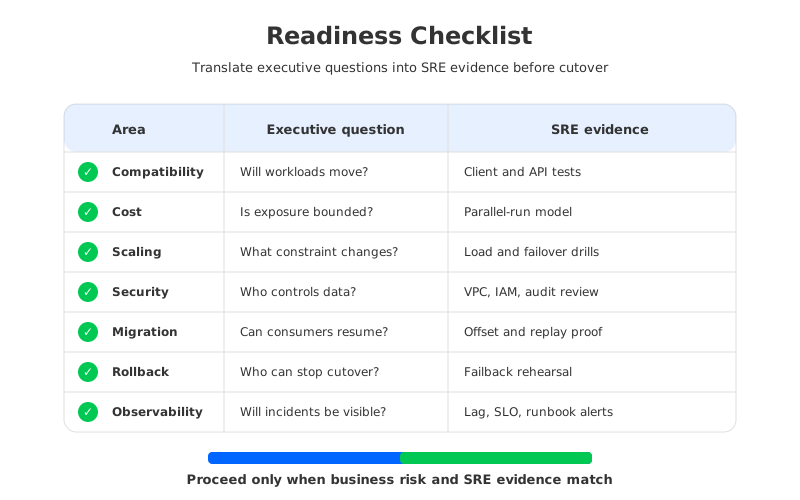
Use the following as the working version:
| Review area | Executive decision question | SRE evidence required |
|---|---|---|
| Business driver | What problem justifies disruption? | Source pain linked to incidents, cost reviews, scaling limits, or governance findings |
| Compatibility | Can workloads move without application rewrites? | Representative client, Topic, ACL, transaction, Connect, and stream processing tests |
| Progress continuity | Can consumers resume predictably? | Offset plan, checkpoint handling, replay window, duplicate handling, and cutover rehearsal |
| Cost exposure | Are migration and steady-state costs separated? | Parallel-run budget, storage model, compute plan, network paths, and observability cost |
| Governance | Does the target fit data-control policy? | Account boundary, VPC design, IAM, encryption, audit logs, Terraform ownership, and access review |
| Operations | Can the team operate and roll back under pressure? | Lag alerts, SLOs, runbooks, rollback authority, incident routing, and support path |
| Architecture payoff | Does the target remove a root constraint? | Evidence for scaling, recovery, retention, balancing, and broker-state changes |
The scorecard should produce one of three outcomes. If compatibility and progress continuity are weak, keep the project in discovery. If migration safety is strong but architecture payoff is weak, describe the project as an endpoint move and avoid overselling architecture renewal. If both safety and target-state payoff are strong, move to a scoped production migration with a small first batch, explicit rollback rules, and a post-cutover review.
A Kafka migration should be boring at cutover because the hard arguments happened earlier. The scorecard makes those arguments explicit: why the business wants the move, what SREs can prove, which architecture constraints are changing, and who owns the remaining risk. If Shared Storage architecture is part of your target-state evaluation, run a proof of concept with real Topic shapes, client versions, retention settings, Consumer group behavior, and failure drills. You can start that evaluation through the AutoMQ Cloud Console.
7FAQ
7.1What is a Kafka migration readiness scorecard?
A Kafka migration readiness scorecard is a decision artifact that scores compatibility, Consumer group progress, data movement, cost, governance, operations, rollback, and target architecture. It helps executives and SREs judge the same migration with the same evidence.
7.2How is a scorecard different from a Kafka migration checklist?
A checklist tracks whether tasks are complete. A scorecard explains whether the evidence is strong enough to proceed, pause, narrow scope, or change the target architecture. The scorecard is better for go/no-go reviews because it exposes weak categories before cutover.
7.3What should executives care about in a Kafka migration?
Executives should care about business justification, customer-facing risk, duplicated migration-period cost, governance boundaries, rollback authority, and whether the target platform fixes the constraint that made migration necessary.
7.4What should SREs care about in a Kafka migration?
SREs should care about client compatibility, Consumer group offsets, lag, replay windows, duplicate handling, alerting, runbooks, rollback mechanics, ownership of writes, and target-platform recovery behavior.
7.5When should AutoMQ be evaluated?
Evaluate AutoMQ when the migration is also an architecture decision. It is most relevant when teams need Kafka compatibility, want to reduce broker-local storage constraints, and prefer BYOC or private deployment boundaries that keep the data plane under customer control.
8References
- Apache Kafka Documentation: Introduction and core concepts
- Apache Kafka Documentation: Consumer configuration
- Apache Kafka Documentation: Transactions
- Apache Kafka Documentation: KRaft
- AutoMQ Documentation: Compatibility with Apache Kafka
- AutoMQ Documentation: Shared Storage architecture overview
- AutoMQ Documentation: S3Stream shared streaming storage
- AutoMQ Documentation: Migration overview
- AutoMQ Documentation: Executing migration
- AutoMQ Documentation: Zero cross-AZ traffic overview


