
Table of Contents
Table of Contents
Kafka multi-AZ architecture is usually introduced as an availability decision: spread brokers across availability zones, configure replication factor, and keep serving traffic when a zone fails. That framing is correct, but incomplete. In cloud environments, the same design can also create a persistent cross-AZ data-transfer bill because Kafka replication, client reads, leader movement, and recovery traffic may all cross zone boundaries.
The result is a design tension that platform teams feel quickly. A single-zone Kafka cluster is too fragile for most production workloads. A naive multi-AZ cluster can survive more failures, but it may move the same byte several times across zone boundaries before a consumer has processed it. Architects, SREs, and FinOps teams therefore need to treat high availability and network cost as one architecture problem.
1Why Kafka Multi-AZ Design Is a Cost and Resilience Decision
An availability zone is a failure domain inside a cloud region. Running Kafka brokers across zones helps the cluster tolerate the loss of a broker, rack, power domain, or zone-level network path. For critical event streams, that separation is often non-negotiable because producers and consumers depend on Kafka as a live coordination layer, not only as a file archive.
Traditional Kafka achieves durability through partition replicas. One replica is elected leader. Followers fetch from the leader. Producers write to the leader, and with acks=all, Kafka only acknowledges after the configured in-sync replica requirement is satisfied. The common production pattern is replication factor three across three zones, combined with min.insync.replicas=2, so the cluster can tolerate one replica becoming unavailable while still preserving stronger write guarantees.
That pattern is effective, but it has a cost shape. When a producer sends a record to a leader in one zone, followers in other zones must fetch that record. If consumers are in different zones from the leaders they read, fetch traffic may cross zones again. If a broker fails and partitions are reassigned, recovery traffic can move large historical segments through the cluster.
The expensive mistakes often come from treating the topology as invisible. Teams choose replication factor, broker count, and partition count, then later discover that clients were deployed in a different zone from leaders, hot partitions concentrated in one zone, or recovery events saturated inter-zone links.
2Replication Factor, ISR, and Leader Placement
Replication factor defines how many copies of each partition exist. In a three-zone cluster, a replication factor of three usually aims to place one replica per zone. That gives the design a clean mental model: any single zone can disappear, and every partition should still have at least one remaining replica. In practice, this requires rack awareness or equivalent placement controls.
The in-sync replica set is equally important. A follower is only useful for strong durability if it is sufficiently caught up to the leader. min.insync.replicas defines how many in-sync replicas must be available for a write to succeed when producers use acks=all. With replication factor three and min.insync.replicas=2, Kafka can keep accepting durable writes after one replica is unavailable.
Leader placement determines where produce traffic lands. If most partition leaders sit in one zone, that zone becomes the write hotspot and the source of most follower replication traffic. If producers are spread across zones without client locality, each producer may frequently write across zones to reach leaders elsewhere. If consumers read from leaders in remote zones, read traffic can add another cross-zone path.
Review these controls together:
- Replication factor: usually at least three for single-zone-failure tolerance in a three-zone design.
min.insync.replicas: commonly two with replication factor three when the workload prefers failed writes over acknowledged under-replication.- Rack awareness: required to keep replicas distributed across zones rather than accidentally co-located.
- Leader balance: needed so no zone becomes the dominant leader or traffic source.
- Client bootstrap strategy: should include brokers across zones so clients can recover after a zone loss.
These settings do not eliminate cost; they make it predictable. Once operators know where leaders, followers, producers, and consumers live, they can estimate which traffic paths cross zone boundaries and decide whether the availability target justifies the transfer volume.
3Where Cross-AZ Traffic Comes From
The most visible cross-AZ traffic in Kafka is replication. A record produced to a leader in Zone A must be fetched by follower replicas in Zone B and Zone C when the partition is replicated across all three zones. For write-heavy workloads, this path can dominate inter-zone movement.
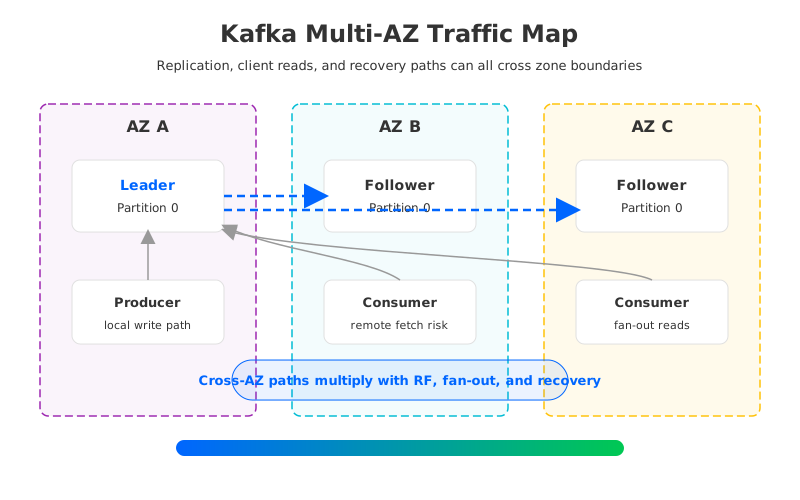
Consumer traffic depends on placement. If consumers run in the same zone as the partition leaders they read, fetch traffic can stay local. If consumers run in a separate compute layer without zone-aware routing, they may read across zones even when local brokers exist. High fan-out workloads amplify this effect because multiple consumer groups fetch the same records independently.
Recovery and rebalancing traffic are less predictable. Broker replacement, disk failure, partition reassignment, leadership movement, and catch-up after an outage can all move data across zones. During recovery, background replication may compete with producers and consumers for network, disk, and CPU, so a cost review should include both steady-state and incident-mode traffic.
There are four common paths to map:
- Produce path: producer to partition leader.
- Replication path: leader to follower replicas.
- Consume path: partition leader, or eligible replica depending on configuration and version, to consumer.
- Recovery path: reassignment, catch-up, broker replacement, and post-failure traffic redistribution.
Cloud billing rules vary by provider and service boundary, so model these paths using the exact deployment target. On AWS, public EC2 pricing documentation describes regional data transfer behavior and notes that data transferred between availability zones can be charged in both directions for certain paths. Other providers have their own terminology and metering rules.
4A Practical Multi-AZ Cost Model
You do not need a perfect simulator to catch the largest cost risks. Start with a simple traffic map and refine it as monitoring data arrives. A useful first pass separates ingress, replication, reads, and recovery overhead.
For a topic with sustained write throughput W, replication factor RF, and one leader copy, follower replication volume is roughly W x (RF - 1) before compression, batching, protocol overhead, and cloud-specific metering. In a three-zone design with one leader and two remote followers, much of that follower traffic may cross zones. If the topic has multiple independent consumer groups, read traffic scales with fan-out rather than write throughput alone.
That model is deliberately approximate, but it forces the right questions:
| Design choice | Availability benefit | Cost pressure | What to verify |
|---|---|---|---|
| RF=3 across three zones | Tolerates one-zone replica loss when ISR is healthy | Two follower copies per record | Whether both follower paths cross paid zone boundaries |
min.insync.replicas=2 | Prevents acknowledged writes with only one in-sync copy | More failed writes during degraded states | Producer retry and backpressure behavior |
| Zone-balanced leaders | Avoids one-zone write hotspot | May require active leader management | Leader skew after broker restart or reassignment |
| Zone-local consumers | Reduces remote fetch traffic | Requires deployment and routing discipline | Consumer placement by group and workload |
| Fast broker replacement | Improves recovery capacity | Can trigger heavy catch-up traffic | Network and disk impact during rebuild |
The wrong conclusion is to avoid multi-AZ replication because it costs money. The right conclusion is to reserve that cost for data that needs the protection and avoid accidental cross-zone paths that do not improve resilience.
5Multi-AZ Design Checklist
A good Kafka multi-AZ review should be short enough to repeat during design, launch, and incident retrospectives. Every availability claim should trace back to a placement rule, client behavior, and cost assumption.
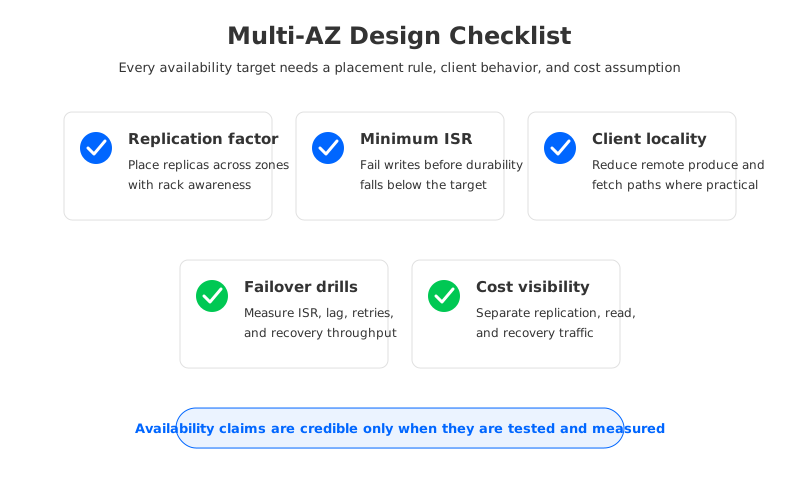
Start with the failure target. If the requirement is "survive one broker," the design may differ from "survive one full zone while continuing durable writes." Then define which topics require that target. Derived analytics topics, replayable source streams, security events, and payment events may have different RPO and RTO needs.
Next, inspect replica and leader placement. Replicas should be distributed across zones, and leaders should not drift into a single-zone hotspot. Topic creation, broker replacement, or manual reassignment can introduce uneven placement over time, so placement needs ongoing observability.
Then evaluate client locality. Producers should know how they reach brokers after one zone fails. Consumers should avoid unnecessary cross-zone fetches where possible. Connectors, stream processors, schema registries, and downstream sinks also matter if they are pinned to the wrong zone.
Finally, test recovery under load. A useful drill measures produce errors, consumer lag, leader election time, ISR shrink and expansion, broker CPU, disk throughput, network saturation, and cloud transfer volume. The review is complete when the team can explain both what fails and what the failure costs.
6How AutoMQ Changes Multi-AZ Kafka Architecture
The previous sections assume the traditional Kafka model where brokers combine compute, protocol serving, and local durable storage. That model is proven, but it also makes broker state heavy. When a broker fails or partitions are reassigned, recovery often involves rebuilding local replicas or moving partition data across the broker fleet.
AutoMQ belongs to a different architectural category: Kafka-compatible streaming with compute separated from shared object-storage-backed durability. Brokers still expose Kafka protocol semantics to clients, but durable data is not tied to broker-local disks in the same way. Replacing broker compute therefore does not have to mean copying the full broker-local state before the system can return to a healthy serving posture.
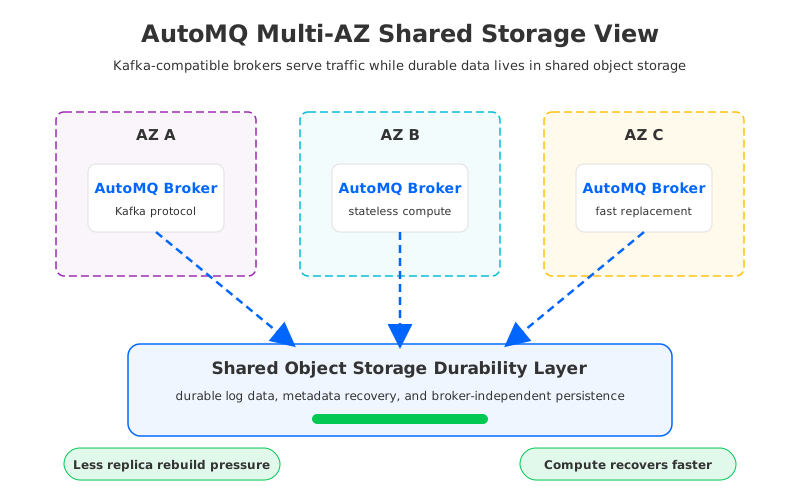
For architects, the important distinction is not "no network cost." Object storage access, cloud network paths, and provider billing still need to be modeled. The distinction is reduced dependence on broker-to-broker replica rebuilds and long partition movement during recovery, which can improve the RTO side of the design.
This matters most when clusters must replace brokers quickly after an AZ or node failure, when partition reassignment has become a recurring operational burden, or when the organization wants Kafka compatibility without tying every durability decision to more broker-local storage and replica copying.
AutoMQ should therefore be evaluated as part of a broader multi-AZ architecture review. The same questions still apply: where are clients, brokers, storage services, and failure domains located; what happens when a zone fails; and which traffic paths are billed by the cloud provider?
7Operating Practices That Keep the Design Honest
Multi-AZ Kafka architecture degrades when the live system drifts away from the diagram. New topics are created, partitions grow, consumer groups multiply, and brokers are replaced. Without a feedback loop, the cluster may remain available but become increasingly expensive and hard to recover.
Track these signals continuously:
- Leader distribution by zone and broker.
- Replica distribution and under-replicated partitions.
- ISR shrink events and producer error rates.
- Cross-zone network volume by broker, client tier, and workload.
- Consumer fetch locality and high fan-out groups.
- Reassignment, recovery, and broker replacement duration.
- Cost per workload or topic class where tagging and accounting allow it.
The operating model should also include placement rules for new workloads. Topic owners should know whether their data is critical, replayable, or derived. Platform teams should define workload classes so teams do not overpay for resilience they do not need or under-protect critical streams.
Availability is a budgeted property. A multi-AZ Kafka design is stronger when every recurring cost has a reason, every failure target has a test, and every test produces evidence.
8References
- Apache Kafka Documentation: Replication
- Apache Kafka Documentation: Broker Configs
- Apache Kafka Documentation: Rack Awareness
- AWS EC2 On-Demand Pricing: Data Transfer
- AWS Global Infrastructure: Regions and Availability Zones
- AutoMQ Documentation
9FAQ
9.1What is a Kafka multi-AZ architecture?
A Kafka multi-AZ architecture runs brokers and replicas across multiple availability zones inside one cloud region. The goal is to keep the cluster available after a broker or zone-level failure by ensuring that replicas, leaders, clients, and quorum requirements are not concentrated in one failure domain.
9.2What replication factor should Kafka use across three AZs?
Many production designs use replication factor three across three zones, with one replica per zone. The right value depends on durability requirements, cost tolerance, and operational capacity. Replication factor must be paired with rack awareness, healthy ISR behavior, and an appropriate min.insync.replicas setting.
9.3Why does Kafka cross-AZ replication cost increase?
Kafka followers fetch records from partition leaders. When leaders and followers are in different availability zones, replication traffic crosses zone boundaries. Consumer reads, rebalancing, partition reassignment, and broker recovery can add more cross-zone traffic depending on client placement and cloud billing rules.
9.4Does min.insync.replicas=2 guarantee no data loss?
No setting provides a universal guarantee across every failure scenario. With replication factor three, min.insync.replicas=2, and producers using acks=all, Kafka can avoid acknowledging writes when fewer than two replicas are in sync. The actual recovery outcome still depends on replica placement, unclean leader election settings, client behavior, and the timing of the failure.
9.5Can Kafka consumers read from nearby replicas to reduce cross-AZ traffic?
Kafka has features that can support more locality-aware fetching in some deployments, but teams should verify behavior against their Kafka version, client configuration, and managed-service constraints. Leader placement, consumer group distribution, and failover behavior still need monitoring.
9.6How does AutoMQ help with multi-AZ Kafka cost and recovery?
AutoMQ separates broker compute from object-storage-backed durability while remaining Kafka-compatible. That can reduce dependence on broker-to-broker replica rebuilds and long local-disk recovery paths. It does not remove the need to model object storage access, client placement, or cloud network billing, but it changes recovery mechanics.


