
Table of Contents
Table of Contents
A large Kafka estate rarely fails because one cluster is bad. It usually gets messy because one cluster is asked to behave like five platforms at once: observability, audit, data products, CDC replay, and user-facing product events. Those workloads share the Kafka API, but they do not share the same tolerance for latency, cost, retention, replay, or operational risk.
That is why mature platform teams end up with multiple Kafka clusters. Sometimes the split is deliberate: one cluster for product events, one for logs, one for CDC, one for regulated data, one per region. Sometimes it is accidental: every business unit creates a cluster after the central platform becomes too expensive or too slow to change. The real question is how to make the cluster map intentional before it becomes another inventory problem.
Diskless Kafka makes that strategy more interesting. By moving durable stream storage away from broker-local disks and toward object storage or shared storage, a diskless design changes the economics of high-throughput, retention-heavy workloads. Traditional brokers still matter where low write latency or mature local-disk operations matter. A useful strategy treats both as placement options, not religious camps.
1Why Enterprises End Up With Many Kafka Clusters
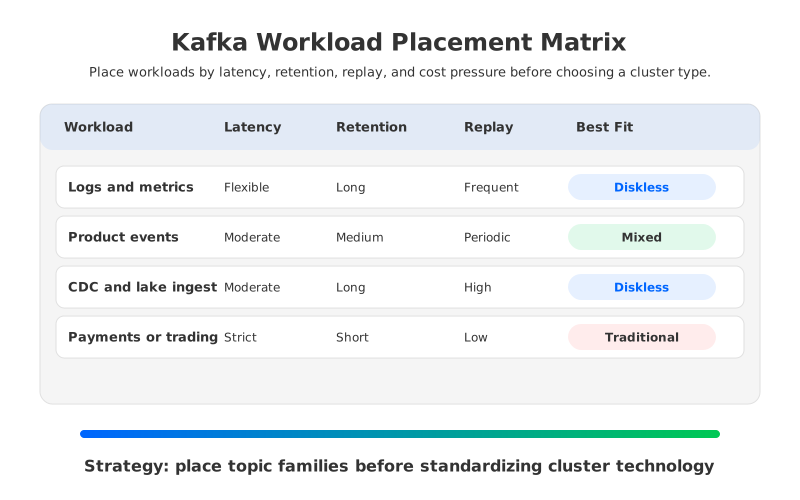
The first split usually appears around latency. A fraud-scoring event that gates checkout and a log line that will be indexed a few seconds later both look like Kafka records, but the business consequence of delay is different. If the checkout path experiences tail-latency spikes, customers feel it. If the log pipeline buffers briefly during a burst, the observability team may accept it as long as data is durable and catch-up is predictable.
The second split is retention. Kafka's topic retention settings define how long log segments are retained before deletion, and Apache Kafka's own documentation frames retention as an SLA for how soon consumers must read their data. A three-day product-event topic and a 90-day audit topic impose different storage pressure, recovery behavior, and failure blast radius.
The third split is ownership. A central platform team may operate the brokers, but the risk belongs to security, compliance, SRE, data engineering, ML, backend services, finance, and product analytics. When every team negotiates against the same cluster, the safest answer becomes overprovisioning. That works until cloud costs, broker disks, partition movement, and upgrade windows become the platform's main product.
These forces lead to familiar multi-cluster patterns:
- Workload clusters: logs, metrics, CDC, product events, and transaction flows are separated because their latency and retention profiles differ.
- Regional clusters: applications write to nearby clusters, while selected topics are replicated across regions for disaster recovery, aggregation, or locality.
- Tenant clusters: regulated domains or large internal customers get isolated clusters to simplify access control, change windows, and chargeback.
- Lifecycle clusters: development, staging, replay, and backfill environments use different cost and durability assumptions from production.
None of these patterns are wrong. The mistake is treating the split as an implementation detail rather than a design decision. Once a company has five, ten, or fifty Kafka clusters, every architecture choice becomes a governance choice: topic naming, schema evolution, offset movement, replication, chargeback, and incident routing.
2Workload Dimensions That Matter
The right cluster type is easier to choose when the team stops asking, "Is diskless Kafka production-ready?" and asks, "Which workload shape are we placing?" Traditional Kafka, tiered storage, and diskless Kafka optimize different parts of the problem.
Apache Kafka's core design replicates each topic partition across a configurable number of brokers. That model gives Kafka its familiar durability and availability behavior. In the cloud, broker-local storage also means the platform team has to plan for attached disk capacity, replica placement, partition movement, network paths, and local recovery. Tiered storage reduces pressure from older segments by adding a remote tier, but the local tier remains part of the active log model.
Diskless Kafka changes the placement question because durable log storage is no longer owned primarily by individual brokers. In AutoMQ, for example, the S3Stream architecture uses object storage as the actual data location while the WAL is used for write acceleration and failure recovery. AutoMQ's stateless broker documentation describes the result directly: broker nodes become stateless because the storage layer is offloaded to cloud storage. That does not make every workload identical, but it changes the cost and scaling envelope.
Use the following dimensions before choosing a cluster type:
| Dimension | What to measure | Why it changes placement |
|---|---|---|
| Latency envelope | p95 and p99 produce latency tolerance by topic family | Low-latency flows may need traditional brokers or low-latency WAL choices; logs may accept more buffering. |
| Retention horizon | Hours, days, or months by topic class | Longer retention increases the value of object storage and shared storage. |
| Write volume | Sustained and peak ingress after compression | High replicated write volume amplifies storage and cross-zone cost. |
| Replay pattern | Rare replay, frequent backfill, or many independent consumers | Heavy replay favors storage designs that decouple compute from retained data. |
| Elasticity | Traffic shape across day, week, campaign, or market cycle | Variable load rewards stateless or near-stateless compute. |
| Failure domain | AZ, region, tenant, compliance boundary | Isolation and replication strategy may matter more than raw efficiency. |
| Operational change rate | Upgrade frequency, broker replacement, partition movement | Stateful broker fleets carry different maintenance cost than stateless compute. |
This table prevents a common false choice. A company does not need one answer called "the Kafka platform." It needs a placement model that says which workload families deserve local-disk familiarity, which deserve diskless economics, and which can move as confidence grows.
3When Diskless Kafka Fits
Diskless Kafka is strongest when the workload is expensive because data is large, retained, replicated, and operationally heavy. Logs, metrics, clickstream analytics, AI context pipelines, security telemetry, and replay-heavy data products often land in this category. They need the Kafka API and durable ordered streams, but not always the same tail-latency budget as a payment authorization path.
The architectural reason is straightforward. In a broker-local design, storage and compute scale together. If retention grows, brokers need more disk. If write volume grows, replication traffic and partition placement become more sensitive. If traffic is cyclical, the cluster still tends to be sized around the peaks because shrinking a stateful broker fleet is not a casual operation.
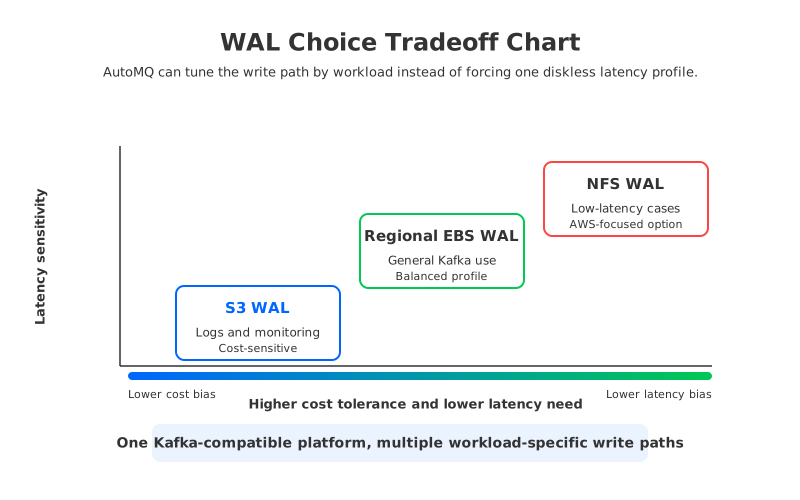
Diskless designs separate those concerns. Durable data lives in object storage or shared storage, while brokers or agents focus on protocol handling, caching, coordination, and write-path buffering. In AutoMQ's model, WAL storage absorbs writes and helps recover data not yet uploaded to object storage. The official WAL documentation makes the tradeoff explicit: S3 WAL is suitable for latency-insensitive scenarios such as logging and monitoring, while Regional EBS WAL and NFS WAL target lower-latency Kafka use cases.
That range is important because "diskless" is not one latency profile. A team might start with S3 WAL for observability streams because cost and elasticity dominate. The same team might choose Regional EBS WAL for product analytics topics that need lower latency but still benefit from shared storage. On AWS, a team evaluating low-latency diskless designs may also look at NFS WAL options. The cluster strategy becomes a workload-to-WAL strategy rather than a forced fork between traditional Kafka and a single diskless mode.
Diskless Kafka is a strong candidate when several of these conditions are true:
- The workload has high ingest volume and high retention, and the current cluster spends too much money on replicated broker storage.
- The traffic pattern has real troughs, but the broker fleet cannot safely scale down because state is tied to nodes.
- Replay and backfill are common, and the team wants retained data to be less coupled to active broker capacity.
- The latency requirement is measured in practical service-level objectives, not inherited from a low-latency workload that happens to share the same cluster.
- The platform team wants Kafka compatibility but also wants cloud-native storage economics and simpler broker replacement.
The last point is where AutoMQ fits naturally. AutoMQ is Kafka-compatible and Apache 2.0 licensed, but its main value is not "replace every cluster tomorrow." It is the ability to run Kafka-compatible workloads with object-storage-native economics while selecting the WAL medium that matches the workload.
4When Traditional Brokers Still Fit
Traditional Kafka brokers still have a place. The strongest cases are latency-critical application flows, tightly tuned operational environments, and workloads whose economics are not dominated by long retention or replicated storage. A trading signal, a payment decision, a synchronous fraud-control path, or a core service-integration bus may deserve the simplest possible write path and the most familiar failure model.
There is also an organizational reason. Many teams have years of runbooks, monitoring, incident playbooks, capacity heuristics, and performance baselines around traditional Kafka. For a high-risk workload, that operational memory is part of the reliability system. A new architecture can be better in the abstract and still be the wrong first landing zone for the most sensitive topic family.
Tiered storage occupies the middle ground. Apache Kafka's tiered storage documentation describes a local tier that remains the broker-local storage used for log segments, with remote storage added for older data. That can reduce local disk pressure without changing the active write path as much as a diskless architecture does. It is not the same as object-storage-native primary storage.
Traditional brokers often fit when these conditions dominate:
- The workload has a strict tail-latency objective and little tolerance for object-storage or shared-storage variability.
- Retention is short enough that broker-local storage is not the main cost driver.
- The traffic shape is stable, so elasticity has less business value.
- Operational teams already have mature tuning, incident, and upgrade practices for the cluster.
- The cost of architectural change is higher than the savings available from storage redesign.
The point is not to defend old architecture out of habit. It is to avoid moving the wrong workload for the right reason. A platform team can use diskless Kafka for logs and replay-heavy analytics while keeping a traditional broker cluster for a small set of latency-critical topics. That is not inconsistency. That is workload placement.
5A Unified Strategy With AutoMQ
The hard part of multi-cluster Kafka is not creating clusters. Cloud APIs, Kubernetes operators, managed services, and automation can create clusters quickly. The hard part is keeping the estate understandable after the first wave. Every extra cluster adds ACLs, schemas, quotas, topic templates, observability, replication flows, on-call routing, and cost allocation.
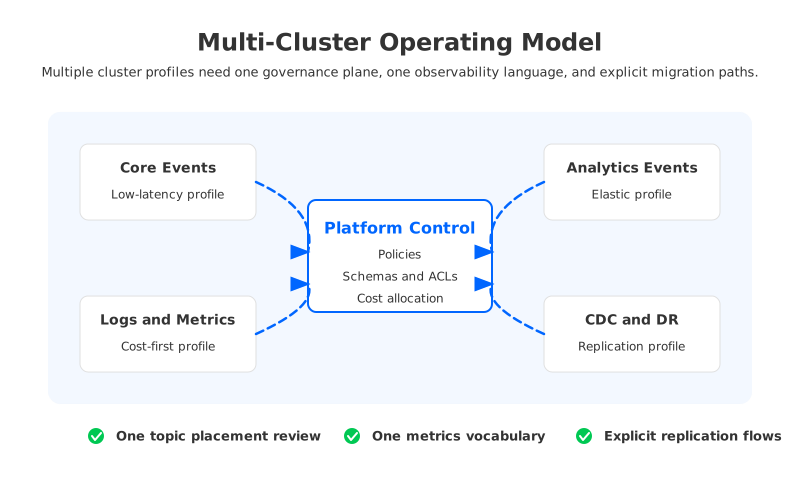
A unified strategy should start with a small number of approved cluster profiles. Each profile should name the workload family, latency envelope, retention range, durability model, replication policy, and owner. That sounds bureaucratic, but it prevents every team from inventing a new Kafka standard under deadline pressure.
For example:
| Profile | Recommended use | Storage posture | Operating rule |
|---|---|---|---|
| Low-latency core | Payments, trading, synchronous service events | Traditional brokers or low-latency WAL-backed diskless cluster | Change slowly, test tail latency aggressively, isolate tenants carefully. |
| Elastic analytics | Product events, clickstream, feature pipelines, AI data feeds | Diskless Kafka with shared/object storage | Optimize for retention, replay, and elastic compute. |
| Observability stream | Logs, metrics, traces, security telemetry | Diskless Kafka with S3 WAL when latency allows | Optimize for cost per retained byte and predictable catch-up. |
| CDC and data movement | Database change streams, lakehouse ingestion, regional aggregation | Depends on latency and replay requirements | Define ordering, replay, and downstream consistency before choosing storage. |
| DR and aggregation | Cross-region replication, audit copy, regional fan-out | Separate target clusters with explicit replication flows | Treat MirrorMaker or equivalent replication as a product with its own SLO. |
Apache Kafka's documentation on geo-replication describes MirrorMaker 2 as a way to replicate topics, topic configurations, consumer groups and offsets, and ACLs across cluster environments. It also calls out active/passive, active/active, aggregation, fan-out, and forwarding patterns. That is useful language for governance: every cross-cluster flow should have an owner, an SLO, a topic filter, and a failover story.
AutoMQ can reduce fragmentation inside this model because its WAL choices let teams cover more workload profiles with a Kafka-compatible, shared-storage architecture. The same strategic platform can use S3 WAL for latency-insensitive logging, Regional EBS WAL for general Kafka use cases, and NFS WAL for low-latency scenarios where that storage service fits the cloud environment. The operating model still needs profiles, but fewer profiles may require completely different platforms.
This is also where open source matters. AutoMQ's GitHub repository is Apache 2.0 licensed, so platform teams can inspect the implementation, test failure behavior, and reason about exit options. Open source does not remove the need for production validation, but it changes the due-diligence process. A Kafka-compatible platform that affects storage, durability, and failover should be evaluated with code-level transparency, failure testing, and workload-specific benchmarks.
6Operating The Cluster Map
Once cluster profiles exist, the platform team needs rules that keep them alive. The most useful rule is topic placement review. Every new high-volume topic should declare retention, expected ingress, fan-out, replay behavior, latency SLO, compliance classification, and regional requirement before it lands on a cluster. Keep the review lightweight, but make it mandatory for workloads that materially change capacity.
The second rule is migration by topic family, not by cluster count. A company may have one overloaded Kafka cluster containing logs, product events, and service integration topics. Moving the entire cluster to a new architecture is risky and usually unnecessary. Moving observability topics first, then analytics topics, then selected CDC streams gives the team measurable wins while protecting sensitive flows.
The third rule is shared observability across all cluster types. Traditional and diskless clusters should report comparable metrics for produce latency, consumer lag, unavailable partitions where applicable, storage growth, request rate, error rate, quota throttling, replication lag, and cost allocation. If each cluster type has its own dashboard language, platform governance will drift back into tool-specific silos.
Finally, chargeback should reflect architecture. A team that keeps 90 days of high-volume logs should see a different cost model from a team that retains product events for 24 hours. When the internal bill exposes storage, cross-zone traffic, replay, and peak capacity, application teams make better placement decisions.
7FAQ
7.1What is a Kafka multi-cluster strategy?
A Kafka multi-cluster strategy is the operating model for deciding which workloads run on which Kafka clusters, how clusters are isolated, how data moves across regions or tenants, and how governance works across the estate. It covers cluster profiles, topic placement, replication flows, observability, ownership, and migration rules.
7.2When should I use diskless Kafka?
Use diskless Kafka when the workload benefits from separating compute from durable stream storage. Good candidates include logs, metrics, analytics events, AI data feeds, replay-heavy topics, and long-retention streams where broker-local disks and replicated storage drive too much cost or operational toil. Latency requirements still need workload-specific testing.
7.3When should I keep traditional Kafka brokers?
Traditional brokers still fit latency-critical flows, small short-retention workloads, stable traffic patterns, and environments with mature local-disk Kafka operations. Payments, trading, synchronous fraud checks, and core service-integration topics may justify a more conservative placement, at least until a diskless option is validated against their tail-latency and failure requirements.
7.4Is Kafka tiered storage the same as diskless Kafka?
No. Apache Kafka tiered storage keeps a local tier for broker log segments and adds remote storage for eligible segments. Diskless Kafka designs move the primary durable log architecture toward object storage or shared storage, with brokers becoming stateless or closer to stateless depending on the implementation. The operational and cost tradeoffs are different.
7.5How does AutoMQ help with multi-cluster Kafka?
AutoMQ provides Kafka compatibility with a shared-storage architecture and multiple WAL choices. S3 WAL can fit latency-insensitive logging and monitoring workloads, Regional EBS WAL can fit general Kafka use cases, and NFS WAL can fit lower-latency scenarios where the storage service is appropriate. That flexibility lets platform teams reduce fragmentation while still placing workloads by latency and cost profile.
7.6Do I still need cross-cluster replication?
Usually yes. Diskless storage does not remove the need for regional isolation, disaster recovery, aggregation, or tenant boundaries. Kafka tools such as MirrorMaker 2 and vendor-specific migration or replication tools still need clear ownership, topic filters, replication lag SLOs, offset handling, and failover procedures.
8Sources
- Apache Kafka Design: replication
- Apache Kafka documentation: topic retention and replication factor
- Apache Kafka Tiered Storage
- Apache Kafka MirrorMaker 2 configuration
- AutoMQ WAL Storage
- AutoMQ S3 Storage
- AutoMQ Stateless Broker
- AutoMQ and Kafka Tiered Storage
- AutoMQ GitHub repository and Apache 2.0 license


