
Table of Contents
Table of Contents
"Multi-region Kafka" sounds like one requirement until the architecture review begins. One team wants disaster recovery after a region outage. Another wants users in Europe to write locally while users in North America do the same. A third wants to migrate clusters with a reversible cutover. All three use the same phrase, but they need different replication patterns, different operational runbooks, and different answers to ordering, offsets, and conflict handling.
That mismatch is where many Kafka geo replication projects become painful. Kafka is excellent at ordered logs inside a cluster, but cross-region replication turns a cluster-local log into a distributed system with WAN latency, duplicate write paths, independent consumer groups, schema drift risk, and cloud network cost. The hard part is rarely copying bytes. The hard part is deciding what correctness means when regions can make progress independently.
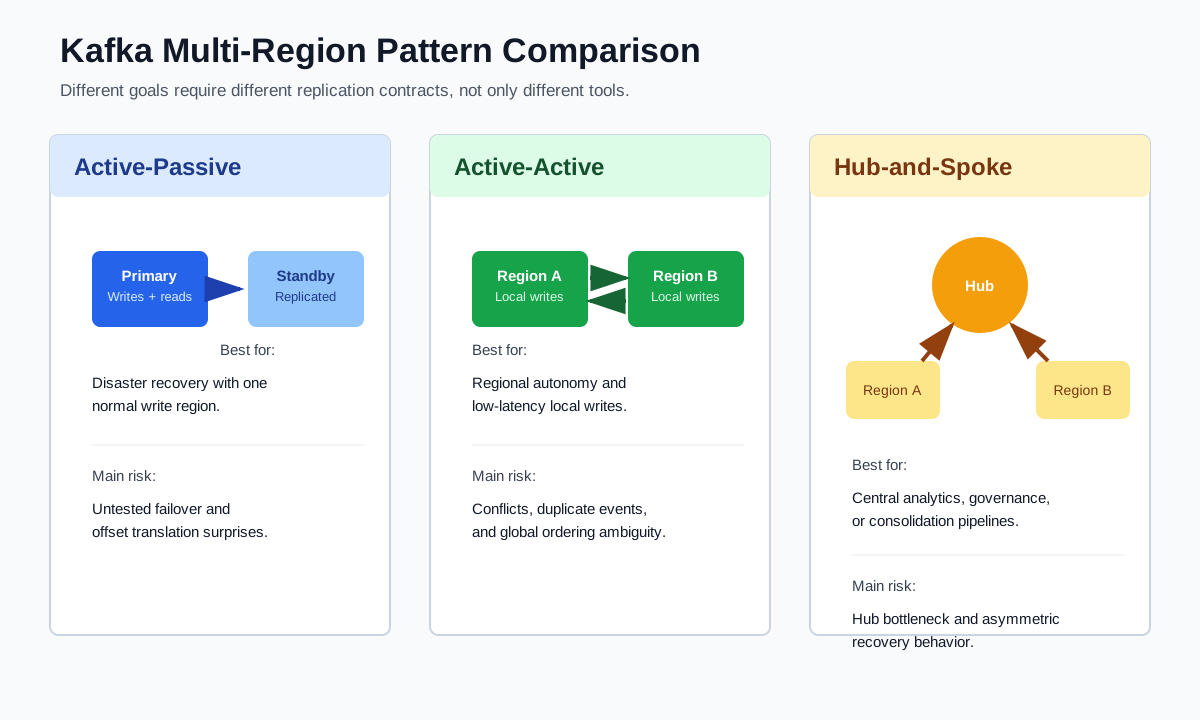
The right design starts by naming the business objective. If the objective is recovery, active-passive may be enough. If the objective is local writes in multiple geographies, active-active can be necessary, but it moves conflict resolution into the application and data model. If the objective is migration, the safest topology may be temporary and asymmetric rather than a permanent global architecture.
1What "Multi-Region Kafka" Actually Means
Kafka multi-region replication usually means one of four patterns. Active-passive keeps one primary Kafka cluster serving production traffic while a secondary region receives replicated topics for disaster recovery. Active-active allows more than one region to accept writes and serve local applications. Hub-and-spoke centralizes traffic through a primary aggregation region, often for analytics or governance. Migration replication copies data from an old cluster to a new cluster while producers and consumers move in controlled waves.
These patterns differ because Kafka preserves order per partition inside a cluster, not across independently writable clusters. A replicated topic in another region is a derived log. Its offsets, timestamps, topic names, and consumer positions may not match the source exactly. Replication tools can copy records, sync checkpoints, and preserve metadata where supported, but they cannot make a WAN behave like a single local commit path.
The design questions are concrete:
- Where are writes accepted? One region gives simpler ordering and failback. Multiple regions improve locality but require conflict rules.
- What is the recovery objective? A low recovery point objective needs continuous replication and monitoring of lag. A low recovery time objective needs pre-tested client switching, DNS, security, quotas, and operational ownership.
- Which consumers move during failover? Replaying from earliest is safe but slow. Mapping consumer offsets is faster but requires confidence in replication checkpoints and topic mapping.
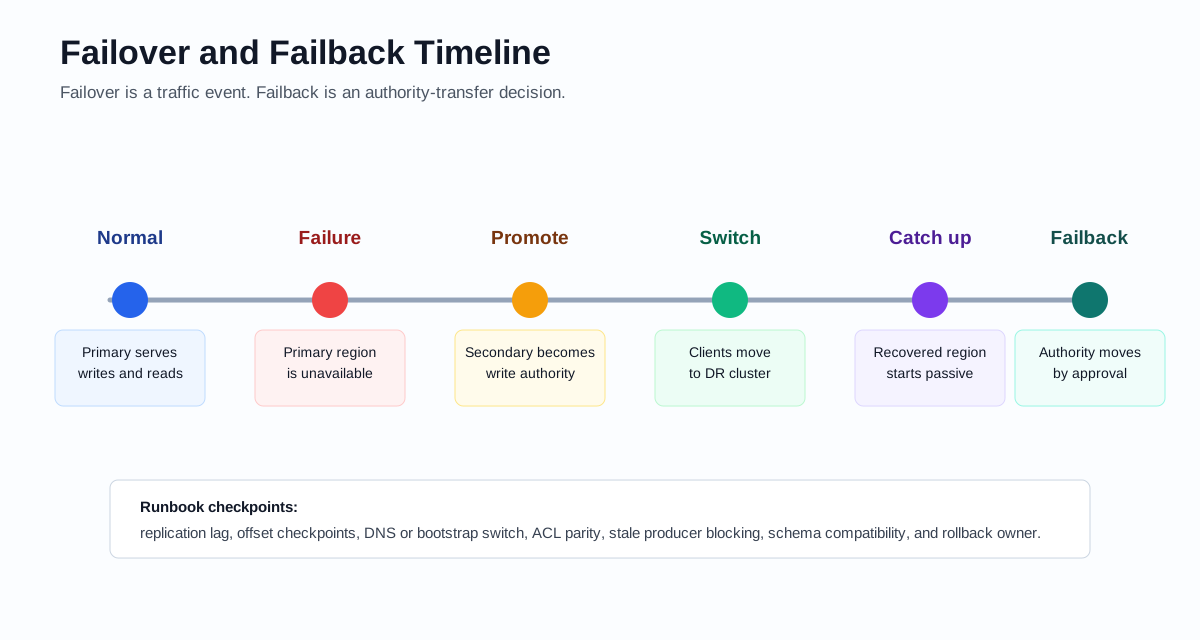
- What happens when the failed region returns? Failover is the visible event. Failback is where duplicate writes, divergent offsets, and stale producers usually surface.
The simplest way to reduce risk is to avoid designing for a more powerful pattern than the business actually needs. Active-active is not a more advanced version of active-passive. It is a different consistency contract.
2Active-Passive Replication Pattern
Active-passive is the default pattern for Kafka disaster recovery because it limits write authority to one cluster during normal operations. Producers write to the primary region. A replication tool copies selected topics, configurations, and sometimes consumer group checkpoints to the secondary region. Consumers normally read from the primary cluster, while the secondary cluster stays warm enough to take traffic when the primary region is unavailable.
This pattern fits teams that care about business continuity but do not need simultaneous writes in multiple regions. It also keeps event ordering easier to reason about because each partition has one source of truth before failover. The secondary log may lag the primary by seconds or longer depending on throughput, WAN capacity, replication configuration, and broker pressure, but the direction of authority is clear.
Active-passive still has sharp edges. Topic names may be prefixed or rewritten by replication tooling. Consumer offsets may need checkpoint translation rather than direct reuse. ACLs, quotas, schemas, connectors, and service discovery must be ready before an incident, because an outage is a bad time to discover that the DR cluster accepts replicated records but rejects real clients.
| Decision area | Active-passive implication | Operational check |
|---|---|---|
| Write authority | One active write region during normal operation | Block or drain stale producers after failover |
| Ordering | Easier because each partition has one normal source | Validate partition mapping and topic naming |
| RPO | Depends on replication lag | Alert on lag by topic and partition |
| RTO | Depends on client switch and secondary readiness | Rehearse DNS, secrets, ACLs, and bootstrap changes |
| Failback | Requires catch-up and authority transfer | Define whether primary returns as passive first |
The key discipline is to treat the secondary region as production infrastructure before it serves production traffic. A passive cluster that is rarely tested becomes a backup in name only. Runbooks should include regular failover drills, consumer offset validation, schema compatibility checks, and a controlled path for moving writes back after recovery.
3Active-Active Replication Pattern
Active-active is attractive because it promises local writes, regional autonomy, and lower user-facing latency. A payment event in Singapore can be written to an Asia Pacific cluster, while a fulfillment event in Virginia can be written to a US cluster. Replication then shares events across regions so services can build a global view.
That benefit changes the problem from disaster recovery to distributed correctness. If two regions write to the same logical entity, Kafka will not decide which event wins. If two producers use the same key in different regions, per-partition ordering is local to each source cluster before replication. If consumers read merged streams, they may see events in an order that is valid by replication arrival but surprising for business logic.
Active-active works best when the data model is designed for it:
- Region-scoped ownership: Each region owns a shard, tenant, account range, or entity set. Cross-region replication shares data, but write conflicts are structurally rare.
- Commutative events: Events can be applied in different orders without changing the final result, or the application can tolerate eventual convergence.
- Explicit conflict resolution: Records carry region, version, timestamp, or vector-like metadata so downstream processors can resolve duplicates and competing updates.
- Read locality with bounded staleness: Local services read local logs for speed while accepting that remote events arrive after WAN replication delay.
When those conditions are absent, active-active becomes a source of ambiguous incidents. A regional outage is no longer the only failure mode. A partial replication delay can make two regions believe different facts. A schema rollout can succeed in one region and break replicated consumers in another. A failback can replay records that look valid but violate application-level expectations.
This does not mean active-active is wrong. It means the architecture must include application semantics, not only Kafka topology. For globally writable systems, the replication diagram is the easy part. The harder document is the conflict policy that names which region owns which data, how duplicate events are detected, and how downstream consumers recover when events arrive late.
4Costs, Latency, Offsets, and Failback
Cross-region replication introduces a cost and latency surface that does not exist inside one Kafka cluster. Every replicated byte traverses a WAN path. Every replication task competes for broker, network, and storage resources. Every additional region multiplies the number of operational relationships between topics, consumers, schemas, and access controls.
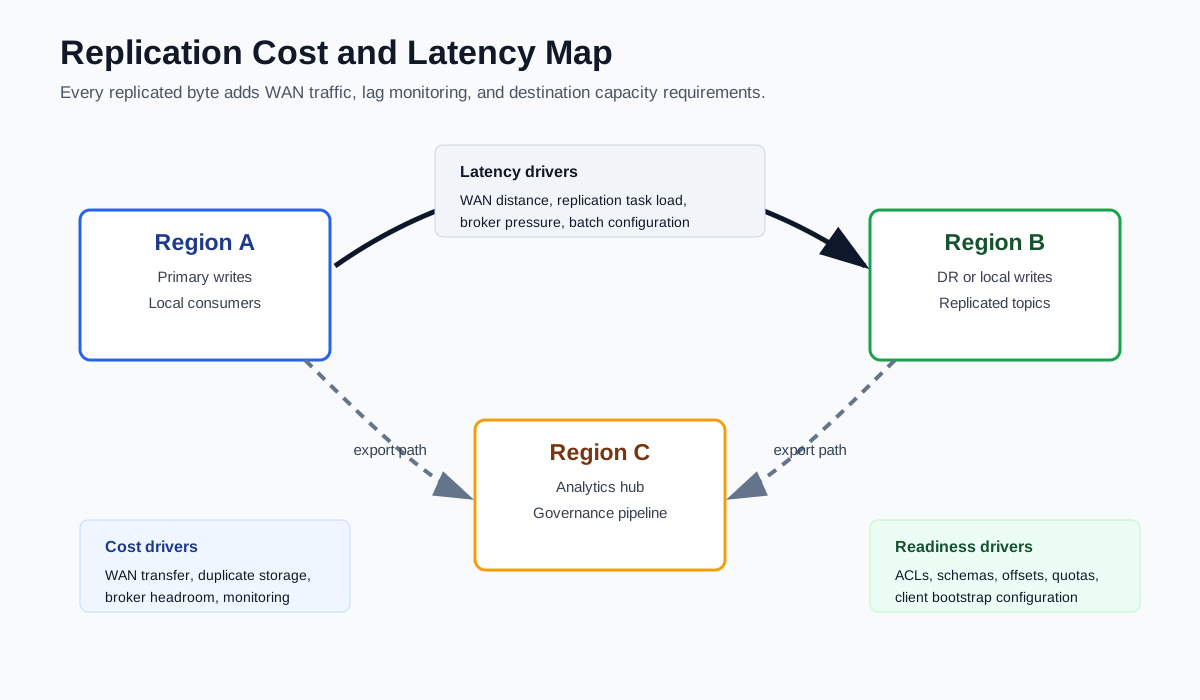
Cost modeling should include more than the replication tool itself. The obvious line item is cross-region data transfer, which cloud providers typically charge separately from regional compute and storage. The less obvious cost is duplicated Kafka capacity: brokers, disks, retained data, replication headroom, monitoring, and incident response in each region. If a secondary cluster must handle full production load during failover, it cannot be sized like a small archive.
Latency matters in two places. Producer latency matters if the application writes synchronously across regions, which most Kafka designs avoid because WAN round trips are too expensive for ordinary event ingestion. Replication latency matters for RPO and read freshness. A design can keep local produce latency low while still accepting that remote consumers see events after a replication delay.
Offsets are another common trap. Kafka offsets are positions in a partition log, not global event identifiers. When a record is replicated into another cluster, the destination offset can differ from the source offset. Tools such as MirrorMaker 2 provide mechanisms around offset synchronization and checkpoints, but production teams still need to validate how those mappings behave for their topic naming, compaction, retention, and consumer group strategy.
Failback combines all of these issues. After a primary region recovers, teams must decide whether to keep the secondary as the active write region, reverse replication, drain in-flight clients, or move authority back. The dangerous version is automatic failback without understanding what happened during the outage. If producers wrote to the secondary and some old producers continued writing to the recovered primary, the system now has two histories.
A clean failover plan is incomplete until it explains how writes become authoritative again after the failed region returns.
This is why multi-region Kafka runbooks should include a "do not automate yet" section. Automating alerting, replication lag checks, and client configuration rollout is useful. Automating authority transfer before the organization has rehearsed split-brain prevention is a good way to make a regional outage harder to audit.
5How to Choose the Right Pattern
The pattern selection framework is straightforward once the team stops asking for "multi-region" and starts asking what failure or locality problem must be solved. For most enterprise Kafka estates, the decision falls into a few repeatable cases.
| Requirement | Recommended pattern | Why it fits |
|---|---|---|
| Regional disaster recovery with one normal write location | Active-passive | Clear write authority, simpler ordering, practical RPO/RTO testing |
| Local writes for independent regional tenants | Active-active with ownership boundaries | Low-latency writes while reducing conflict probability |
| Global writes to the same entities | Active-active with explicit conflict model | Kafka topology alone cannot define correctness |
| Central analytics from many regions | Hub-and-spoke | Centralizes governance and downstream processing |
| Cluster or platform migration | Temporary one-way replication | Keeps rollback and cutover simpler than permanent mesh replication |
The table hides a judgment call that architecture review boards should make explicit: not every topic deserves the same replication pattern. Command topics, payment events, audit logs, feature streams, and analytics feeds have different tolerance for duplicates, staleness, and replay. Applying one global replication policy to every topic is convenient for platform teams but rarely aligned with business risk.
A practical design process starts with topic classification. Group topics by write authority, ordering sensitivity, retention, consumer criticality, and acceptable data loss. Then define replication rules per group. Some topics may need active-passive DR with strict monitoring. Some may only need asynchronous export to an analytics region. Some should not be replicated until the owning application has a conflict strategy.
Security and governance need the same specificity. Replicated Kafka data can cross legal, compliance, or tenancy boundaries. A multi-region plan should define encryption, credentials, ACL propagation, schema compatibility, and data residency rules before the topology is implemented. Those details are not paperwork. They are the difference between a recoverable outage and a compliance incident during recovery.
6Where AutoMQ Fits in Multi-Region Planning
The core tradeoff in multi-region Kafka is not solved by naming a replication tool. Teams still need to choose active-passive or active-active, define write authority, test offset behavior, and model cross-region cost. Once those decisions are explicit, the target cluster architecture matters because replication is only useful if the destination can absorb traffic, scale predictably, and recover without long broker data movement.
This is where AutoMQ can fit naturally as a Kafka-compatible target architecture. AutoMQ is designed around Kafka protocol compatibility while using object-storage-backed shared storage and stateless brokers. In a multi-region plan, that does not remove the need for replication semantics, but it can simplify the operating model of the clusters that participate in the topology. A DR or migration target still needs topics, clients, ACLs, and runbooks, yet broker scaling and retained data are less tightly coupled than in traditional broker-local storage designs.
For active-passive designs, that separation is useful because the passive side must be ready for production load without turning into a large idle cost center. For migration designs, Kafka compatibility reduces application rewrite pressure while the platform team validates producers, consumers, offsets, and rollback behavior. For active-active designs, AutoMQ does not make conflicts disappear, but it can be part of a cleaner Kafka-compatible foundation once the application has defined ownership and convergence rules.
The important framing is architectural, not promotional: multi-region replication is a system design problem first and a platform choice second. A Kafka-compatible shared-storage platform can improve elasticity and target-cluster operations, but the team still owns the topology contract. That contract should say where writes happen, how lag is monitored, what consumers do during failover, and who approves failback.
7References
- Apache Kafka documentation: Geo-Replication
- Apache Kafka documentation: MirrorMaker 2
- Apache Kafka documentation: Consumer groups and offsets
- AutoMQ documentation
8FAQ
8.1Is active-active Kafka always better than active-passive?
No. Active-active is better only when the business needs local writes or regional autonomy and the application can handle conflicts, duplicates, and late-arriving events. Active-passive is often the better disaster recovery pattern because it keeps write authority clear and makes failover easier to rehearse.
8.2Can Kafka offsets be reused directly after cross-region failover?
Not reliably. Offsets are positions in a specific partition log, and replicated records may receive different offsets in the destination cluster. Use the offset synchronization or checkpoint mechanisms supported by your replication tooling, then validate them with the exact topics, consumer groups, retention settings, and topic naming rules used in production.
8.3What is the biggest hidden cost in Kafka geo replication?
Cross-region network transfer is the most visible hidden cost, but duplicated production capacity is often just as important. A secondary cluster that must take full traffic during failover needs enough brokers, storage, monitoring, and operational support to behave like production, not like a small standby environment.
8.4When should a team consider AutoMQ for multi-region Kafka planning?
Consider AutoMQ when the goal is to keep Kafka-compatible clients and ecosystem behavior while reducing the operational burden of broker-local storage in the participating clusters. It is most relevant as a target architecture for DR, migration, or elastic Kafka-compatible deployments, while replication topology and conflict semantics still need explicit design.


