
Table of Contents
Table of Contents
The question behind kafka object storage is rarely whether Kafka can put bytes in S3, Google Cloud Storage, Azure Blob Storage, or another object store. It can, through several patterns. The harder question is what those bytes mean to Kafka: exported events for analytics, older log segments behind tiered storage, or the primary durable log for a Kafka-compatible shared-storage system.
That distinction decides whether the architecture works. Object storage is durable, elastic capacity with high aggregate throughput and cloud-native lifecycle controls. It is not a local disk replacement for every low-latency random read, and it does not remove the need to reason about acknowledgments, offsets, caches, metadata, object sizing, and request cost. Kafka is an append/fetch system with strict ordering per partition; object storage is an immutable-object service optimized for large sequential transfers. A good design connects those semantics instead of pretending they are identical.
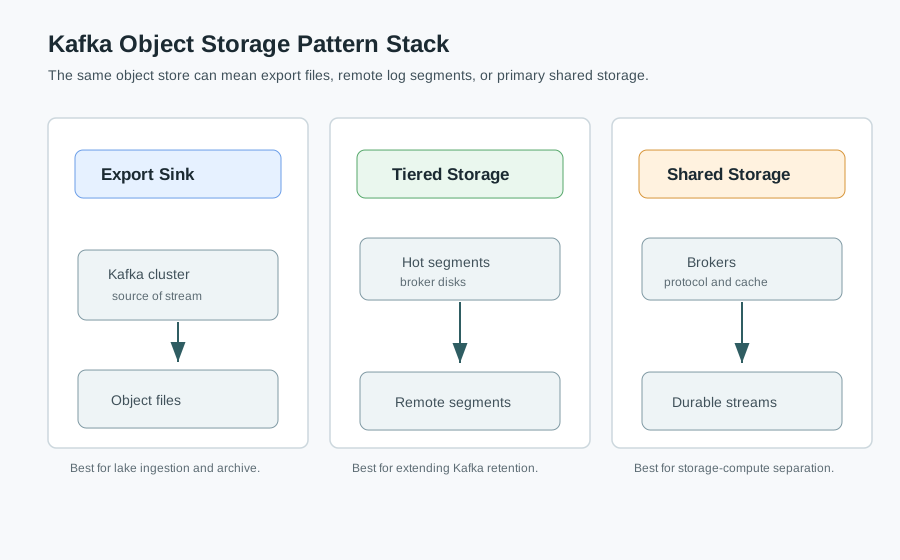
For architects redesigning Kafka storage, the practical decision is a pattern choice. Use an export path when object storage is a downstream lake. Use tiering when older Kafka data should move out of broker disks while brokers still own the active log. Use shared storage when the goal is storage-compute separation, faster broker replacement, and durable Kafka-style logs anchored in object storage.
1Why Object Storage Is Attractive for Kafka
Traditional Kafka stores partition log segments on broker-attached disks. The model is direct and fast for tailing consumers, but it couples retained data to broker lifecycle. More retention means more broker storage, larger failure domains, longer reassignment windows, and capacity planning tied to machines rather than data.
Object storage changes the capacity plane. Cloud object stores are designed for large, durable datasets, independent growth, lifecycle policies, and access from many compute nodes. For Kafka, that maps especially well to long retention, replay history, CDC backlogs, audit streams, and data lake handoff. A platform team can keep Kafka protocol semantics for applications while moving a meaningful share of durable bytes away from broker-local disks.
The attraction is architectural, not magical. Object storage gives Kafka designs a place to put retained data without binding every byte to a specific broker:
- Elastic capacity. Retention can grow without resizing every broker around the full historical footprint.
- Durability boundary. Durable data can live in a service built for replicated object persistence rather than only in broker disks.
- Lifecycle control. Older data can move through object storage classes or expiration rules when the workload allows it.
- Compute flexibility. Brokers can become easier to replace when the durable log is not trapped on their local volumes.
The phrase "Kafka on object storage" hides a critical caveat: producers and consumers still expect Kafka behavior. A producer cares when a write is acknowledged; a consumer cares whether offset reads are ordered and recoverable; an operator cares whether a broker failure requires data movement.
2The Three Kafka Object Storage Patterns
Object storage appears in Kafka architectures at three different layers. The same bucket technology can support all three, but the semantics differ enough that they should not be evaluated as one category.
2.1Exporting Kafka Data to Object Storage
The simplest pattern is export. Kafka remains the system of record for streaming, and a connector writes selected records into object storage as files. Kafka Connect sink connectors, including S3-style sinks, are often used for this. The object store becomes a downstream destination for analytics, warehouse ingestion, archive, or batch processing.
This pattern is valuable when the goal is not to make Kafka storage cheaper or more elastic, but to make Kafka data available outside Kafka. The connector can batch records by topic, partition, time window, schema, or format. Consumers that read from the object store are no longer Kafka consumers; they are file readers working with objects.
The operational questions are connector questions:
- What delivery guarantee does the connector provide under retries and task restarts?
- How are files named, partitioned, and compacted for downstream readers?
- How does schema evolution work across object files?
- What happens when the object store is slow, throttled, or temporarily unavailable?
Export is the right pattern for lake ingestion and archive. It is the wrong pattern if Kafka must serve historical fetches from object storage while preserving Kafka offsets.
2.2Tiering Older Log Segments
Tiered storage keeps Kafka as Kafka while adding a remote storage layer for older log segments. Hot data remains on brokers, and older segments can move to object storage or another remote tier. The Kafka abstraction stays centered on topics, partitions, segments, and offsets.
This pattern targets long retention. If most consumers read near the tail but some workloads occasionally replay older history, tiering can reduce pressure on broker disks while preserving a Kafka fetch path. It also changes failure and recovery behavior, because some retained segments no longer need to be restored from broker-local replicas alone.
The design still depends on the Kafka distribution and implementation details: when a segment becomes eligible for remote storage, how remote metadata is stored, how reads are fetched and cached, and what happens when consumers jump from hot local data to cold remote data. Tiered storage reduces old data on brokers, but it does not necessarily make brokers stateless.
Tiering is usually a good fit when an existing Kafka estate needs longer retention without a full architecture change. It is less complete when the platform goal is storage-compute separation from the start.
2.3Building Kafka-Compatible Shared Storage
The third pattern is shared-storage Kafka: durable stream data is written to object storage as part of the primary architecture, while brokers focus on Kafka protocol requests, hot data cache, and write/read coordination. In this model, object storage is not merely an export sink or a cold tier. It is the durable storage substrate.
This is the pattern behind Kafka-compatible cloud-native systems such as AutoMQ, which uses an object-storage-centered stream layer while preserving Kafka APIs for clients. Applications keep Kafka produce and fetch semantics while durable storage moves away from broker-local disks.
Shared storage changes the scaling problem. If brokers are not the permanent owners of large local log histories, a cluster can reason about compute and storage more independently. Broker replacement, scale-out, and scale-in become less tied to copying retained partitions between machines. The tradeoff is that the storage layer has to solve a more difficult problem: it must map Kafka's append/fetch workload onto object storage efficiently and safely.
| Pattern | Object storage role | Kafka semantics | Best fit |
|---|---|---|---|
| Export sink | Downstream files | Outside Kafka fetch path | Lake ingestion, archive, batch analytics |
| Tiered storage | Remote older segments | Kafka reads can access remote history | Existing Kafka with longer retention |
| Shared storage | Primary durable stream layer | Kafka-compatible produce/fetch path | Cloud-native storage-compute separation |
The patterns can coexist. A shared-storage Kafka system may still export data to a lake, and a tiered Kafka deployment may still use connectors. The mistake is using one pattern's strengths to justify another pattern's requirements without checking the semantics.
3The Hard Parts: Latency, Metadata, and Small Objects
Object storage makes retained capacity easier to reason about, but it introduces a different engineering surface. Kafka writes are small, ordered appends. Object stores prefer immutable objects that are large enough to amortize request overhead. Kafka consumers can seek by offset and read sequentially from a partition. Object stores read objects by key and byte range. These models can work together, but only with deliberate buffering, indexing, and caching.
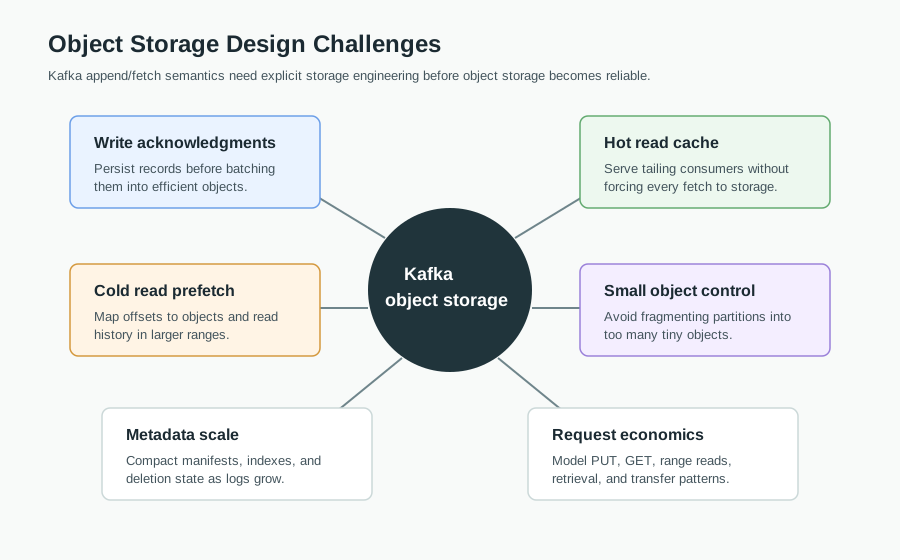
The first hard part is write acknowledgment. A Kafka producer configured for durability expects an acknowledgment only after replication and persistence requirements are satisfied. In an object-storage-centered design, the system needs a write-ahead path or equivalent persistence mechanism before data is organized into durable objects. Otherwise, batching records for efficient object writes can conflict with producer durability expectations.
The second hard part is hot reads. Many Kafka consumers read near the tail. If every fetch had to wait on object storage, latency would suffer and request volume would rise. A practical design keeps recent data in memory, local cache, or fast temporary storage so tailing consumers see Kafka-like behavior. Object storage becomes the durable backing layer, not the only place every read touches.
Cold reads are different. A consumer replaying hours or days of history benefits from prefetch, sequential range reads, and offset indexes that find the right objects quickly. A good design groups data into objects with predictable indexing and reads ahead in larger chunks while respecting consumer position.
Small objects are the third hard part. Object stores can handle many objects, but each object carries metadata, listing, lifecycle, and request overhead. Kafka partitions with low traffic can create inefficient fragments if the system flushes too eagerly. High-traffic partitions can create management pressure if metadata grows without compaction. Object size, segment roll policy, and metadata compaction are core architecture decisions, not afterthoughts.
Request cost and service limits also matter. Object stores publish performance guidance and pricing dimensions around requests, data retrieval, storage class, and transfer. A Kafka design that looks efficient by bytes stored can become inefficient by request count if it performs many small reads or writes. Architects should model request patterns under tailing consumers, replay consumers, broker restarts, and backfill jobs.
4How AutoMQ Approaches Object Storage
AutoMQ is a Kafka-compatible cloud-native streaming system designed around object storage rather than broker-local disks. Its relevance here is architectural: Kafka clients keep using familiar APIs, while the storage layer is built for cloud object stores.
The key idea is storage-compute separation. Brokers handle Kafka protocol traffic and serve hot reads through cache, while durable stream data is persisted through an object-storage-backed stream layer. This lets the architecture treat object storage as elastic durable capacity and brokers as compute nodes that can be replaced or scaled with less dependence on moving retained local logs.
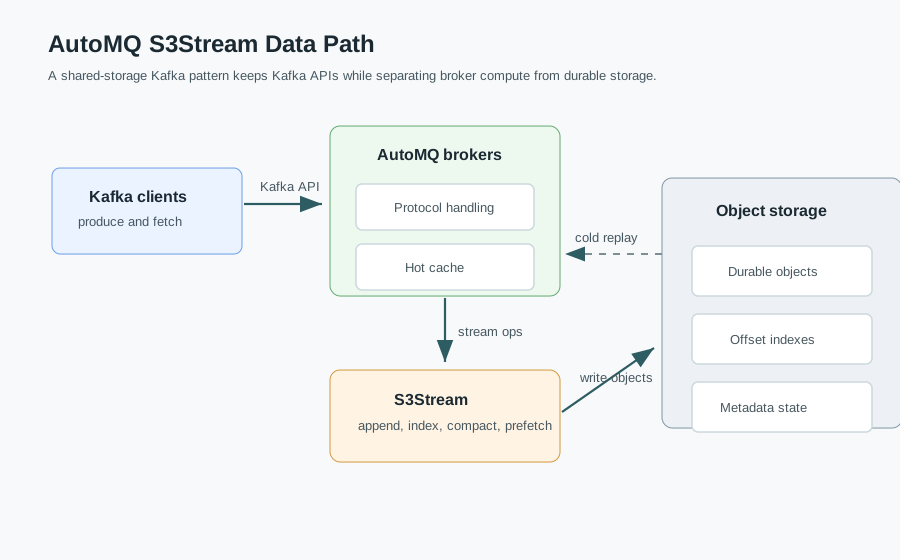
That does not remove the hard parts; it moves them into the storage design. A system built for object storage has to decide how records are buffered, how offsets map to object locations, how metadata is compacted, how consumers replay older ranges, and how hot reads avoid unnecessary object requests. AutoMQ's S3Stream architecture treats those issues as first-class design concerns instead of bolting object storage onto a local-disk broker model.
This is where the distinction between "Kafka data in object storage" and "Kafka designed around object storage" matters. Export sinks make object files. Tiered storage relocates older segments. Shared-storage Kafka redesigns the durable log path so object storage participates in the primary stream architecture.
5Architecture Checklist
Before choosing a Kafka object storage pattern, align the design around workload semantics. The most expensive mistakes often come from answering a storage question without answering a Kafka question.
- Write durability. Define when a produce request is acknowledged and what storage or replication state exists at that point.
- Hot read path. Identify where the newest records are served from and how cache misses behave.
- Cold replay path. Model offset lookup, prefetch, range reads, and backfill concurrency.
- Object layout. Set object sizing, partition grouping, segment roll, and compaction rules.
- Metadata scale. Plan how offset indexes, object manifests, and deletion markers are stored and compacted.
- Failure behavior. Test broker loss, object store errors, cache loss, and controller failover.
- Request economics. Estimate object PUT, GET, LIST, range-read, retrieval, and transfer patterns, not only stored bytes.
- Operational ownership. Decide whether the team wants to operate connector tasks, Kafka tiering, or a shared-storage Kafka platform.
The answer can be different by topic. A payments audit topic may fit tiering or shared storage. A product analytics firehose may need export plus a shorter Kafka retention window. A mission-critical CDC pipeline may justify shared storage if broker replacement and replay reliability are central requirements.
6Choosing the Right Pattern
If the goal is analytics delivery, use an export sink and optimize file layout for the lake: downstream formats where appropriate, deterministic object names, schema compatibility, and monitoring around connector lag.
If the goal is longer Kafka retention with limited architecture change, evaluate tiered storage. Pay close attention to read-path behavior, operational maturity in your Kafka distribution, and how much local broker state remains. Tiering can be a strong incremental move, especially when hot data is small and historical replay is occasional.
If the goal is cloud-native Kafka storage architecture, evaluate shared-storage Kafka. The decision is less about whether object storage is "fast enough" in isolation and more about whether the system has a complete design for acknowledgments, caches, metadata, and replay. Object storage is viable for Kafka-style workloads when the architecture is built around its strengths and shields Kafka clients from its mismatches.
That is the core answer to "Can Kafka use object storage?" Yes, but not as a generic disk swap. Kafka can export to object storage, tier older segments, or run on a Kafka-compatible architecture that uses object storage as durable shared storage. The right choice depends on what must remain true about Kafka semantics when the bytes leave broker-local disks.
7References
- Apache Kafka documentation
- Apache Kafka KIP-405: Kafka Tiered Storage
- Confluent Amazon S3 Sink Connector documentation
- Amazon S3 performance design patterns
- Amazon S3 strong consistency
- AutoMQ architecture overview
8FAQ
8.1Can Kafka store data directly in object storage?
Kafka data can be written to object storage through connectors, tiered storage, or a Kafka-compatible shared-storage architecture. These are different designs. A connector exports records as files. Tiered storage moves older Kafka log data to a remote tier. Shared-storage Kafka uses object storage as part of the primary durable log design.
8.2Is object storage a replacement for Kafka broker disks?
Not by itself. Object storage is durable elastic capacity, but Kafka still needs low-latency append handling, offset indexes, hot caches, metadata management, and failure recovery. A system can reduce dependence on broker-local disks only when those responsibilities are redesigned around object storage.
8.3What is the biggest risk in Kafka object storage design?
The biggest risk is treating object storage as a local disk with a different API. Small writes, random reads, frequent listing, and unbounded metadata can create latency and cost problems. The design should batch intelligently, cache recent data, prefetch cold reads, and compact metadata.
8.4When should a team choose shared-storage Kafka?
Shared-storage Kafka is worth evaluating when long retention, fast broker replacement, elastic scaling, or storage-compute separation are primary goals. It is especially relevant for cloud infrastructure teams that want Kafka protocol compatibility without binding retained data to broker-local disks.


