
Table of Contents
Table of Contents
Long retention is where Kafka on GCP stops being a broker-sizing exercise and becomes a storage architecture decision. A 24-hour operational topic can often be handled with ordinary capacity planning. A 30-day audit stream, a 90-day CDC replay buffer, or a warehouse backfill topic behaves differently. The write path may look stable, but retained history keeps growing, replicas multiply the footprint, and historical reads can arrive when the platform is already under pressure.
That is why Kafka long retention GCP is not the same search as "how many brokers do I need?" The useful question is where retained log data should live after it is no longer hot. On Google Cloud, the main choices are broker-attached disks, managed Kafka storage, tiered storage where available, and shared-storage Kafka architectures that put durable stream data in object storage while keeping Kafka protocol compatibility.
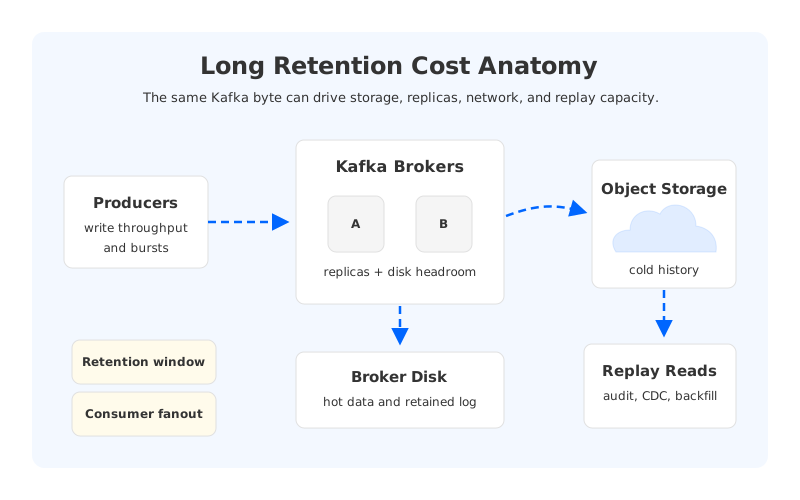
The right answer depends on replay expectations, FinOps constraints, compliance requirements, consumer fanout, and how much operational work your team is willing to own. Teams that need Kafka Connect, Debezium, Flink, Kafka Streams, consumer-owned offsets, and partition-aware processing are usually trying to make Kafka storage fit cloud infrastructure better, not replace Kafka semantics.
1Why Long Retention Changes Kafka Economics
Kafka retention looks deceptively simple in configuration. Apache Kafka exposes retention controls such as retention.ms and retention.bytes, and operators can apply those limits per topic. In production, that policy becomes a recurring infrastructure commitment because Kafka stores logs as partition replicas. A long-retention topic consumes storage after compression, replication, broker placement, spare capacity, operational headroom, and recovery planning are included.
For platform teams, the critical inputs are not exotic:
- Write throughput and compression. Retention starts with bytes written per unit of time, then changes with compression and cleanup policy.
- Replication and zone layout. Production Kafka usually uses multiple replicas, and multi-zone placement changes both durability assumptions and network paths.
- Consumer fanout. Long-retention data is often kept for replay, and replay reads are rarely evenly distributed.
- Recovery headroom. A broker-local storage model needs room for failure handling, reassignment, and hot partition mitigation.
- Governance horizon. Audit logs, CDC streams, and regulatory evidence often have retention windows set by business policy, not by Kafka operators.
This is the first FinOps trap. A team may optimize compute while storage quietly becomes the durable cost center. Cutting brokers can even make the problem worse if the cluster becomes disk-bound, because the retained log still has to live somewhere and remain recoverable after failure.
2Broker Disk Retention on GCP
The most familiar way to run Kafka on GCP is to attach persistent storage to brokers, whether the brokers run on Compute Engine or GKE. Each broker owns local log segments for its assigned partitions, replicas are distributed across brokers, and consumers read from the broker that hosts the relevant replica. It is a proven architecture, and many teams can operate it successfully.
The tradeoff is that retention is bound to broker lifecycle. If a broker needs replacement, resizing, or rebalancing, the data assigned to that broker matters. If a topic's retention grows, disk pressure grows on the brokers that own those partitions. If a high-retention topic has uneven partition traffic, the cluster can have spare aggregate capacity while a subset of brokers becomes operationally constrained.
On GCP, Persistent Disk pricing and performance characteristics make the storage choice explicit. Teams select disk types, provision capacity, and decide whether the deployment needs zonal or regional durability patterns. Google Cloud also provides Managed Service for Apache Kafka, whose pricing separates dimensions such as vCPU, memory, broker storage, and network usage. Managed operations help, but retention, replication, and replay still need workload modeling.
| Storage decision | What it solves | What remains for long retention |
|---|---|---|
| Larger broker disks | More retained log capacity | Broker-local state still affects recovery and scaling |
| More brokers | More aggregate storage and throughput | Reassignment and partition placement still need discipline |
| Regional durability patterns | Higher infrastructure resilience | Cost and architecture must reflect replicated storage behavior |
| Managed Kafka | Less broker lifecycle work for the team | Retention, fanout, storage growth, and network paths still need modeling |
Broker disk retention is often reasonable when retention windows are short, replay is rare, and cluster growth is predictable. It becomes less attractive when the retained dataset is much larger than the active working set.
3Tiered Storage and Object Storage Considerations
Tiered storage exists because broker disks are not always the right place for old log segments. Apache Kafka's tiered storage work moves older log data to remote storage while keeping Kafka's log abstraction. Conceptually, this fits long retention: hot data stays closer to brokers, while older data can be retained outside the broker's primary disk footprint.
That said, tiered storage is not a magic switch. It changes the storage hierarchy, but the operational implications depend on the Kafka distribution, feature maturity, cloud integration, read path, and failure behavior. The architectural question is not only "Can old segments move to object storage?" It is "Does this make brokers stateless enough for the operations we care about?"
Object storage is attractive on GCP because Cloud Storage is designed for durable, scalable object data. For long-retention Kafka workloads, that maps naturally to audit history, CDC replay buffers, and historical event logs that are not continuously read at tailing speed. But object storage is not a drop-in disk; Kafka needs an explicit strategy for writes, reads, caching, metadata, and recovery.
Evaluate object-storage-based retention across four dimensions:
- Write path. How does the system acknowledge Kafka writes before data is organized into durable objects?
- Read path. What happens when consumers tail recent records versus replay older retained records?
- Failure path. Can a broker fail or scale down without forcing large retained logs to move between brokers?
- Cost path. Which bytes are stored, replicated, cached, read, and transferred under realistic replay patterns?
These questions separate tiered storage from shared-storage Kafka. Tiered storage usually starts with a broker-local Kafka design and adds remote storage for older segments. Shared-storage Kafka starts from a different premise: durable stream data should live in a shared storage layer, and brokers should coordinate access rather than permanently own large local histories.
4Traditional Kafka vs Shared Storage Retention
Long retention punishes architectures that make historical data follow broker ownership. A broker-local model can be efficient for hot traffic, but old log data still occupies capacity that affects cluster operations. When platform teams add brokers, replace nodes, or recover after failure, local ownership can turn retained history into a data movement problem.
Shared-storage Kafka changes that center of gravity. Instead of treating broker disks as the durable home of every retained replica, durable stream data lives in shared storage. Brokers become compute nodes that handle protocol serving, coordination, caching, and write staging. The engineering problem moves from "How do we keep enough local disk everywhere?" to "How do we make shared storage behave like a Kafka log?"
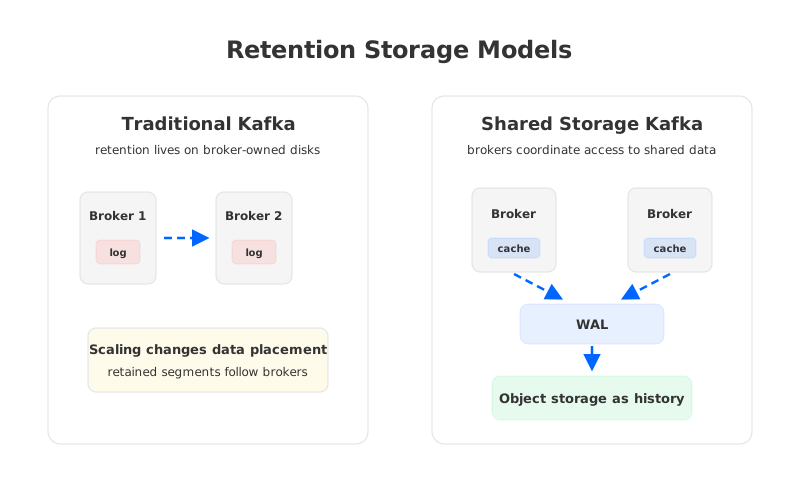
The difference is easiest to see during replay. A CDC owner may rebuild a warehouse table from historical offsets, an audit team may inspect events from a previous month, or a downstream pipeline may recover after being offline. In broker-local Kafka, those reads hit the brokers and disks that hold the old segments. In a shared-storage model, the system can use object storage as the durable history layer and broker-side cache for data that is hot, tailing, or likely to be read again.
This is also where product categories matter. A Kafka-compatible shared-storage system is not a cloud-native queue and not a Pub/Sub replacement. The application still speaks Kafka; the storage and operations model underneath the protocol changes.
5Shared-Storage Kafka With AutoMQ
AutoMQ fits into this shared-storage category: it is a Kafka-compatible cloud-native streaming system that rethinks Kafka storage around object storage, S3Stream, WAL, and cache. The point is not to claim that object storage is always better than disk. The point is narrower: when retained history is much larger than hot working data, binding all history to broker-local disk creates cost and operations pressure that the architecture itself can avoid.
AutoMQ's S3Stream model uses object storage as the durable storage foundation and separates brokers from permanent ownership of large local logs. For GCP readers, the mental model is object-storage-backed stream data with Kafka-compatible access patterns, not a rewrite of producers and consumers.
5.1WAL for Low-Latency Writes
Object storage is durable and scalable, but Kafka writes cannot be treated as casual batch uploads. Producers expect acknowledgments governed by Kafka semantics, and operators expect a clear durability story. WAL absorbs the immediate write path and stages durable progress before data is organized into the long-term object storage layout.
5.2Object Storage for Durable Data
The durable history layer is where long-retention economics change. Audit logs and CDC replay topics often have a large cold portion: data that must remain available but is not constantly read. Object storage is designed for this kind of durable capacity, while broker compute can be sized closer to active serving and replay behavior.
5.3Cache for Tailing and Catch-Up Reads
Replay is where naive object-storage designs often disappoint. If every historical read turns into uncached object fetches, the platform can move the bottleneck from disk capacity to read latency and request behavior. A production design needs cache for tailing consumers, repeated reads, and catch-up workloads.
AutoMQ's cache-oriented read path is relevant for long retention because replay is rarely a one-time event. A warehouse backfill, failed connector, fraud investigation, or compliance export may create multiple reads over overlapping ranges. Cache serves hot and fetched data without requiring all retained history to live on broker disks.
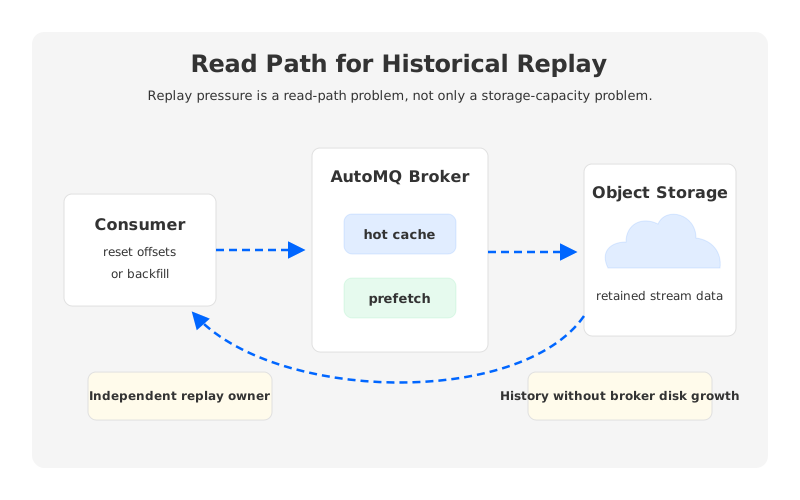
For data platform teams, this changes the design conversation. Instead of asking whether brokers can hold 90 days of log data plus replicas plus spare headroom, the platform can ask which data is hot, which data is retained for replay, how often replay happens, and how cache should protect the read path.
6Design Checklist for Google Cloud Kafka Retention
Start with workload classes, not a single global retention default. A metrics topic, a payment audit topic, and a Debezium CDC topic may all use Kafka, but they do not deserve the same storage architecture.
Use this checklist when designing Kafka on GCP storage for long retention:
| Question | Why it matters |
|---|---|
| What is the logical retention window per topic class? | Prevents audit and CDC workloads from silently inheriting short operational defaults. |
| What is the compressed write volume per day? | Converts retention into stored bytes before replicas and architecture overhead. |
| How many independent consumers may replay history? | Separates storage capacity from read-path pressure. |
| Are historical reads predictable or incident-driven? | Determines whether cache and prefetch behavior are central to the architecture. |
| What happens when a broker is replaced? | Reveals whether retained history is tied to local disk ownership. |
| Does the platform need Kafka compatibility? | Determines whether Pub/Sub-style semantics are acceptable or whether Kafka APIs must remain. |
| Who owns the bill for retained history? | Makes FinOps chargeback possible for audit, CDC, and warehouse teams. |
The design should also model failure days, not only normal days. Long retention often exists because something will go wrong: a consumer outage, a bad deployment, a missing warehouse partition, or an audit request.
7When Broker Disk Is Still Fine
Shared storage is not the default answer for every Kafka deployment on GCP. Broker disk retention can be the right choice when the cluster has stable traffic, short retention, limited replay, predictable growth, and an operations team that is comfortable with Kafka reassignment and disk management. The warning sign is when disk ownership makes teams avoid extending retention, delay broker replacement, or treat historical backfill as an incident.
8Choosing a Retention Architecture
For most GCP teams, the practical decision is a three-way comparison:
- Broker-disk Kafka when you need direct control, retention is moderate, and the team can operate partition placement and disk growth.
- Tiered storage when your Kafka distribution supports it well and your main pain is moving older segments away from primary broker disks.
- Shared-storage Kafka when long retention, replay, elastic compute, and broker replacement make local data ownership feel like the wrong primitive.
AutoMQ belongs in the third category. It keeps Kafka compatibility as the user-facing contract while moving durable stream storage toward object storage with S3Stream, WAL, and cache. For teams designing Kafka on GCP storage, it is worth evaluating alongside self-managed Kafka, Google Cloud Managed Service for Apache Kafka, and tiered-storage options.
The evaluation should be practical. Run representative producers and consumers. Validate offset reset, catch-up reads, connector behavior, and failure recovery. Model GCP costs with the same workload inputs across architectures.
Long retention starts as a product requirement: keep the log long enough for audit, CDC, recovery, or warehouse replay. On GCP, it quickly becomes an architecture question. The teams that answer it well decide which data should be hot, which data should be durable history, and which storage model lets Kafka keep its application contract without turning retention into a permanent operations tax.
If you are evaluating Kafka-compatible shared storage for long retention, review the AutoMQ architecture overview and compare it against your current GCP workload model.
9References
- Apache Kafka Documentation
- Apache Kafka 4.1 Documentation
- Google Cloud Managed Service for Apache Kafka Pricing
- Google Cloud Persistent Disk Pricing
- Google Cloud Storage Pricing
- AutoMQ Architecture Overview
10FAQ
10.1What is the main problem with Kafka long retention on GCP?
Retention expands the durable state the Kafka platform must store, replicate, recover, and serve during replay. In traditional Kafka, that state is tied to broker-local storage, so long retention affects broker sizing, reassignment, failure recovery, and cost planning.
10.2Is tiered storage the same as shared-storage Kafka?
No. Tiered storage usually adds remote storage to a broker-local Kafka architecture so older segments can move away from primary broker disks. Shared-storage Kafka makes shared storage the durable foundation and treats brokers more like compute nodes that coordinate access, cache data, and handle protocol serving.
10.3Why does object storage matter for Kafka retention?
Object storage is a natural fit for large durable histories that are not constantly read at tailing speed. For Kafka, the architectural challenge is using object storage without weakening the write path or replay path. That is why WAL, metadata management, and cache behavior matter.
10.4How does AutoMQ help with long retention and replay?
AutoMQ is Kafka-compatible and uses a shared-storage architecture built around S3Stream, object storage, WAL, and cache. For long-retention workloads, that means durable history can live outside broker-local disks while brokers focus on serving Kafka traffic, caching hot data, and supporting catch-up reads.


