
Table of Contents
Table of Contents
Searches for Kafka on Google Cloud Storage often hide several different architecture questions. One team may want to land Kafka records in a GCS bucket for BigQuery, Dataflow, Dataproc, or lakehouse processing. Another may want Apache Kafka Tiered Storage so older log segments move away from broker disks. A third may be evaluating whether Kafka-compatible brokers can use object storage as a shared durable layer, making broker compute easier to replace and scale.
Those patterns share the words Kafka and GCS, but they are not the same design. GCS as a sink destination does not change the Kafka cluster's own storage model. Remote or tiered storage extends retention while Kafka still has a local active tier. Shared storage changes the responsibility boundary: brokers stay Kafka-compatible, but retained stream data is no longer permanently owned by broker-local disks.
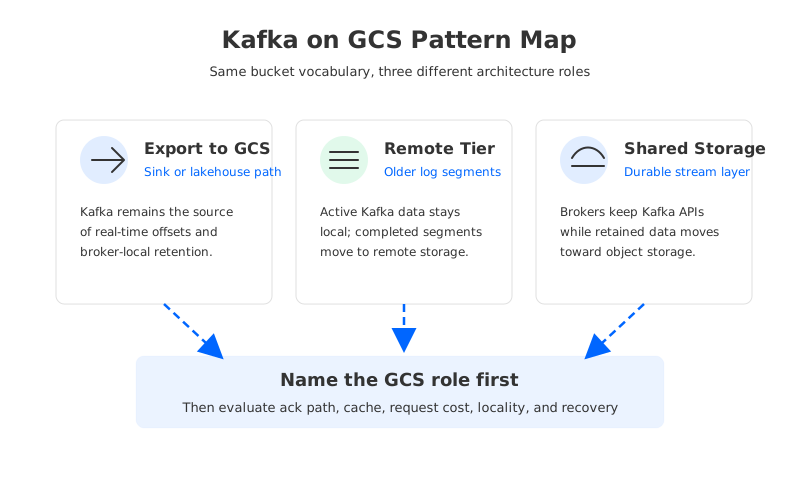
The best architecture review starts by naming which role GCS plays. After that, the discussion becomes concrete: storage class, bucket location, operation cost, read locality, private connectivity, cache behavior, and recovery. GCS is a strong object storage substrate, but Kafka still needs ordered append, acknowledgments, offsets, partition metadata, replay, and predictable failure behavior.
1What "Kafka on GCS" Can Mean
The first pattern is export. Kafka remains the system of record for real-time consumers, while a connector or pipeline writes records into Google Cloud Storage for analytics, audit archives, machine learning features, or file-based processing. The GCS copy is valuable, but it is downstream. Kafka clients still depend on Kafka retention, offsets, partitions, and consumer groups.
The second pattern is remote or tiered storage. Apache Kafka's Tiered Storage direction separates local and remote log segments. Recent active data remains local to brokers, while older completed segments can be stored remotely. In GCP, a remote storage implementation may target GCS. This reduces local disk pressure for long retention, but brokers still own the active write path and hot tier.
The third pattern is shared storage for Kafka-compatible architecture. Object storage becomes part of the durable storage foundation behind Kafka-compatible brokers. A purpose-built layer translates Kafka log semantics into object layout, write-ahead durability, metadata, indexing, and caching. This is the direction AutoMQ represents for teams that want Kafka compatibility while moving persistent stream storage toward shared object storage.
The distinction matters because the operational promises differ:
| Pattern | Role of GCS | Kafka storage impact | Best fit |
|---|---|---|---|
| Export to GCS | Downstream destination | Broker disks still hold Kafka retention | Analytics, audit, lakehouse files |
| Remote or tiered storage | Remote tier for older segments | Local active tier remains important | Long Kafka replay with familiar broker model |
| Shared storage | Durable storage substrate | Broker-local persistent ownership is reduced | Elastic Kafka-compatible architecture on cloud storage |
Mislabeling the pattern leads to bad decisions. An export pipeline will not make broker replacement faster. Tiered Storage will not make every broker stateless. Shared storage cannot be evaluated by bucket price alone because the storage engine must preserve Kafka semantics.
2Why GCS Is Attractive for Kafka Storage Problems
Google Cloud Storage offers regional, dual-region, and multi-region bucket locations, strong durability as a managed object storage service, lifecycle management, IAM integration, and storage classes for different access patterns. Those features align with common Kafka platform pain: retained bytes grow faster than compute, replays need history, and infrastructure teams want storage that scales independently of broker machines. GCS also keeps exported Kafka data close to BigQuery, Dataflow, Dataproc, Vertex AI, and other Google Cloud services.
But object storage characteristics do not map one-to-one to Kafka log characteristics. Kafka appends small ordered records to partitions and acknowledges producers at a durability boundary. GCS stores immutable objects and charges for storage, operations, retrieval from certain classes, and network paths. A Kafka architecture that creates too many small objects, lists frequently, or sends hot reads to remote storage can convert a storage optimization into a latency and operations-cost problem.
That is why the design conversation should move from "Can Kafka use GCS?" to "Which Kafka path touches GCS, and under what workload?"
3GCS Storage Classes Are Workload Choices
GCS storage classes are workload choices tied to access frequency, retrieval behavior, and minimum storage duration. Standard Storage is designed for frequently accessed data. Nearline, Coldline, and Archive Storage target less frequent access and may introduce retrieval fees or minimum duration considerations. Kafka-readable data should be placed according to replay and recovery expectations, not only capacity price.
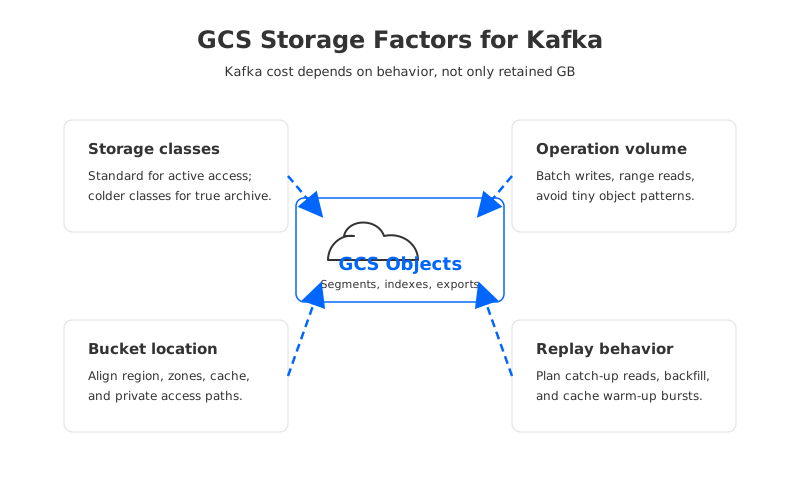
For Kafka export, storage class selection can be straightforward. If objects are written once and read by analytics jobs on predictable schedules, lifecycle rules can move older data into colder classes. The Kafka cluster itself is not waiting on those objects to serve consumers, so retrieval latency and cost are part of analytics planning rather than Kafka availability.
For tiered storage, the choice is more delicate. Historical Kafka segments may look cold until an incident, migration, offset reset, or backfill causes many consumers to replay older ranges. A class that is cost-effective for archive retention may be a poor fit if platform teams expect operational replay from Kafka with low surprise cost. Standard Storage may be appropriate for active remote segments, with lifecycle transitions applied only to data that applications truly treat as archival.
The practical rule is simple: classify by access pattern, not by age alone. Kafka's old data is sometimes the most important data in the room.
4Operation Cost Can Matter as Much as GB-Month Cost
GCS pricing includes storage capacity, operations, retrieval fees for some classes, and network data transfer. Operations are grouped into classes on Google Cloud's pricing pages, and the details vary by storage class and request type. For Kafka architecture, the exact price table is less important than the workload multiplier: Kafka can generate operations continuously.
Object storage is efficient when writes are batched into reasonably sized immutable objects and reads are served as larger sequential ranges. Kafka workloads can become expensive when implementation details work against that model. Tiny objects, frequent metadata checks, repeated listing, cache misses, and per-fetch remote reads can all increase operation count.
A cost model for Kafka on GCS should cover at least five events:
- Steady produce. How many object writes happen per topic, partition, and time window?
- Near-tail consume. Are active consumers served from broker memory, local cache, or remote objects?
- Historical replay. How many object reads and index lookups are required to scan retained data?
- Broker replacement. How much cache warm-up and metadata reconstruction touches GCS?
- Backfill surge. What happens when many consumers reset offsets together?
This is why "store Kafka data in GCS" is too vague. Good object layout shows up in operation volume, tail latency, cache pressure, and recovery behavior.
5Network Locality Is Part of the Storage Architecture
GCS bucket location is a topology decision. A regional bucket places data in a specific region. A dual-region bucket stores data across two selected regions. A multi-region bucket is broader and can be useful for some global workloads. Kafka architecture has to align that bucket decision with where brokers, producers, consumers, connectors, and caches run.
For a GCP Kafka platform, keep high-volume storage traffic inside the intended region and private path. If brokers run on GKE or Compute Engine in one region, a regional bucket in the same region is easier to reason about for latency and network cost. Disaster recovery should be designed explicitly through storage placement, Kafka replication, application replay, or a separate workflow.
Zone topology also matters. Kafka brokers often run across zones for availability. GCS is regional from the perspective of a regional bucket, but the rest of the Kafka path is still zonal: producer ingress, broker leadership, local cache, write-ahead storage, and consumer egress. A zone failure can move leadership and consumers, causing cache misses and read bursts.
The network review should answer whether brokers and buckets are in compatible locations, whether object traffic uses private Google Cloud paths, what happens when a zone loses brokers and local caches, and whether multi-region durability is required for Kafka itself or only downstream copies.
6Designing the Write Path: Acknowledgment Before Object Layout
The write path is where Kafka semantics meet object storage physics. GCS stores objects; Kafka writes ordered records. A producer using acks=all expects an acknowledgment only after the cluster reaches the configured durability condition. A storage engine that batches records into objects must preserve that durability signal.
For export pipelines, this is separate from Kafka durability. The producer is acknowledged by Kafka before the sink writes to GCS. If the connector falls behind, Kafka remains the source of truth as long as retention covers the lag.
For tiered storage, the active segment and producer acknowledgment path are still local to Kafka brokers. Completed segments can later move to remote storage. The critical questions become remote segment metadata, deletion policy, fetch behavior, and recovery when a broker needs historical data.
For shared storage, the architecture needs an explicit write-ahead or commit path. It may use local or network-attached WAL storage, quorum metadata, object commits, or other mechanisms, but the design must define when a record is durable enough to acknowledge. Object layout can happen after that boundary, but acknowledged data cannot live only in volatile buffers.
This is where AutoMQ's architecture is relevant. AutoMQ is Kafka-compatible and built around separating broker compute from durable stream storage. Its direction is to keep Kafka protocol compatibility while using shared storage, WAL, and cache mechanisms so object storage can serve as a streaming substrate rather than a file dump.
The evaluation should stay concrete: produce latency, crash recovery, object layout, cache hit rate, catch-up reads, and compatibility with existing Kafka clients.
7Read Locality: Tail Reads, Catch-Up Reads, and Replay
Kafka consumers are not all the same. Near-tail consumers continuously read data that was produced seconds or minutes earlier. Catch-up consumers read behind the tail after a restart or lag event. Replay consumers intentionally scan older offsets for backfill, migration, or incident response. A GCS-backed architecture should treat those as different paths.
Near-tail reads should usually stay close to brokers. Memory, page cache, local cache, or a dedicated hot tier protects latency and avoids unnecessary object operations.
Catch-up reads depend on the cache window. If a consumer is minutes behind, the system may still serve from hot cache. If it is hours behind, it may need indexed range reads from GCS. Good object layout and prefetch matter here. The system should read contiguous ranges, not chase many tiny objects.
Historical replay is where object storage can shine if the data is organized well. Large immutable objects, offset indexes, and bounded prefetch can support high-throughput scans. The risk is operational surprise: a replay job can create a burst of reads, retrieval, and network traffic.
8GCP Shared Storage Kafka Blueprint
A useful blueprint separates responsibilities rather than drawing a bucket under a Kafka logo. Brokers handle Kafka protocol work, partition leadership, client compatibility, hot cache, and coordination. A write-ahead path protects acknowledgments. GCS stores durable retained data through an indexed object layout. Observability tracks cache hit rate, object operations, bytes by path, replay throughput, and recovery time.
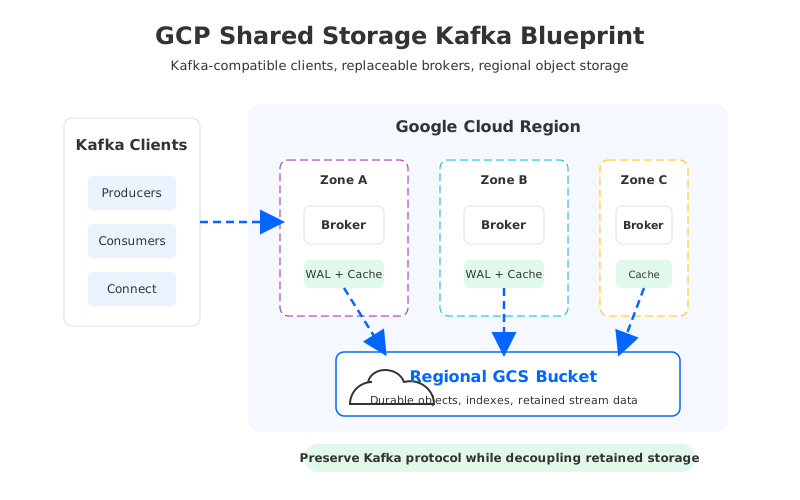
In a GKE-based deployment, brokers may run across zones in a regional or zonal cluster design. Local SSD, Persistent Disk, or other storage may serve cache or WAL roles, but those resources should not become permanent owners of retained history.
Kafka compatibility is the reason this architecture is interesting. Application teams should not have to rewrite producers and consumers because the storage layer changed. Kafka Connect pipelines should keep using Kafka topics. Kafka Streams applications should keep their topic and offset contracts. The platform change should be visible in scaling, retention, and recovery behavior, not in every application integration.
AutoMQ fits this blueprint as a Kafka-compatible shared storage direction for cloud teams that want to preserve the Kafka ecosystem while changing the storage foundation. It should be validated with production-shaped tests, failure scenarios, and the same workload assumptions used for tiered storage or export-only designs.
9Evaluation Checklist for Kafka on GCS
Before choosing a pattern, write down the answers in a form an operations team can use during an incident:
| Area | Question to answer |
|---|---|
| Pattern | Is GCS a sink, remote tier, or shared durable storage layer? |
| Storage class | Which objects are frequently accessed, replayed, or truly archival? |
| Bucket location | Are buckets, brokers, caches, and consumers in the intended region? |
| Operation model | How many writes, reads, listings, metadata calls, and range reads occur? |
| Ack path | What exact durable boundary exists before producer success? |
| Cache | What reads are served locally, and how is cache rebuilt after failure? |
| Failure domain | What happens when a zone, broker group, or storage path degrades? |
| Compatibility | Do existing producers, consumers, Connect jobs, and Streams apps keep working? |
The healthiest decision may be different for each workload. An analytics-heavy topic may need export to GCS, a compliance-retention topic may need tiered storage, and a storage-bound platform with frequent scaling may justify shared storage. Kafka on Google Cloud Storage works when GCS is given a precise role, hot reads stay local, operation paths are modeled, and Kafka semantics remain explicit.
10References
- Google Cloud Storage classes
- Google Cloud Storage pricing
- Google Cloud Storage bucket locations
- Apache Kafka KIP-405: Kafka Tiered Storage
- Apache Kafka documentation
- AutoMQ documentation
11FAQ
11.1Can Kafka write directly to Google Cloud Storage?
Kafka can export records to GCS through connectors or pipelines, and Kafka-compatible storage systems can use object storage as part of their durable layer. Plain object writes alone do not implement Kafka's log semantics. The architecture still needs acknowledgments, ordering, offsets, metadata, cache, and recovery.
11.2Is Kafka on GCS the same as Kafka Tiered Storage?
No. Tiered Storage usually means Kafka keeps an active local tier and moves older completed segments to remote storage. Kafka on GCS can also mean downstream export or a shared-storage architecture where object storage is closer to the durable foundation.
11.3Which GCS storage class should Kafka use?
It depends on the pattern and access frequency. Export archives may use colder lifecycle transitions. Active remote segments or shared-storage data often need a class and lifecycle policy that match expected read behavior, not only age.
11.4Does GCS reduce Kafka cost automatically?
Not automatically. GCS can make retained capacity more elastic, but operation count, retrieval fees, cache misses, network locality, and replay behavior affect the total cost. Model requests and traffic paths before comparing only storage capacity prices.
11.5Where does AutoMQ fit for GCP teams?
AutoMQ is relevant when teams want Kafka-compatible clients, Connect, and Streams while evaluating a shared-storage architecture that moves durable stream data away from broker-local disks. It is not a replacement for GCS export; it is a different storage architecture direction.


