
Table of Contents
Table of Contents
Kafka on GKE looks attractive for a reason. Platform teams already use Kubernetes to standardize deployment, scheduling, observability, and resource governance. If the organization has built its internal platform around Google Kubernetes Engine, running Kafka there feels like the natural way to keep streaming inside the same operating model.
The catch is that Kubernetes automation does not make Kafka stateless. Apache Kafka still stores log data on broker-attached storage, keeps partition leadership on brokers, and relies on replication across brokers for durability and availability. GKE can restart a pod, reschedule a workload, and attach a PersistentVolume, but it cannot remove the data gravity created by Kafka's broker-local storage model. That distinction is where many Google Cloud Kafka plans become more expensive than the first design review suggested.
The better question is what kind of Kafka operating model you are buying when you place a stateful log service on Kubernetes.
1Why Kafka on GKE Is Still Stateful
GKE gives you a managed Kubernetes control plane, node pools, workload primitives, and Google Cloud integration. Kafka brings a different set of assumptions. A Kafka broker is not a disposable web pod; it is a process with an identity, partition replicas, and local log directories that matter to cluster health.
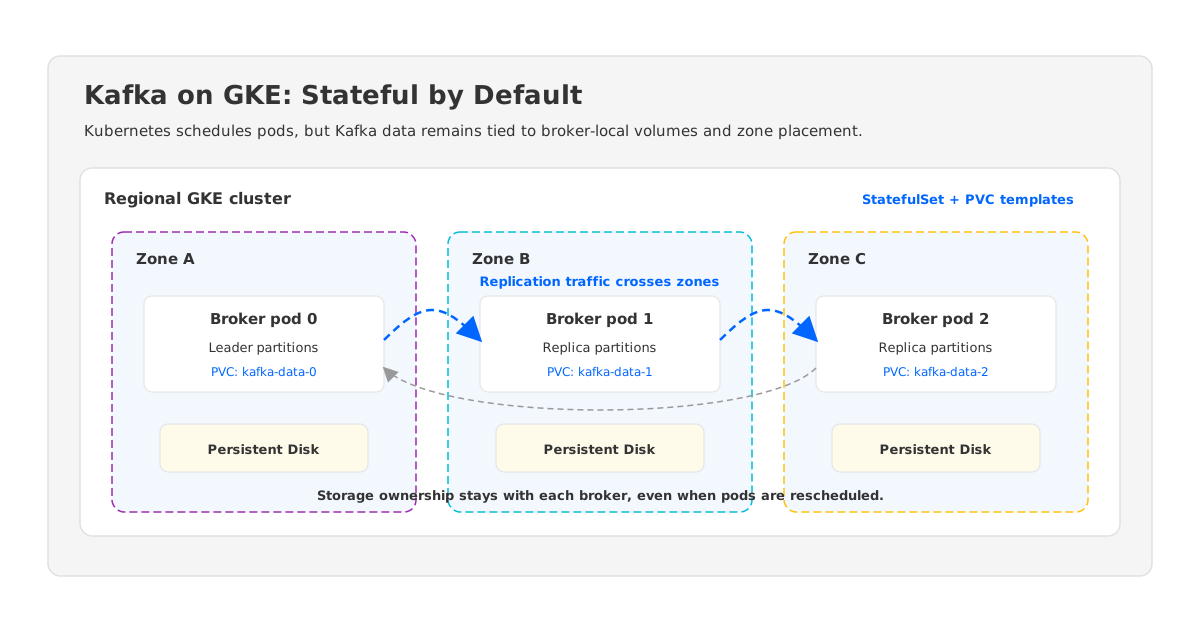
That identity is why most Kubernetes Kafka deployments use StatefulSets rather than Deployments. A StatefulSet gives each broker a stable ordinal, stable network identity, and a predictable relationship to its PersistentVolumeClaim. The PVC then binds the broker to underlying storage, commonly a Persistent Disk class or another block storage option supported by GKE. From the Kubernetes side, this is a standard pattern. From the Kafka side, it is the minimum structure needed to avoid treating log storage as an interchangeable cache.
This has a practical consequence: broker replacement is not the same as replacing a stateless pod. If the replacement lands in a different zone, storage topology matters. If a disk cannot attach where the pod is scheduled, scheduling waits or fails. If the cluster has to move partitions away from a broker, Kafka reassignment becomes part of the operation.
Kubernetes solved a large part of the deployment problem. It did not erase the storage problem.
2The Common GKE Deployment Pattern
The baseline production pattern is usually a regional GKE cluster or a multi-zone node pool, with Kafka brokers spread across zones. Each broker runs as a pod managed by a StatefulSet, and each pod receives a PVC from a storage class. Kafka listeners, headless services, disruption budgets, anti-affinity rules, and node pool constraints hold the shape together.
That shape gives platform teams a familiar control surface, but every component carries a Kafka-specific interpretation:
- StatefulSet ordinals define broker identity. Broker
0, broker1, and broker2are not anonymous replicas of the same workload. Their placement and storage history affect cluster recovery. - PVCs preserve log directories across pod restarts. This is necessary for Kafka, but it also means storage lifecycle and pod lifecycle are no longer independent.
- Zone spreading reduces correlated failure risk. It also increases the importance of inter-zone replication traffic, storage topology, and scheduling constraints.
- Pod disruption controls protect availability. They prevent Kubernetes from draining too much Kafka capacity at once, but they also slow maintenance operations when the cluster is already tight on capacity.
- Node pools become part of the Kafka capacity plan. CPU, memory, network bandwidth, disk throughput, and disk size all have to line up with broker-level traffic, not just pod requests.
For small clusters, this pattern is manageable. For high retention, many partitions, strict recovery targets, and frequent scaling needs, the operating model becomes less Kubernetes-native than it first appears. The orchestration layer is flexible; the data layer is still anchored.
3Storage and Zone Design Decisions
Storage is the first place where Kafka on GKE becomes a design exercise rather than a deployment exercise. Persistent Disk options differ in capacity, throughput, IOPS, replication behavior, and attachment semantics. Regional or highly available disk configurations can improve storage availability, but they also change the cost model. Zonal disks can be more straightforward, yet they make broker recovery more sensitive.
Kafka adds another layer on top of that. A replication factor of 3 means each record is stored by multiple broker replicas. In a multi-zone layout, those replicas commonly live in different zones so the cluster can survive a zone-level event. That durability model is sound, but the application itself now generates cross-zone replication traffic.
The cost categories that matter are broader than the monthly node price:
| Design area | What teams estimate first | What often appears later |
|---|---|---|
| Compute | GKE node pool capacity for broker pods | Headroom for rebalance, catch-up, rolling upgrades, and traffic bursts |
| Storage | Persistent disk size for retention | Replicated log copies, disk throughput, snapshots, and storage class tradeoffs |
| Network | Client ingress and egress | Cross-zone replication, remote reads, reassignments, and recovery traffic |
| Operations | Helm chart or operator setup | Broker replacement, partition balancing, disk expansion, and incident drills |
None of these are exotic problems. They are the normal consequences of running a broker-local log system across cloud zones. The surprise comes from assuming that GKE absorbs them.
4Hidden Cost and Scaling Pitfalls
The hidden costs of Kafka on GKE usually show up in capacity planning before they show up in invoices. Kafka clusters are often sized for the worst credible combination of traffic, retention, and recovery, because being under-provisioned during a broker failure is worse than paying for unused headroom on a quiet day. That headroom lives in nodes, disks, network bandwidth, and operational attention.
The most visible pitfall is scaling. Adding broker pods to a StatefulSet can be mechanically straightforward, but making those brokers useful requires partition movement. Kafka does not become balanced because Kubernetes added a pod. Partitions have to be assigned, leaders may need to move, and replicas have to copy log data.
Broker replacement has the same shape. A failed node can be replaced by GKE, yet Kafka still has to reconcile durable data and replica state. If the original disk returns, the broker may resume from local data. If it does not, the cluster has to rebuild replicas elsewhere.
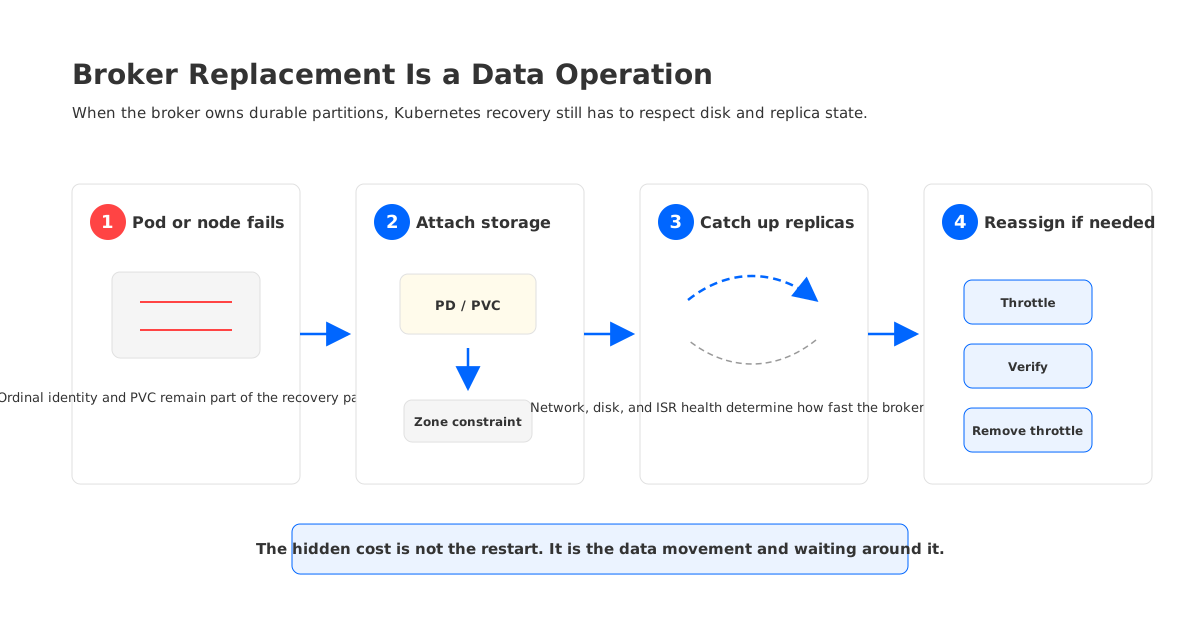
This is why a GKE Kafka cost model should include time, not just resources. How long does it take to replace a broker with a large partition set? How much traffic does a reassignment generate? A design that looks cost-effective at steady state can become expensive when every scaling or recovery event becomes a data movement project.
5Where Google Cloud Managed Kafka and Pub/Sub Fit
Google Cloud gives teams several ways to avoid self-managing every part of Kafka infrastructure. Managed Service for Apache Kafka runs Kafka clusters with managed infrastructure. Pub/Sub is a fully managed messaging and ingestion service with a different API and operating model. Both deserve evaluation before a team commits to running Kafka on GKE.
The choice depends on what you are optimizing for. Pub/Sub is compelling when the application can use Pub/Sub semantics. Managed Kafka is relevant when the team wants Kafka protocol compatibility without owning all infrastructure operations. Self-managed Kafka on GKE remains attractive when platform control matters.
The important part is to compare operating models, not labels:
| Option | Strong fit | Watch carefully |
|---|---|---|
| Pub/Sub | Managed messaging without Kafka client requirements | API semantics and migration effort |
| Managed Kafka | Kafka-compatible workloads with managed infrastructure | Limits, availability, pricing, and responsibility boundaries |
| Kafka on GKE | Kubernetes-level control over brokers, nodes, storage, and networking | Stateful operations and data movement |
| Shared-storage Kafka on GKE | Kafka compatibility with less broker-local data ownership | Latency design, storage architecture, and compatibility validation |
This comparison is about exposing the cost center. If the workload depends on Kafka clients, Connect, Streams, or ecosystem tooling, moving away from Kafka semantics may be a larger migration than expected.
6Shared-Storage Kafka on GKE with AutoMQ
Once the problem is framed as broker data ownership, the alternative architecture becomes easier to evaluate. Instead of asking Kubernetes to make stateful brokers behave like stateless pods, shared-storage Kafka changes what a broker is responsible for. Brokers still serve Kafka protocol traffic, but durable log data moves into shared storage.
AutoMQ fits this category. It is a Kafka-compatible streaming system that rethinks Kafka storage around shared object storage and stateless brokers. Its documentation describes S3Stream as the shared streaming storage layer and explains how stateless brokers reduce scaling, reassignment, and replacement cost. The appeal for GKE is that the Kafka data plane aligns better with how Kubernetes already wants to operate.
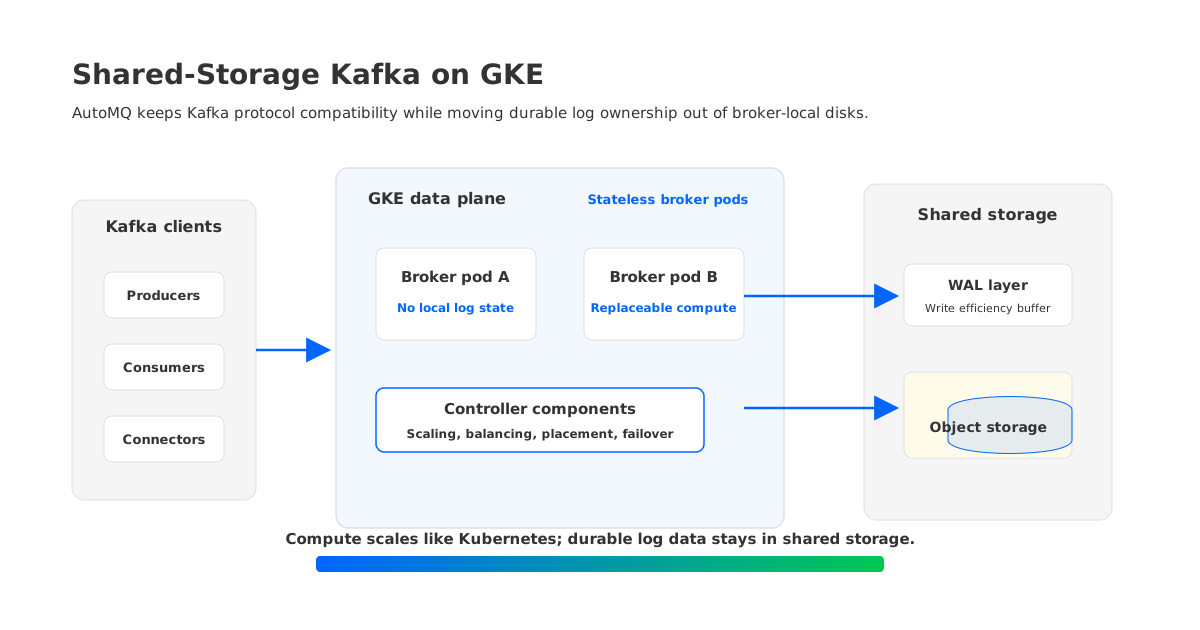
There is a real technical tradeoff here. Object storage is durable and cost-efficient for large data volumes, but it is not a drop-in substitute for local disk latency. A serious shared-storage Kafka design has to address write latency, metadata management, and failure recovery. AutoMQ's architecture introduces a write-ahead log layer and shared storage design to handle those concerns.
For GKE teams, the resulting decision is concrete:
- If broker recovery is painful because partitions are large and replicas take too long to rebuild, reduce broker-local data ownership.
- If scaling is painful because every added broker triggers large reassignment work, make scaling more about compute placement than data copying.
- If node maintenance regularly collides with Kafka disruption rules, separate Kubernetes scheduling from durable log placement.
- If cross-zone replication dominates the cost conversation, model whether shared storage changes the traffic pattern enough to matter.
AutoMQ should not be evaluated as a generic "lower cost Kafka" claim. It should be evaluated as an architecture that changes the expensive part of Kafka on GKE: durable log ownership by individual brokers.
7Deployment Checklist for Kafka on GKE
A production review for Kafka on GKE should force every assumption into the open. A working demo is not proof of a resilient operating model.
Start with storage. Document the storage class, zone behavior, volume expansion process, backup plan, and what happens when a broker pod cannot attach its expected volume. Then move to Kafka internals: partition count, replication factor, leader distribution, rack awareness, retention, reassignment policy, and recovery time.
Network modeling belongs in the same review. Estimate producer write traffic, replication traffic, consumer read traffic, and recovery or reassignment traffic. Google Cloud's VPC pricing distinguishes several data transfer paths, so "inside the same cloud" is not the same as "free."
Finally, test the events that make the design uncomfortable:
- Drain a node pool while Kafka is under load and measure client impact.
- Replace a broker with large partitions and record the end-to-end recovery time.
- Add brokers and rebalance partitions with production-like throttles.
- Expand disks and confirm the operational path is documented.
- Simulate a zone-level placement constraint and verify that scheduling, storage, and Kafka leadership behave as expected.
These tests require respect for the system you are building. Kafka on GKE should win because its operating model is understood, not because Kubernetes made the deployment look clean.
8Decision Guidance
Use Kafka on GKE when your team needs Kubernetes-native control and is prepared to operate Kafka as a stateful distributed log. Use managed Kafka when compatibility matters but infrastructure ownership is not the differentiator. Use Pub/Sub when the application can adopt Pub/Sub semantics.
Consider shared-storage Kafka when the repeated pain is not Kafka's protocol, but Kafka's storage model on cloud infrastructure. Many teams do not want to replace Kafka clients or rebuild streaming applications; they want broker replacement, scaling, and recovery to stop behaving like large data migration events.
If your Google Cloud Kafka plan keeps circling the same questions around PVCs, zone affinity, inter-zone replication, and partition movement, model the data path before choosing the platform. Include a Kafka-compatible shared-storage option such as AutoMQ in the proof of concept, and test it against your own retention, throughput, and recovery targets: review AutoMQ for your GKE Kafka architecture.
9References
- Google Cloud, Managed Service for Apache Kafka overview: https://cloud.google.com/managed-service-for-apache-kafka/docs/overview
- Google Cloud, GKE PersistentVolumes: https://cloud.google.com/kubernetes-engine/docs/concepts/persistent-volumes
- Google Cloud, GKE regional clusters: https://cloud.google.com/kubernetes-engine/docs/concepts/regional-clusters
- Google Cloud, VPC network pricing: https://cloud.google.com/vpc/network-pricing
- Google Cloud, GKE pricing: https://cloud.google.com/kubernetes-engine/pricing
- Google Cloud, disk pricing: https://cloud.google.com/compute/disks-image-pricing
- Google Cloud, Cloud Storage pricing: https://cloud.google.com/storage/pricing
- Google Cloud, Pub/Sub overview: https://cloud.google.com/pubsub/docs/overview
- Apache Kafka documentation, KRaft: https://kafka.apache.org/documentation/#kraft
- Apache Kafka documentation, replication: https://kafka.apache.org/documentation/#replication
- Apache Kafka documentation, cluster expansion: https://kafka.apache.org/documentation/#basic_ops_cluster_expansion
- AutoMQ documentation, architecture overview: https://docs.automq.com/automq/architecture/overview?utm_source=blog&utm_medium=references&utm_campaign=kw10-c06-0011
- AutoMQ documentation, S3Stream shared streaming storage: https://docs.automq.com/automq/architecture/s3stream-shared-streaming-storage/overview?utm_source=blog&utm_medium=references&utm_campaign=kw10-c06-0011
- AutoMQ documentation, stateless broker: https://docs.automq.com/automq/architecture/technical-advantage/stateless-broker?utm_source=blog&utm_medium=references&utm_campaign=kw10-c06-0011
- AutoMQ documentation, compatibility with Apache Kafka: https://docs.automq.com/automq/what-is-automq/compatibility-with-apache-kafka?utm_source=blog&utm_medium=references&utm_campaign=kw10-c06-0011
10FAQ
10.1Can Kafka run reliably on GKE?
Yes. Reliability depends on whether the deployment accounts for StatefulSets, PVCs, storage topology, broker placement, disruption budgets, broker loss, node maintenance, disk expansion, and reassignment under realistic load.
10.2Is Kafka on GKE less expensive than managed Kafka on Google Cloud?
It depends on the workload. Self-managed Kafka on GKE can provide more control, but that control creates engineering and on-call cost. Compare compute, storage, network transfer, recovery headroom, and operational time.
10.3What is the biggest hidden cost of Kafka on GKE?
The biggest hidden cost is usually data movement. Cross-zone replication, reassignment, catch-up, and recovery traffic can consume network, disk, and operator time.
10.4When should a team consider AutoMQ for GKE Kafka workloads?
Consider AutoMQ when the team wants Kafka compatibility but struggles with broker-local storage on Kubernetes. If scaling, broker replacement, partition movement, or cross-zone replication cost keeps recurring, test shared-storage Kafka against the same workload.
10.5Does shared-storage Kafka remove every operational concern?
No. It changes the main bottleneck, but teams still need to validate latency, throughput, durability, compatibility, observability, and failure recovery.


