
Table of Contents
Table of Contents
Kubernetes is very good at restarting containers, scheduling pods, rolling out configuration, and standardizing operational workflows. That makes it a natural place to run platform services. Kafka, however, is not only a set of broker processes. It is also a distributed log whose availability, latency, and recovery behavior depend on where partition replicas live and how much broker-local data must move when the topology changes.
This is the central tension behind kafka kubernetes and kafka on kubernetes searches. Kubernetes can orchestrate Kafka, but it cannot erase Kafka's stateful storage model. A StatefulSet can preserve pod identity. A PersistentVolume can preserve bytes across pod rescheduling. An operator can reconcile manifests, certificates, rolling restarts, and topic resources. None of those changes the fact that traditional Kafka brokers still own local log data.
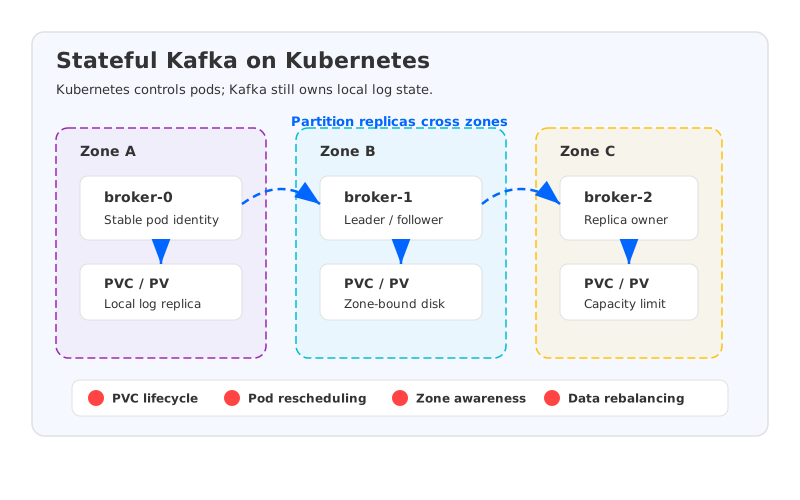
For small clusters, that distinction may feel academic. For production clusters with multi-zone availability, strict recovery objectives, long retention, or bursty workloads, it becomes the difference between a Kubernetes-native service and a stateful system that happens to be wrapped in Kubernetes objects.
1Kubernetes Can Run Kafka, but State Still Matters
The Kubernetes StatefulSet abstraction exists because some workloads need sticky identity and stable storage. Kubernetes documentation describes StatefulSets as a way to manage applications that need persistent storage or stable network identity, and it explicitly distinguishes those requirements from stateless replicas. Kafka fits that category. A broker identity is not interchangeable in the same way as a web server pod, because clients, controllers, partition leaders, followers, and storage all depend on broker identity and assignment.
A typical Kubernetes Kafka deployment maps these ideas into familiar objects:
- A StatefulSet or node pool provides ordered broker pods and stable names.
- A headless service exposes predictable DNS names.
- PersistentVolumeClaims request broker storage.
- PersistentVolumes map to cloud block disks, local disks, or CSI-provisioned storage.
- Pod affinity, anti-affinity, and topology spread rules try to keep replicas across zones or nodes.
- PodDisruptionBudgets and rolling updates limit how many brokers can be unavailable at once.
This is a reasonable model. It gives platform teams repeatability, infrastructure-as-code, and integration with Kubernetes security and observability. The mistake is treating those objects as if they make Kafka stateless. They do not. They provide a better envelope around state.
Kafka's data plane still works through partition leaders and replicas. When a broker owns replicas, those replicas are stored on that broker's log directories. If the broker pod moves, Kubernetes needs to reattach or remount the right storage. If the broker is replaced or the cluster is expanded, Kafka may need partition reassignment so data and load become balanced again. Kubernetes handles pod lifecycle; Kafka still handles log ownership.
2The Hard Parts of Kafka on Kubernetes
Most incidents in Kubernetes Kafka clusters are not caused by YAML syntax. They come from mismatches between Kubernetes failure handling and Kafka storage semantics. The hard parts are predictable, which is good news for architects. They can be designed for.
2.1Persistent Volumes and Broker Identity
PersistentVolumes have a lifecycle independent of individual pods. That independence is useful because a restarted Kafka pod can attach to the same storage and continue as the same broker. It also creates a binding that must be treated carefully. A PVC is not just a capacity request; for Kafka it often represents a broker's local log history.
That has several operational consequences. Deleting the wrong PVC can delete the wrong broker data. Recreating a pod without its expected volume can turn a normal restart into replica recovery. Moving from one storage class to another is not only a Kubernetes storage migration; it may require Kafka-level replica movement or node pool replacement. If the underlying volume is zonal, the scheduler must place the broker where the volume can attach.
Platform teams should therefore model Kafka storage as a first-class failure domain. The question is not only "does the pod come back?" It is "does the same broker identity return with the expected data, in the expected zone, with the expected throughput and latency?"
2.2Pod Rescheduling and Zone Awareness
Kubernetes rescheduling is a strength for stateless workloads. If a node dies, create the pod somewhere else. For Kafka, "somewhere else" may be constrained by storage attachment and replica placement. A cloud block volume is commonly zonal. A pod that needs that volume cannot freely restart in another zone unless the storage layer supports it or the data is rebuilt elsewhere.
Kafka availability planning has a second layer: partition replicas should be spread across failure domains. If all replicas of a partition land in one zone, the cluster may look healthy until a zone event exposes the placement mistake. Kubernetes can express topology rules, and operators can help apply rack awareness, but the design still needs alignment between Kafka replica assignment, Kubernetes node labels, storage classes, and cloud availability zones.
The cost model follows the topology. Multi-zone replication may increase cross-zone traffic. Zonal disks can be lower-latency and predictable, but they tie broker recovery to zone capacity. Network-attached or replicated storage may relax rescheduling constraints, but it can change latency, throughput, and cost. There is no single answer; the right answer depends on whether the cluster is optimized for throughput, recovery time, storage cost, or operational simplicity.
2.3Storage Expansion Is Not Elasticity
Kubernetes supports expanding many PVC-backed volumes when the StorageClass allows it. Strimzi also documents persistent volume resizing for Kafka clusters that use persistent-claim volumes. This is valuable, but it should not be confused with Kafka elasticity.
Increasing a disk gives an existing broker more space. It does not automatically rebalance partitions, reduce hotspot brokers, or separate retention growth from compute capacity. If broker CPU is idle but disk is full, increasing the volume may be the right short-term move. If some brokers are overloaded while others are underused, storage expansion may postpone a reassignment rather than solve the distribution problem.
The distinction matters in capacity planning. Kubernetes teams often expect horizontal scaling to be the default answer: add pods, spread load, remove pods when demand falls. Traditional Kafka scaling is more stateful. Adding brokers creates new capacity, but existing partitions do not magically redistribute themselves without a balancing process. Removing brokers requires even more care because their replicas must move somewhere else first.
2.4Rebalancing Is Data Movement
Kafka partition reassignment is the operational step that makes scaling feel different from ordinary Kubernetes scaling. Adding brokers is mechanically straightforward, but new brokers do not carry existing data until partitions are moved. During reassignment, replicas are copied, leaders may move, replication traffic competes with client traffic, and operators need throttling and monitoring to avoid turning a balancing event into a production incident.
This is why "Kafka on Kubernetes architecture" should include a rebalance plan, not only a deployment plan. The plan should answer:
- How are partition movements generated and reviewed?
- What traffic limits protect producers and consumers during reassignment?
- Which metrics define a healthy rebalance: under-replicated partitions, request latency, disk throughput, network saturation, consumer lag?
- Who can pause, cancel, or roll back a movement?
- How often does the cluster need balancing after topic growth, retention changes, or node pool changes?
A Kubernetes operator can automate parts of this workflow. It can also make the workflow safer and more repeatable. But the physical work remains: bytes move from one broker-local log to another.
3What Operators Solve and What They Do Not
Kafka operators such as Strimzi are a major improvement over hand-built Kubernetes manifests. They encode common deployment patterns, manage custom resources, coordinate rolling updates, handle listeners and certificates, support storage configuration, integrate with node pools, and expose Kubernetes-native workflows for Kafka administration. For many teams, using an operator is the difference between an experimental Kafka-on-Kubernetes deployment and an operable one.
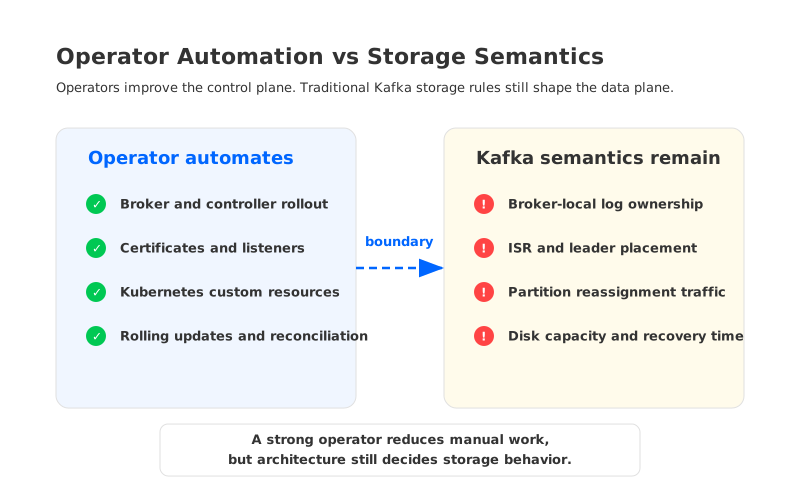
The boundary is important. Operators automate the management plane. They do not repeal the data plane. Traditional Kafka still has partition replicas, broker-local logs, disk capacity, ISR health, leader placement, and reassignment cost. A good operator can reduce human error around those concerns, but it cannot make a local-disk Kafka architecture behave like a stateless Deployment.
This is also why a Kubernetes Kafka design should avoid two extremes. The first extreme is "never run Kafka on Kubernetes," which ignores the maturity of operators and the value of standardized platform operations. The second is "Kubernetes will handle it," which ignores the storage behavior that Kafka depends on. The useful middle position is more precise: Kubernetes is a strong control plane for Kafka, as long as architects keep Kafka's storage and rebalance semantics visible.
4How Stateless Kafka Changes the Kubernetes Model
The architectural alternative is to change what the broker owns. If brokers no longer hold long-lived durable log data on local disks, Kubernetes can treat broker pods more like compute. Storage still exists, of course. It moves into a shared storage layer, typically object storage plus a write-ahead or metadata path designed for streaming semantics. The broker becomes responsible for Kafka protocol handling, caching, coordination, and serving traffic, while durable data is no longer permanently attached to a single pod's disk.
AutoMQ is one example of this category: a Kafka-compatible streaming system that replaces the traditional broker-local storage layer with shared object-storage-backed storage. Its architecture is relevant to Kubernetes not because it removes every stateful concern, but because it changes the unit of recovery and scaling. Broker replacement no longer implies restoring a large local log. Partition movement can become more about metadata, leadership, and cache warming than bulk disk-to-disk copying.
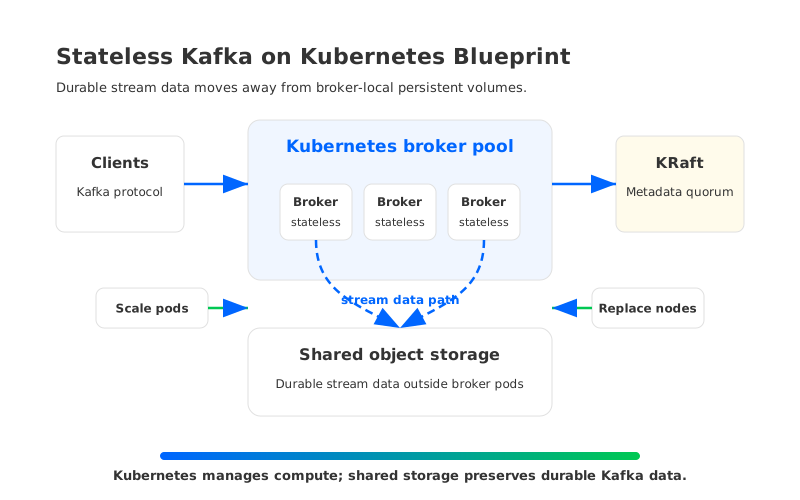
This model aligns more naturally with Kubernetes for several reasons. Brokers can be scheduled and replaced with fewer persistent-volume dependencies. Horizontal scaling can add serving capacity without first moving large local replicas onto the new pod. Storage growth follows object storage capacity rather than broker disk provisioning. Node maintenance becomes less entangled with log ownership.
There are still design questions. Object storage has different latency and I/O characteristics than local SSDs, so the streaming storage engine must handle write paths, caching, batching, metadata consistency, and recovery carefully. Architects should evaluate compatibility, operational maturity, observability, failure behavior, and migration paths. Stateless brokers are not magic; they are a different storage architecture with a different set of tradeoffs.
5Architecture Decision Checklist
The best Kubernetes Kafka architecture depends on the workload, not on a slogan. Use the following decision table to make the tradeoffs explicit.
| Architecture choice | Fits when | Watch carefully |
|---|---|---|
| Traditional Kafka on VMs | You want maximum control over disks, networking, and operating system tuning | Manual lifecycle management, slower infrastructure standardization |
| Traditional Kafka on Kubernetes with an operator | You want Kubernetes-native deployment while accepting broker-local persistent storage | PVC lifecycle, zone placement, rebalance operations, disk expansion, disruption budgets |
| Managed Kafka service | You want to offload most operations to a provider | Cost transparency, network architecture, scaling limits, data residency, feature control |
| Kafka-compatible stateless brokers on Kubernetes | You want Kafka APIs with storage-compute separation and object storage economics | Storage engine maturity, object storage dependency, compatibility validation, migration planning |
For architects evaluating kafka k8s, the practical recommendation is clear: start by deciding whether broker-local storage is acceptable for your operating model. If your Kafka clusters are stable, retention is modest, and rebalances are rare, an operator-managed StatefulSet can be a strong answer. If your teams frequently resize clusters, replace nodes, extend retention, or fight storage-driven cost growth, the storage architecture deserves a deeper look before the deployment model is finalized.
The real question is not whether Kafka can run on Kubernetes. It can. The question is whether your Kafka storage model behaves the way your Kubernetes platform expects workloads to behave.
6References
- Kubernetes StatefulSet documentation
- Kubernetes PersistentVolumes documentation
- Kubernetes StorageClasses documentation
- Apache Kafka basic operations: expanding a cluster
- Strimzi deploying and managing documentation
- AutoMQ architecture overview
- AutoMQ Kubernetes deployment overview
7FAQ
7.1Is Kafka good on Kubernetes?
Kafka can run well on Kubernetes when the architecture treats it as a stateful distributed log, not as a stateless microservice. Use a mature operator, persistent storage, topology-aware placement, PodDisruptionBudgets, monitoring, and a tested rebalance process. The risk is not Kubernetes itself; the risk is hiding Kafka storage ownership behind Kubernetes automation.
7.2Why is Kafka on Kubernetes hard?
The hardest part is the combination of StatefulSet identity, PersistentVolumes, broker-local logs, zone placement, and partition reassignment. Kubernetes can restart and reschedule pods, but Kafka still needs correct replica placement, disk capacity, ISR health, and controlled data movement.
7.3Do Kafka operators make Kafka stateless?
No. Operators automate deployment and many day-two tasks, but traditional Kafka brokers still own local log data. Operators reduce operational burden; they do not change Kafka's storage semantics unless the underlying Kafka-compatible system uses a different storage architecture.
7.4What is the difference between Stateful Kafka and stateless Kafka on Kubernetes?
Stateful Kafka keeps durable partition data on broker-local persistent volumes. Stateless Kafka-compatible architectures move durable stream storage into shared storage, often object storage, so brokers behave more like replaceable compute nodes. The second model can better match Kubernetes scaling and recovery patterns, but it must be validated for compatibility, latency, and operational maturity.
7.5When should architects consider AutoMQ for Kubernetes Kafka?
Consider AutoMQ when the main pain is not deploying Kafka but operating broker-local storage: frequent rebalancing, storage expansion, node replacement, long retention, or cost pressure from over-provisioned disks and replication. It is most relevant when the team wants Kafka compatibility while moving toward stateless brokers and object-storage-backed shared storage.


