
Table of Contents
Table of Contents
Private cloud teams search for Kafka on MinIO for different reasons. One team may want Kafka Connect to write events into an on-prem object store. Another may want Apache Kafka tiered storage to move older log segments out of broker disks. A platform architecture team may be asking a deeper question: can Kafka-compatible brokers use MinIO as the shared storage foundation, so compute nodes are no longer permanent owners of retained data?
Those questions use the same words but describe different systems. Treating them as one design leads to weak capacity models, unclear failure boundaries, and disappointment during proof of concept testing. MinIO is S3-compatible object storage; Kafka is a streaming log with ordering, offsets, consumer groups, and strict durability expectations. A workable design starts by deciding which role MinIO plays.
The private cloud context makes this more important. Public cloud object storage hides much of the physical topology behind a regional service. In a private cloud, the object store is your platform. The same team often owns Kubernetes nodes, storage servers, leaf-spine networks, DNS, certificates, access keys, observability, and disaster recovery rules. Kafka on MinIO therefore becomes an architecture review, not a connector setting.
1Three Meanings of Kafka on MinIO
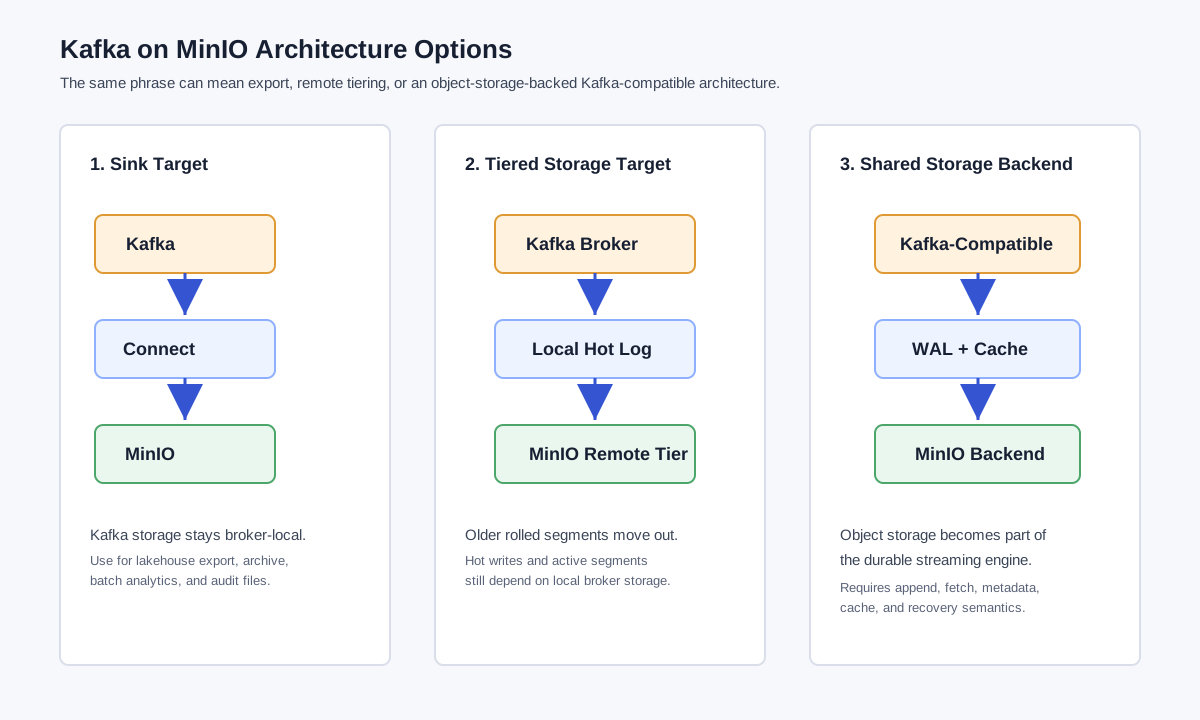
The first meaning is MinIO as a sink target. Kafka runs normally on broker-local disks, and Kafka Connect writes selected records to MinIO buckets. This is common for lakehouse ingestion, audit archives, machine learning pipelines, and batch analytics. The Kafka cluster does not become object-storage-backed; MinIO receives a copy of data after Kafka has already accepted it.
This pattern is a strong fit when the goal is downstream persistence. The platform team can tune connector tasks, object naming, file formats, flush intervals, and compaction without changing Kafka's core storage path. The tradeoff is that Kafka retention and replay still depend on broker storage. If an application needs to reset offsets and read the original topic, the MinIO export is not a substitute for retained Kafka log data.
The second meaning is MinIO as a tiered storage target. Apache Kafka's tiered storage design, described in KIP-405, keeps the active local log path while moving older rolled segments to a remote tier. MinIO can act as an S3-compatible remote object store in that model if the tiered storage plugin and deployment support it. This reduces pressure on broker disks for long retention, but brokers still own the hot write path and active local segments.
The third meaning is MinIO as a shared storage backend for a Kafka-compatible system. In this design, MinIO is not a downstream export and not only a cold tier. It is part of the durable storage substrate behind brokers that focus on Kafka protocol processing, leadership, cache, and coordination. The system must provide a streaming storage layer that turns object storage into append, fetch, trim, metadata, and recovery behavior compatible with Kafka workloads.
These three meanings are not interchangeable:
| Meaning | Role of MinIO | What changes in Kafka operations | Primary design question |
|---|---|---|---|
| Sink target | Destination for copied records | Kafka storage remains broker-local | How should events be landed for analytics or archive? |
| Tiered storage target | Remote tier for older segments | Local hot tier remains critical | How much retained history can leave broker disks? |
| Shared storage backend | Durable storage substrate | Brokers become less tied to retained data | Can compute and storage scale independently? |
For private cloud architects, the third pattern has the largest operational impact. It can reduce broker data ownership, but it also shifts more responsibility to the object storage platform and the network between brokers and MinIO.
2Private Cloud Network Design
Kafka and MinIO should be placed as if they are one data platform with two different latency profiles. Kafka clients send small produce and fetch requests that are sensitive to tail latency. MinIO handles larger object operations, healing traffic, metadata activity, and background load. A single flat network can work in a lab, but production design needs clear traffic classes.
At minimum, separate these paths logically even if they share physical switches:
- Client-to-Kafka traffic, usually through Kubernetes Services, load balancers, or private DNS names.
- Kafka-to-MinIO S3 API traffic, which should stay inside private routes and avoid public egress paths.
- MinIO east-west traffic for erasure-coded object writes, reads, healing, and server pool behavior.
- Control-plane traffic for Kubernetes, operators, certificates, identity, metrics, and logs.
The most common private cloud mistake is sizing only Kafka ingress and egress. In a shared storage design, the broker-to-object-store path becomes part of the write and recovery model. In a tiered storage design, historical replay can also pull large ranges from MinIO through brokers. In a sink design, Kafka Connect workers may generate bursty object writes during flush cycles. Each meaning of Kafka on MinIO stresses the network differently.
Network locality matters. If Kafka brokers are distributed across zones, racks, or rooms, decide whether MinIO is a regional object service reachable with uniform latency, or whether storage access should prefer local failure domains. A stretched object store can give the appearance of one bucket while hiding cross-domain traffic on every write. That may be acceptable for archive exports and poor for low-latency shared storage.
Private endpoints, internal DNS, TLS certificates, and MTU settings also belong in the design review. S3-compatible endpoints are often treated as generic URLs, but Kafka workloads expose small routing mistakes quickly. A certificate mismatch, DNS TTL problem, proxy hop, or overloaded NAT path can become producer latency, consumer lag, or connector retry storms.
3Failure Domains Are the Real Architecture
In public cloud diagrams, an availability zone is a convenient label. In private cloud, failure domains are engineered. A domain may be a rack, power feed, top-of-rack switch, storage server pool, Kubernetes node pool, or data hall. Kafka and MinIO need a shared failure-domain vocabulary before anyone can claim high availability.
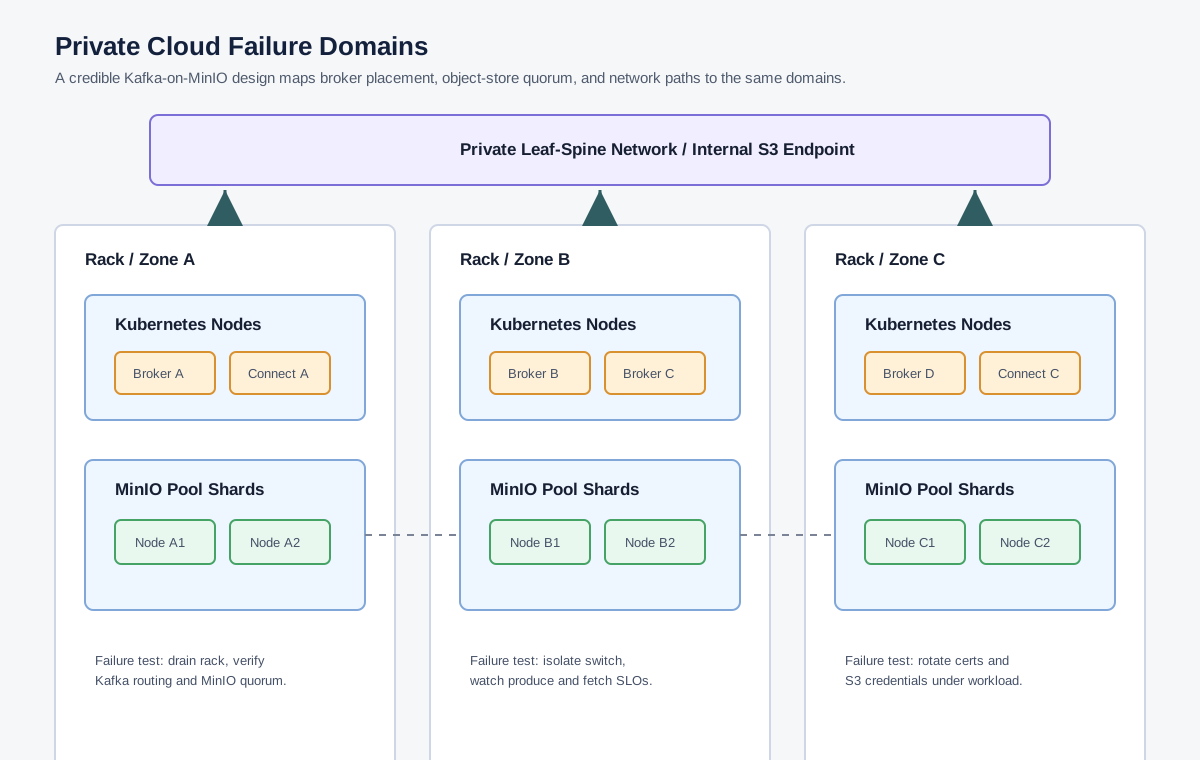
MinIO uses erasure coding to distribute object shards across drives in an erasure set. Its documentation describes data and parity shards, read quorum, and write quorum. That matters for Kafka because a storage-side quorum loss is not a Kafka broker failure; it is a durable storage availability event. The Kafka architecture must define what happens when MinIO loses drives, a storage node, a rack, or a network partition.
For sink exports, a MinIO outage may block connector delivery while Kafka continues to accept writes until connector lag or retention becomes a problem. For tiered storage, a MinIO outage may affect remote segment upload and historical fetch. For a shared storage backend, MinIO availability is on the core durability path, so failure testing must be closer to producer acknowledgment behavior.
Designers should map each component to an expected blast radius:
| Failure event | Sink target impact | Tiered storage impact | Shared storage backend impact |
|---|---|---|---|
| Kafka broker restart | Connector may rebalance | Local Kafka recovery path applies | Broker should recover without copying retained history |
| MinIO node loss | Export retries or slows | Remote tier operations may slow | Storage quorum and latency directly affect Kafka service |
| Rack isolation | Depends on worker placement | Depends on local and remote tier paths | Must preserve both broker routing and object-store quorum |
| DNS or certificate failure | S3 writes fail | Remote tier access fails | Produce, fetch, or recovery path may fail depending on design |
The point is not to avoid failures. The point is to know which layer owns each failure and which SLO is affected. A private cloud architecture is credible only when a platform engineer can pull a node, drain a rack, rotate credentials, or throttle an object-store pool and predict the user-visible outcome.
4Buckets, Object Layout, and Credentials
Bucket design should match responsibility boundaries. A Kafka Connect sink should not share a bucket prefix with Kafka internal storage. Tiered storage and shared storage backends should have dedicated buckets or prefixes, lifecycle policies, encryption rules, access policies, and monitoring. Mixing them makes audit, cleanup, and incident response harder.
Use least-privilege credentials per workload class. A connector writing analytics files may need put, abort multipart upload, and list permissions for its own prefix. A Kafka tiered storage plugin may need read, write, list, and delete behavior for remote log metadata and segment objects. A shared storage backend may need broader object operations because it manages stream objects, indexes, compaction, and recovery state. Do not copy one access key across all Kafka-related components because the endpoint happens to be the same.
Credential rotation needs a runbook. In Kubernetes, that usually means Secrets, service accounts, external secret controllers, or a private identity provider. The rotation test should cover active producers, active consumers, background compaction, connector retries, and broker restart. If credentials are static environment variables injected at pod start, rotation may require a rolling restart; the architecture should say so.
Object layout is another place where private cloud teams can lose performance. Object storage is efficient when writes are batched into object-friendly sizes and reads use predictable ranges. Kafka, however, receives ordered appends and serves offset-based fetches. A connector can buffer records into files. Tiered storage uploads rolled segments. A shared storage engine needs its own layout, metadata, and compaction strategy so the object store does not become a tiny-object bottleneck.
5Latency and Capacity Planning
Capacity planning for Kafka on MinIO has to include Kafka throughput, retained bytes, object operations, network paths, and storage-side redundancy. A single "TB per day" number is not enough. Two workloads with the same retained volume can have very different object request rates and replay behavior.
For a private cloud PoC, model these inputs before choosing hardware:
- Sustained produce throughput and peak produce throughput per Kafka cluster.
- Consumer fanout near the tail and expected historical replay frequency.
- Retention period by topic class, not only by total cluster.
- Target producer acknowledgment latency and acceptable p99 fetch latency.
- Object-store parity policy, usable capacity ratio, and rebuild traffic.
- Expected PUT, GET, LIST, delete, multipart, and range-read behavior.
- Kubernetes node placement, storage node placement, and east-west bandwidth.
Latency planning should separate the acknowledgment path from background object organization. In a sink pattern, producer acknowledgment is Kafka-local; MinIO latency affects export lag. In tiered storage, producer acknowledgment still depends on Kafka's local path, while remote reads affect historical fetch. In a shared storage backend, the implementation must define what durable step happens before acknowledgment and how write-ahead storage, cache, and object upload interact.
AutoMQ Software and AutoMQ Open Source are relevant in this third category. AutoMQ is Kafka-compatible and uses S3-compatible object storage through S3Stream as a shared storage architecture. In private cloud deployments, that storage can be provided by systems such as MinIO when the environment satisfies the required S3-compatible endpoint, bucket, credential, latency, and capacity characteristics. AutoMQ Open Source uses S3-compatible storage for its WAL option, while commercial deployments may use other WAL media depending on the deployment model; the important architectural point is that object storage is treated as part of the Kafka storage engine, not as a passive archive.
This makes PoC testing more concrete. Instead of asking whether Kafka can write to MinIO, ask whether the full system preserves Kafka behavior under private cloud conditions: producer acknowledgments, consumer lag, broker replacement, object-store healing, credential rotation, DNS changes, and long replay.
6A Practical PoC Sequence
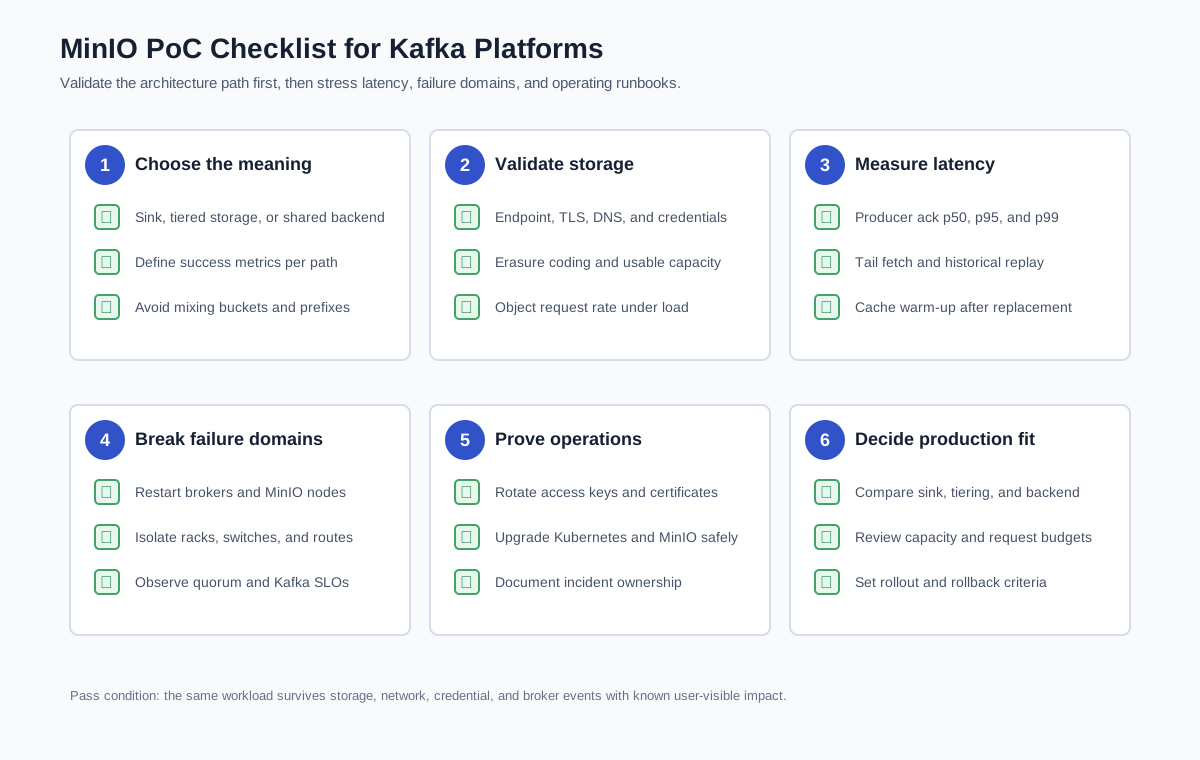
Start with the meaning of Kafka on MinIO you intend to validate. A sink PoC should test connector throughput, file layout, schema handling, retry behavior, and downstream query usability. A tiered storage PoC should test local retention, remote upload, remote fetch, topic configuration, and operational visibility. A shared storage PoC should test the Kafka-compatible system as a whole, including the write path and recovery path.
Then run failure tests before scaling tests. Many teams do this in the opposite order and get attractive throughput numbers that say little about production readiness. Pull a Kafka broker. Restart a MinIO node. Block an S3 endpoint route. Rotate access keys. Expire a certificate. Drain a Kubernetes node. Watch producer latency, consumer lag, object-store metrics, and platform alerts at the same time.
Capacity testing should include historical replay. Long-retention Kafka platforms are rarely stressed only by steady tailing consumers. Backfills, new consumer groups, incident investigations, and analytics jobs can read old offsets at the least convenient time. In a MinIO-backed design, replay tests reveal whether cache, range reads, object layout, and MinIO request capacity are aligned.
Finally, turn the PoC into an operating model. Define who owns bucket policies, MinIO upgrades, Kafka upgrades, object-store alerts, certificate rotation, storage expansion, disaster recovery drills, and incident handoff. Kafka on MinIO is not a single product checkbox. It is a platform contract between streaming compute and private cloud object storage.
7References
- Apache Kafka KIP-405: Kafka Tiered Storage
- MinIO Erasure Coding
- MinIO Availability and Resiliency
- MinIO Server Reference
- AutoMQ S3Stream Shared Streaming Storage Overview
- AutoMQ Object Storage Configuration
8FAQ
8.1Can Apache Kafka use MinIO as storage?
Kafka can use MinIO in multiple ways, but the meaning matters. Kafka Connect can export records to MinIO as a sink. Tiered storage can use an S3-compatible target for older segments when the plugin and deployment support it. A Kafka-compatible shared storage system can use MinIO as part of its durable backend if it implements the streaming semantics around object storage.
8.2Is MinIO a replacement for Kafka broker disks?
Not for ordinary Kafka by itself. Traditional Kafka still depends on broker-local storage for its active log path. MinIO can reduce pressure through export or tiering, while a shared storage architecture requires a Kafka-compatible engine designed to use object storage as durable storage.
8.3What should platform teams test first?
Test failure behavior before celebrating throughput. Broker restart, MinIO node loss, endpoint routing failure, credential rotation, certificate expiry, and historical replay reveal whether the architecture is production-ready.
8.4Where does AutoMQ fit in a Kafka on MinIO design?
AutoMQ fits the shared storage backend meaning. It keeps Kafka protocol compatibility while using S3-compatible object storage through S3Stream, which makes it relevant for private cloud teams evaluating MinIO-backed Kafka-compatible storage architectures.


