
Table of Contents
Table of Contents
Teams rarely search for Kafka on S3 because they want a dictionary definition. They search because a practical boundary has become blurry. Does the team need to export Kafka data into Amazon S3? Is the question about Apache Kafka tiered storage? Is the goal to run a Kafka-compatible streaming platform whose durable storage is backed by S3? Or is Finance asking why retained event data and broker disks keep growing together?
Those are different decisions. A connector that writes topic data into object storage helps a lakehouse workflow, but it does not change how Kafka brokers acknowledge writes. Tiered storage can move older log segments away from local broker disks, but the hot path still has broker-local responsibilities. A shared-storage Kafka-compatible architecture makes object storage central to durability, usually with a WAL and cache layer between clients and S3.
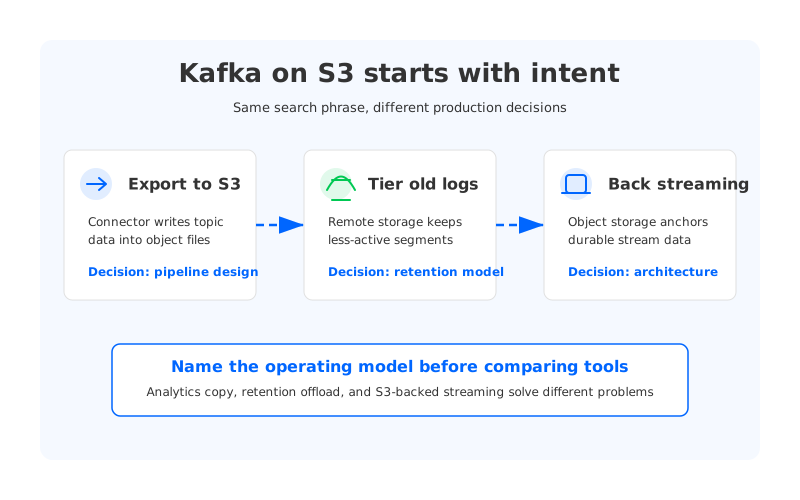
The phrase is useful only after the team names the intent. Without that step, a review can compare unrelated things: a sink connector, a retention feature, a managed Kafka service, and another streaming engine. The better question is: "which part of the Kafka operating model are we trying to change?"
1Why Kafka on S3 means several things
Kafka and S3 sit next to each other in many data platforms, but they usually play different roles. Kafka is the low-latency stream log that applications produce to and consume from. S3 is the durable object store that analytics systems, backups, and long-retention datasets often rely on. Putting the two names together can describe integration, storage offload, or a different broker architecture.
The first intent is Kafka-to-S3 export. In this model, Kafka remains the system of record for streaming applications while a connector or pipeline writes topic data into S3 for downstream processing. The evaluation questions are connector semantics, file format, partitioning layout, schema evolution, error handling, and replay behavior.
The second intent is tiered storage. Apache Kafka documents tiered storage as a way to keep less frequently accessed log segments in remote storage. This can reduce pressure on broker-attached disks and help longer retention policies fit more comfortably. It does not make every broker responsibility disappear. Teams still need to validate hot-path behavior, remote reads, tooling, and upgrade maturity.
The third intent is S3-backed Kafka-compatible architecture. Here the team is not asking how to copy Kafka data to S3 after the fact. It is asking whether durable stream storage itself can be based on object storage while preserving Kafka client compatibility. That deserves a different proof plan than a connector test.
These intents often appear in the same search session because they share the same pain: data volume grows, replay becomes more common, and local broker storage feels like the wrong place for long-lived event history. The shared pain is real. The remedies are not interchangeable.
2The connector path: export is not storage architecture
Kafka-to-S3 export is the most familiar path because it fits the existing Kafka mental model. Producers write to Kafka, consumers continue to consume from Kafka, and a connector writes records into S3 in batches. Data teams then query the exported files with engines such as Spark, Trino, Athena, or a lakehouse table format.
That separation is a strength when the goal is analytics integration. A connector can provide file rollover policies, compression choices, schema handling, object naming patterns, and dead-letter behavior. It shapes streaming records for query engines while application teams stay on familiar Kafka topics.
The same separation becomes a limitation when the real issue is Kafka infrastructure cost or recovery. Exporting records to S3 does not reduce the bytes Kafka brokers must accept, retain on the hot path, or serve to consumers. It may even add another consumer workload that reads every record. That can be right for analytics, but it is not a broker storage redesign.
Use the connector path when the required outcome is downstream data availability:
- Lakehouse ingestion. Teams need topic data in S3 with predictable object layout, formats, and replay controls.
- Batch consumption. Teams want historical Kafka data available to systems that prefer object storage files over Kafka fetches.
- Pipeline isolation. Teams want analytics jobs away from production application topics.
The approval evidence should match the intent. Test file correctness, idempotent export behavior, failure recovery, schema changes, and object lifecycle policies. Do not use a connector test as evidence that broker scaling, cross-zone traffic, or retained log recovery has been solved.
3The tiered storage path: offload does not equal stateless brokers
Tiered storage addresses a different problem. Instead of exporting a separate copy for analytics, the Kafka cluster uses remote storage for older log segments. This can be attractive when retention requirements grow faster than broker disks.
The distinction between hot and cold paths matters. Kafka brokers still handle producers, consumers, partition leadership, coordination, and the active log. Remote storage changes where older segments live and how they are fetched, but the team still needs to understand which operations remain tied to broker state.
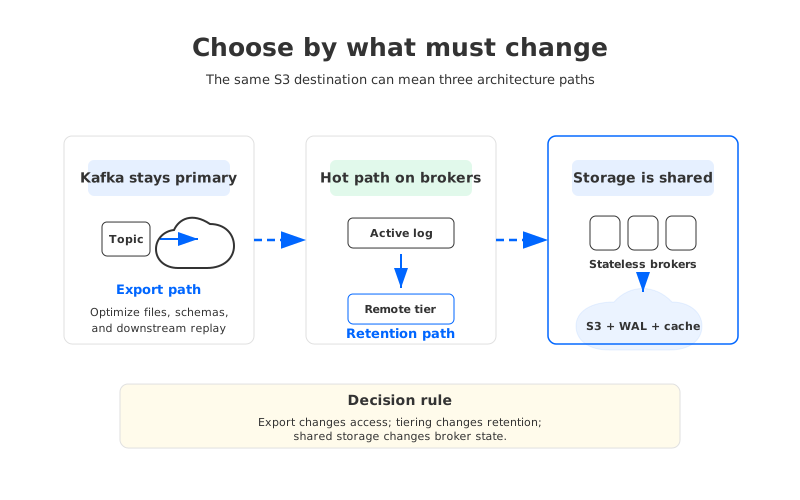
Good tiered storage evaluation is specific about byte paths. When a producer receives an acknowledgment, where is the authoritative copy? When a consumer replays old data, which storage tier serves the fetch? When a broker is replaced, how much local state must be rebuilt? Those questions turn a feature label into an operational model.
Tiered storage can be the right answer for teams that want to extend retention without redesigning the platform. It is less complete when the triggering pain is elastic scaling, broker replacement time, cross-zone write amplification, or a desire to decouple compute and storage more aggressively.
4The S3-backed architecture path: change the durability boundary
An S3-backed Kafka-compatible architecture changes the decision boundary more directly. The core idea is to keep Kafka protocol compatibility while moving durable stream storage from broker-local disks into shared object storage. Because S3 has different latency and access characteristics from local disks, practical systems also need a write-ahead log, cache design, metadata discipline, and careful recovery behavior.
This is where platform teams should slow down. Object storage is durable and elastic, but Kafka clients expect low-latency acknowledgments, ordered reads, predictable consumer group behavior, retention semantics, quotas, ACLs, and operational metrics. If the architecture bridge is weak, the system may look attractive in a cost model and still fail the production contract.
The evaluation should therefore start with observable behavior rather than vendor diagrams:
| Decision area | What to prove | Why it matters |
|---|---|---|
| Write path | Acknowledgment, durability point, retry behavior, idempotence, and latency under load | Producers depend on clear write guarantees beyond protocol compatibility |
| Read path | Tail reads, historical replay, cache hit behavior, and degraded storage paths | Consumers feel the storage design during lag recovery and replay |
| Storage independence | Retention growth without proportional broker disk growth | Long-lived streams should not force compute and storage to scale together |
| Network path | Cross-zone movement during writes, reads, recovery, and scaling | Cloud networking can dominate the bill for replicated streaming workloads |
| Operations | Broker replacement, scaling, metrics, logs, upgrades, and rollback | Architecture value disappears if runbooks become harder under incident pressure |
This table avoids the trap of comparing object storage claims in the abstract. The question is not whether S3 is durable. The question is whether the streaming system built around S3 preserves the Kafka behaviors your workloads actually use.
5Cost modeling starts with byte ownership
The cost appeal of S3 is clear: object storage is elastic, widely supported, and priced differently from broker-attached compute and disks. The engineering question is more subtle. Kafka cost combines broker instances, storage, inter-zone traffic, private connectivity, object operations where used, observability, support, and migration overlap.
A useful Kafka on S3 cost model separates four byte paths:
- Ingest bytes. Records entering the system, including batching, compression, durability writes, and connector consumers that read every record.
- Retained bytes. Historical data kept for replay, backfill, or state reconstruction.
- Fan-out bytes. Consumer reads, including multiple consumer groups and heavy historical replay.
- Recovery bytes. Data moved or fetched during broker replacement, zone impairment, or scale events.
Traditional Kafka clusters often make retained bytes and broker capacity feel coupled because brokers own local log data. Tiered storage can reduce that coupling for older segments. Shared-storage systems push the separation further by making durable storage independent from broker compute. The shape of savings depends on which byte path dominates.
This is why a pricing comparison that looks only at broker subscription or instance cost is incomplete. A platform with low compute cost can still create expensive network movement. A platform with object storage economics can disappoint if replay creates unexpected request or data transfer patterns. Model steady state, growth state, replay state, and failure state.
6Migration risk is mostly about semantics
Changing how Kafka relates to S3 can be a small pipeline change or a platform migration. Adding a Kafka-to-S3 connector requires validation around exported files and downstream consumers. Enabling tiered storage requires validation around retention, remote reads, operational visibility, and rollback. Moving to another Kafka-compatible shared-storage platform requires a full compatibility and cutover plan.
The risky part is rarely copying bytes alone. Kafka applications depend on offsets, ordering, topic configuration, ACLs, consumer group behavior, quotas, transactions where used, and monitoring conventions. A migration can move data and still break applications if those semantics change unexpectedly.
A practical migration plan has four gates. First, inventory the Kafka features that production workloads actually use. Second, run representative producers and consumers with realistic client settings and failure injection. Third, run shadow traffic long enough to observe lag, replay, security, and cost behavior. Fourth, rehearse rollback with the same dashboards and owners who will handle cutover.
The first workload should have real producers, real consumers, meaningful ACLs, familiar lag behavior, and an owner who can judge correctness. Migration confidence comes from representative friction, not from a perfect happy path.
7A production readiness scorecard
By the time a team moves from research to architecture review, the output should be a scorecard rather than a preference list. The scorecard should compare connector export, tiered storage, and S3-backed Kafka-compatible architecture without pretending they solve the same problem.
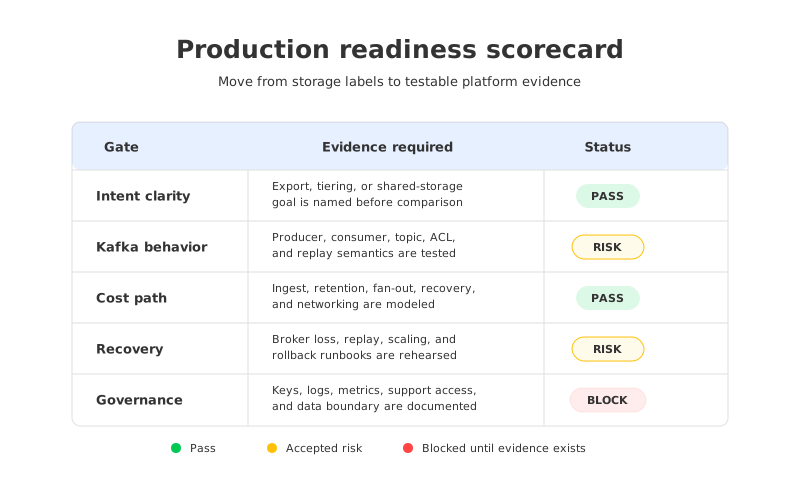
Use three states: pass, accepted risk, and blocked. Connector export may fit analytics but be irrelevant to broker recovery. Tiered storage may fit retention growth but leave some write-path cost drivers unchanged. Shared-storage architecture may improve elasticity while requiring deeper validation around WAL, cache behavior, and operational ownership.
| Evaluation question | Pass condition | Blocked signal |
|---|---|---|
| Intent clarity | The team has named export, tiering, or S3-backed streaming as the primary goal | Stakeholders compare unrelated options under one label |
| Kafka behavior | Producer, consumer, topic, security, and operational semantics are tested with real settings | The proof relies on a basic produce-consume smoke test |
| Cost path | The model includes ingest, retention, fan-out, recovery, networking, and migration overlap | The business case compares only storage price |
| Recovery | Broker loss, replay, scale events, and rollback have rehearsed runbooks | Recovery depends on manual interpretation during an incident |
| Governance | Data plane, control plane, keys, logs, metrics, and support access are documented | Security review starts after the platform decision |
This scorecard also prevents over-migration. If the real need is a lakehouse copy, a connector may be enough. If only retention is painful, tiered storage may be the conservative change. If broker-local disks, recovery, and network movement dominate the operating model, a shared-storage Kafka-compatible system deserves a serious test.
8Where AutoMQ fits
AutoMQ belongs in the third category: Kafka-compatible streaming with shared storage. It uses S3Stream Shared Storage architecture, stateless brokers, object-storage-backed durability, and WAL storage to separate durable stream data from broker-local disks while preserving Kafka client compatibility. That makes AutoMQ relevant when Kafka on S3 is really about changing the storage and recovery model, not only exporting records into S3.
Evaluate AutoMQ with the same scorecard used for any architecture candidate. Keep the test neutral: run representative Kafka clients, validate producer and consumer semantics, model byte paths, observe replay behavior, rehearse broker replacement, and document governance boundaries. AutoMQ's architecture is designed for independent compute and storage scaling and for reducing inter-zone traffic in cloud deployments, but those advantages should be proven against your workload.
This is the useful endpoint of a Kafka on S3 search. The team should know whether it needs a connector, tiered storage, or a different Kafka-compatible storage architecture. It should know which byte paths drive cost, which semantics must not change, and which runbooks must work during failure. If shared-storage Kafka compatibility is the path worth testing, review the AutoMQ Cloud Console with one representative workload and use the same intent, cost, recovery, and governance scorecard before making the platform decision.
9References
- Apache Kafka documentation
- Apache Kafka Connect documentation
- Apache Kafka Tiered Storage documentation
- AWS pricing: Amazon S3
- AWS pricing: Amazon EC2 On-Demand data transfer
- AWS pricing: Amazon MSK
- AutoMQ documentation: Compatibility with Apache Kafka
- AutoMQ documentation: S3Stream Shared Streaming Storage
- AutoMQ documentation: WAL storage
- AutoMQ documentation: Eliminate inter-zone traffic overview
10FAQ
10.1Does Kafka on S3 mean Kafka Connect writing data to S3?
Sometimes. Many teams use the phrase to mean exporting Kafka topic data into S3 for analytics, audit, or lakehouse ingestion. That is a connector or pipeline decision, not a change to Kafka's broker storage model.
10.2Is Apache Kafka tiered storage the same as S3-backed Kafka?
No. Tiered storage moves older log segments to remote storage while Kafka brokers still own important hot-path responsibilities. S3-backed Kafka-compatible architecture makes shared object storage part of the primary durability model and needs WAL, cache, metadata, and recovery mechanisms to preserve Kafka behavior.
10.3What should platform teams test first?
Start by naming the intent: export, tiering, or shared-storage streaming. Then test the Kafka behaviors that production applications depend on, including producer acknowledgments, consumer groups, offsets, retention, ACLs, replay, metrics, and rollback.
10.4How should FinOps teams model Kafka on S3 cost?
Model byte paths rather than product labels. Include ingest, retained data, consumer fan-out, replay, recovery, cross-zone movement, private connectivity, object storage operations, observability, and migration overlap.
10.5Where does AutoMQ fit in a Kafka on S3 evaluation?
AutoMQ fits when the goal is a Kafka-compatible shared-storage architecture backed by object storage, not merely a sink connector. It should be evaluated with representative workloads, neutral compatibility tests, cost modeling, recovery drills, and governance review.


