
Table of Contents
Table of Contents
Kafka operational complexity usually shows up as an organizational symptom before it shows up as an architecture review. The cluster is running, producers and consumers are healthy most days, and yet every meaningful change still needs the same few people. They know which topics are hot, which brokers are near disk limits, which dashboards matter during a reassignment, and which upgrade step must not be rushed.
That is the first sign Kafka has become more than a messaging system. It has become a platform. The difficulty is not that Apache Kafka is poorly designed; Kafka's design has carried demanding production workloads for years. The difficulty is that its reliability model exposes many distributed-system responsibilities to the team that operates it. At small scale, those responsibilities fit inside normal infrastructure work. At larger scale, Kafka operations become a discipline of their own.
1The First Sign Kafka Has Become a Platform Problem
The phrase "Kafka is hard to operate" can sound too broad to be useful. One team might run a few brokers for years with little drama. Another might operate many clusters, thousands of partitions, long retention, multiple availability zones, strict latency SLOs, and continuous application changes.
The platform problem starts when Kafka reliability depends on specialist memory. Someone knows why a topic has a nonstandard retention policy. Someone remembers the last time a broker replacement caused replication lag. Someone can tell whether a consumer lag alert is a real outage or a replay. When those answers live in a small group of people, the business is depending on human routing, not only on infrastructure.
Engineering leaders should separate "Kafka works" from "Kafka is operationally mature." A working cluster can accept writes, serve reads, and survive ordinary broker restarts. A mature platform can absorb growth, maintenance, workload skew, upgrades, and incidents without turning each change into a bespoke investigation. The gap between those two states is where kafka operational complexity lives.
2The Operational Domains Kafka Teams Must Own
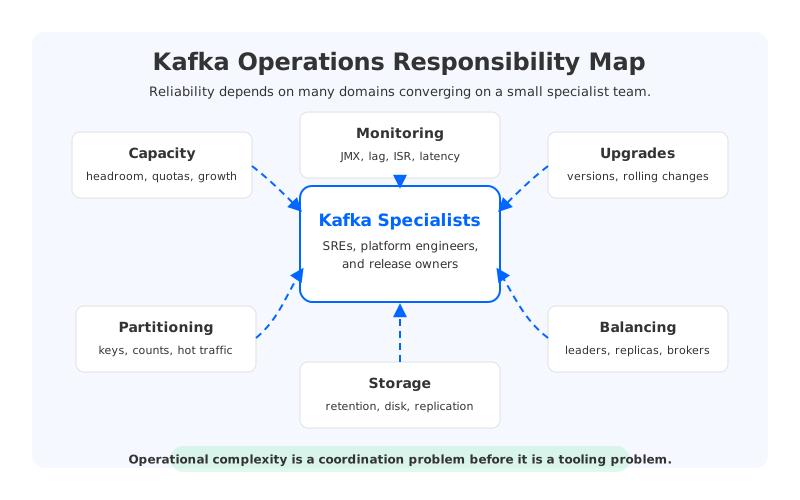
Kafka cluster management spans more domains than most teams expect when they first adopt it. The API is familiar to application teams, but the operational surface underneath it is wide. A platform team is not only keeping brokers online; it is managing the conditions under which ordering, durability, latency, replay, and throughput continue to hold.
The domains usually fall into eight buckets:
- Capacity planning. Brokers need enough CPU, memory, network, disk throughput, and disk space for normal traffic, peak traffic, replication, consumer replay, and maintenance work.
- Partitioning. Topic partition counts and key choices determine parallelism, ordering, hot partitions, metadata volume, and the future cost of reassignments.
- Balancing. Leaders, followers, disk usage, network load, and traffic skew need active attention because even replica counts do not guarantee even workload.
- Storage and retention. Retention settings, compaction, segment configuration, disk headroom, and replication factor shape both cost and recovery behavior.
- Upgrades and configuration changes. Broker versions, inter-broker protocol versions, feature gates, client compatibility, and rolling restart order all matter.
- Monitoring. Kafka exposes a large metric surface through JMX, including broker health, request latency, under-replicated partitions, controller state, network, logs, and consumer lag.
- Disaster recovery. Teams need plans for zone failure, region failure, data loss boundaries, replication lag, offset handling, and application cutover.
- Incident response. During an incident, operators must distinguish client issues, broker saturation, partition skew, storage pressure, controller events, and downstream lag quickly enough to act.
Each domain is manageable by itself. The complexity comes from coupling: capacity changes reassignment risk, partitioning changes monitoring and balancing behavior, retention changes disk pressure, and upgrades touch clients, broker configuration, and rollback. Better tooling helps, but the team still needs a mental model of how each control affects the rest of the cluster.
3Why Stateful Brokers Make Routine Work Risky
Traditional Kafka uses a Shared Nothing architecture: each broker manages its own local storage and participates in replication for the partitions it hosts. This model is one reason Kafka can deliver high throughput and strong locality. It also means a broker is not only a compute process. It is the owner of durable partition replicas.
That ownership changes the risk profile of ordinary maintenance. Adding a broker is not enough by itself; partitions need to be placed on it before capacity improves. Draining or replacing a broker means moving partition replicas away from it, so infrastructure work becomes data-placement work.
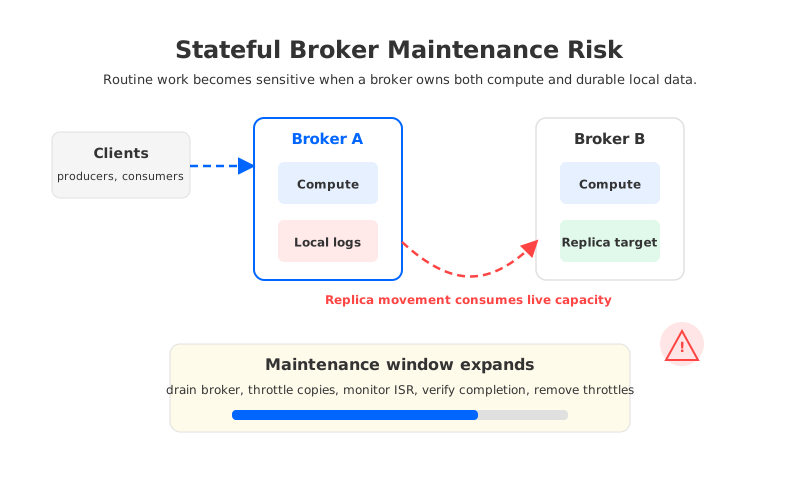
Apache Kafka's operations documentation reflects this reality. Partition reassignment is a planned operation: operators generate or provide a reassignment plan, execute it, verify it, and manage throttling so replica movement does not overwhelm production traffic. Broker decommissioning also depends on moving partitions away before the broker is removed. These are normal Kafka operations, not edge cases.
The hard part is that maintenance consumes the same resources the cluster needs to serve users. Replica movement uses network and disk I/O. Rebuilds can increase replication pressure. Large reassignment plans can run long enough to overlap with traffic changes or application deploys. Throttles reduce blast radius, but they also lengthen the period where the cluster is in transition.
This is the root of many "Kafka is complicated" stories. The operator is not only asking, "Can I change this broker?" The operator is asking:
- Which partition replicas will move?
- How many retained bytes will move?
- Which clients are already near latency limits?
- How much replication headroom exists during the window?
- What happens if another broker fails before the operation completes?
- Who can tell whether the cluster is safer after the change?
These questions are not signs that Kafka is bad. They show that Kafka's architecture makes storage ownership part of broker operations. At scale, that is a serious operating model.
4The Operational Loops That Create Staff Load
The hardest Kafka work often happens in loops that repeat every quarter: plan capacity, review partitions, rebalance, upgrade, monitor, and respond to incidents. Together, they explain why kafka operations become expensive in staff time.
Capacity planning is more than broker count. Producers write records, consumers fetch records, followers replicate records, and reassignment copies records. A cluster can have enough brokers for normal traffic and still lack headroom for peak load, broker drain, rolling restart, replay, or failure recovery. Many teams size Kafka conservatively because the cost of being wrong is high, which is rational but not free.
Partitioning creates a second loop. Partitions give Kafka parallelism and ordering, but they also affect metadata, leader distribution, replica placement, monitoring cardinality, and reassignment work. A topic created for a small workload may later become critical. A key that looked evenly distributed may become hot after product behavior changes. Adding partitions can help some throughput problems, but it does not automatically fix a dominant key or an ordering-sensitive application.
Upgrades create a third loop. A broker upgrade is not the same as restarting a stateless service behind a load balancer. Operators must consider client compatibility, broker versions, feature levels, rolling restart order, controller behavior, and rollback. Kafka's upgrade documentation is version-specific because protocol and feature activation need sequencing. Producers, consumers, Kafka Connect workers, stream processors, schema tooling, exporters, and automation scripts may all have assumptions that need testing.
Monitoring ties these loops together. Apache Kafka's monitoring documentation lists a broad broker, controller, network, log, and request metric surface. Teams also track consumer lag, produce errors, fetch latency, connector health, and end-to-end freshness. The challenge is interpreting signals during change. Under-replicated partitions can mean real risk or a controlled operation. Consumer lag can mean an outage, a replay, or a planned deploy.
This is where Kafka hard to operate becomes a workflow problem. Dashboards show symptoms, but incident response needs classification: client-side or broker-side, failing or recovering, overload or reassignment, throttle or add capacity, rollback or wait. Without runbooks and trained responders, monitoring produces noise. With the right operating model, it becomes decision support.
5A Kafka Operations Maturity Model
Because Kafka complexity grows gradually, teams need a maturity model that is more practical than "self-managed versus managed." The useful question is how much of the operating model is repeatable, automated, and safe under change.
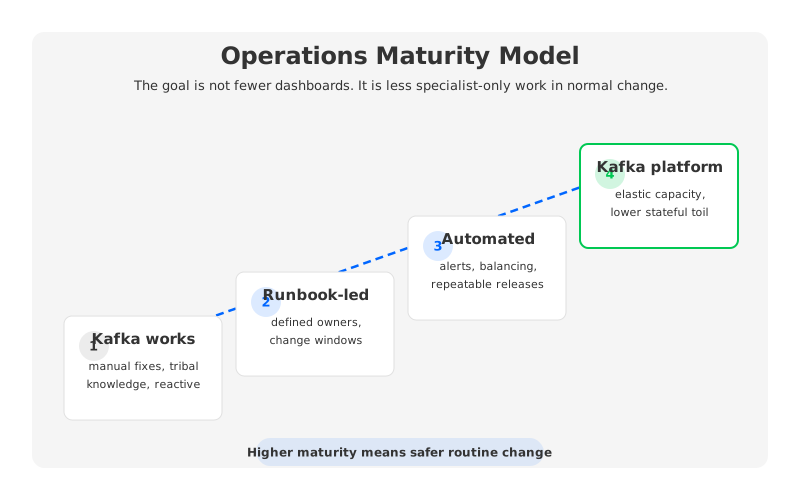
Stage 1: Kafka works. The cluster is healthy under normal traffic, but knowledge is informal. Topic creation, rebalancing, broker replacement, and incident response depend on a few people.
Stage 2: Runbook-led Kafka. The team has named owners, dashboards, alert thresholds, topic standards, reassignment procedures, upgrade checklists, and incident roles. Operations are still manual, but they are no longer improvised.
Stage 3: Automated Kafka. Provisioning, monitoring, reassignment planning, deployment, configuration review, and alert routing are partly automated. Automation reduces toil, but the cluster may still be constrained by broker-local data movement.
Stage 4: Kafka as a platform. Kafka is treated as an internal product with lifecycle management, service levels, self-service guardrails, cost visibility, capacity policy, disaster recovery practice, and continuous improvement. The best version of this stage reduces the number of operations that require specialist intervention in the first place.
The maturity model helps leaders estimate staff time and risk. If the team is at Stage 1 but Kafka carries customer-facing workflows, the risk is organizational as well as technical. If the team is at Stage 3 but still cannot scale in, drain brokers, or rebalance without long data movement, the bottleneck may be architectural rather than procedural.
6How AutoMQ Reduces Stateful Broker Operations
Once the root cause is clear, the architectural question becomes easier to ask. If much of Kafka operational overhead comes from brokers owning durable local state, what changes when durable storage is separated from broker compute?
AutoMQ is a Kafka-Compatible streaming platform built around a Shared Storage architecture. Instead of treating each broker as the long-term home of partition data, AutoMQ uses object storage as the durable storage layer and stateless brokers for Kafka protocol serving, caching, and traffic handling. The goal is not to abandon the Kafka API; it is to reduce the stateful broker operations that make routine Kafka work risky.
That difference matters in the same operational domains discussed above:
- Capacity and scaling. Stateless brokers make compute capacity easier to add or remove because durable data is not trapped on each broker's local disks.
- Balancing. AutoMQ Self-Balancing can adjust traffic and partition distribution continuously without relying on bulk local replica movement.
- Storage. Shared object storage changes the retention and broker sizing conversation because retained data no longer has to map directly to broker-local disk.
- Lifecycle management. A control-plane experience such as AutoMQ Console can centralize cluster lifecycle, resource management, access control, and operational visibility in customer-controlled deployments.
- Incident response. Broker replacement and scaling events can be handled with a smaller stateful footprint, though teams still need observability, storage-layer monitoring, and workload-aware runbooks.
This is not a claim that Kafka operations disappear. Platform teams still need to validate client compatibility, topic design, object storage behavior, cache warm-up, security, networking, upgrades, and disaster recovery. The tradeoff changes because the broker is no longer the durable owner of local partition data.
That is the natural place to evaluate AutoMQ: when the organization's pain is not "we need one more Kafka dashboard," but "our safest operations are still too dependent on stateful broker maintenance." If the team mainly needs stronger runbooks and better alerting, improve those first. If the same incidents keep returning to broker-local storage, data movement, and specialist-only changes, a Kafka-Compatible shared-storage architecture belongs in the platform review.
7A Practical Checklist for Leaders
Engineering leaders do not need every Kafka metric to assess operational risk. They need enough structure to see whether Kafka is a stable platform or a specialist-dependent system that happens to be running. The next Kafka review should ask who can operate Kafka during an incident, how topics are approved, how safe broker maintenance is, how capacity is planned, how reassignments are handled, and what happens when a specialist is unavailable.
Kafka can be a strong foundation for streaming infrastructure. It also asks the operating team to manage partitions, brokers, storage, replication, upgrades, monitoring, disaster recovery, and incidents. At scale, the useful strategy is to decide which complexity belongs in runbooks, which belongs in automation, and which should be removed by architecture.
The opening symptom is still the clearest diagnostic: if Kafka reliability depends on a small number of specialists, the cluster may be working, but the platform is not mature yet. The next step is to identify whether the bottleneck is people, process, tooling, or broker-local state. That answer determines whether you need stronger Kafka operations, a managed operating model, or a Kafka-Compatible architecture such as AutoMQ that reduces stateful broker work while preserving the Kafka ecosystem.
8References
- Apache Kafka 4.3 documentation: basic Kafka operations
- Apache Kafka 4.3 documentation: monitoring
- Apache Kafka 4.3 documentation: upgrading
- Apache Kafka 4.3 documentation: broker configuration
- AutoMQ documentation: architecture overview
- AutoMQ documentation: Stateless Broker
- AutoMQ documentation: Continuous Self-Balancing
9FAQ
9.1Why is Kafka hard to operate at scale?
Kafka is hard to operate at scale because many reliability responsibilities converge on the platform team: capacity planning, partitioning, broker balancing, local storage, replication, upgrades, monitoring, disaster recovery, and incident response. The work becomes harder when brokers own durable local partition data, because routine changes can require live data movement.
9.2Is Kafka operational complexity a reason to replace Kafka?
Not always. Some teams only need better runbooks, stronger monitoring, clearer topic governance, or automation for reassignment and upgrades. Replacement becomes worth evaluating when operational pain is structural, especially when broker maintenance, scaling, and recovery are repeatedly constrained by broker-local data.
9.3How can platform teams reduce Kafka operational overhead?
Start with ownership, topic standards, capacity models, monitoring, upgrade runbooks, and incident drills. Then automate repeated workflows such as provisioning, alert routing, reassignment planning, and configuration review. If stateful broker operations remain the main source of risk, compare Kafka-Compatible shared-storage architectures that separate durable storage from broker compute.
9.4Does AutoMQ remove the need for Kafka operations?
No. AutoMQ changes the operating model by using stateless brokers and Shared Storage architecture, which can reduce stateful broker maintenance, balancing, and scaling work. Teams still need to operate clients, topics, security, networking, storage behavior, observability, upgrades, and disaster recovery with production discipline.


