
Table of Contents
Table of Contents
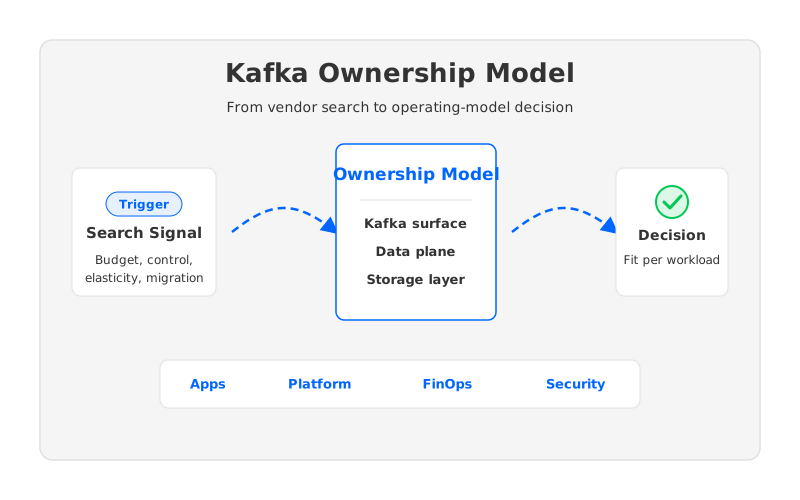
Teams rarely search for confluent alternatives because they want a longer vendor list. By the time that query appears, the organization already knows Kafka is important and is trying to decide who should own which parts of the streaming platform. Confluent is a mature Kafka ecosystem company with a broad managed platform, connectors, governance, and stream processing capabilities. The harder question is whether that ownership model fits the team's data boundary, cloud strategy, cost model, and operating habits.
That distinction changes the evaluation. A procurement spreadsheet may ask for feature parity, but a platform team needs to know what happens during broker scaling, partition movement, consumer lag, disaster recovery, network isolation, and workload growth. A FinOps team wants to know which costs scale with retained data, replicated bytes, private connectivity, and operational headcount. A security team wants to know which control plane sees metadata, which data plane stores customer data, and which cloud account contains the infrastructure.
1Why Teams Search for Confluent Alternatives
The search usually starts with one of four triggers. The first is budget pressure: a streaming estate grows from a few critical pipelines into an internal platform, and the bill no longer maps cleanly to business value. The second is control pressure: regulated teams may prefer deployment patterns where the data plane stays inside their own cloud account or private environment. The third is platform pressure: teams want Kafka compatibility but need faster scaling, less storage movement, or a different storage architecture. The fourth is migration pressure: an existing Kafka estate is difficult to operate, but rewriting producers, consumers, connectors, and governance workflows is not acceptable.
Those triggers are not anti-Confluent. They are ownership questions. Confluent Cloud can be a strong fit when a team wants a broad managed data streaming platform and is comfortable with that service boundary. Self-managed Apache Kafka can be a strong fit when a team has deep Kafka expertise and wants full operational control. Amazon MSK can be a strong fit when the team wants AWS-native managed Kafka operations. Kafka-compatible systems can be a strong fit when the team wants Kafka-facing applications but a different storage or operating model underneath.
The mistake is evaluating these paths as interchangeable products. They are different answers to the same operating question: how much of Kafka should your team own, how much should a provider own, and where should durable stream data live?
2The Ownership Model Matters More Than the Vendor Category
A useful evaluation separates the Kafka surface from the platform substrate. The Kafka surface includes protocol compatibility, producers, consumers, consumer groups, transactions, ACLs, connectors, schemas, monitoring expectations, and the application behavior engineers already depend on. The substrate includes broker lifecycle, storage durability, replication paths, networking, cloud accounts, private endpoints, observability, upgrades, and incident response. Teams get into trouble when they compare only the surface and ignore the substrate.
| Evaluation layer | Question to ask | Why it changes the shortlist |
|---|---|---|
| Application compatibility | Will existing Kafka clients, consumer groups, idempotent producers, transactions, ACLs, and tooling behave as expected? | A low-migration path depends on preserving Kafka semantics, not only offering a Kafka-like endpoint. |
| Data-plane boundary | Where are brokers, storage, logs, metrics, and backups located? | Security and compliance teams care whether customer data remains in a customer-controlled cloud account or private environment. |
| Storage architecture | Are brokers the durable home for active data, or is durable data decoupled from broker-local disks? | This determines how scaling, recovery, retention growth, and broker replacement behave. |
| Network shape | Which write, replication, read, and migration paths cross availability zones, VPC boundaries, or regions? | Network charges and failure domains often become visible only after workloads grow. |
| Migration control | How are topics copied, offsets synchronized, producers cut over, and rollback handled? | A platform change fails when cutover discipline is weaker than the architecture story. |
This table is intentionally not a feature checklist. Feature checklists make every option look close until the first incident. Ownership models reveal where the work lands when a workload doubles, a broker fails, a team needs longer retention, or a compliance review asks where the bytes sit.
3Architecture Criteria Behind the Shortlist
Start with Kafka compatibility, but do not stop there. Apache Kafka has well-defined client behavior around producers, consumers, offsets, ACLs, and transactions, and many organizations have built internal runbooks around those semantics. A platform that claims Kafka compatibility should be tested with representative client libraries, retry settings, idempotent producers, transactional workloads, consumer group behavior, and monitoring integrations. Compatibility is not a checkbox; it is a rehearsal of your production behavior.
The second criterion is storage ownership. Traditional Kafka places durable log data on broker-attached storage and uses replication across brokers for availability. Tiered Storage changes the retention equation by moving completed log segments to remote storage while preserving the local tier for active broker operation. A shared-storage or diskless-style architecture goes further: durable stream data is placed in shared object storage, while brokers become less tied to the long-term ownership of retained bytes. Both patterns can use object storage, but they solve different problems.
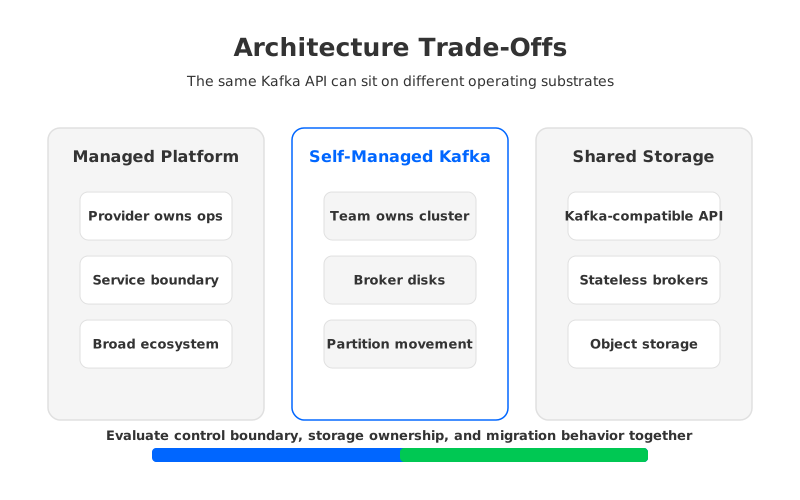
The third criterion is network path control. In multi-AZ Kafka deployments, high availability usually means traffic crosses zone boundaries for replication, producer placement, consumer reads, reassignment, or recovery. AWS guidance for reliable MSK deployments includes multiple Availability Zones and replication factors greater than 1, which is sensible for availability. It also means platform teams should model the byte paths created by that design. Nearest replica fetching, placement, and shared-storage architectures can all change the shape of the network bill, but they do so through different mechanisms.
The fourth criterion is operational elasticity. In a shared-nothing Kafka architecture, broker scaling and balancing often become storage movement problems. Adding brokers is not hard in isolation; redistributing partitions and retained data safely is the hard part. AWS MSK documentation, for example, describes partition reassignment as a careful operational action rather than background magic. A managed service can reduce the toil around the action, but the architecture still determines how much data must move.
4Migration and Ownership Questions for Platform Teams
The most reliable evaluation starts with a small number of representative workloads instead of an abstract platform debate. Pick one latency-sensitive topic, one high-throughput topic, one long-retention topic, and one connector-heavy workflow. Then run the same questions against each ownership model. A platform that looks excellent for long retention may be less attractive for tail-latency-sensitive command streams. A platform that minimizes operational work may still create governance concerns for a regulated data set.
For each workload, ask the team to answer these questions in writing:
- What Kafka client behavior must remain unchanged during and after migration? Include producer retry settings, idempotence, transactions, consumer group assignment, offset commits, and monitoring assumptions.
- Which data paths are acceptable across zones, regions, VPCs, or provider-managed boundaries? Separate steady-state write paths from recovery and backfill paths.
- Who owns broker sizing, storage growth, partition balancing, upgrades, incident response, and rollback decisions?
- What is the rollback point? A migration plan without a rollback boundary is a hope, not an operating model.
- Which costs scale with throughput, retained data, requests, private connectivity, cross-zone traffic, and people time?
The answers often narrow the shortlist faster than a feature table. If the organization wants the broadest managed streaming platform, Confluent may remain the right answer. If the organization wants AWS-native operations and accepts the MSK model, Amazon MSK may be the natural path. If the organization has exceptional Kafka operations capacity, self-managed Kafka may still be rational. If the organization wants Kafka-facing applications with a different storage and data-plane ownership model, Kafka-compatible shared-storage systems become worth testing.
5How AutoMQ Fits the Evaluation
Once the decision is framed around ownership, AutoMQ belongs in the discussion as a Kafka-compatible, cloud-native streaming system built on Shared Storage architecture. It preserves Kafka protocol compatibility while moving durable stream storage away from broker-local disks and into S3-compatible object storage through S3Stream. WAL storage protects the write path, while object storage becomes the durable storage layer. The point is not to bypass evaluation; the point is to test a different answer to the ownership question.
AutoMQ is most relevant when the team wants three properties at the same time. First, applications should continue to use Kafka-compatible APIs and ecosystem expectations. Second, durable data should be decoupled from broker lifecycle so scaling, balancing, and recovery are less tied to retained log bytes. Third, deployment boundaries should support customer-controlled infrastructure models such as AutoMQ BYOC or private software deployment, depending on the organization's governance needs.
That combination changes how the proof of concept should be run. Do not test only a happy-path producer and consumer. Test broker replacement, retention growth, consumer catch-up, zone placement, partition balancing, and migration rollback. Measure whether the architecture reduces the operational work that originally triggered the search. AutoMQ's value is strongest when the pain is architectural: broker-attached storage is limiting elasticity, cross-zone traffic is difficult to control, or the team wants Kafka compatibility without inheriting every shared-nothing operational constraint.
6Production Readiness Scorecard
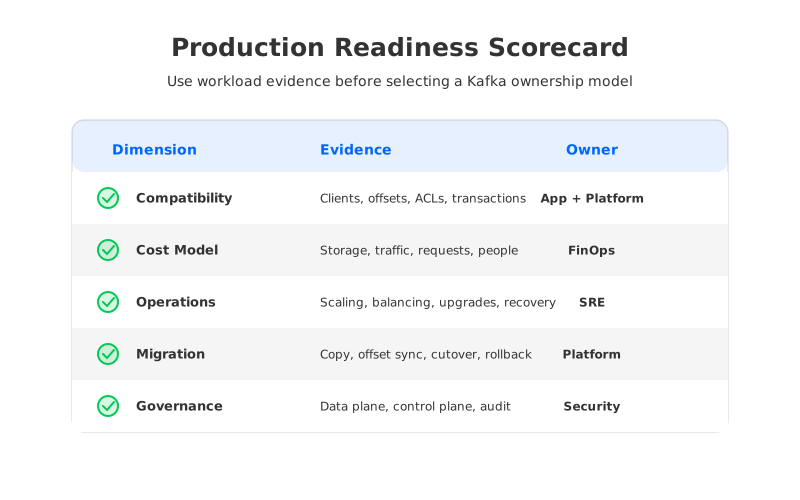
A good scorecard makes trade-offs visible without turning the decision into a popularity contest. The following worksheet is deliberately practical. It gives platform, SRE, FinOps, security, and application teams a shared language for the decision.
| Dimension | Strong signal | Risk signal |
|---|---|---|
| Compatibility | Representative clients, offsets, transactions, ACLs, monitoring, and failure handling pass in rehearsal. | Evaluation uses a demo client and assumes real applications will behave the same. |
| Cost model | Throughput, retention, storage, requests, private connectivity, and network paths are modeled separately. | The business case uses one blended cost metric and ignores recovery or backfill traffic. |
| Operations | Scaling, broker replacement, balancing, upgrades, and incident response have clear owners. | The team assumes the provider or product removes every Kafka operating concern. |
| Migration | Topic copy, offset sync, producer cutover, consumer cutover, validation, and rollback are rehearsed. | Cutover depends on a big-bang switch with unclear duplicate-handling rules. |
| Governance | Data plane, control plane, observability, access control, and audit boundaries are documented. | Security review starts after technical selection, when architecture choices are already locked. |
The scorecard should produce a decision, not a winner. One workload may stay on an existing platform. Another may move to a managed service. A third may justify a Kafka-compatible shared-storage design. Streaming platforms are often estates, not single-instance purchases, and the cleanest architecture is the one whose ownership boundaries match the workloads it serves.
7Closing the Evaluation Loop
The search for confluent alternatives starts as a vendor query, but the durable decision is architectural. Confluent, MSK, self-managed Kafka, and Kafka-compatible shared-storage systems represent different ways to divide responsibility between application teams, platform teams, cloud providers, and product vendors. The right evaluation asks where the Kafka surface must remain stable and where the operating model should change.
If your team is evaluating Kafka-compatible infrastructure because broker storage, cross-zone traffic, or data-plane control has become the constraint, test that boundary directly. Start with the AutoMQ Cloud Console and run one representative workload through your own compatibility, migration, cost, and governance scorecard.
8References
- Apache Kafka documentation
- Apache Kafka Tiered Storage documentation
- Apache Kafka producer configuration: idempotence
- Apache Kafka authorization and ACLs
- AWS documentation: Best practices for Amazon MSK Standard brokers
- AWS documentation: Amazon MSK migration with MSK Replicator
- AutoMQ documentation: Compatibility with Apache Kafka
- AutoMQ documentation: S3Stream Shared Streaming Storage
- AutoMQ documentation: WAL storage
- AutoMQ documentation: Inter-zone traffic overview
9FAQ
9.1What is the main reason teams evaluate Confluent alternatives?
Most teams are not looking for a name-for-name replacement. They are evaluating a different ownership model for Kafka compatibility, data-plane control, storage architecture, cost behavior, and migration risk.
9.2Is Confluent the wrong choice for Kafka?
No. Confluent can be a strong choice for teams that want a broad managed data streaming platform and accept its service boundary. The evaluation should be factual: compare the operating model to the team's workloads, governance requirements, and budget structure.
9.3Is Tiered Storage the same as Shared Storage architecture?
No. Tiered Storage moves completed log segments to remote storage while local broker storage remains central to active operation. Shared Storage architecture places durable stream data in shared object storage so broker lifecycle work is less tied to retained bytes.
9.4Where does AutoMQ fit in a Confluent alternatives evaluation?
AutoMQ fits when a team wants Kafka-compatible APIs with a Shared Storage architecture, object-storage-backed durability, stateless broker operation for durable data ownership, and deployment boundaries that can stay closer to customer-controlled infrastructure.
9.5How should a platform team start the evaluation?
Choose representative workloads, then test compatibility, write and read behavior, recovery, network paths, migration cutover, rollback, governance, and cost allocation. A real workload rehearsal is more useful than a broad feature matrix.


