
Table of Contents
Table of Contents
"Add more partitions" is one of the most common answers to a Kafka scaling problem. It is also one of the easiest answers to give too early. A topic with too few partitions can cap producer distribution, limit consumer parallelism, and make a small number of leaders carry too much traffic. Increasing the partition count often looks like the cleanest way to unlock throughput.
The catch is that a partition is not a free unit of parallelism. It is a unit of metadata, leadership, local log storage, replica placement, consumer assignment, recovery work, and operational responsibility. Kafka partition scaling improves one side of the system while adding weight to another.
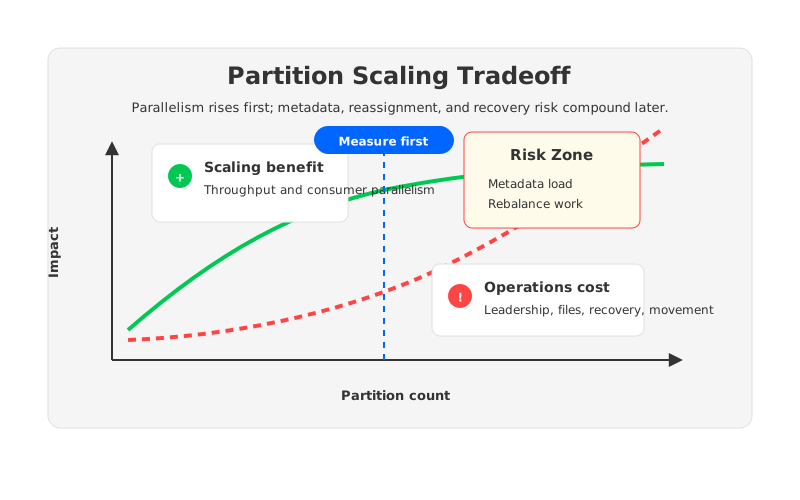
That is why teams searching for Kafka partition scaling guidance often find conflicting advice. Application teams want more concurrency. Platform teams worry about metadata, controller load, broker file handles, leader skew, and reassignment windows.
1Why Partitions Are Kafka's Scaling Unit
Kafka scales topics by splitting each topic log into partitions. Kafka's operations documentation states that partition count controls how many logs a topic is sharded into, affects the servers that can handle the data set and read/write load, and impacts maximum consumer parallelism. A topic with one partition can preserve a simple total order, but it cannot spread work across many consumers in the same consumer group.
Partitions help in several concrete ways:
- They distribute topic traffic across brokers, subject to leader placement and replica assignment.
- They let a consumer group process a topic in parallel, because partitions are assigned across group members.
- They create more scheduling units for balancing leaders, replicas, and hot traffic across the cluster.
- They allow larger topics to be split into independent logs with separate offsets and retention mechanics.
This is the good side of Kafka partition scaling. If a topic has high write throughput and too few partitions, producers may concentrate work on a small number of leaders. If a consumer group needs more active consumers than there are partitions, extra consumers sit idle for that topic.
Kafka throughput per partition is not fixed. It depends on record size, batching, compression, acknowledgments, replication factor, disk, network, consumer fetch behavior, and key distribution. Treat any single partition-limit rule as a dated starting point, not a design law.
2What Changes When Partition Count Grows
The first few partition increases often feel harmless. Then every operation touches a larger surface area. Metadata grows. More partition leaders must be tracked. More local logs and segment files exist. Consumer groups have more assignments to process. Recovery after broker events has more partition state to inspect.
The operational cost shows up as a set of smaller burdens that compound:
| Added Partition Surface | Why It Matters Operationally |
|---|---|
| Metadata | Brokers, controllers, producers, and consumers need current partition and leadership information. Larger metadata surfaces increase coordination work and client refresh impact. |
| Leadership | Every partition needs a leader. More leaders create more chances for leader skew and uneven request load. |
| Local log directories | Kafka stores partition logs under broker log directories, so partition count affects files, folders, segment management, and disk recovery work. |
| Replicas | With replication factor above one, every new partition creates multiple replicas that must be placed, monitored, and kept in sync. |
| Consumer assignment | Consumer groups must assign partitions to members. More partitions can mean more assignment work and more lag visibility points. |
| Reassignment | Moving partition replicas between brokers becomes a larger data movement project as retained bytes and replica count grow. |
This is where Kafka scaling issues become easy to misread. A team may add partitions to improve write distribution, then discover that the harder problem was hot keys. Another team may add partitions for consumer concurrency, then find that downstream processing or database writes are the real bottleneck.
The strongest warning is that partitions are easier to add than to remove. Kafka's current operations documentation says Kafka does not support reducing the number of partitions for a topic. You can create a new topic with a different count and migrate clients, but that is a project.
3The Hidden Consumer Group Cost
Consumer parallelism is the argument that convinces many teams to increase partitions. The logic is sound: within a consumer group, work is distributed by partition assignment. If a topic has twelve partitions, a group can have up to twelve actively assigned consumers for that topic.
But consumer scaling has its own traps. More partitions do not guarantee balanced consumption if the input is unevenly keyed. One partition can carry a large share of traffic while other partitions remain quiet. The bottleneck moves from "not enough partitions" to "not enough evenness."
Partition changes can also affect application semantics. Kafka's documentation warns that increasing a topic's partition count changes key distribution when records are routed by a modulo of partition count, which can affect ordering guarantees for existing keys. It also notes metadata propagation delay and consumer discovery concerns after partitions are added.
Before increasing partitions for consumer throughput, check whether:
- Lag is concentrated on specific partitions or spread evenly.
- The consumer group has idle members because partition count is too low.
- Consumers are blocked by downstream services rather than Kafka fetch throughput.
- Key ordering assumptions survive a changed partition mapping.
- Producers and consumers can tolerate metadata refresh and rebalance behavior.
The goal is to make partition count match the real concurrency model. Adding partitions to compensate for slow handlers, uneven keys, or downstream write limits can make Kafka busier without removing the user-visible bottleneck.
4The Operational Cost of Reassigning Partitions
Partition reassignment is where Kafka partition management becomes visibly heavy. Adding brokers is not enough by itself; existing partitions do not automatically move onto new brokers in a way that instantly balances old traffic. Kafka provides reassignment tools to generate, execute, and verify partition movement, and its operations docs describe throttling migration traffic to protect production workloads.
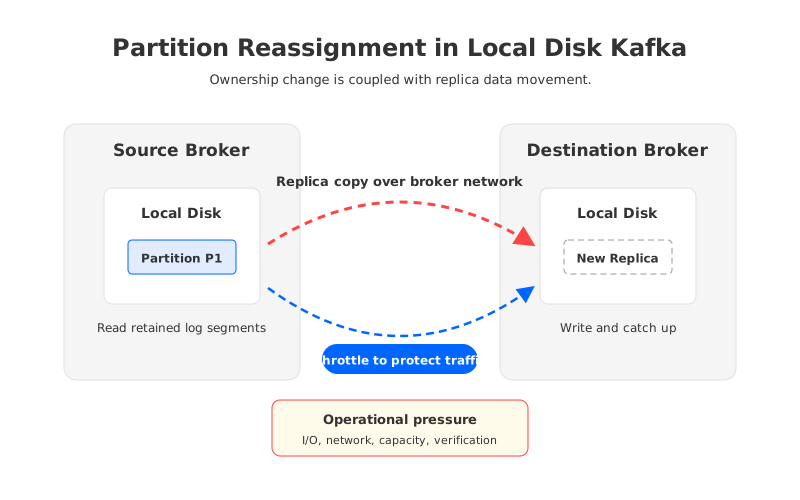
In traditional Kafka, the heaviness comes from broker-local storage. A partition replica is not only an ownership record; it is log data on a broker's local disk. If a retained partition moves to another broker, the destination must catch up with the replica data. That consumes source broker I/O, destination broker I/O, network bandwidth, disk capacity, and operator attention.
The tradeoff is uncomfortable:
- Fast reassignment shortens the maintenance window but competes harder with live produce and consume traffic.
- Slow reassignment protects production traffic but extends the time the cluster remains imbalanced.
- Partial reassignment reduces blast radius but increases planning, verification, and rollback complexity.
This is why partition count and retention cannot be planned independently. A high partition count with short retention has a different reassignment profile from a high partition count with long retention, high write rate, and replication across failure domains.
5How To Decide Whether To Add Partitions
The safest partition decision starts from observed bottlenecks, not a generic target number. Treat the topic as a system with several possible ceilings, then ask which ceiling partitions would actually raise.
| Signal | What It Suggests | Partition Change Risk |
|---|---|---|
| A few partition leaders are saturated | More partitions may help if traffic can distribute across them. | Hot keys may keep load concentrated. |
| Consumer group has fewer active assignments than desired workers | More partitions may increase parallelism. | Rebalance and ordering behavior must be checked. |
| All partitions show similar lag and consumers are CPU-bound | Partitions may help only if more consumers can be added. | Downstream systems may become the next bottleneck. |
| Broker storage is the main constraint | More partitions rarely solve it directly. | More replicas and segments can worsen management overhead. |
| Reassignment already takes too long | More partitions may add future operational work. | Architecture or placement strategy may matter more than count. |
Use a review checklist before changing a production topic:
- Current per-partition write rate, read rate, and consumer lag distribution.
- Leader distribution by broker and availability zone.
- Topic retention, compaction, segment settings, and retained bytes per partition.
- Consumer group assignment, rebalance frequency, and idle member count.
- Producer partitioning strategy, key skew, ordering assumptions, and metadata refresh settings.
- Future broker expansion or decommissioning work caused by the new count.
That checklist gives operators and application teams a shared language. If both sides can connect a proposed partition increase to measured throughput or lag, the change is easier to defend. If the only argument is "more partitions are more scalable," the design is not ready.
6Broker-Local Storage Makes Partition Growth Stickier
The long-term issue is not that Kafka has partitions. Partitions are the right abstraction for ordered, parallel logs. The issue is that traditional Kafka binds partition ownership to broker-local log storage. With many partitions and significant retained data, changing where partitions live becomes a physical data placement operation.
This has direct consequences for Kafka scalability:
- Broker scale-out may require follow-up reassignment before new capacity is useful for old hot traffic.
- Broker scale-in requires moving partition replicas away from brokers being removed.
- Hotspot mitigation may require shifting leaders, replicas, or both.
- Long-retention topics make every ownership change more expensive because more local data is attached to the partition.
Tiered storage can reduce some pressure by moving older data to remote storage, but it does not always remove the primary-storage reassignment problem. If the active log and replica placement still live on broker-local disks, operational changes still involve local partition state.
7How AutoMQ Reduces Partition Movement Pain
If the operational penalty comes from copying broker-local partition data, the architectural alternative is to decouple durable log storage from broker ownership. In a shared-storage model, brokers still serve Kafka protocol traffic, leadership, caching, and runtime coordination, but durable data is stored outside the broker fleet.
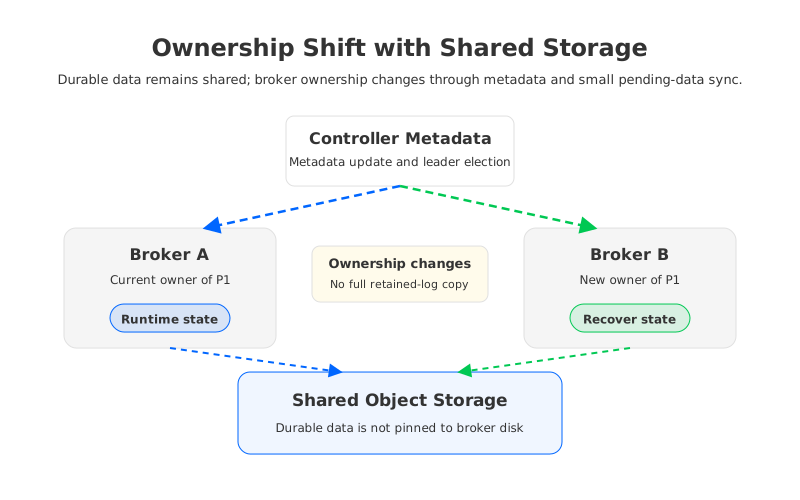
AutoMQ is a Kafka-compatible streaming platform built around that shared storage idea. Its architecture documentation describes replacing Kafka's local log storage with S3Stream, using object storage as the primary data repository, and making brokers stateless. Its partition reassignment documentation explains that reassignment can focus on metadata and the small amount of data not yet uploaded to object storage, rather than copying the entire retained partition between broker disks.
That does not make partition design irrelevant. Teams still need to choose partition counts carefully, monitor hot keys, plan consumer concurrency, and validate ordering behavior. Shared storage changes a different part of the equation: the cost of changing ownership when the cluster needs to rebalance, scale out, scale in, or respond to hotspots.
For operators, the practical evaluation is straightforward. If partition growth is mainly about client concurrency and metadata scale, tune Kafka carefully and measure. If the pain repeatedly appears during expansion, decommissioning, hotspot relief, or recovery, examine whether broker-local storage is the root constraint. In that case, a Kafka-compatible shared-storage architecture such as AutoMQ may reduce the operational penalty without forcing application teams to abandon Kafka clients.
8A Practical Partition Scaling Policy
A durable Kafka partition management policy should avoid both extremes. Under-partitioning creates immediate throughput and parallelism ceilings. Over-partitioning creates a slow accumulation of metadata, leadership, reassignment, and recovery work.
A useful policy includes:
- A default partition count by workload class, not one global default for every topic.
- A requirement to document key distribution and ordering assumptions before increasing partitions.
- A capacity test or production metric review for kafka throughput per partition.
- A consumer group review showing whether more partitions will create useful active work.
- A reassignment estimate covering retained bytes, replication factor, and throttling.
This may sound heavy for a topic setting, but it is lighter than discovering later that a quick scaling fix created a permanent operations liability. The common answer, "add partitions," is not wrong. It is incomplete. Add partitions when they raise a measured ceiling, when application semantics can tolerate the change, and when the operations team can live with the future reassignment and recovery surface. When that future surface is the actual problem, changing the storage and ownership model may matter more than changing the partition count again.
9References
- Apache Kafka Basic Kafka Operations
- Apache Kafka Introduction: Concepts and Terms
- Apache Kafka Design: Replication
- Apache Kafka Consumer Rebalance Protocol
- AutoMQ Architecture Overview
- AutoMQ Stateless Broker
- AutoMQ Partition Reassignment in Seconds
- AutoMQ Continuous Self-Balancing
10FAQ
10.1What is Kafka partition scaling?
Kafka partition scaling is the practice of changing or planning topic partition counts so a topic can spread read and write work across more brokers and consumers. It is a core Kafka scalability mechanism, but it also increases metadata, leadership, replica placement, reassignment, and recovery work.
10.2Do more Kafka partitions always increase throughput?
No. More partitions can increase throughput when the current partition count is the bottleneck and traffic distributes well. They may not help when the real bottleneck is hot keys, slow consumers, downstream systems, broker storage, or network limits.
10.3How many Kafka partitions should a topic have?
There is no universal safe number. Start from required producer throughput, consumer parallelism, key distribution, retention, replication factor, broker capacity, and reassignment tolerance. Avoid hard limits unless they are tied to your Kafka version, workload test, and operating model.
10.4Can Kafka partition count be reduced later?
Kafka's operations documentation states that Kafka does not support reducing the number of partitions for a topic. To move to fewer partitions, teams usually need to create a new topic with the desired partition count and migrate producers and consumers.
10.5Why does partition reassignment take so much operational planning?
In traditional Kafka, partition replicas are stored on broker-local disks. Moving replicas between brokers can require copying retained data while live traffic continues, so operators often need throttling, verification, rollback planning, and careful monitoring.
10.6How does AutoMQ help with Kafka partition management?
AutoMQ uses a Kafka-compatible shared storage architecture with stateless brokers. Because durable data is stored in shared object storage rather than pinned to broker-local disks, partition ownership changes can focus more on metadata and small pending data, reducing the data-movement pain around reassignment and elasticity.


