
Table of Contents
Table of Contents
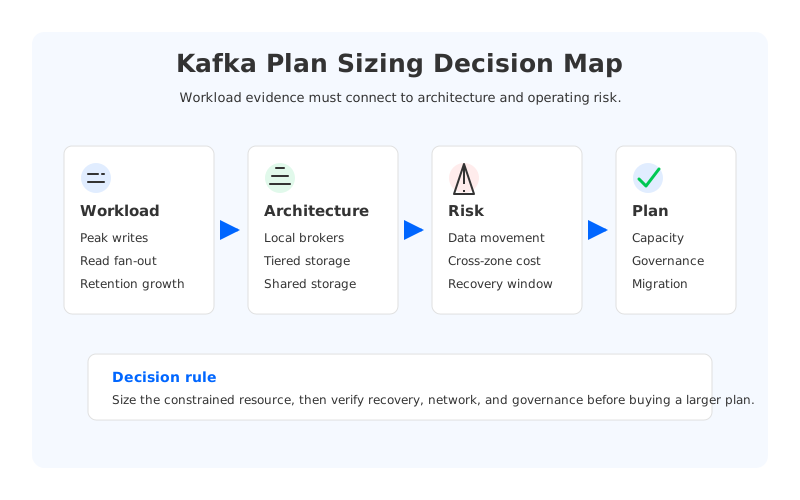
Kafka plan sizing starts with a practical procurement question: how large should the streaming platform be, and which plan will survive the next twelve months without turning into waste? The obvious inputs are throughput, retention, partitions, and availability. The harder inputs are replay behavior, read fan-out, broker recovery time, scaling data movement, cloud network charges, compliance boundaries, and the operating model your team can support.
That is why kafka plan sizing is a misleadingly small search query. It sounds like a broker-count exercise, but production sizing is a risk allocation exercise: how much capacity to reserve, which failure modes to pay for upfront, which operations to automate, and which parts of Kafka's historical architecture still fit a cloud cost model. The useful answer is a framework that turns vague plan comparisons into specific questions about workload shape, storage architecture, governance, migration, and total cost.
1Why Teams Search for kafka plan sizing
Most teams search for sizing guidance when a cluster is nearing a limit, when a managed-service quote is larger than expected, when retention changed, or when a product team wants Kafka capacity but cannot describe its traffic yet. The platform owner has to translate incomplete demand into a plan that finance, security, application teams, and SREs can all live with.
The first trap is treating average throughput as the workload. Average write rate is useful for a first approximation, but Kafka platforms are usually sized by peaks, recovery, and retained state. A cluster that handles a steady 100 MiB/s write workload may still struggle when a downstream outage creates hours of replay, multiple consumer groups fan out from the same topics, or a broker replacement triggers large replica movement during business traffic.
The second trap is treating "Kafka-compatible" as one operational category. Two systems can both support Kafka clients while making very different choices about storage, scaling, control plane boundaries, network paths, and failure recovery. For technical buyers, the question is less "What is the smallest plan that works today?" and more "What plan lets us absorb growth without re-architecting under pressure?"
2The Production Constraint Behind the Problem
Apache Kafka's traditional Shared Nothing architecture binds compute and durable storage together. Brokers own local log data, serve reads, coordinate partition leadership, and participate in replication. This design is explicit and proven, but it also means that a broker is not merely a replaceable compute process. It carries state, and that state shapes every sizing decision.
Broker-local state turns ordinary production actions into capacity events. Adding brokers can require partition reassignment. Replacing brokers can require replica catch-up. Increasing retention can force larger local disks even when compute demand is flat. Consumer replay can compete with fresh writes for the same broker I/O budget.
The most common sizing pressures fall into a few categories:
- Write and replication pressure. Producer throughput is only part of the write path. Replication, acknowledgement settings, compression, batching, and leader placement all affect how much broker capacity a workload needs.
- Read fan-out and replay. A topic with many consumer groups can produce far more read traffic than the write rate suggests. Lag recovery is especially important because historical reads often arrive when the business is already watching the system closely.
- Retention and local disk growth. Longer retention changes the failure and scaling profile. The issue is not only the price of disks; it is the amount of state that must be placed, protected, moved, and monitored.
- Operational work under load. Rolling upgrades, broker replacement, partition movement, connector recovery, and incident response consume the same capacity reserve that production traffic depends on.
- Governance boundaries. Multi-team Kafka platforms need quotas, ACLs, auditability, network isolation, and cost allocation. These controls decide whether tenants share capacity safely or force separate clusters.
The important pattern is that capacity and operations are not separable. A plan that ignores recovery work may look cost-effective until the first incident, while a plan that handles incidents only by permanent over-provisioning may be reliable but hard to defend in a FinOps review.
3Architecture Options and Trade-Offs
The architecture question behind Kafka plan sizing is direct: when the workload grows, does the platform need to scale compute, storage, or both? Traditional Kafka often makes that distinction hard because brokers are responsible for both. The same node class may be chosen for disk, network, CPU, or recovery headroom, and the final plan inherits the most restrictive requirement.
Tiered Storage changes part of this model by allowing older log segments to live in remote storage. Apache Kafka's Tiered Storage work recognizes that long retention should not always mean ever-larger broker disks. It is still not the same as making brokers stateless. Active segments, cache behavior, leadership, and operational recovery remain tied to broker-local responsibilities.
Shared Storage architecture takes a more direct approach. Durable stream data is placed in shared object storage, while brokers act more like stateless compute. Scaling compute no longer has to imply moving a proportional amount of durable data between broker-local disks. The sizing unit becomes closer to "how much compute and network do we need for the active workload?" rather than "how much compute, storage, and relocation reserve must every broker carry?"
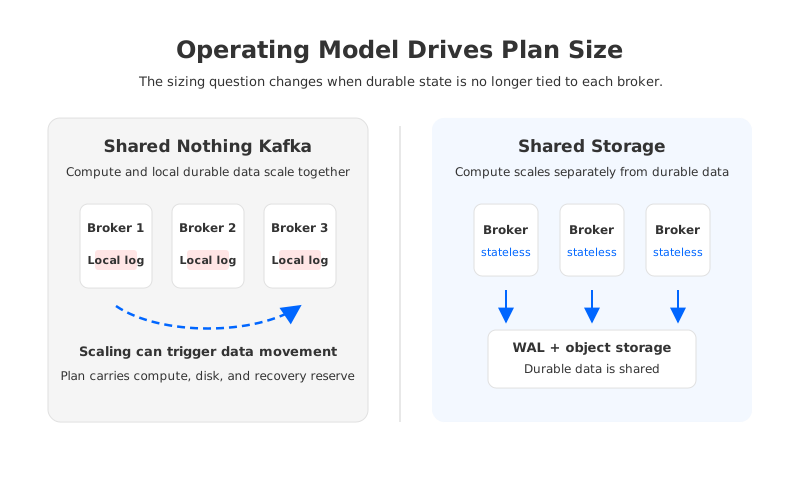
This does not make every trade-off disappear. Shared storage systems still need a write-ahead log layer, metadata coordination, cache strategy, failure handling, and careful network design. Object storage changes the economics and durability model, but it must be integrated in a way that preserves Kafka-facing semantics and production latency targets. The real change is the main sizing boundary.
A practical comparison should separate the options by operating model:
| Architecture choice | What it helps | What still needs discipline |
|---|---|---|
| Traditional Shared Nothing Kafka | Predictable local log model and mature operational knowledge | Broker-local disk, replica movement, recovery reserve, and cross-zone replication cost |
| Kafka with Tiered Storage | Longer retention with less pressure on local disks for older segments | Active data, broker recovery, cache behavior, and local-state operations |
| Kafka-compatible Shared Storage | Independent compute/storage scaling and less broker-local durable state | WAL design, object storage integration, cache policy, and compatibility validation |
| Fully managed Kafka service | Reduced infrastructure ownership for the customer team | Plan limits, network fees, governance model, migration path, and control-plane boundary |
This is where procurement and architecture meet. A managed plan can be operationally attractive, but the buyer still needs to know which costs scale with brokers, storage, traffic, and data movement. A BYOC or self-managed option can preserve more control, but it must prove safe operations. A shared-storage system can improve elasticity, but it must prove compatibility and recovery behavior.
4Evaluation Checklist for Platform Teams
A useful Kafka plan sizing review starts with workload evidence and ends with an operating decision. Teams often skip the middle and compare plan tiers directly. That shortcut is risky because plan labels hide where data lives, how capacity changes, who owns the network path, and what happens during a failure.
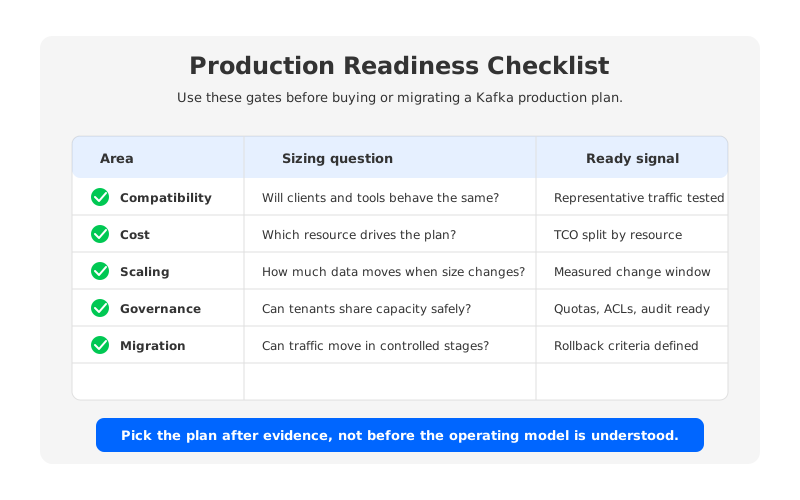
Use these questions before choosing a plan or renewing a production Kafka commitment:
- What is the real workload shape? Measure peak writes, average writes, read fan-out, replay windows, partition count, message size distribution, and connector load separately.
- Which resource sets the plan size? Identify whether the current limit is CPU, network, local disk throughput, retained bytes, partition count, connection count, or operational recovery time. Buying a larger plan for the wrong bottleneck creates expensive calm.
- How much data moves when the plan changes? Scaling that triggers large partition or replica movement can consume the same capacity it is trying to create. Include the cost and risk of changing size, not only running after the change.
- Where does cross-zone traffic appear? In multi-AZ designs, replication, consumer placement, proxy layers, private endpoints, and object storage access can all affect the bill. Network is a design dimension, not a footnote.
- What governance model does the platform need? A shared cluster may need quotas, ACLs, audit logs, tenant isolation, naming rules, and chargeback. Separate clusters may simplify boundaries but increase baseline spend and operations.
- Can the team test compatibility before cutover? Kafka client compatibility, transactional behavior, offsets, connector behavior, MirrorMaker 2 or linking strategy, and rollback criteria should be validated on representative traffic.
- What happens during the worst maintenance window? Include rolling upgrades, broker replacement, storage growth, and incident recovery. A plan that works only when nothing is changing is not a production plan.
These questions also classify the decision. If the bottleneck is governance, a larger broker tier will not fix tenant isolation. If the bottleneck is retained data, more CPU may be irrelevant. If the bottleneck is recovery data movement, the architecture may matter more than the plan size.
5How AutoMQ Changes the Operating Model
After the sizing review separates workload, storage, recovery, and governance, one conclusion often becomes visible: the expensive part is not always Kafka traffic itself. It is the coupling between broker compute and broker-local durable state. When that coupling is the primary constraint, a Kafka-compatible Shared Storage architecture deserves evaluation.
AutoMQ is a cloud-native streaming platform that keeps Kafka protocol compatibility while using a Shared Storage architecture backed by object storage. Its design uses stateless brokers, a WAL layer, and shared object storage so compute and storage can be scaled more independently than in a broker-local storage model. For plan sizing, the question changes from "how large must every broker be?" to "which parts of the workload need compute, durable storage, network locality, and governance?"
That shift is useful in three situations. The first is uneven growth: retention or replay requirements grow faster than steady write traffic. The second is elastic demand: traffic spikes need compute headroom but should not force long-lived storage over-sizing. The third is operational recovery: broker replacement and scaling should not become large local data relocation projects every time the plan changes.
AutoMQ's fit should still be tested with the same discipline as any platform change:
- Compatibility first. Producers, consumers, transactions, offsets, Kafka Connect jobs, and operational tooling should be validated before broad migration.
- Cost model second. Separate compute, object storage, WAL, network, private connectivity, and operations.
- Governance and boundary control. BYOC or self-managed deployment models matter when data residency, VPC boundaries, IAM, audit, and procurement controls are part of the decision.
- Migration reversibility. A credible plan includes parallel validation, traffic cutover stages, consumer offset strategy, and rollback criteria.
This is not an argument for replacing every Kafka cluster with one architecture. Some workloads are steady, small, and already well served by their current platform. Others are dominated by local operational friction, slow scaling, high retention, or cross-zone movement. The framework should reveal that difference before the team signs a larger commitment.
6A Decision Matrix for Kafka Plan Sizing
The final plan should be a short decision record, not a vendor comparison spreadsheet with hundreds of cells. It should state the workload class, bottleneck, selected architecture, operating model, migration path, and missing evidence.
| Sizing question | If yes | Design implication |
|---|---|---|
| Is retained data growing faster than active throughput? | Storage is driving the plan | Evaluate tiered or shared storage before buying larger compute nodes |
| Does scaling require heavy data movement? | Recovery risk is driving the plan | Prefer architectures or tools that reduce broker-local relocation |
| Is read fan-out much larger than write rate? | Network and consumer recovery are driving the plan | Size for egress, cache behavior, lag recovery, and tenant isolation |
| Are teams sharing one platform? | Governance is driving the plan | Include quotas, ACLs, chargeback, observability, and audit requirements |
| Is procurement comparing managed, BYOC, and self-managed? | Control boundary is driving the plan | Compare ownership, data residency, marketplace path, and support model |
Strong sizing reviews usually produce fewer, clearer options. One workload might stay on a conventional Kafka plan with better quotas and retention limits. Another might justify a managed-service tier because the team wants to outsource more operations. A high-retention or elastic workload might justify testing shared storage because the current plan is paying for too much broker-local state.
If your kafka plan sizing search started with a budget review, a renewal quote, or a cluster that no longer scales cleanly, turn the question into a workload evidence pack. Measure the pressure points, map them to the operating model, and test the architecture that changes the limiting factor. To evaluate AutoMQ, start from the AutoMQ Cloud entry point and validate one representative workload before expanding the decision.
7References
- Apache Kafka documentation
- Apache Kafka documentation: producer configuration
- Apache Kafka documentation: consumer configuration
- Apache Kafka KIP-405: Kafka Tiered Storage
- AWS EC2 instance network bandwidth documentation
- AWS EC2 On-Demand pricing
- AWS S3 data durability documentation
- AutoMQ architecture overview
- AutoMQ compatibility with Apache Kafka
- AutoMQ cross-AZ traffic cost guidance
8FAQ
8.1What is Kafka plan sizing?
Kafka plan sizing is the process of choosing production capacity and operating model for Kafka or Kafka-compatible streaming infrastructure. It includes throughput, retention, partition count, read fan-out, recovery behavior, network cost, governance, migration risk, and support boundaries.
8.2Does Tiered Storage remove the need for larger Kafka plans?
Tiered Storage can reduce pressure from long retention by moving older data to remote storage, but it does not make brokers fully stateless. Active data, cache behavior, leadership, and operational recovery still need sizing discipline.
8.3When should teams evaluate a Kafka-compatible shared-storage architecture?
Evaluate shared storage when broker-local durable state is the main constraint. Common signals include slow scaling, high retention growth, large rebalancing movement, expensive recovery buffers, or cloud network costs tied to replication and placement. Compatibility and migration testing should come first.
8.4How should FinOps teams participate in Kafka plan sizing?
FinOps teams should ask engineering to separate compute, storage, network, recovery reserve, support, and operational labor. That breakdown shows whether spend is protecting a real workload or compensating for an architecture that cannot scale the constrained resource independently.
8.5Should production teams size for average or peak Kafka traffic?
Production teams should understand both, but they usually size for peak traffic plus recovery scenarios. Average traffic estimates baseline cost. Peak traffic, replay windows, broker replacement, and maintenance work determine whether the plan survives production conditions.


