
Table of Contents
Table of Contents
Many enterprise teams ask for on-prem Kafka when the real requirement is private control. They need auditability, predictable network boundaries, customer-managed infrastructure, data locality, and a support process that security teams can reason about. None of those requirements automatically implies a rack-based Kafka deployment with broker-local disks, manual capacity planning, and long hardware refresh cycles.
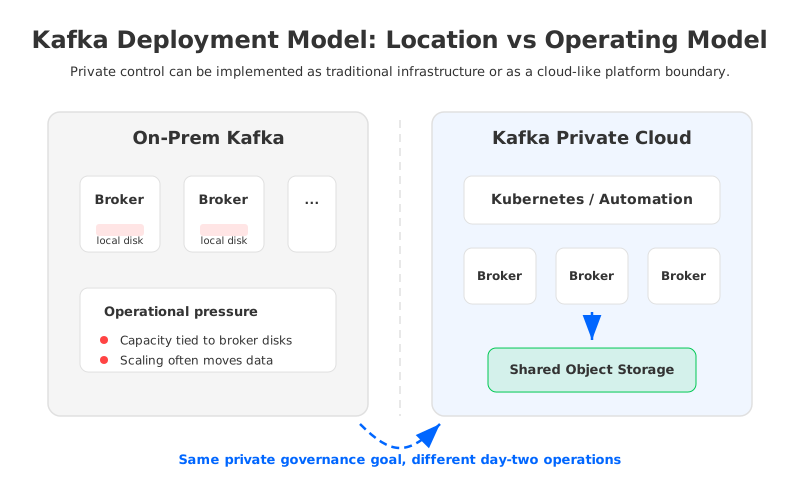
That distinction matters because Apache Kafka is not difficult only at the API layer. Kafka's operational weight comes from how brokers own local storage, how partitions map to disks, how replication consumes network and capacity, and how scaling usually means moving data. A physical on-premises cluster can satisfy a compliance checklist while still creating a brittle data platform. A Kafka private cloud model can keep the control boundary private while using Kubernetes, S3-compatible object storage, automated lifecycle management, and centralized observability to reduce operational drag.
The right question is not "cloud or data center?" It is: which deployment model gives the enterprise enough control without freezing Kafka into yesterday's infrastructure model?
1What Teams Usually Mean by Private Kafka
Searches for Kafka private cloud, on premise Kafka, Kafka on premise, and on-premise Kafka often mix three different concerns. The first is data control: records, logs, credentials, and metadata should stay inside an environment the enterprise owns or governs. The second is operational control: platform teams want to decide upgrade windows, network policy, observability integrations, identity boundaries, and incident response procedures. The third is commercial control: infrastructure spend should map to existing procurement, cloud commitments, or data center investment.
Traditional on-premises Kafka solves the location question by placing brokers in company-operated facilities. That can be useful for regulated workloads, plant-floor systems, local applications, or environments with limited external connectivity. But on-prem does not automatically solve elasticity, operational consistency, storage efficiency, or upgrade safety. It often gives teams maximum ownership of the infrastructure and responsibility for every failure mode.
Kafka private cloud is a broader model. It can run in a corporate data center, a sovereign cloud, a dedicated cloud account, a private Kubernetes environment, or a hybrid environment connected through private networking. The core idea is that the Kafka data plane and governance boundary remain private, while the operational substrate may look closer to cloud-native infrastructure than a static server estate.
For enterprise architects, the deployment model should be judged by four questions:
- Who owns the data plane, including storage, credentials, and audit logs?
- How are brokers provisioned, patched, replaced, and observed?
- How does the platform scale when throughput, retention, or partition count changes?
- What happens when hardware, disks, zones, or Kubernetes nodes fail?
Those questions are more useful than labels. A self-managed Kafka cluster on bare metal and a private cloud Kafka platform may both be "private," but their day-two behavior can be completely different.
2On-Prem Kafka: Strengths and Operational Limits
On-premises Kafka remains a valid architecture when the enterprise needs close physical proximity to producers, strict isolation from public cloud networks, or reuse of existing data center investments. It can also be the only practical option for industrial systems, government networks, or environments where outbound connectivity is heavily constrained.
Its strengths are clear:
- Physical and network placement are under enterprise control.
- Hardware profiles can be standardized for internal platform patterns.
- Security teams can align Kafka with existing data center access and monitoring controls.
- Procurement can amortize infrastructure across broader private platform investments.
The tradeoff is that Kafka's storage model exposes every capacity mistake. Apache Kafka brokers store log data in configured log directories, and partitions are assigned to brokers that own local storage. When retention grows, a broker fills. When partition balance changes, data moves across brokers. When a disk fails, replicas and ISR health become operational priorities. When a broker class is undersized, the fix often includes both compute work and data movement.
On-premises capacity planning therefore has two clocks. The first is the workload clock: daily ingest, burst throughput, consumer replay, retention policy, replication factor, and partition growth. The second is the hardware clock: procurement lead time, rack space, power, firmware, replacement parts, operating system lifecycle, and decommissioning. Kafka SREs live at the intersection of those clocks.
This creates a familiar pattern. A cluster is sized for the next expected peak because adding capacity later is slow. Retention gets negotiated down because disks are finite. Rebalancing is delayed because it competes with production traffic. Teams add runbooks for broker replacement, partition reassignment, disk expansion, and rolling upgrades. Over time, the platform becomes stable but heavy.
That heaviness is not a sign of poor engineering. It is the natural result of running a shared-nothing log system on infrastructure that changes slowly.
3Private Cloud Kafka: Control Without Freezing the Platform
Kafka private cloud tries to preserve private governance while modernizing the operating model. In practice, it usually means Kafka runs inside a controlled cloud-like environment: Kubernetes or another orchestration layer for compute, infrastructure-as-code for provisioning, private networking for application access, centralized metrics and logs, and object storage or managed block storage for durable capacity.
This model gives platform teams a stronger automation surface. Instead of treating brokers as long-lived machines, teams can treat them as replaceable workloads. Kubernetes StatefulSets, persistent volumes, scheduling controls, and health probes can standardize parts of the lifecycle. Infrastructure-as-code can make cluster creation repeatable. Observability systems can collect broker metrics, JVM metrics, storage metrics, node signals, and application lag in one place.
Private cloud does not remove Kafka expertise. It changes where the expertise is applied. Engineers still need to understand partitions, replication, quotas, client behavior, schema and connector patterns, and failure modes. But fewer tasks should depend on manually nursing individual servers.
The private cloud model also makes storage choices more explicit. A team may use persistent volumes for broker-local Kafka, S3-compatible object storage for tiered or shared storage architectures, NFS-like shared filesystems for specific write-ahead-log designs, or cloud block volumes when the private environment is built on a dedicated cloud account. Each choice has latency, durability, cost, and operational implications.
The key advantage is optionality. Private cloud Kafka can be designed around the requirement that matters most:
| Enterprise requirement | Traditional on-prem Kafka | Private cloud Kafka |
|---|---|---|
| Physical isolation | Strong fit | Possible, depending on private cloud location |
| Kubernetes-native lifecycle | Usually added later | Common design point |
| Elastic compute replacement | Limited by broker-local data | Stronger when storage is decoupled |
| Long retention | Disk planning heavy | Better fit with object storage designs |
| Unified observability | Often custom integration | Usually a platform baseline |
| Hardware refresh | Direct Kafka project risk | Abstracted when the platform owns nodes |
| Audit boundary | Data center controls | Data plane plus automation controls |
The risk is that "private cloud" can become a vague label. A real private cloud Kafka design needs concrete answers about storage, identity, networking, backup, upgrade ownership, and support access.
4Storage and Scaling Are the Real Fault Line
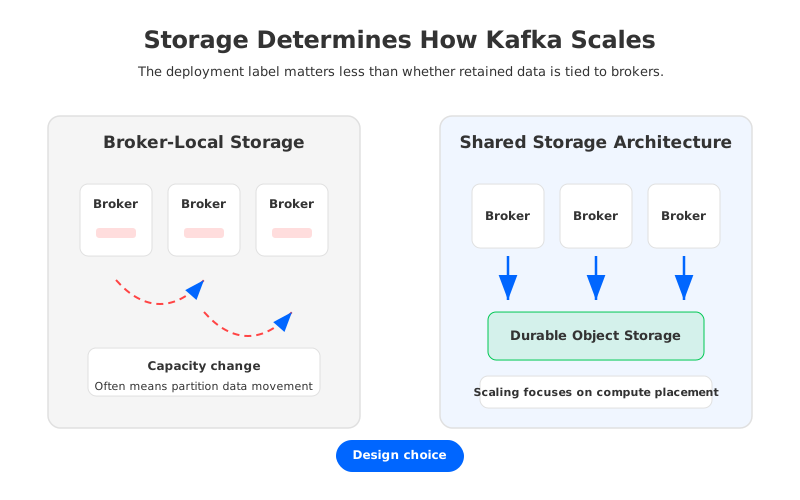
The biggest architectural difference is storage ownership. Traditional Kafka brokers are not merely compute nodes; they are compute plus durable log storage. That coupling is why scaling often becomes a data movement event. If a topic's partitions need a new distribution, replicas must be reassigned. If a broker is replaced, data must be recovered. If retention grows, broker disks must absorb it.
This is manageable at modest scale. At enterprise scale, it becomes the bottleneck behind many operational conversations:
- Can the team add brokers without saturating internal network links?
- Can it increase retention without buying hardware months ahead?
- Can it replace aging nodes without a large rebalance window?
- Can it isolate noisy workloads without duplicating full clusters?
- Can it prove durability and recovery behavior to auditors?
Private cloud gives architects a chance to revisit this coupling. A broker-local design can still run in Kubernetes, but Kubernetes alone does not make Kafka storage elastic. If persistent volumes remain the source of truth for partition data, many traditional constraints remain. The cluster may be easier to deploy, yet still expensive to rebalance and recover.
Object storage changes the conversation when it becomes a durable storage layer rather than a cold archive bolted onto the side. S3-compatible systems such as MinIO, Ceph, and cloud object stores provide a capacity abstraction that is not tied to any individual broker. For Kafka-compatible systems that separate compute from durable stream storage, brokers can become closer to stateless serving nodes. Scaling then focuses more on compute placement and metadata, and less on moving every retained segment between broker disks.
This is where AutoMQ Software fits naturally for private environments. AutoMQ keeps Kafka protocol compatibility while using a shared storage architecture: brokers handle compute and network I/O, while durable data is stored in S3-compatible object storage. A WAL layer can be backed by options such as S3, NFS, or cloud block storage depending on latency and infrastructure constraints. The practical implication is not that private Kafka becomes effortless. It is that broker replacement, scaling, and recovery are less dominated by large partition data movement.
For a private cloud team, that is the architectural prize: keep private control, but avoid making every capacity change a storage migration.
5Kubernetes Helps, but It Is Not the Whole Answer
Kubernetes is often the first technology named in a Kafka private cloud discussion. It is useful, but it should be treated as an orchestration layer rather than a storage strategy. StatefulSets can provide stable identities. Persistent volumes can attach durable storage. Operators can automate cluster creation, rolling updates, certificates, and configuration changes. Network policies and service discovery can make private access more consistent.
Those are real benefits. They reduce procedural drift and make Kafka fit the enterprise platform operating model. But Kubernetes cannot erase Kafka's local-disk coupling by itself. A broker that owns a large persistent volume still has data gravity. Replacing that broker, expanding its storage, or redistributing partitions remains a Kafka storage operation.
The best private cloud Kafka designs separate concerns:
- Kubernetes schedules and replaces compute.
- Storage architecture defines where durable data lives.
- Observability defines how teams detect lag, saturation, disk pressure, and client impact.
- Automation defines how upgrades, certificates, and configuration changes are applied.
- Governance defines who can access records, metadata, logs, and support workflows.
When those layers are conflated, the design becomes fragile. A team may believe it has modernized Kafka because it runs in containers, while the hardest operational risks remain hidden in persistent volumes and manual partition movement.
6Cost Framework: Avoid Unsourced Benchmarks, Model the Drivers
Enterprise Kafka cost analysis should avoid universal numbers. Data center power, depreciation, labor, storage systems, replication factor, network topology, retention, and support model differ widely. A private cloud running on owned hardware is not priced like a public cloud account, and a dedicated cloud account is not priced like a colocated data center.
Instead, model the drivers:
| Cost driver | What to model |
|---|---|
| Broker capacity | CPU, memory, network, disk throughput, and headroom |
| Storage | Retention, replication, hot/cold tiers, object storage, volume expansion |
| Data movement | Rebalances, replica catch-up, recovery, cross-zone or cross-rack paths |
| Operations | Patching, monitoring, incident response, upgrades, certificate rotation |
| Hardware lifecycle | Procurement, warranty, replacement, firmware, decommissioning |
| Platform services | Kubernetes, object storage, logging, metrics, backup, security tooling |
Traditional on-prem Kafka may look cost-effective when hardware is already owned and workloads are stable. It can become expensive when teams must overprovision years ahead, keep large disk buffers for retention, or perform labor-intensive recovery and refresh projects. Private cloud Kafka may add platform layers, but those layers can reduce manual work and make capacity changes more repeatable.
The most important metric is not the price of one broker. It is the cost of changing the system safely.
7Decision Checklist for Enterprise Teams
Use this checklist before choosing between on-prem Kafka and Kafka private cloud:
- Define what "private" means. Is it physical location, data residency, customer-managed keys, private networking, audit evidence, or support access control?
- Map Kafka workloads by retention, throughput, replay frequency, latency sensitivity, and compliance tier.
- Identify whether broker-local storage is acceptable for the largest retention and recovery scenarios.
- Decide whether Kubernetes is required for lifecycle consistency or merely preferred for platform alignment.
- Choose a storage model before choosing an operator or packaging model.
- Validate observability: broker metrics, client lag, storage saturation, node health, audit logs, and change history.
- Model hardware lifecycle and cluster scaling as first-class cost events.
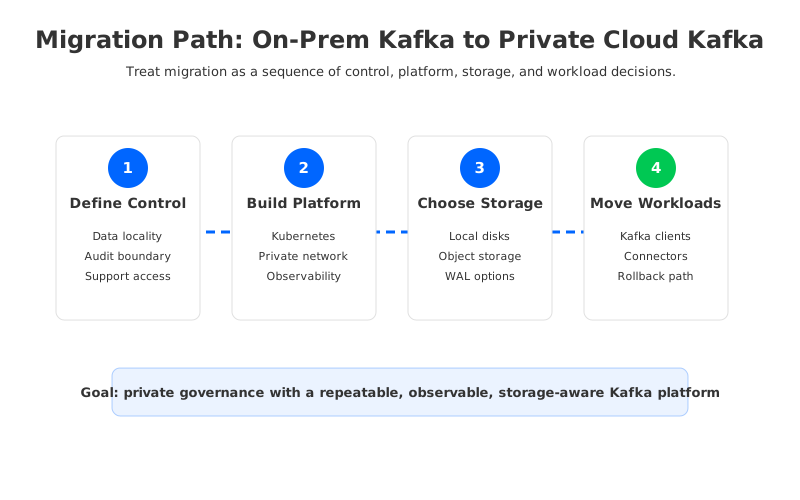
- Require a migration path that preserves Kafka clients, Kafka Connect patterns, and operational rollback options.
For stable, locality-bound workloads with mature data center operations, on-premises Kafka can still be the right answer. For teams that want private control but also need faster scaling, more repeatable operations, and less data movement during broker changes, a private cloud architecture is often the better long-term fit.
The real decision is architectural, not ideological. If the enterprise only needs private governance, do not force every Kafka workload into a physical-server operating model. If the enterprise truly needs on-premises placement, design it with the same discipline used for cloud platforms: automate the lifecycle, make storage explicit, and reduce the blast radius of scaling and recovery.
8References
- Apache Kafka Documentation: Operations
- Apache Kafka Documentation: Broker Configurations
- Kubernetes Documentation: StatefulSets
- Kubernetes Documentation: Persistent Volumes
- Amazon S3 API Reference
- AutoMQ FAQ
- AutoMQ GitHub Repository
9FAQ
9.1Is Kafka private cloud the same as on-prem Kafka?
No. On-prem Kafka usually means Kafka runs in company-operated facilities. Kafka private cloud means the Kafka data plane runs inside a private governance boundary, which may be a data center, sovereign cloud, dedicated cloud account, or private Kubernetes platform. The key difference is the operating model: private cloud can use automation, orchestration, and shared storage patterns that are not typical in traditional on-premises clusters.
9.2When should an enterprise keep Kafka on-premises?
On-premises Kafka can fit workloads that require physical locality, isolation from public cloud networks, industrial site connectivity, or reuse of existing data center platforms. It works best when workload growth is predictable and the organization has mature Kafka, storage, network, and hardware operations.
9.3Does Kubernetes solve Kafka scaling problems?
Kubernetes helps with scheduling, identity, rolling changes, and automation, but it does not automatically decouple Kafka brokers from local persistent data. If broker disks remain the durable source of truth, scaling and recovery can still involve significant data movement.
9.4How does object storage change private Kafka architecture?
S3-compatible object storage can provide a durable capacity layer independent of individual broker machines. In Kafka-compatible shared storage systems, this makes brokers less stateful and reduces the pressure to move retained partition data during scaling, replacement, or recovery.
9.5Where does AutoMQ Software fit?
AutoMQ Software fits teams that want Kafka compatibility in a private or self-managed environment while reducing the operational burden of broker-local storage. Its shared storage architecture places durable stream data in S3-compatible object storage, with stateless brokers and WAL options that can be matched to the environment's latency and infrastructure requirements.


