
Table of Contents
Table of Contents
The search for kafka queue semantics vs stream semantics usually starts after a system has outgrown a clean diagram. One team wants multiple workers to share a backlog. Another team wants every service to replay the same facts at its own pace. A platform team is asked whether Kafka can behave like a queue, whether a queue can behave like Kafka, and what will break when the workload moves from a tidy proof of concept into production traffic.
The frustrating answer is that both models can be valid. Kafka has always made it possible to build queue-like processing through consumer groups: records in a partition are assigned to one consumer in the group at a time, while different groups can read the same stream independently. At the same time, Kafka's durable log, offset model, retention settings, and replay behavior are stream-native ideas. Calling one model "right" and the other "wrong" misses the real decision. The real question is which semantic contract your application needs, and whether the platform architecture can operate that contract under scale, replay, failure, and cost pressure.
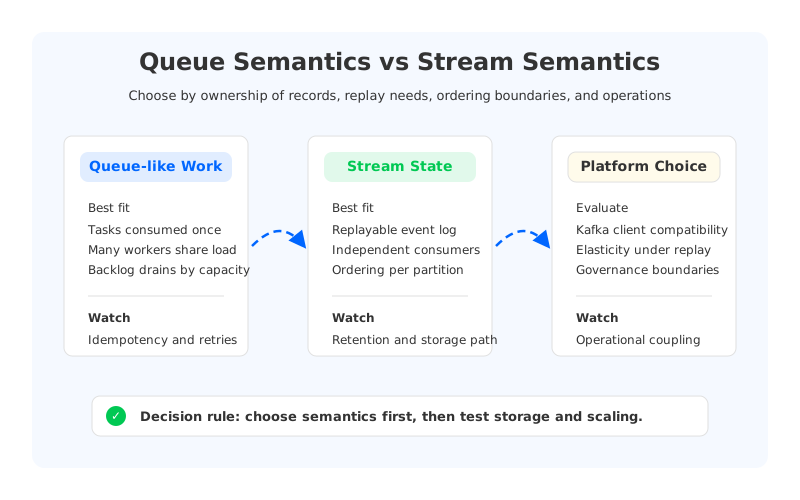
Queue semantics are about work ownership. Stream semantics are about fact history. Kafka sits in an interesting middle: it exposes a stream abstraction, then lets consumer groups distribute processing work over that stream. That middle ground is powerful, but it also creates confusion because API behavior, application correctness, and infrastructure behavior often get discussed as if they were the same thing.
1Queue Semantics: Work Is Claimed
A queue is a good mental model when the system cares that a unit of work is processed, not that every downstream application sees every unit independently. Think image resizing jobs, webhook delivery, ML inference tasks, or asynchronous order enrichment. The record is a work item. Multiple workers compete for capacity. Once a worker completes the task, the system should not ask every other worker to do the same task again.
Kafka consumer groups can support this shape for many workloads. Consumers with the same group id divide topic partitions among themselves, and each partition is consumed by one member of that group at a time. That gives a familiar work-sharing pattern, but it is still constrained by Kafka's partition model. If a topic has 12 partitions, extra consumers may help availability, but they do not create more partition-level parallelism.
Queue-like designs therefore need a sharper review than "Kafka can do consumer groups." The production questions are concrete:
- How much parallelism is available? Parallelism comes from partitions, processing model, and safe application-level concurrency. Adding consumers alone does not overcome partition count or key skew.
- What does retry mean? A failed task may need backoff, dead-letter handling, idempotent side effects, and poison-message isolation. Offset commits alone do not define the whole retry contract.
- Does ordering matter? Queue workers often want maximum throughput; Kafka partitions preserve order within a partition. Those two goals can collide when a slow record blocks later records with the same key.
- Who owns completion? In a work queue, completion is the central state transition. In Kafka, the consumer's committed offset is progress, but the application must still make external side effects safe.
The queue model is attractive when the backlog is large and the work is independent. It becomes risky when the application quietly depends on ordering, replay, or multiple services observing the same event.
2Stream Semantics: Facts Are Retained
A stream is a better mental model when the event itself is a durable fact. An order was placed. A payment was authorized. A feature vector was updated. A device emitted telemetry. Different consumers may need to read the same fact for fraud detection, analytics, search indexing, customer notifications, and model training. Each consumer owns its own progress through the log, and the platform retains enough history to let consumers catch up or replay.
Kafka's offset model fits this pattern well. A consumer group tracks its position in each partition; another group can read the same records without interfering. Retention policies decide how long the log remains available. Transactions and idempotent producers can help teams reason about exactly-once processing in specific read-process-write flows, though they do not magically make every external side effect transactional.
The stream model is useful when the system needs time travel. A team can deploy a corrected consumer and replay older events, or rebuild state after changing transformation logic. That is difficult to bolt onto a traditional queue because a queue usually optimizes for removing work once it is completed.
That advantage has a cost. Retained history needs storage. Replay can compete with live traffic. A consumer that starts hours behind the head of the log may stress a very different data path than a consumer tailing fresh records. This is where semantic discussions become infrastructure discussions. A stream contract is not only an API promise; it is a storage and operations promise.
3The Architecture Underneath The Semantics
Traditional Kafka uses a shared-nothing broker model. Brokers own partition leadership, serve reads and writes, and store log segments on broker-local storage. Replication improves durability and availability, but it also means data placement is tied to brokers. When traffic grows, teams scale brokers, rebalance partitions, move replicas, and reserve capacity for failure.
That coupling matters for both queue-like and stream-like workloads. Queue-like workloads can produce sudden backlog drains: many workers restart, claim work, and increase fetch pressure. Stream workloads can produce long replays while live consumers keep tailing the head of the log. The application talks in offsets and records, but the platform pays in broker I/O, network paths, cache behavior, partition movement, and storage retention.
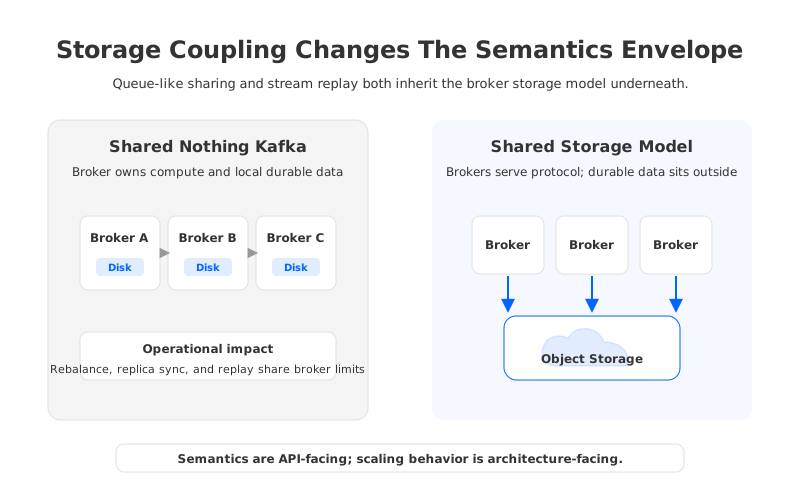
Apache Kafka's tiered storage feature addresses part of this problem by moving eligible older log segments to remote storage, reducing pressure on broker-local disks for long retention. That is valuable, but it does not remove every form of broker coupling. The hot path, leadership, local cache, metadata, and recovery behavior still need operational attention. For platform teams trying to make streaming infrastructure more elastic, the storage boundary becomes the next design question.
The important distinction is this: semantics describe what applications can rely on; architecture describes what operators must keep true while applications rely on it. A queue-like API with poor retry isolation is not production-ready. A stream-like API with fragile replay behavior is also not production-ready. The right abstraction must survive incidents, deployment waves, traffic spikes, and cost audits.
4A Decision Framework For Platform Teams
The useful comparison is a set of contracts that can be tested. A platform team should force each candidate architecture through the same questions before choosing Kafka, a queue service, a Kafka-compatible system, or a hybrid pattern.
| Decision area | Queue-like workload | Stream workload | What to test |
|---|---|---|---|
| Ownership | One worker should complete a task | Many applications may read the same fact | Consumer group behavior, retry state, duplicate handling |
| Parallelism | Scale workers against backlog | Scale consumers by partition and group | Partition count, key skew, processing concurrency |
| Ordering | Often local or relaxed | Often partition-key dependent | Reordering tolerance and slow-record behavior |
| Replay | Usually exceptional | Often a first-class capability | Retention, catch-up speed, replay isolation |
| Cost driver | Backlog bursts and worker capacity | Retention, fan-out, and historical reads | Storage growth, broker I/O, cross-zone paths |
| Governance | Who can claim and complete work | Who can read, retain, and replay facts | ACLs, audit, data boundary, schema control |
This table usually reveals that most real systems are not pure. A payment event is a durable stream fact, but a chargeback investigation may create queue-like tasks. A CDC stream feeds analytics, but a sink connector may need work-queue retry semantics for failed writes. The architecture should make those mixed contracts explicit instead of hiding them in application code.
Hybrid designs are often the cleanest answer. Use Kafka topics as the system of record for facts. Derive work topics for task-like processing. Keep failed tasks in explicit retry or dead-letter topics instead of burying them behind offset movement. Use separate consumer groups for independent applications. These patterns are not glamorous, but they prevent semantic confusion from becoming an incident.
5Cost, Governance, And Migration Are Part Of Semantics
Semantic choices also create organizational consequences. A queue can be easier to reason about for one application team because completion is local. A stream can be easier to govern at platform level because facts remain observable and replayable. Neither property is free. Completion state, retention state, and replay rights all need ownership.
Cost is the first place the hidden contract shows up. Queue-like workloads can create bursty compute needs because backlog drain speed depends on worker capacity and downstream throughput. Stream workloads create storage and network needs because retained data, fan-out reads, and replay traffic continue after the original write.
Governance has a similar shape. If records are work items, the main risk is duplicate side effects, stuck work, or unbounded retries. If records are durable facts, the main risk is unauthorized replay, long-lived sensitive data, schema drift, and unclear retention ownership. The operating model must define who can create topics, extend retention, add consumer groups, access historical data, and run backfills.
Migration makes the distinction sharper. Moving a queue-like workload to Kafka is not only a client rewrite. The team must map acknowledgement, retry, dead-letter, and duplicate-handling behavior into Kafka topics, offsets, and application logic. Moving a stream workload away from broker-local assumptions is not only a storage migration. The team must preserve client compatibility, offset continuity, ordering expectations, security boundaries, and rollback options.
6Where AutoMQ Changes The Operating Model
Once the semantic contract is clear, the platform architecture can be evaluated without turning the article into a vendor comparison. The neutral requirement is straightforward: keep Kafka-compatible application behavior while reducing broker-storage coupling where it limits elasticity, replay, or cost control.
AutoMQ belongs in that architectural category. It is a Kafka-compatible, cloud-native streaming system that uses shared storage and a more stateless broker design, so durable stream data is externalized from broker-local disks while clients continue to use Kafka APIs. For a queue-like workload, that does not remove the need for idempotent workers, retry topics, or partition-aware concurrency. For a stream workload, it does not remove the need to design retention, schema, and governance. The practical difference is that broker replacement, scale-out, long retention, and catch-up reads can be evaluated against a shared-storage model.
That distinction is useful only when tied to real tests. A proof of concept should run the application's actual producer and consumer clients, not only a synthetic benchmark. It should replay from older offsets while live traffic continues, scale brokers under load, replace nodes, observe lag slope, inspect storage metrics, and verify security boundaries. If those tests matter, a shared-storage Kafka-compatible architecture becomes a serious option.
AutoMQ's value proposition is strongest when the pain is architectural: broker-local storage pressure, slow recovery, retention cost, replay interference, or cloud elasticity limits. It is weaker when the pain is purely application-level: a blocking database write, a bad partition key, or a non-idempotent retry loop. That boundary keeps the evaluation useful for the architects and SREs who will own the result.
7Production Readiness Checklist
A semantics decision is ready for production when it has been rehearsed across failure paths, not when the happy-path demo passes.
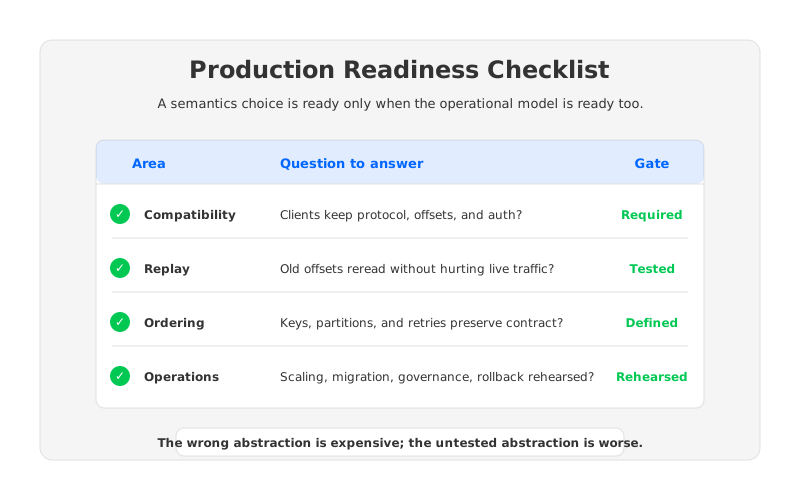
Before standardizing on queue-like or stream-like behavior in Kafka, validate these gates:
- Compatibility gate. Existing clients, auth, producer guarantees, consumer offsets, and observability expectations must be mapped explicitly.
- Replay gate. The team should know whether historical reads are normal, rare, or forbidden, then test the storage path behind that answer.
- Ordering gate. Partition keys, retry topics, dead-letter handling, and side effects should preserve the business contract.
- Cost gate. Retention, fan-out, replay, cross-zone traffic, storage, and worker capacity should be visible before the design becomes a platform default.
- Governance gate. Topic ownership, schema evolution, data access, retention changes, and replay permissions should have owners.
- Migration and rollback gate. The cutover plan should preserve offsets and client behavior, and the rollback plan should be tested before production traffic depends on it.
The cleanest answer may be Kafka as a durable event stream, Kafka plus derived work topics, a managed queue for task-only workloads, or a Kafka-compatible shared-storage platform when operations are the limiting factor. What matters is that the semantic contract and the operating model match.
If broker-storage coupling is part of your evaluation, test it with real producers, consumers, replay windows, and failure drills. The next step is not a slogan; it is a workload-specific proof of concept against the semantics your teams already depend on. You can start from the AutoMQ project or compare deployment options in the docs.
8References
- Apache Kafka Documentation for consumer groups, offsets, transactions, replication, and tiered storage concepts.
- Apache Kafka 4.3 Documentation for current Kafka configuration and operational reference material.
- Apache Kafka KIP-932: Queues for Kafka for the public design discussion around share groups and queue-style consumption.
- AutoMQ Documentation for Kafka compatibility, shared-storage architecture, BYOC deployment, and cloud-native operating guidance.
9FAQ
Is Kafka a queue or a stream? Kafka is primarily a distributed event log, but consumer groups let teams implement queue-like work sharing. Kafka retains records by topic policy and lets independent consumer groups track offsets, while a traditional queue centers on claiming and completing work items.
When should I use queue semantics on Kafka? Use queue-like semantics when a record represents work for one worker pool and the team has a clear retry, idempotency, dead-letter, and ordering plan. It is a poor fit when every downstream service needs independent replay.
When are stream semantics better? Stream semantics are better when events are durable facts that multiple consumers may need to read independently, replay, audit, or use to rebuild state. They are common in CDC, telemetry, fraud detection, feature pipelines, and event-driven integration.
Do Kafka consumer groups give unlimited queue parallelism? No. In conventional Kafka consumer groups, partition assignment limits active parallelism. More consumers than partitions may improve failover readiness, but they do not create more active partition assignments unless the workload uses a different consumption model or application-level parallelism.
How does storage architecture affect queue or stream semantics? Storage architecture affects replay speed, retention cost, broker recovery, scaling, and whether catch-up reads interfere with live traffic. The API may expose the same offsets and records, but operators still need a platform that can maintain those contracts under real workload pressure.
Where does AutoMQ fit in this decision? AutoMQ is relevant when teams want Kafka-compatible APIs but need a cloud-native shared-storage operating model. Evaluate it after the semantic contract is clear, especially when replay, elasticity, retention, and broker-local storage coupling recur.


