
Table of Contents
Table of Contents
A Kafka quota usually becomes visible at the worst possible moment. A fraud pipeline starts a replay, a producer release doubles its batch volume, or a connector backfill pushes a shared cluster into latency spikes. The workload team sees throttling. The platform team sees cluster-wide risk. Finance sees another request for idle headroom. Kafka quota management sits in the middle because it is both a runtime control and a governance contract.
Kafka gives operators quota primitives for produce throughput, fetch throughput, and request percentage. Those settings are useful, but they are not a complete operating model. A quota may protect brokers today while still leaving unresolved questions about ownership, replay priority, local disk growth, cross-zone traffic, and who pays for reserved capacity tomorrow.
The goal is not to make every team slower. It is to let many teams share Kafka without allowing one workload to turn normal operations into a cluster incident. That requires a different question from "what value should I put in producer_byte_rate?" The better question is: what resource is the quota protecting, what behavior should change when the limit is reached, and does the architecture make that policy enforceable?
1Why teams search for kafka quota management
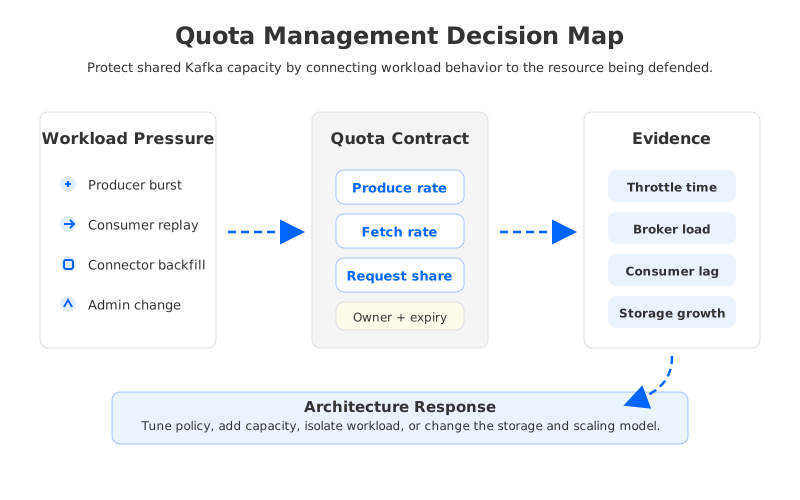
The search intent is almost always production-driven. Teams already know Kafka can move a lot of data. They are trying to stop one application from consuming more than its fair share of a shared platform. The pressure shows up in familiar patterns:
- Producer bursts that saturate request handlers, network links, or broker write paths faster than a platform team can add safe capacity.
- Consumer replays that are legitimate from an application recovery point of view but compete with live traffic for fetch bandwidth and cache locality.
- Connector and batch jobs that operate on a different rhythm from user-facing services, making average traffic a poor predictor of peak load.
- Administrative changes such as topic creation, partition count changes, retention updates, and ACL adjustments that need ownership and auditability.
Kafka quota management becomes politically difficult because each pattern has a reasonable owner. The producing team wants to ship. The consuming team wants to recover. The platform team wants the cluster to remain stable. If the quota system only says "throttled" without explaining the protected resource, teams learn to treat limits as arbitrary.
Good quota policy starts by naming the constrained dimension. Produce throughput, fetch throughput, request percentage, retained storage, partition count, connection count, and replay concurrency are not interchangeable. A producer can pressure write durability, while a replay can pressure reads and downstream systems. A single quota value cannot describe all of those behaviors.
2The governance pressure behind shared streaming platforms
Shared Kafka clusters are attractive because they centralize expertise and reduce platform sprawl. A small number of well-operated clusters can give application teams a consistent Kafka endpoint, a standard security model, common monitoring, and predictable support. The trade-off is that every shared cluster needs a fairness model. Without one, the loudest workload gets the most capacity, and the quiet workloads fund the blast radius.
The fairness model has to include more than Kafka configuration. A team-level quota should be tied to identity, topic ownership, environment, business criticality, and change process. A temporary backfill should not use the same approval path as a permanent traffic increase, and development traffic should not get the same replay priority as a payment service. Quotas are the runtime expression of these governance decisions.
This is where many organizations get stuck. They write a policy that sounds reasonable in a platform document, then discover that the data plane makes the policy expensive to operate. If raising a tenant limit means resizing brokers, increasing local disk, checking inter-zone traffic, and planning partition reassignment, the quota process will be slow. If lowering the limit causes recovery jobs to miss their recovery objective, the policy will be bypassed during incidents.
The useful design rule is simple: a quota should protect a real shared resource, and the platform should expose enough telemetry for both sides to understand the outcome. Application teams should see throttle time, request latency, consumer lag, and their own traffic shape. Platform teams should see broker saturation, storage growth, replication pressure, and noisy workload attribution.
3Why broker-local architecture makes quota policy harder
Traditional Apache Kafka uses a Shared Nothing architecture. Each broker owns local log segments for assigned partitions, and replication keeps additional copies on other brokers for durability and availability. This model is mature and widely understood. It also means the broker is not only a request processor. The broker is a storage owner, replica participant, recovery target, page cache manager, and cost unit.
That coupling matters when quotas are used to control noisy workloads. A producer burst is not only a request-rate event. It becomes local log growth, replica traffic, controller metadata pressure, and future data movement if partition placement needs to change. A consumer replay is not only a fetch-rate event. It can displace hot cache, increase storage reads, compete with live consumers, and expose whether the cluster was sized for recovery traffic or only steady state.
Tiered storage can help with long retention economics, but it does not automatically make brokers stateless or remove all broker-local operational constraints. Platform teams still have to reason about hot data, fetch behavior, local storage, reassignments, and failure recovery. The quota setting is visible; the harder part is the capacity model behind it.
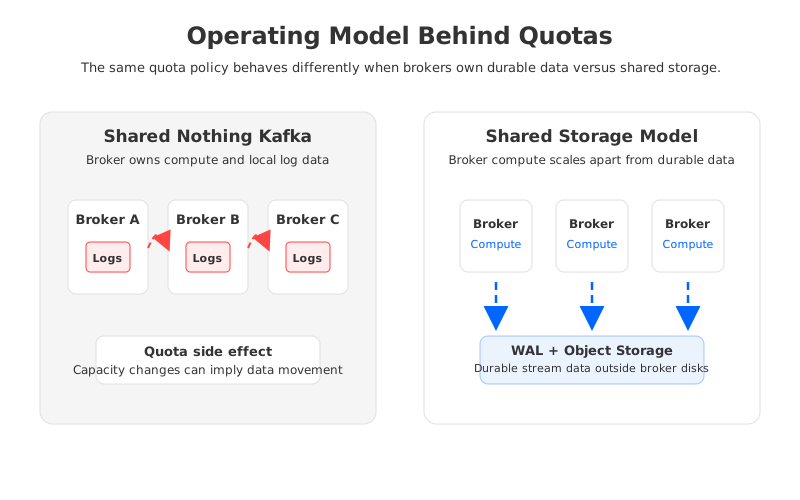
When a cluster is near its operating envelope, a quota can prevent immediate harm, but it cannot create elasticity by itself. If the right answer is "this tenant needs more capacity," the platform has to add capacity safely. In a broker-local model, that often intersects with partition movement and disk ownership.
4Contracts, ownership, access, and audit trade-offs
A usable Kafka quota model needs clear contracts. The contract should say what the team can do by default, what happens when the team exceeds that envelope, and how the limit can change. It should also separate steady-state policy from incident policy. A consumer group recovering from a downstream outage may need a temporary replay window that would be inappropriate as a permanent entitlement.
The contract usually spans four boundaries:
| Boundary | What to define | Why it matters |
|---|---|---|
| Identity | Principal, client ID, service account, team, environment | Quotas are hard to defend if ownership is ambiguous. |
| Resource | Produce, fetch, request share, retained data, partitions, connections | Different noisy behaviors pressure different parts of the platform. |
| Evidence | Throttle time, lag, broker saturation, storage growth, audit logs | Both application and platform teams need the same incident narrative. |
| Change path | Approval, expiry, rollback, emergency override | Temporary exceptions should not become permanent hidden policy. |
The access model is as important as the rate limit. If every team can request topic changes, ACL updates, and quota increases through informal channels, the platform loses auditability. If every change requires a heavyweight review, teams route around the process. The middle ground is a controlled self-service path: predefined workload classes, ownership metadata, bounded quota envelopes, and evidence collection for exceptions.
This is also where schema governance, topic catalogs, and platform portals become relevant. They do not replace Kafka quotas. They give the quota a social and operational context. A production topic should have a visible owner, retention class, data classification, expected write envelope, replay policy, and escalation path. Without that context, the quota is only a number attached to a client string.
5Evaluation checklist for platform teams
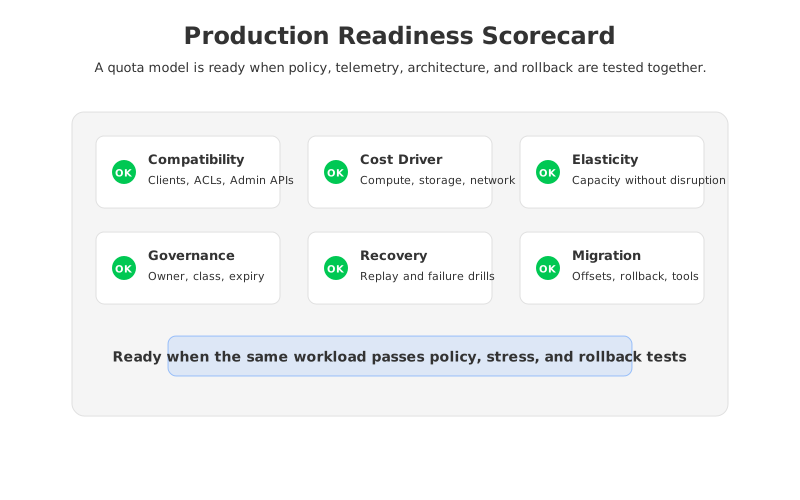
Before tuning quotas or selecting a different Kafka-compatible platform, evaluate the complete operating model. The checklist should include Kafka semantics, cost, elasticity, governance, recovery, and migration risk. A platform that exposes quota settings but makes capacity expansion painful may still leave teams stuck. A platform that scales quickly but weakens compatibility can create application risk.
Use this decision frame during architecture review:
| Question | What a strong answer looks like |
|---|---|
| Kafka compatibility | Producers, consumers, AdminClient workflows, ACLs, transactions, compaction, consumer groups, and quota-related operations can be tested against real workloads. |
| Elasticity | Capacity can be added for request pressure without turning every quota increase into a large data movement project. |
| Cost accountability | The team can explain which cost driver the quota protects: compute, local disk, object storage, network transfer, replay load, or support time. |
| Governance | Every quota maps to an owner, workload class, environment, and review process. |
| Recovery | Incident replays and catch-up reads have a policy that protects live traffic without blocking urgent recovery. |
| Migration risk | Client behavior, offsets, ACLs, topic configuration, monitoring, and rollback are verified before cutover. |
The point of this checklist is to expose weak assumptions. Some teams will discover that their current Kafka estate only needs better ownership metadata, dashboards, and exception handling. Others will discover that the same quota incidents keep tracing back to slow scaling, broker-local storage pressure, and high reserved headroom.
6How AutoMQ changes the operating model
Once the evaluation reaches architecture, AutoMQ becomes relevant as a Kafka-compatible streaming platform built around Shared Storage architecture. The application-facing contract remains Kafka-oriented: producers, consumers, topics, partitions, consumer groups, and Kafka ecosystem tools remain central to the operating model. AutoMQ separates broker compute from durable stream storage by using WAL storage for write durability and object storage as the shared storage layer.
That separation changes quota management in a specific way: it reduces durable data ownership attached to each broker. Brokers can focus more on request handling, leadership, caching, and coordination, while persisted stream data is stored outside broker-local disks. When a workload needs more request capacity, scaling broker compute is less entangled with copying partition data between local disks.
This does not make quotas unnecessary. Shared Storage architecture still needs admission control, workload isolation, tenant policy, observability, and security review. What changes is the reason quotas exist. Instead of using quotas partly to compensate for slow broker-local data movement and expensive idle headroom, teams can aim quotas more directly at fairness, SLO protection, replay safety, and cost accountability.
AutoMQ also fits the governance discussion because many Kafka teams want infrastructure control without returning to full self-management. BYOC and software deployment models keep the data plane within customer-controlled cloud boundaries, which matters for teams that need their own network, IAM, audit, and observability posture. Those controls do not remove validation work for clients, ACLs, quotas, and migration workflows, but they reduce the gap between platform governance and where the data runs.
The migration test should stay concrete. Pick one workload with meaningful traffic, one replay scenario, one connector or batch job, and one administrative workflow. Run the same quota and recovery cases on the current environment and the target architecture. If the target platform claims Kafka compatibility, prove it with the exact clients and tools your teams use. If it claims better elasticity, prove that adding capacity does not trigger the data movement bottleneck you are trying to escape.
7A practical rollout pattern
Quota management should evolve in layers. Start with observability and ownership before tightening limits. A platform team that cannot attribute traffic by owner will struggle to enforce policy fairly. Then classify workload shapes: latency-sensitive services, ingestion, replay-heavy analytics, connector backfills, development traffic, and emergency recovery. Each class should have a default envelope and an exception path.
The next layer is enforcement. Apply quotas where they map to real constrained resources, and avoid using one limit as a proxy for every problem. Producer limits can protect write paths. Consumer limits can protect fetch capacity and live traffic. Request-share limits can protect broker request handling. Storage and partition policies often belong in topic templates rather than client quotas.
Finally, connect quota changes to capacity actions. If many teams repeatedly need exceptions, the policy is telling you something. The cluster may be undersized, the workload classes may be wrong, the architecture may not fit the traffic shape, or the organization may be using a shared platform for tenants that deserve stronger isolation. Treat quotas as signals, not only as brakes.
Back at the incident that started the search, the desired outcome was never a prettier quota file. The desired outcome was a shared Kafka platform where one workload can burst, recover, or backfill without forcing every other team into a negotiation. If broker-local storage and data movement keep turning quota reviews into capacity projects, evaluate whether a Shared Storage Kafka-compatible architecture changes the operating model enough to matter. To test that path, start with AutoMQ's contact page and bring your real quota scenarios.
8References
- Apache Kafka, Operations: Basic Kafka Operations
- Apache Kafka, Configuration
- Apache Kafka, Consumer configuration
- Apache Kafka, KIP-405: Kafka Tiered Storage
- AutoMQ Docs, Compatibility with Apache Kafka
- AutoMQ Docs, Architecture Overview
- AutoMQ Docs, WAL Storage
- AutoMQ Docs, Continuous Self-Balancing
- AutoMQ Docs, Eliminate Inter-Zone Traffic
9FAQ
9.1What is Kafka quota management?
Kafka quota management is the practice of limiting and governing how clients, users, or workload classes consume shared Kafka resources. It commonly covers produce throughput, fetch throughput, and request share, but production programs often extend the model to ownership, topic policy, storage growth, replay behavior, and exception handling.
9.2Which Kafka quotas matter most for noisy workloads?
Producer throughput quotas help control write bursts, consumer throughput quotas help protect fetch capacity, and request-percentage quotas help limit broker request-handler pressure. The right quota depends on the failure mode. A replay-heavy workload should not be governed the same way as a steady ingestion service or an administrative automation tool.
9.3Do Kafka quotas replace capacity planning?
No. Quotas are guardrails, not capacity. They can slow a workload before it harms others, but they do not remove the need to size brokers, storage, network paths, partitions, and recovery headroom.
9.4Does Shared Storage architecture remove the need for quotas?
No. Shared Storage architecture changes how durable data is placed and how broker capacity can scale, but teams still need quotas for fairness, workload isolation, and SLO protection. The benefit is that quota policy can be less entangled with broker-local storage movement and more focused on workload behavior.
9.5How should a team test quota behavior during migration?
Use a production-like workload rather than a demo topic. Include steady writes, a burst, a consumer replay, an ACL or quota change, observability checks, and a broker or zone failure drill. Verify client behavior, offsets, throttling visibility, rollback, and operational ownership before moving critical traffic.


