
Table of Contents
Table of Contents
Kafka rebalancing rarely fails in a dramatic way. It usually fails by becoming too expensive to run at the moment you need it most. A broker is replaced, a new broker is added, disk usage skews, one partition becomes hotter than the rest, or an expansion plan needs to move load before the next traffic peak. The operation is familiar; the risk window is the part that makes teams hesitate.
That hesitation is why many Kafka operators look for Cruise Control. The tool is valuable because it turns cluster balancing from a manual spreadsheet exercise into a goal-driven optimization loop. It can model broker load, generate reassignment proposals, execute them with constraints, and help teams avoid the worst placement decisions.
But Cruise Control does not change what a traditional Kafka broker is. If durable partition data lives on broker-local disks, a broker rebalance is still a data movement operation. Better planning can reduce unnecessary movement, choose safer destinations, and throttle execution, but it cannot make a large local log stop being large.
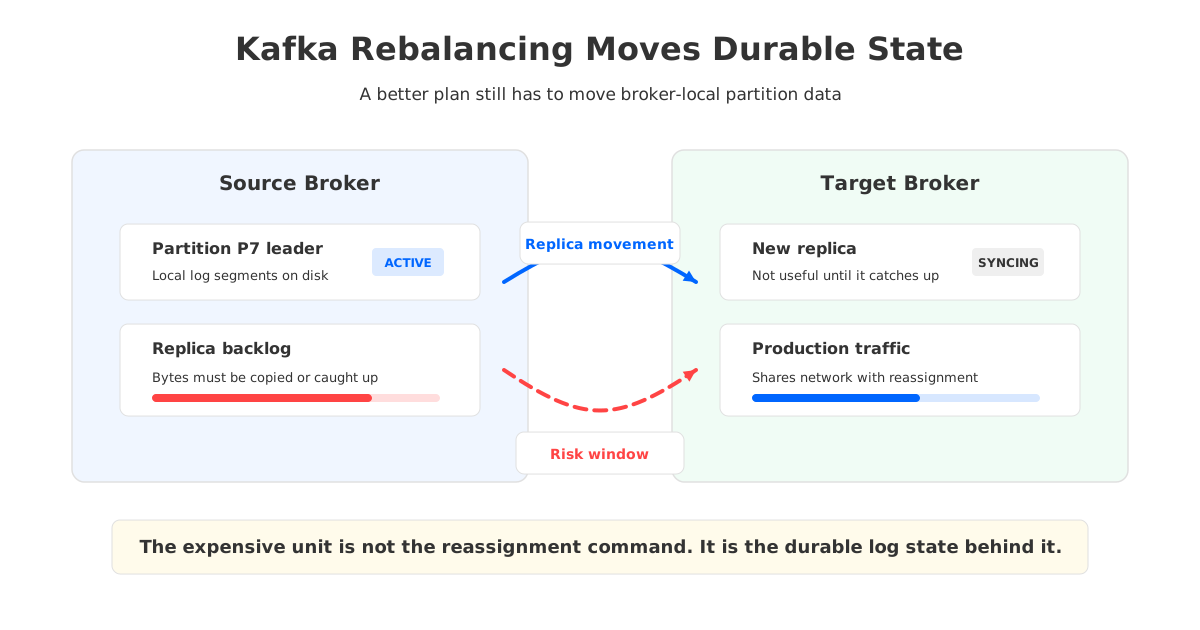
The practical question is not whether Cruise Control is useful. It is. The better question is where its boundary sits. When the pain comes from poor placement decisions, Cruise Control is often the right lever. When the pain comes from broker-local storage itself, the lever has reached the edge of the architecture.
1Why Kafka Rebalancing Becomes Painful
Kafka has several operations that people casually call "rebalancing," and mixing them together makes incident reviews confusing. Consumer group rebalancing assigns partitions to consumers. Broker or partition reassignment moves partition replicas and leadership across brokers. Cruise Control mainly addresses the second class: balancing cluster resource usage by changing replica and leader placement.
That distinction matters because broker rebalancing touches the physical shape of the cluster. In traditional Kafka, partitions are stored as logs under broker-local log directories. A reassignment does not only update a routing table; it creates or moves replicas, catches them up, changes leader placement, and waits for the cluster to return to a healthy replication state. Apache Kafka's operations documentation exposes this reality directly through the partition reassignment workflow and the ability to throttle reassignment traffic.
The operational pain usually comes from four pressure points:
- Expansion is not instantly useful. A new broker starts empty. It only helps after replicas or leaders move onto it, so compute capacity arrives before balanced traffic does.
- Hot partitions resist neat averages. A partition with disproportionate write or read traffic can dominate disk, network, or CPU even when the broker count looks reasonable.
- Throttling is a tradeoff, not a cure. Lower throttles protect production traffic but extend the rebalance window. Higher throttles finish sooner but compete with clients and replication.
- Failure handling overlaps with maintenance. Under-replicated partitions, leader movement, and catch-up traffic can turn a planned balancing task into a broader availability concern.
These are not signs that Kafka is badly designed. Kafka's original model placed durable logs on brokers and used replication to keep those logs available. That model is simple, robust, and well understood. The friction appears when cloud teams expect infrastructure to scale like stateless compute while the Kafka data plane still behaves like stateful storage.
2What Cruise Control Helps With
Cruise Control exists because manual Kafka balancing does not scale well. Its GitHub project describes it as software that automates dynamic workload rebalance and self-healing for Kafka clusters. In practice, it gives operators a structured way to answer questions that are hard to answer from broker dashboards alone: which brokers are overloaded, which goals are violated, what reassignment plan would improve the cluster, and how much movement the plan would require.
That is a meaningful layer of automation. A mature Cruise Control deployment can help with:
- Goal-based optimization. Operators can express balancing goals for disk, network, CPU, replica distribution, leader distribution, rack awareness, and related constraints.
- Proposal generation. Instead of hand-editing reassignment JSON, the system can generate a plan based on cluster metrics and configured goals.
- Controlled execution. Reassignments can be executed with operational limits rather than dumped onto the cluster as an unconstrained maintenance event.
- Ongoing observability. The tool gives teams a shared model of balance and risk, which is often more useful than arguing from separate broker-level charts.
For many traditional Kafka clusters, Cruise Control is exactly the right improvement. It reduces toil, makes balancing more repeatable, and helps teams avoid creating new hotspots while trying to fix old ones. If the cluster is reasonably sized, the workload is predictable, and the primary issue is placement quality, Cruise Control can buy a lot of operational headroom.
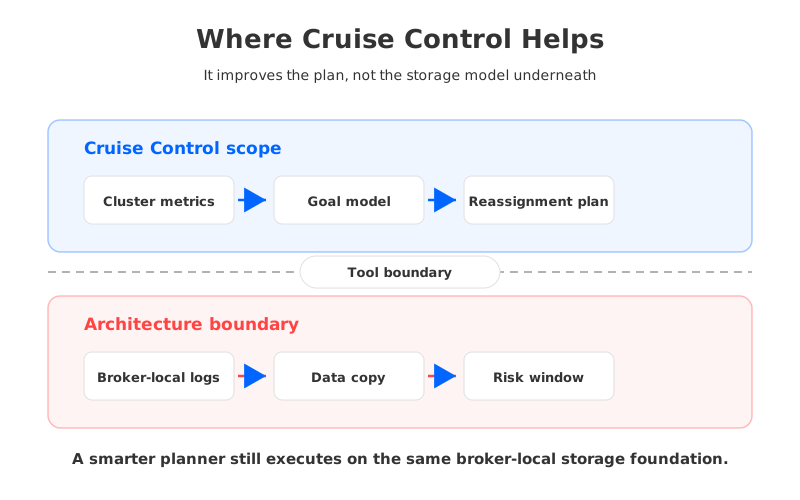
The boundary appears after the plan is accepted. Cruise Control can decide that replica A should move from broker 1 to broker 4. It can make that decision better than a tired human during a maintenance window. But the data still has to get there through Kafka's reassignment path, and the cluster still has to absorb the resulting network, disk, replication, and leadership effects.
3What Cruise Control Cannot Remove
The hardest Kafka rebalancing issues are not planning issues. They are conservation-of-state issues. If a partition has accumulated a large local log and the new placement requires another broker to host that replica, the system must reconcile that state somehow. No optimizer can erase the bytes; it can only choose when and where they move.
That is why slow rebalancing often survives even after Cruise Control is configured correctly. Teams tune goals, exclusions, anomaly detectors, replica movement limits, inter-broker throttles, and maintenance windows, yet the underlying task remains bounded by how much state must be copied and how much production traffic the cluster can spare during the copy. The better the team becomes at protecting production traffic, the longer some movements take.
The tradeoff is easier to see as a boundary table:
| Layer | Cruise Control can improve | Cruise Control cannot remove |
|---|---|---|
| Placement | Which replicas and leaders should move | The fact that broker-local replicas own durable data |
| Execution | Movement order, concurrency, throttling, exclusions | The need to catch up moved replicas before the cluster is balanced |
| Risk control | Avoiding overloaded destinations and goal violations | The maintenance window created by large data movement |
| Operations | Repeatability, visibility, fewer manual plans | The coupling between broker identity and stored log data |
This is why "Kafka rebalance slow" searches often lead to two different answers. The first answer is operational: use better planning, metrics, throttles, and controlled reassignment. The second answer is architectural: reduce the amount of durable state that must move when ownership changes. Cruise Control addresses the first answer. It cannot fully deliver the second while the storage model remains broker-local.
4Shared Storage and Faster Partition Reassignment
A shared-storage Kafka architecture changes the shape of the problem by moving durable log data away from broker-local disks. Brokers still serve Kafka clients and participate in metadata, leadership, request handling, caching, and runtime coordination. The difference is that the durable record state is no longer tied to a specific broker's local disk.
AutoMQ is designed around that separation. Its architecture keeps Kafka protocol compatibility while storing most data in object storage, with broker compute becoming much more replaceable. In AutoMQ's partition reassignment documentation, the key mechanism is that reassignment mainly needs to force-upload the small amount of data not yet persisted to object storage, then transfer partition serving responsibility through metadata and recovery steps. AutoMQ documents second-level reassignment behavior under this model and explains that this becomes the foundation for automatic scaling and continuous self-balancing.
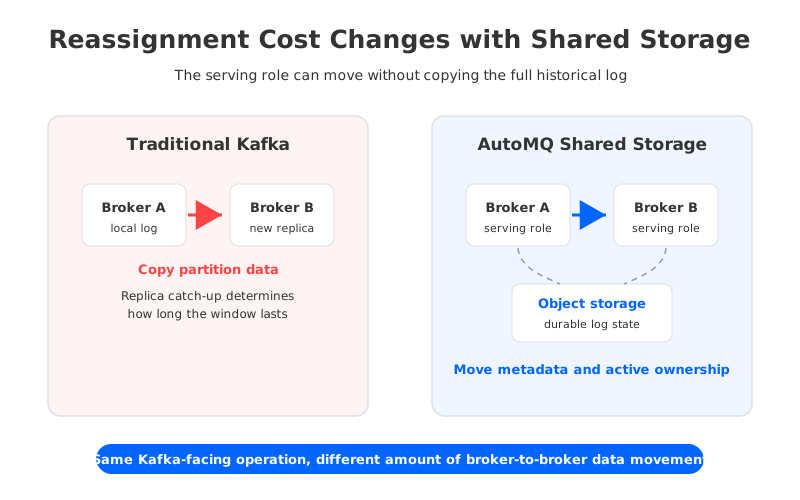
The important point is not that every rebalance becomes magically free. The system still needs correct metadata handling, clean shutdown behavior, object storage access, leadership changes, observability, and operational safeguards. But the expensive part changes. Instead of copying the full historical partition log from one broker to another during a reassignment, the system can rely on shared durable storage and move the serving role with far less broker-to-broker data transfer.
That difference matters most in the scenarios where Cruise Control feels least satisfying:
- Emergency expansion. Adding brokers helps sooner when new compute can take partition responsibility without waiting for large replica copies.
- Hotspot mitigation. Moving serving responsibility away from a constrained broker does not require the same amount of historical data movement.
- Scale-in and replacement. Draining a broker becomes less about evacuating durable logs and more about shifting active responsibilities safely.
- Continuous balancing. Smaller movement cost makes balancing viable as a routine control loop instead of a carefully rationed maintenance task.
This is the architecture-level reason AutoMQ should not be framed as "a Cruise Control replacement." Cruise Control optimizes traditional Kafka balancing. AutoMQ changes the storage and reassignment model so that the balancing problem has a different cost profile.
5Decision Framework
The right next step depends on what kind of pain your team is seeing. If your cluster has no systematic balancing automation, Cruise Control or a managed equivalent should probably be evaluated before you jump to a platform change. Many teams still have avoidable imbalance because they rely on manual reassignment, rough disk averages, or maintenance scripts that do not understand workload goals.
Architecture change becomes more relevant when the bottleneck is not decision quality. You can tell the difference by looking at what happens after the plan is good. If the proposal is reasonable but the operation still takes too long, creates too much replication pressure, or requires too much human supervision, the limiting factor is probably broker-local state movement.
Use this framework before choosing the next lever:
| Symptom | Better Cruise Control tuning may help | Architecture evaluation is warranted |
|---|---|---|
| Brokers are imbalanced because placement is ad hoc | Yes. Start with goals, metrics, and controlled proposals. | Not yet; fix the operating model first. |
| Reassignments are correct but take too long under safe throttles | Partly. Tune concurrency and limits. | Yes. The movement cost is becoming structural. |
| New brokers stay underused for too long after expansion | Partly. Improve proposal timing. | Yes, especially for bursty or elastic workloads. |
| Hot partition mitigation is blocked by large log movement | Partly. Plan carefully. | Yes. Shared storage can change the movement unit. |
| Teams avoid balancing because maintenance windows are risky | Partly. Automate and observe better. | Yes. Avoided maintenance is a strong architecture signal. |
The common failure mode is treating every Kafka rebalancing issue as a tooling gap. Tooling matters, and Cruise Control deserves respect for what it automates. But if your team keeps asking a planner to solve a storage-coupling problem, the planner will eventually look worse than it is.
Start with the boundary. Cruise Control can make traditional Kafka rebalancing smarter. Shared-storage Kafka can make many reassignments smaller. Once that distinction is clear, the decision stops being "Cruise Control or AutoMQ" and becomes a more useful question: are you optimizing a broker-local architecture, or are you ready to change the architecture that makes rebalancing expensive?
6Sources
- LinkedIn Cruise Control GitHub repository
- Apache Kafka basic operations: partition reassignment
- AutoMQ partition reassignment in seconds
- AutoMQ continuous self-balancing
- AutoMQ scale-out/in in seconds
7FAQ
7.1Is Cruise Control still useful for Kafka?
Yes. Cruise Control is useful when the cluster still follows the traditional broker-local storage model and the team needs better balancing decisions, safer proposals, and more repeatable reassignment execution. The boundary is that Cruise Control optimizes movement; it does not remove the storage architecture that makes large movements expensive.
7.2Why can Kafka partition rebalancing take so long?
Traditional Kafka stores partition logs on broker-local disks. When a reassignment requires a broker to host a replica it does not already have, Kafka has to create or catch up that replica and move data through the cluster under safe operational limits. Throttling can protect production traffic, but it also extends the time needed for large movements.
7.3Does Cruise Control eliminate under-replicated partitions during rebalance?
Cruise Control can help plan and control reassignments so the cluster is less likely to be pushed into unsafe states. It cannot guarantee that every operational event avoids under-replication, because broker failures, throttling choices, large movement volume, and workload pressure still matter.
7.4Is AutoMQ a replacement for Cruise Control?
No. AutoMQ should be understood as an architectural alternative for teams that want Kafka compatibility with shared storage and more elastic broker behavior. Cruise Control is a balancing tool for Kafka clusters; AutoMQ changes the storage model that makes many traditional rebalancing operations heavy.
7.5When should a team evaluate shared-storage Kafka?
Evaluate shared-storage Kafka when good balancing plans still produce long maintenance windows, high replication pressure, delayed expansion benefit, or repeated hotspot mitigation work. Those symptoms suggest the team is no longer dealing only with placement quality; it is dealing with the cost of moving durable broker-local state.


