
Table of Contents
Table of Contents
A Kafka rebalance often starts with an ordinary operational goal: add brokers before a traffic spike, drain a broker for maintenance, recover from a disk incident, or smooth out a cluster where a few nodes carry too much data. On the change calendar, it looks like capacity hygiene. In production, it can turn into a long-running data movement project that competes with clients for network, disk, and replication bandwidth.
That gap is why Kafka rebalancing issues feel so frustrating. The goal is to make the cluster healthier, but the path there can increase the risks you are trying to reduce. A partition reassignment can run for hours, throttling can make it safer but slower, an aggressive throttle can hurt client latency, and an interrupted move leaves the team validating replica state under pressure.
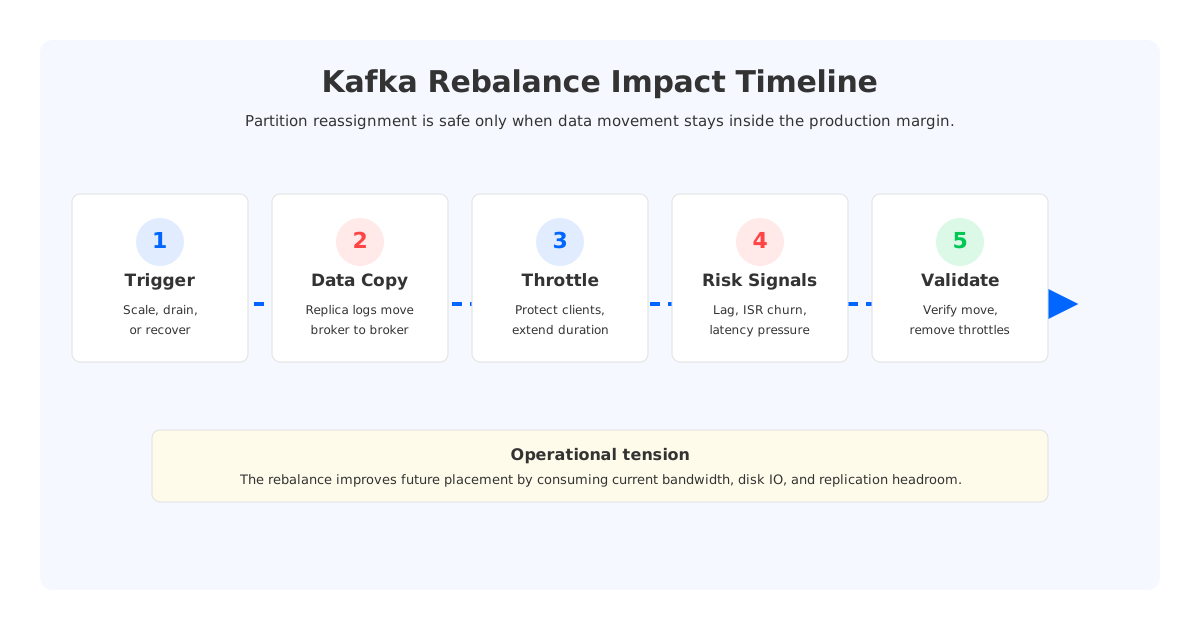
The word "rebalance" hides two mechanisms. One affects which consumers process which partitions. The other affects where partition replicas live across brokers. They share a name, but create very different failure modes.
1Which Kafka Rebalance Are We Talking About?
When an application team says "Kafka rebalance," they often mean a consumer group rebalance. A consumer joins, leaves, restarts, times out, or changes subscription, and the group coordinator assigns partitions to consumers again. The impact is application-facing: processing pauses, offset commits become sensitive, and lag can rise while ownership changes. Kafka's consumer group protocol and cooperative assignment options reduce disruption, but the scope is still consumer membership and partition assignment within the application group.
When a platform team says "Kafka rebalance," they usually mean broker-side partition movement. A partition replica is moved from one broker to another to fix skew, add capacity, replace hardware, or restore placement after failure. This is not a quick ownership shuffle. In traditional Kafka, the destination broker needs a partition copy that catches up through replication before the move is complete.
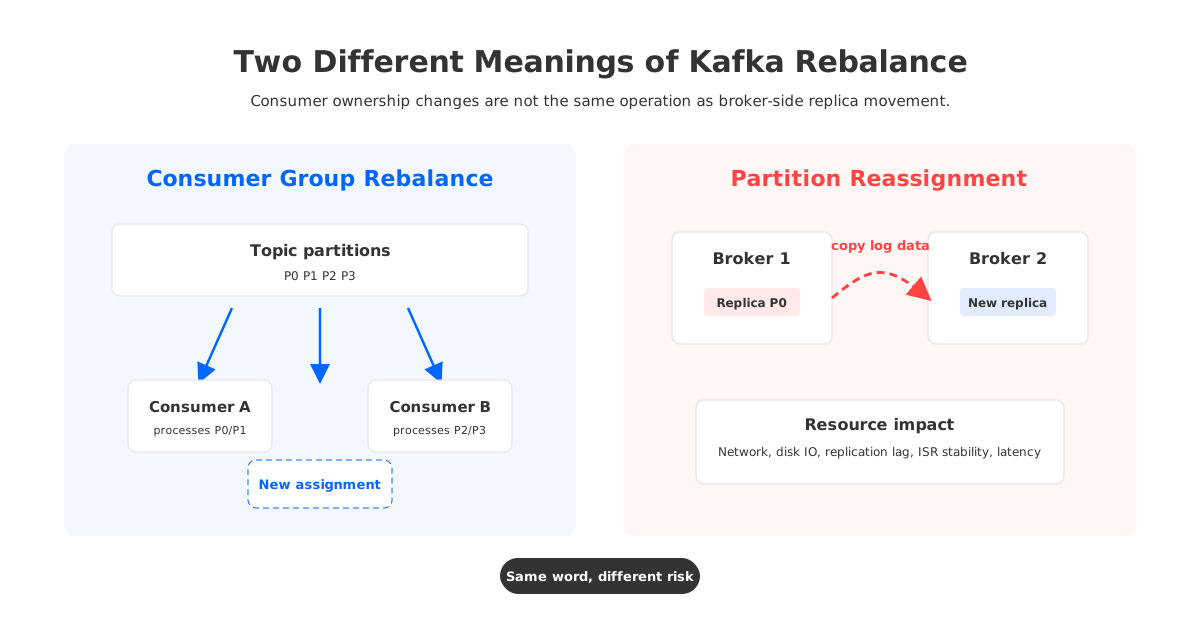
The distinction matters because the right mitigation depends on which rebalance is hurting you. Consumer group rebalances are addressed with client configuration, heartbeat/session tuning, cooperative assignors, static membership, and deployment discipline. Kafka partition rebalancing is addressed with reassignment plans, replication throttles, disk and network monitoring, broker placement strategy, and sometimes cluster-level automation.
| Operational question | Consumer group rebalance | Partition reassignment / broker rebalancing |
|---|---|---|
| What changes ownership? | Consumers take over partitions for processing. | Brokers host different leader or follower replicas. |
| Primary bottleneck | Application pause, polling, heartbeats, offset commits. | Network copy, disk IO, follower catch-up, controller activity. |
| Typical trigger | Consumer restart, deploy, timeout, membership change. | Scaling, maintenance, disk skew, broker replacement, rack/AZ placement. |
| Main risk | Lag spike or duplicate/late processing if app logic is weak. | Client latency, replication lag, under-replicated partitions, long maintenance windows. |
| Main control surface | Consumer configs and deployment patterns. | Reassignment plan, throttle, monitoring, automation, architecture. |
The operational pain usually comes from the second category: kafka partition rebalancing and kafka broker rebalancing. If your incident started with kafka-reassign-partitions, a balancing tool, or a broker drain plan, the problem is moving persistent partition replicas through a live production cluster.
2Why Partition Reassignment Is Expensive in Traditional Kafka
Kafka's original storage model binds durable log data to broker-local disks. Brokers own partitions, partitions are stored as append-only logs on local storage, and replication provides durability across brokers. When the cluster topology changes, moving a partition replica means moving bytes, not metadata alone.
Apache Kafka's reassignment process reflects that reality. An operator generates or provides a reassignment plan, executes it, monitors progress, verifies completion, and removes throttles when the work is done. During the move, target replicas are added, data is copied to the destination brokers, replication catches up, and old replicas are removed after the assignment converges. Kafka supports throttling reassignment traffic because unbounded replica movement can interfere with normal production traffic.
That throttle is useful and uncomfortable. Set it too high and the rebalance can saturate network links, overload disks, or increase request latency. Set it too low and the operation can run into the next traffic cycle. The correct limit depends on partition size, produce rate, replication factor, disk headroom, broker placement, traffic, and risk tolerance.
The operational loop usually looks like this:
- Build a reassignment plan that moves the smallest useful set of replicas. A plan that fixes every imbalance in one run may be too large for the maintenance window.
- Apply replication throttles before the move creates pressure. Throttles protect client workloads, but they also extend the time replicas spend in an intermediate state.
- Watch replication health while the cluster is changing. Under-replicated partitions, offline partitions, ISR churn, request latency, disk utilization, and network throughput matter more than a single progress indicator.
- Verify completion and clean up. Leaving reassignment throttles in place after the move can constrain future replication.
The hard part is that none of these steps are isolated from production workload. A hot partition keeps receiving writes while its replica is copied. A busy broker may also serve fetches for followers and consumers. Background maintenance becomes a competing workload inside the same resource pool.
3Production Symptoms During a Risky Rebalance
Kafka rebalancing issues rarely show up as one clean alarm. More often, the cluster gives you a mixed signal: some partitions are moving, some brokers are healthy, some clients are slower, and the team has to decide whether to keep going, slow down, or stop.
The symptoms usually cluster around these areas:
- Replication lag and ISR churn. Moving replicas increases follower fetch activity. If followers cannot keep up, in-sync replica sets can shrink and expand, which raises durability and availability concerns.
- Network saturation. Replica movement competes with producer replication, consumer fetches, and cross-zone traffic. In cloud environments, this can also increase data transfer cost depending on placement.
- Disk pressure. Destination brokers write copied log segments while serving normal broker duties. Source brokers read historical data while continuing to handle live traffic.
- Controller and metadata activity. Large reassignment plans create many state transitions. Operators still need to watch whether control-plane work is keeping up.
- Client-visible latency or lag. The business does not care that the root cause is a background reassignment. It sees slower produce acknowledgements, slower fetches, or downstream lag.
These symptoms explain why a kafka rebalance that "moves partitions" can become a production risk. The operation changes capacity placement by consuming capacity. That is an awkward bargain when the reason for rebalancing is that capacity was already uneven.
4The Throttle Trade-Off
Replication throttles are the main safety valve for Kafka partition reassignment. They limit how much bandwidth reassignment traffic can use so the cluster has room for normal workloads. Kafka documents reassignment throttling as part of the operational workflow, and experienced operators treat it as a required control.
The trade-off is structural: throttling makes the operation gentler by making it longer. A long move is not automatically bad, but it extends the period where the cluster is in transition. A broker failure, traffic surge, disk anomaly, or application retry storm can collide with the ongoing reassignment and turn maintenance into incident response.
| Throttle posture | Why teams choose it | Operational downside |
|---|---|---|
| Conservative | Protect client latency and keep replication pressure low. | Reassignment may take too long and overlap with peak traffic. |
| Aggressive | Finish before the maintenance window closes. | Higher risk of network, disk, and request latency impact. |
| Adaptive | Adjust based on live metrics and time remaining. | Requires better monitoring, runbooks, and operator confidence. |
The safest throttle strategy is usually adaptive, but adaptive operation depends on observability. Teams need a clear view of broker network throughput, disk utilization, request latency, produce/fetch rates, under-replicated partitions, offline partitions, and reassignment progress. Without those signals, throttle changes are guesswork.
5Mitigation Options and Their Limits
Traditional Kafka operators have practical ways to reduce rebalancing risk. The problem is that they manage the cost of data movement rather than removing the root cause.
The first option is to tune the reassignment itself. Move fewer partitions per wave, prioritize the hottest imbalance first, and avoid mixing broker drains, rack placement changes, and large topic expansions in the same operation. This reduces blast radius but increases operational rounds.
The second option is scheduling. Run partition movement outside peak traffic, avoid known batch windows, and coordinate with application deployments so consumer group churn does not stack on broker-side movement. Scheduling helps, but many Kafka clusters support global applications or customer-facing analytics where "quiet" is a relative word.
The third option is automation. LinkedIn's Cruise Control, for example, is widely used to analyze Kafka workload, detect imbalance, and propose or execute balancing actions. Automation can make broker rebalancing more consistent because it replaces one-off manual decisions with goals, constraints, and repeatable execution. It still operates within the same physical reality: if replicas live on broker disks, balancing them requires copying log data through the cluster.
The fourth option is architecture. This is the option teams reach for when rebalancing has become a recurring operational tax rather than an occasional maintenance task. If the expensive part of kafka broker rebalancing is bulk data movement, the architectural question becomes direct: can brokers change ownership without dragging all durable data from one local disk to another?
6How AutoMQ Changes Partition Rebalancing
The answer requires separating two responsibilities that traditional Kafka couples together: serving traffic and owning local persistent data. A Kafka-compatible system with shared storage can keep durable log data outside individual broker disks, then let brokers act more like stateless compute nodes. In that design, moving partition responsibility is closer to relocating ownership and traffic than copying a large local log.
AutoMQ is one implementation of that architecture: a Kafka-compatible streaming system that stores durable data in object storage and uses stateless brokers to serve Kafka protocol workloads. Its public documentation describes continuous self-balancing and scale-out or scale-in behavior built around shared storage rather than broker-local data gravity. The important point is that the unit of change becomes smaller.
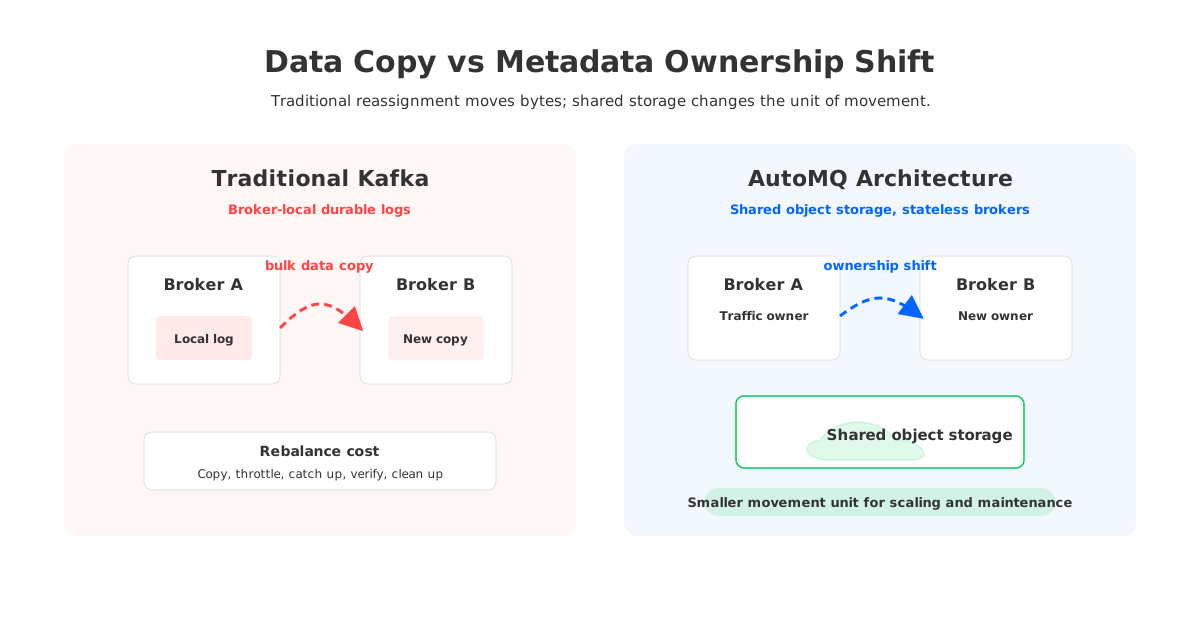
This changes the operational shape of a rebalance:
- Less bulk copy inside the broker fleet. Durable data already lives in shared storage, so partition movement does not need to recopy the full historical log between broker-local disks.
- Faster broker elasticity. Adding or removing broker capacity can focus on traffic serving and partition ownership rather than waiting for large local replicas to migrate.
- Smaller maintenance blast radius. Draining a broker becomes less tied to moving all of its durable data away first.
- Simpler balancing logic. Self-balancing can work continuously because each adjustment has lower data-movement cost.
This does not mean every operational concern disappears. You still need to monitor client latency, traffic distribution, object storage behavior, metadata health, and workload hotspots. Shared storage changes the dominant bottleneck; it does not excuse teams from operating the system. But it attacks the coupling between placement change and bulk data copy.
The practical decision is whether your team sees partition movement as an occasional controlled task or a recurring constraint on scaling, maintenance, and recovery. If rebalancing happens rarely and your clusters have generous maintenance windows, careful throttling and automation may be enough. If every expansion or broker drain turns into a long-running production risk, architecture deserves a place in the incident review.
7A Field Checklist for the Next Kafka Rebalance
Before the next kafka partition rebalancing operation, operators should make the implicit trade-offs visible. Name the imbalance first: disk skew, leader skew, replica placement, capacity headroom, or broker evacuation. Then define guardrails for under-replicated partitions, offline partitions, produce latency, fetch latency, disk utilization, network saturation, and throttle changes. Finally, put reassignment verification and throttle removal in the same runbook as execution, because the end of a long rebalance is exactly when cleanup mistakes are easiest to miss.
The deeper lesson is that kafka broker rebalancing is a test of how much operational slack your architecture has. Traditional Kafka can be operated safely with discipline, automation, and monitoring, but the cost model remains tied to moving data between brokers. Shared-storage architectures change that equation by making broker placement less dependent on local disk ownership.
That is the question worth asking after a painful rebalance: did the incident happen because the runbook was weak, or because the architecture made the safe path too narrow? If the answer is the second one, compare Kafka-compatible shared-storage designs such as AutoMQ and see how reassignment, scaling, and broker maintenance work when durable data is no longer trapped on individual brokers.
8References
- Apache Kafka 4.3 documentation: basic Kafka operations and partition reassignment
- Apache Kafka 4.2 documentation: consumer rebalance protocol
- LinkedIn Cruise Control for Apache Kafka
- AutoMQ documentation: continuous self-balancing
- AutoMQ documentation: scale out/in in seconds
9FAQ
9.1Is kafka rebalancing the same as partition reassignment?
Not always. A consumer group rebalance changes which consumers process partitions. Partition reassignment changes which brokers host replicas. Consumer rebalances mainly affect application processing, while partition reassignment affects broker disk, network, replication, and placement.
9.2Why does Kafka partition reassignment take so long?
In traditional Kafka, partition replicas are stored on broker-local disks. Moving a replica to another broker requires copying log data and letting the new replica catch up. Throttling protects production traffic, but it can also extend the operation.
9.3Should I use Cruise Control for kafka broker rebalancing?
Cruise Control can help automate cluster balancing decisions and execution, especially when manual reassignment becomes inconsistent. It does not remove the data-copy cost of moving replicas in a broker-local storage architecture, so teams still need throttles, monitoring, and maintenance discipline.
9.4What metrics should I watch during Kafka partition rebalancing?
Watch under-replicated partitions, offline partitions, ISR changes, broker network throughput, disk utilization, request latency, produce and fetch rates, controller health, and reassignment progress. The exact dashboard differs by environment, but the goal is to see both data movement progress and client impact.
9.5How does AutoMQ reduce kafka rebalancing issues?
AutoMQ uses shared object storage and stateless brokers while remaining Kafka-compatible. Because durable data is not tied to broker-local disks in the same way, partition reassignment can focus more on metadata ownership and traffic relocation instead of bulk broker-to-broker data copy.


