
Table of Contents
Table of Contents
Kafka scaling rarely fails because a team cannot add brokers. It fails because adding brokers is only the visible part of the work. The hard part is everything that follows: deciding which partitions move, limiting replication traffic, watching lag and latency, pausing other maintenance, and explaining why a capacity increase became an operations window.
That is the search intent behind kafka rebalancing scaling. The reader is not asking whether Kafka can scale. Kafka can scale very far when it is carefully operated. The real question is why a normal capacity change so often turns into a project with a runbook, a rollback plan, and several people watching dashboards.
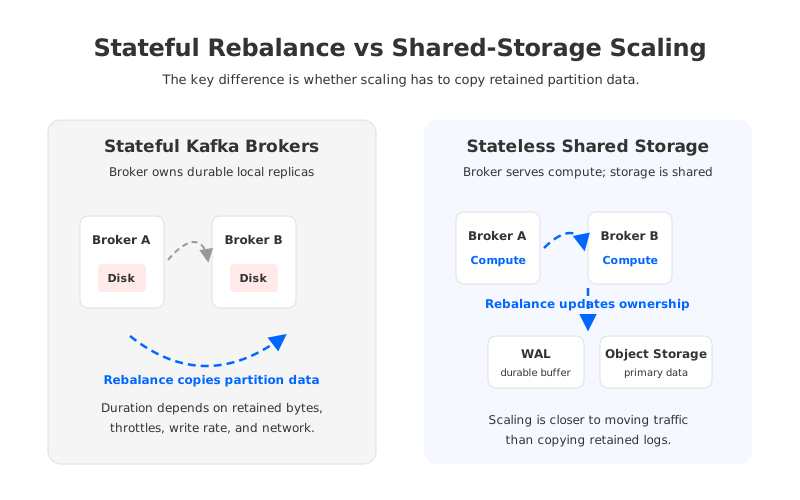
The answer sits in Kafka's storage model. Traditional Apache Kafka binds durable partition data to broker-local disks. When a partition moves, the system is not only changing ownership; it is also moving data. That coupling is workable when growth is predictable and the platform team can schedule rebalancing during quiet hours. It becomes painful when traffic changes faster than the storage layout can follow.
1Why Kafka rebalancing scaling becomes operational work
Partition reassignment is a normal Kafka operation. Platform teams use it when they add brokers, remove brokers, fix skewed placement, increase replication factor, respond to disk pressure, or isolate a hot broker. Kafka exposes tooling for reassignment plans and throttles that limit replica-movement bandwidth.
The tooling exists because the operation is data-intensive. In a shared-nothing Kafka architecture, each broker owns local replicas for specific partitions. When the placement changes, the target broker has to catch up by fetching partition data while producers may still be writing to the leader. The larger the retained log and the busier the topic, the more the reassignment competes with normal workload traffic.
That competition creates an operations loop:
- Throttle too aggressively, and the rebalance takes longer than the capacity event allows. The cluster may remain imbalanced while the traffic peak is still happening.
- Throttle too loosely, and replication traffic can disturb producers, followers, consumers, page cache behavior, and network utilization.
- Move too many partitions at once, and the cluster can trade one hotspot for another. Move too few, and the team spends more time iterating.
- Ignore downstream behavior, and consumer lag, stream processors, connectors, and operational alerts become the hidden cost of the scaling event.
This is why Kafka scaling can feel less like adding capacity and more like moving load-bearing walls. The logical action is simple: add capacity and redistribute traffic. The physical action is heavier: copy enough local state for the target broker to own the partitions.
2The difference between balancing traffic and moving storage
A useful evaluation starts by separating two goals that often get bundled together. The first goal is traffic balance: leaders and replicas should be distributed so brokers have enough CPU, network, request-handler capacity, and disk bandwidth. The second goal is storage placement: retained log data must be available where Kafka expects it to be available.
Traditional Kafka couples those goals. Moving traffic usually means moving replica storage. Tiered storage can reduce the amount of historical data that must remain local, but it does not fully remove the local tier from the operating model. Kafka's tiered storage design keeps local storage for active log segments and uses remote storage for older segments, so the platform team still needs to reason about local log state, follower catch-up, remote reads, and topic constraints.
This distinction matters during scaling. A broker added for more write throughput does not immediately help if the busy leaders are still elsewhere. A broker added for more disk capacity does not immediately help if data movement is throttled to protect production traffic. A broker removed during scale-in is not gone operationally until its partitions are safely moved away.
| Scaling question | Traffic-balancing concern | Storage-movement concern |
|---|---|---|
| Add brokers for a traffic spike | Which leaders should move to the added brokers? | How much retained data must be copied before the move is complete? |
| Remove brokers after the peak | Which partitions can leave without creating another hotspot? | How long will decommissioning compete with foreground traffic? |
| Fix a hot partition | Which broker has enough spare headroom? | Does the move require copying a large log while the partition keeps receiving writes? |
| Increase replication factor | Which failure domains should hold replicas? | How much network and disk IO will replica catch-up consume? |
The table is not a criticism of Kafka. It is the natural tradeoff of a storage architecture designed around broker-owned logs. Cloud infrastructure changed the economics and elasticity expectation, but many Kafka estates still inherit that coupling.
3What to measure before changing the architecture
The first reaction to rebalance pain is often tuning. That is reasonable. Many teams can reduce risk by improving partition strategy, using reassignment throttles, watching ISR health, avoiding unnecessary leader movement, and keeping enough broker headroom. The mistake is treating every rebalance problem as a tuning problem.
Before changing the platform architecture, measure the operational surface of rebalancing in your current environment:
- Data volume per moved partition. Reassignment pain is shaped less by partition count alone and more by retained bytes, write rate, and catch-up distance.
- Foreground sensitivity. Some workloads tolerate a long rebalance with throttled movement. Others treat latency jitter or consumer lag as a customer-visible incident.
- Maintenance frequency. A rebalance that is acceptable once a quarter may become unacceptable when elastic scaling, peak events, and node replacement happen every week.
- Failure-domain rules. Multi-AZ placement, rack awareness, and replication factor determine where replicas can move and how much cross-zone traffic the move may create.
- Downstream coupling. Stream processors, connector jobs, Flink savepoints, consumer offsets, and alert thresholds decide how much coordination is needed around the Kafka operation.
These measurements prevent two bad outcomes. One is overengineering: replacing a workable Kafka estate because a few reassignment defaults were weak. The other is undertreating the problem: tuning around a storage model that no longer fits the traffic pattern.
4Architecture patterns teams usually compare
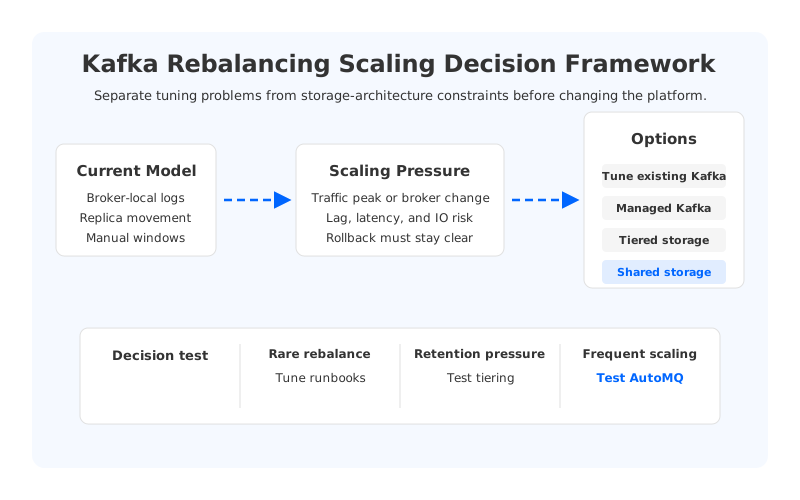
When rebalancing becomes a repeated scaling tax, teams usually compare four paths.
The first path is better operations on the existing Kafka cluster. This includes cleaner partition sizing, stricter broker headroom targets, reassignment automation, better throttling profiles, and more disciplined observability. It is the lowest-disruption path, and it should be tried when the pain is episodic rather than structural.
The second path is managed Kafka. A managed service can remove infrastructure toil, improve upgrade discipline, and provide a clearer support boundary. It does not automatically remove the underlying tradeoff if the service still uses a broker-local storage model. The buyer should ask how scaling, rebalance duration, throttling, cross-zone replication, and decommissioning behave under their workload.
The third path is Kafka with tiered storage. This can improve retention economics and reduce local storage pressure because older log segments can live in remote storage. It is helpful when the main problem is long retention. It is less complete when the main problem is elastic scaling because the active local tier still matters.
The fourth path is a Kafka-compatible shared-storage architecture. In this model, the broker keeps the Kafka-facing compute responsibilities while durable data is stored in shared object storage with a write-ahead log path for low-latency persistence and recovery. The operational promise is different: scaling should be closer to moving ownership and traffic than copying retained partition data.
5Where AutoMQ changes the operating model
If the root cause is the coupling between broker compute and broker-local durable storage, the architecture has to break that coupling without asking application teams to leave the Kafka ecosystem. AutoMQ fits that category: it is a Kafka-compatible streaming platform that keeps Kafka protocol and ecosystem semantics while replacing broker-local log storage with a shared-storage architecture based on S3Stream, WAL storage, and object storage.
The important point is not that AutoMQ adds another rebalance command. It changes what a rebalance needs to do. In AutoMQ, durable partition data is not treated as a broker-owned local asset. During partition reassignment, the system primarily needs to make sure the small amount of data not yet uploaded to object storage is safe, update metadata and leadership, and let the destination broker recover the partition view from shared storage. AutoMQ's documentation describes second-level partition reassignment as the foundation for scale-out, scale-in, and continuous self-balancing.
That does not remove the need for production validation. A serious evaluation still needs to test producer retry behavior, consumer lag, topic count, partition count, ACLs, quotas, observability, failure recovery, and the WAL option used in the target deployment. The difference is that the scaling question moves from "How long will it take to copy the retained log?" to "Can the platform safely transfer ownership and traffic within the workload's tolerance?"
AutoMQ also matters during migration. Many teams with rebalance pain already have a large Kafka estate. AutoMQ Kafka Linking is relevant because it is designed to synchronize topics and consumer-group progress while preserving offset consistency for migration scenarios.
6Evaluation checklist for platform teams
Do not evaluate rebalancing only by running a small topic on an empty cluster. The workload that hurts is usually the one with uneven producers, longer retention, bursty reads, and downstream systems that turn small timing changes into operational noise.
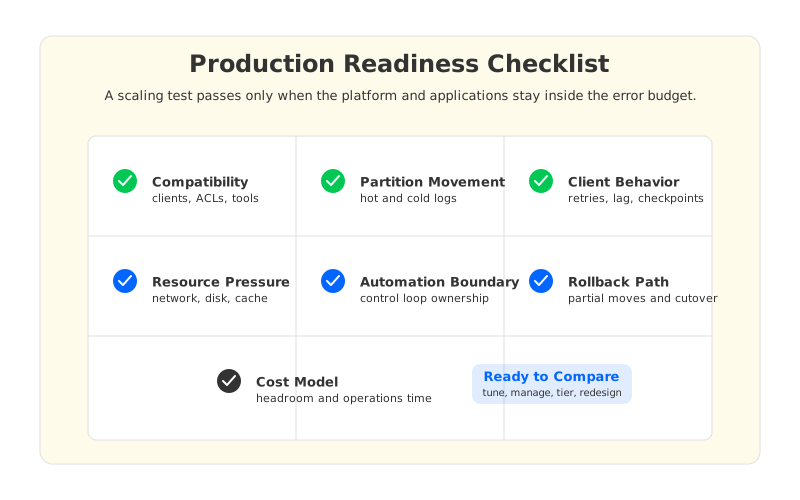
Use this checklist as a practical starting point:
| Evaluation area | What to test | Why it matters |
|---|---|---|
| Partition movement | Move hot, cold, large, and small partitions under write load. | Rebalance duration should be understood across different log shapes, not only in a toy topic. |
| Client behavior | Observe producer retries, metadata refresh, consumer lag, and stream processor checkpoints. | Scaling is successful only if applications continue within their error budget. |
| Network and storage pressure | Track replication traffic, cross-AZ paths, disk IO, page cache effects, and object-storage calls where applicable. | Rebalancing often competes with the workload it is meant to protect. |
| Automation boundary | Define who or what decides when to add brokers, move leaders, and remove brokers. | Elasticity without a control loop still leaves humans coordinating every event. |
| Rollback path | Practice backing out of a partial migration or a problematic rebalance. | A plan that cannot roll back is an incident waiting for a quiet label. |
| Cost model | Include idle headroom, replication traffic, retained storage, and operational time. | The bill for rebalancing is not only infrastructure; it is also delayed capacity and human coordination. |
This checklist also helps compare categories fairly. A managed Kafka service may win if the main constraint is team bandwidth. Tiered storage may win if the main constraint is retained history. A shared-storage Kafka-compatible platform may win if the repeated pain is scaling, broker replacement, hotspot recovery, and partition movement.
7Decision table: tune, manage, tier, or redesign
There is no universal answer. The right architecture depends on the shape of the workload and the cost of operational delay.
| Situation | Likely next step | Reasoning |
|---|---|---|
| Rebalancing is rare and predictable | Improve runbooks and reassignment throttles | The existing architecture may be good enough if the operation fits maintenance windows. |
| The team lacks Kafka operations capacity | Evaluate managed Kafka | A stronger service boundary may matter more than changing storage architecture. |
| Retention growth is the main pressure | Evaluate tiered storage and object-storage retention patterns | Remote storage can reduce local retention pressure when scaling frequency is manageable. |
| Traffic spikes require fast capacity changes | Evaluate Kafka-compatible shared storage | The bottleneck is the physical movement of broker-local state during scaling. |
| Migration risk is dominated by offsets and stateful consumers | Test a migration path with offset consistency and rollback | The target architecture is only useful if cutover risk is controlled. |
For many platform teams, the turning point is not a single catastrophic rebalance. It is the moment when every planned growth event starts to reserve people, calendar time, and cluster headroom. At that point, Kafka rebalancing is no longer an implementation detail. It is part of the platform's elasticity contract.
If your team is already measuring Kafka scaling by the operational project around it, study the storage model before adding another layer of automation. Start with the AutoMQ documentation on partition reassignment in seconds and shared-storage architecture, then test the pattern against your own partitions, consumers, and failure domains.
8References
- Apache Kafka Operations: Expanding your cluster and partition reassignment
- Apache Kafka KIP-405: Tiered Storage
- AutoMQ Documentation: Difference with Apache Kafka
- AutoMQ Documentation: Partition Reassignment in Seconds
- AutoMQ Documentation: Kafka Linking Overview
9FAQ
9.1Is Kafka rebalancing the same as consumer group rebalancing?
No. This article focuses on broker-side partition reassignment: moving partition replicas or leadership across brokers during scaling, decommissioning, or hotspot recovery. Consumer group rebalancing is the process of assigning topic partitions across consumers in a group. Both can affect application behavior, but they operate at different layers.
9.2Can Kafka tiered storage eliminate rebalance work?
Tiered storage can reduce local storage pressure by moving older log segments to remote storage. It does not make the broker completely stateless because active local log segments and replica behavior still matter. For retention-heavy workloads, it can be valuable. For fast elastic scaling, teams should test whether the remaining local tier still controls rebalance duration.
9.3What should I monitor during Kafka partition reassignment?
Monitor reassignment progress, under-replicated partitions, ISR changes, broker network throughput, disk IO, request latency, producer retries, consumer lag, controller health, and downstream processor checkpoints. The key is to watch both the Kafka operation and the application symptoms it can create.
9.4When does a shared-storage Kafka architecture become worth evaluating?
It becomes worth evaluating when partition movement is a repeated blocker for scaling, broker replacement, or hotspot recovery. If the operational cost comes from copying retained partition data between brokers, a Kafka-compatible shared-storage design changes the problem by making durable data independent of broker-local disks.
9.5Does AutoMQ require application rewrites?
AutoMQ is designed to preserve Kafka protocol and ecosystem compatibility, so the evaluation usually starts with existing Kafka clients and tools. Production teams should still test their own clients, security settings, connectors, stream processors, metrics, and rollback procedures before migration.


