
Table of Contents
Table of Contents
Peak traffic is where a Kafka platform stops being an abstract architecture choice and becomes a calendar problem. A concert campaign, live event, or sudden content surge can turn "add capacity" into capacity planning, broker provisioning, partition reassignment, replica catch-up, and rollback preparation. The hard part is not that Kafka cannot scale. The hard part is that a large stateful Kafka estate often has to move data before it can use new compute.
Tencent Music operates QQ Music, Kugou Music, Kuwo Music, and WeSing, according to its public business overview. AutoMQ's public Tencent Music case says the team deployed AutoMQ across 6 production clusters, reached 480K peak QPS and 1.6 GiB/s of traffic, reduced average Kafka cluster costs by more than 50%, and shortened scale-out from roughly 1 day to seconds. The search problem behind this case is not "can Kafka handle high throughput?" It is: what happens when every meaningful capacity change needs a stateful data movement plan?
1Why Peak Events Expose Kafka Scaling Limits
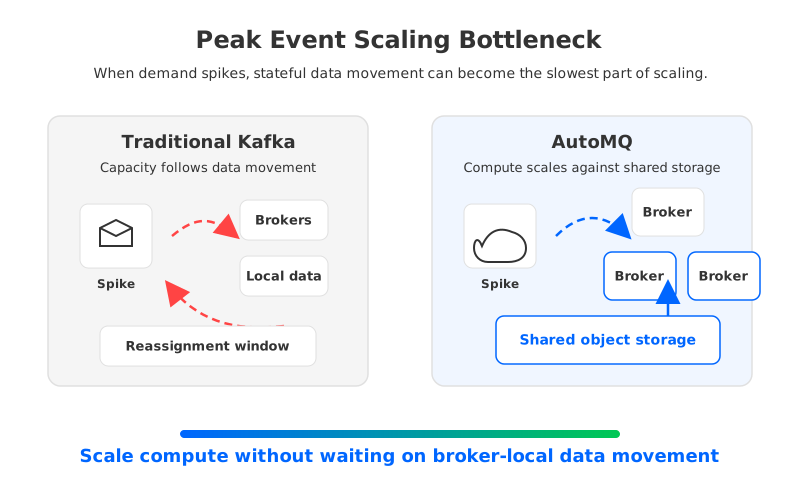
Most Kafka clusters look healthy when demand follows the forecast. Brokers have enough disk, partitions are evenly placed, consumers keep up, and the team has time to plan expansion. Peak events break that rhythm. Traffic grows in a compressed window, and the platform team has to decide whether to run hot, over-provision ahead of time, or start a stateful scaling operation while the business is watching.
Traditional Kafka's operating model makes that choice expensive because brokers are both compute and storage. Adding a broker increases available compute, but it does not automatically make the existing data layout match the new cluster shape. Partitions still need reassignment, replicas still need catch-up, and the cluster still needs enough I/O headroom to move data while serving live traffic. At Tencent Music's scale, the planning window itself becomes part of the bottleneck.
This is why "Kafka scaling bottleneck" is often a storage problem wearing a compute costume. Engineers ask for more serving capacity, but the platform has to move persistent log state to unlock it. The bigger the cluster and the sharper the peak, the more that coupling pushes teams toward conservative provisioning.
2Tencent Music's Real-Time Streaming Workload
Tencent Music's public case describes a production streaming environment supporting major consumer-facing audio platforms. The published AutoMQ case highlights 6 production clusters, 480K peak QPS, and 1.6 GiB/s. Those numbers show a platform large enough for small operating assumptions to become expensive. A capacity policy that is tolerable for one cluster can become a material TCO issue when repeated across several production clusters.
The public evidence does not disclose Tencent Music's private topic layout, retention settings, broker count, or event-by-event traffic profile. The approved facts still point to the central problem: a high-scale Kafka-compatible platform needed faster elasticity and lower cost without forcing teams to abandon Kafka semantics.
| Public case detail | What it tells a Kafka operator |
|---|---|
| 6 production clusters | The decision had to work beyond a lab migration or isolated workload. |
| 480K peak QPS | Request handling and burst behavior mattered, not only storage capacity. |
| 1.6 GiB/s traffic | Throughput was large enough for replication, disk, and network design to affect cost. |
| 50%+ average cost reduction | The result was measured as a fleet-level TCO outcome, not a narrow hardware tweak. |
| Scale-out from 1 day to seconds | Elasticity was an operational requirement, not a cosmetic feature. |
The table also hints at why Kafka compatibility mattered. Tencent Music could not treat its streaming layer as a greenfield experiment. At this scale, producers, consumers, monitoring, topic conventions, and operational habits are part of the system. A useful architecture change has to preserve the Kafka-facing contract while changing the economics underneath.
3The Cost of Scaling Stateful Brokers
Stateful Kafka clusters tend to pay for safety before they pay for demand. Teams provision disk for retained logs, compute for peaks, and network and I/O headroom so replication and reassignment do not starve live traffic. None of those choices is irrational. They are the cost of keeping a stateful distributed log predictable.
The pressure grows when traffic is bursty. Provisioning for average load creates peak risk. Provisioning for peak load leaves capacity underused between events. Reactive scaling can stretch beyond the business need when partition movement and replica catch-up dominate the scale-out window.
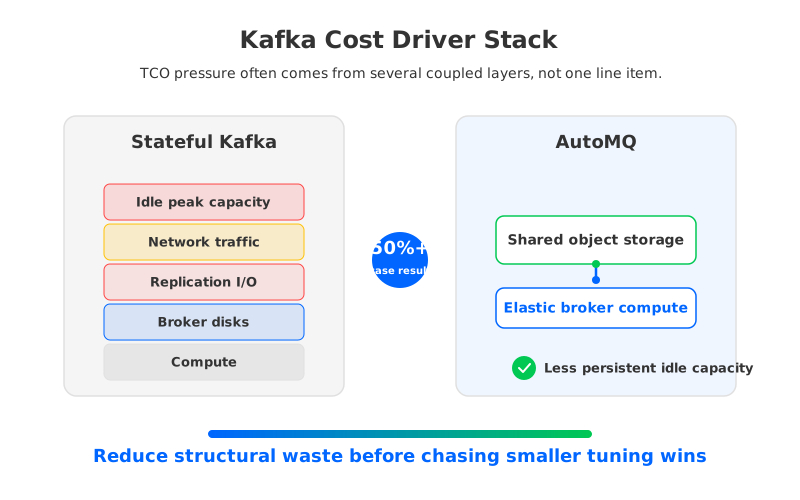
The common escape hatch is over-provisioning, and it is often the responsible short-term decision. A platform team would rather carry extra capacity than discover during a live event that a reassignment cannot finish quickly enough. The problem is that over-provisioning turns a rare peak into a permanent bill. Tencent Music's reported more-than-50% average Kafka cluster cost reduction suggests the team reduced structural waste, not only tuned a few instance sizes.
Tiered Storage can help by moving older log segments to object storage. That can reduce local disk pressure for historical data, but it does not fully remove broker-local state from the active operating model. The broker remains a stateful unit in many scaling and recovery workflows. For a team trying to turn scale-out from a day-scale operation into seconds, the deeper question is where durable stream data should live.
4Object Storage and Stateless Compute as the Turning Point
AutoMQ's architectural answer is to separate broker compute from durable storage. In AutoMQ's Shared Storage architecture, brokers remain Kafka-compatible serving nodes, while durable data is stored in S3-compatible object storage through S3Stream. That changes the unit of scaling. Instead of adding a broker and moving broker-owned data to make it useful, the platform can add compute capacity against a shared storage layer.
This is the technical reason the Tencent Music result is plausible. If partitions are tied to local broker disks, scaling requires data movement. If data lives in shared object storage and brokers are stateless, scaling can focus on metadata, leadership, traffic distribution, and compute availability. The slow part is no longer copying durable log segments between broker disks before the cluster can benefit from new capacity.
AutoMQ also changes the cost model because object storage is a more natural home for retained stream data than over-provisioned broker disks. Brokers can be sized closer to active compute and cache needs, while storage capacity follows retained data. For a consumer internet workload with sharp peaks, compute can expand for traffic while storage avoids being replicated as broker-local capacity for every peak plan.
This is not magic. Teams still need to validate latency, WAL storage choice, object storage behavior, cache hit patterns, failure recovery, monitoring, security, and migration plans. The point is narrower: once durable log data is no longer owned by individual brokers, the platform has a credible path to seconds-level elasticity.
5What Changed in Tencent Music's Production Rollout
The public Tencent Music case describes a staged adoption path. AutoMQ's case page says the project moved from technical sharing in June 2025, to a July 2025 test environment with performance and functional validation, and then to August 2025 production migration for relevant clusters. That sequence reads like a real platform decision, not a one-step announcement. Production streaming teams do not get to skip validation because the architecture diagram looks clean.
Tencent Music ran AutoMQ across 6 production clusters, so the deployment crossed from evaluation into operating practice. The platform handled 480K peak QPS and 1.6 GiB/s, which gives the scale claim technical weight. AutoMQ also reports more than 50% average cost reduction and scale-out moving from 1 day to seconds, connecting the architecture decision to both FinOps and operations.
Those claims should be read carefully. "50%+" is an average Kafka cluster cost reduction as presented in AutoMQ's public customer case, not a universal promise for every Kafka workload. "Seconds" describes the case's scale-out improvement, not a substitute for workload-specific testing. The lesson is that stateful broker scaling was important enough for a large consumer platform to change the storage model.
6What Large Kafka Teams Should Evaluate
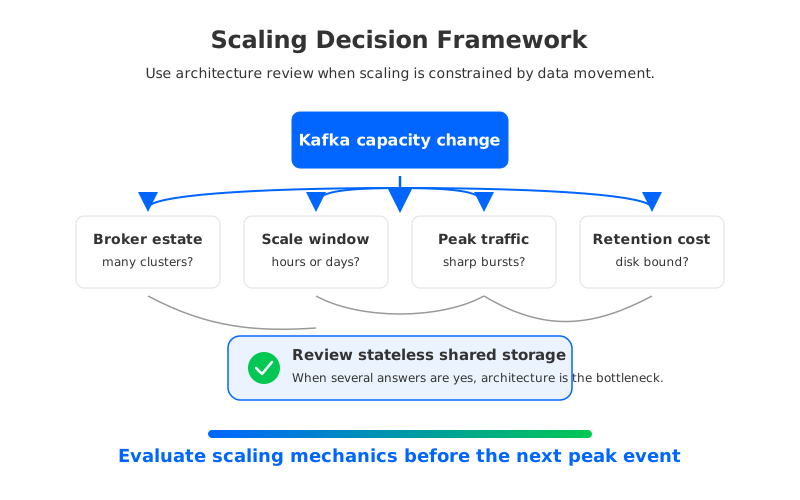
Tencent Music's case is most relevant for teams whose Kafka estate is large enough that capacity changes require meetings. If a cluster can be resized during a quiet afternoon, the urgency may be lower. If adding capacity means planning around partition reassignment, disk usage, replication traffic, peak events, and cost approvals, then the architecture deserves another look.
Use a decision framework before vendor comparison:
- Broker and cluster count. Repeated over-provisioning and reassignment become platform-level costs.
- Scale-out window. If expansion takes hours or days, the team is paying for stateful coupling in operational time.
- Peak-to-average ratio. Sharp peaks make permanent peak provisioning expensive and reactive scaling risky.
- Retention growth. Long retention makes local disk planning harder when storage and compute scale together.
- Compatibility constraints. If applications and tools expect Kafka behavior, a Kafka-compatible architecture change is more practical than a streaming rewrite.
- TCO target. Cost goals should include compute, storage, replication, network, operations, and idle capacity.
This is where competitive comparisons should stay honest. Managed Kafka can reduce operational burden but does not automatically remove the stateful broker model. Tiered Storage can reduce historical storage pressure but may leave active broker-local state in place. A Kafka replacement can offer a different architecture but may create migration work. AutoMQ fits when the team wants the Kafka interface and a different storage-compute relationship.
7Lessons for Teams Facing Kafka Scaling Bottlenecks
The strongest part of Tencent Music's story is the connection between a visible business pattern and an infrastructure mechanism. Peak events made elasticity valuable. Stateful brokers made elasticity slow and expensive. Shared object storage and stateless brokers changed the scaling path. Across 6 production clusters, the reported result was lower average cost and a much shorter scale-out window.
That pattern is useful even for teams smaller than Tencent Music. The first question is not whether a platform has 480K peak QPS. The first question is whether Kafka capacity is being managed as a stateful data relocation problem when the business needs elastic serving capacity. If the answer is yes, adding more brokers may only postpone the next planning cycle.
AutoMQ's role in this story is specific: keep Kafka compatibility while replacing broker-local durable storage with a Shared Storage architecture. That makes brokers behave more like compute resources and object storage more like the durable stream data layer. For Tencent Music, the public case says that shift supported 1.6 GiB/s of production traffic, more than 50% average Kafka cluster cost reduction, and scale-out from roughly 1 day to seconds.
The next time a peak event turns capacity planning into a calendar exercise, look past the broker count. The bottleneck may be the assumption that new compute has to wait for data to move before it can help.
8FAQ
8.1What Kafka scaling problem did Tencent Music face?
AutoMQ's public customer case frames the problem around large-scale production traffic, cost pressure, and slow scale-out. The case reports that scale-out improved from roughly 1 day to seconds after Tencent Music adopted AutoMQ.
8.2What production scale does the public case disclose?
The public AutoMQ case states that Tencent Music deployed AutoMQ across 6 production clusters, with 480K peak QPS and 1.6 GiB/s of traffic. It does not disclose private topic counts, partition counts, retention settings, or broker counts.
8.3How much did Tencent Music reduce Kafka costs?
AutoMQ's public case reports more than 50% average Kafka cluster cost reduction. That number should be treated as a customer-case result, not a universal guarantee for every workload.
8.4Why does stateless broker architecture help Kafka scale faster?
In traditional Kafka, brokers own local persistent log data, so adding or reshaping capacity can require partition reassignment and data movement. AutoMQ stores durable stream data in shared object storage and keeps brokers stateless, so scale-out can focus more on adding compute and redistributing traffic.
8.5Is AutoMQ the same as Kafka Tiered Storage?
No. Kafka Tiered Storage offloads older data to remote storage while the broker-local primary log model can remain central to operations. AutoMQ uses a Shared Storage architecture where durable data lives in S3-compatible object storage through S3Stream, which changes broker lifecycle and scaling behavior.
8.6What should a Kafka team validate before adopting AutoMQ?
Teams should validate client compatibility, latency, WAL storage choice, object storage access, catch-up reads, failure recovery, observability, security, and migration flow. Tencent Music's results are a useful reference point, but every production workload needs its own test plan.


