
Table of Contents
Table of Contents
A single bad record can cross more systems than the team that created it can see. Imagine an order event whose status value is misspelled as settledd. The producer serializes it, the broker appends the record, a stream processor fails to match it to the settled branch, a connector maps the unfamiliar value to NULL, and a warehouse reconciliation job discovers the missing settlement later. Every component behaved according to its local rules. The contract failed between them.
That failure makes Kafka schema enforcement a governance decision, not a serializer setting. Produce-time enforcement rejects a record before it enters the Topic. Consume-time enforcement lets it travel and asks each Consumer what it can decode, tolerate, quarantine, or reject. The choice changes latency, data spread, and repair ownership.
A useful default is to make the producer’s contract gate hard, then make consumers compatible and explicit about what they can read. That gives the source a clear publishing responsibility without forcing every reader to understand every historical or transitional version. The broker remains the transport boundary throughout.
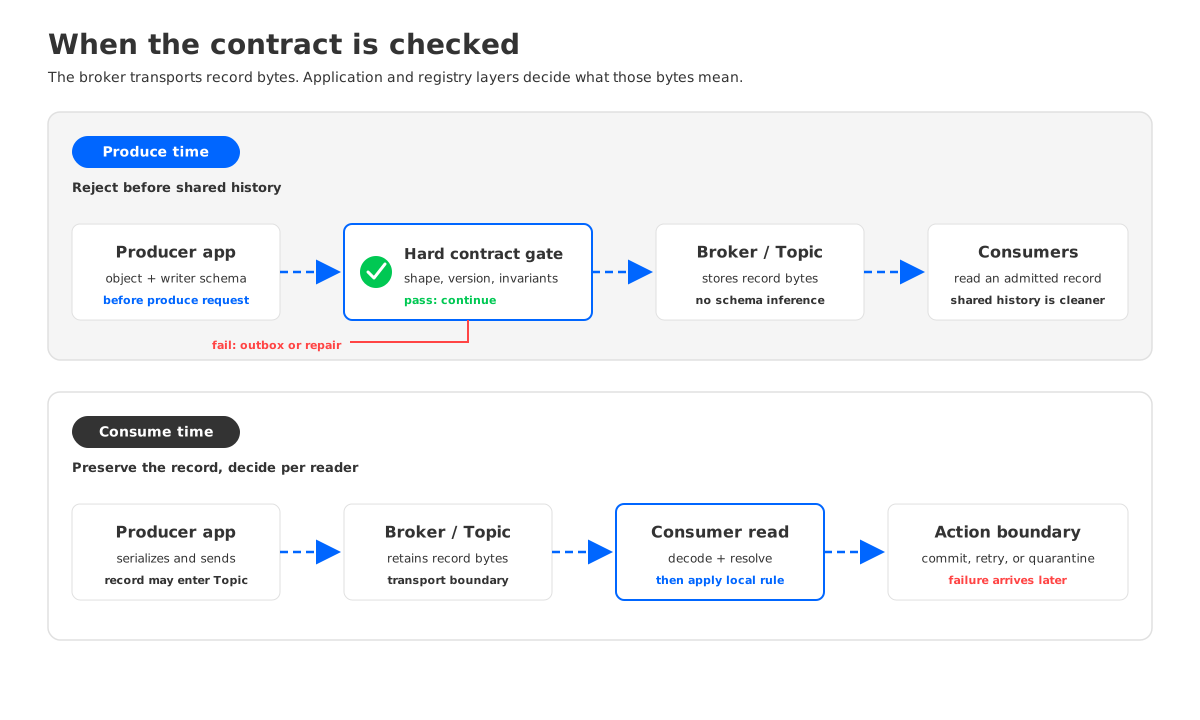
1A Kafka record can be valid transport and invalid business data
Schema enforcement starts with a boundary teams often blur. An application serializes a value into bytes, places those bytes in a Kafka record, and sends a produce request. A schema registry can store schema versions and apply compatibility rules when a serializer registers or checks a schema. The serializer and the producer application can also perform field and business validation before the request is built.
The broker sees a key, value, timestamp, and headers. It stores and serves them under Kafka’s delivery semantics. A Kafka-compatible broker does not infer that bytes are Avro, Protobuf, JSON Schema, or a custom format, and it does not decide whether settledd violates the order contract. That interpretation belongs to application-side serialization, deserialization, registry, and validation logic. The Apache Kafka protocol documentation describes the record-facing protocol boundary; the Apache Avro specification describes schema resolution for Avro readers and writers.
1.1What produce-time enforcement means
Produce-time enforcement runs before the record is accepted by the Kafka client’s produce path. The application or serializer checks the candidate value against a known schema, and the registry may check the proposed schema version against its compatibility policy. If the check fails, the producer returns an error, sends the record to an application-level outbox, or applies a documented retry path. The record does not become part of the Topic’s accepted history.
This is strongest for errors the publisher can know at the point of creation:
- Required fields are absent or have the wrong type.
- An enum or constrained value is outside the contract.
- A schema version is incompatible with the configured evolution policy.
- A field violates a local invariant, such as a non-negative amount or a valid identifier shape.
The gate must be placed before the Kafka produce request, and its failure must be visible to the producer owner. A registry compatibility result can protect structure and evolution, while application validation protects values and meaning. Neither one replaces the other.
1.2What consume-time enforcement means
Consume-time enforcement runs after the broker has returned a record to a Consumer. The deserializer resolves the writer schema or wire format, then application code decides whether the decoded value is acceptable for that processing path. The Consumer can commit the offset after a successful decision, retry the record, pause the partition, send the record to a quarantine Topic, or record a validation failure and move on.
This boundary is useful when a reader must coexist with older and proposed records. A compatible reader can supply defaults, ignore fields it does not use, or map several schema versions into one internal model. It can also reject a record whose structure decodes correctly but whose business value is not safe for that particular sink.
Consume-time enforcement therefore has two separate questions:
- Can this Consumer decode the record with the writer and reader schemas available to it?
- After decoding, is the value valid for this Consumer’s action?
The first is schema resolution; the second is application policy. Keeping them separate shows whether a failure belongs to the registry, deserializer, business code, or Topic owner.
2Compare the trade-offs that change the operating model
The decision becomes clearer when the same record is judged across the three dimensions that matter during an incident: latency, data quality, and responsibility. Neither enforcement point removes work. It decides when the work happens and which system absorbs the failure.
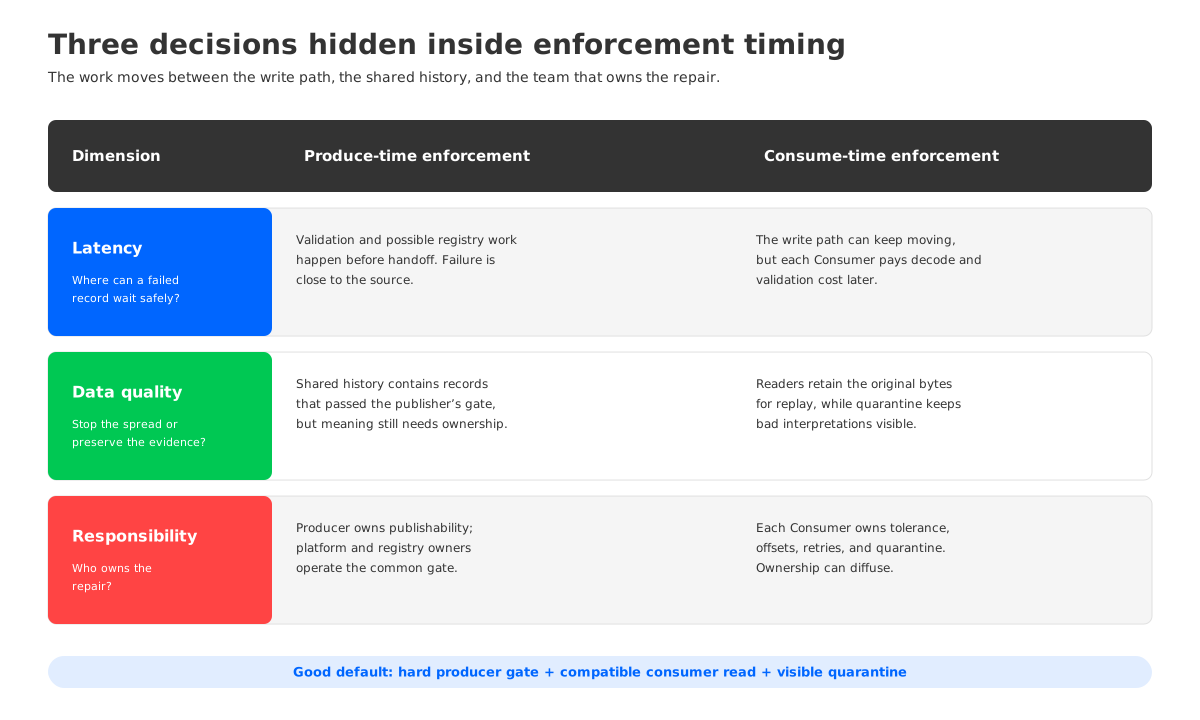
| Dimension | Produce-time enforcement | Consume-time enforcement |
|---|---|---|
| Latency | Adds validation, serialization, and possible registry work before the producer can hand off the record. A rejected record fails close to its source. | Keeps the write path moving when the broker can accept the bytes, but moves decode and validation cost into each Consumer path. |
| Data quality | Prevents a record that fails the producer’s contract from entering the shared history. It cannot catch a rule the producer never encoded. | Preserves the record for replay and lets each reader apply its own acceptance rule. Bad data can reach several systems before one of them objects. |
| Responsibility | The producer team owns the publish decision and must repair or explain the rejected event. Platform and registry teams provide the gate and policy. | Each Consumer team owns its tolerance, quarantine, retry, and offset behavior. The Topic owner still owns the contract, but responsibility is easier to diffuse. |
2.1Latency: fail early or keep the write path moving
Produce-time checks put the delay where the producer has the most context. The application already knows which domain object it is creating, so it can reject a missing field or invalid value before the record leaves the process. That can protect downstream latency, but it also makes registry reachability, serializer work, and validation code part of the producer’s write budget. A cold schema lookup or a slow compatibility check can be visible as producer errors even while the broker is healthy.
Consume-time checks protect the act of publishing. The producer can write a record while readers decide whether they can process it. This is useful for a broad Topic with several readers that evolve on different schedules, and it can keep unrelated Consumers moving when one sink has a stricter rule. The price is repeated work and later failure. A bad record may be fetched, decoded, retried, logged, quarantined, and replayed by more than one downstream path.
2.2Data quality: stop the spread or preserve the evidence
A hard producer gate improves shared history, but it cannot prove business meaning. A producer can still publish a valid amount in the wrong currency or a value that violates domain rules.
Consume-time enforcement keeps the original record available for reader upgrades, optional fields, and forensic replay. The flexibility becomes dangerous when each Consumer silently coerces or drops values: a warehouse may load a null, a rule engine may skip an event, and a dashboard may continue with an incomplete count.
Use compatible reads for known evolution, not unknown meaning. Route an undecodable record, invalid enum, or failed domain invariant to a visible quarantine path with the Topic, Partition, Offset, schema identity, and failure reason attached.
2.3Responsibility: name the owner before choosing the gate
Produce-time enforcement gives the cleanest ownership signal. The producer owner changed the contract, so that team receives the failure at the point where it can still inspect the source object and release. A platform team can operate the registry and the admission mechanism, but it should not become the owner of domain meaning.
Consume-time enforcement is unavoidable for reader-specific rules. A fraud Consumer may reject a transaction that an audit Consumer must retain. A lake sink may accept a field that a billing sink requires. Those differences are legitimate, but they need explicit policies so that “compatible read” does not become “every Consumer invents a contract.”
The practical governance split is:
- The producer owns whether a record is publishable under the Topic contract.
- The schema or platform owner operates version policy, registry availability, and common gates.
- Each Consumer owns how it reads compatible versions and what it does with a value that is unsafe for its action.
- The data owner decides semantic rules that no serializer can infer, such as units, identity, and allowed state transitions.
A failure without an owner is a delayed outage. Put the owner beside the decision, then choose the enforcement point that lets that owner act with the evidence it has.
3The hybrid policy: hard at produce, tolerant at consume
The mixed strategy works when the two sides enforce different promises. The producer performs hard admission checks for the shared contract. The Consumer performs compatible reads for expected versions and explicit rejection for records outside its local safety boundary.
A hard producer gate should cover the facts every reader must be able to trust:
- The wire format and schema identity are registered or otherwise approved.
- Required fields, types, enum values, and basic invariants are valid.
- The proposed schema satisfies the Topic’s compatibility policy.
- The producer has an owner, a test fixture, and a failure route for rejected records.
The Consumer then reads the history it is expected to read. It supports the declared writer versions, applies schema-resolution rules such as defaults where the format defines them, and converts accepted records into an internal model. When a record decodes but violates a sink-specific rule, the Consumer quarantines it with enough metadata to replay. It does not silently turn an unknown value into a business default.
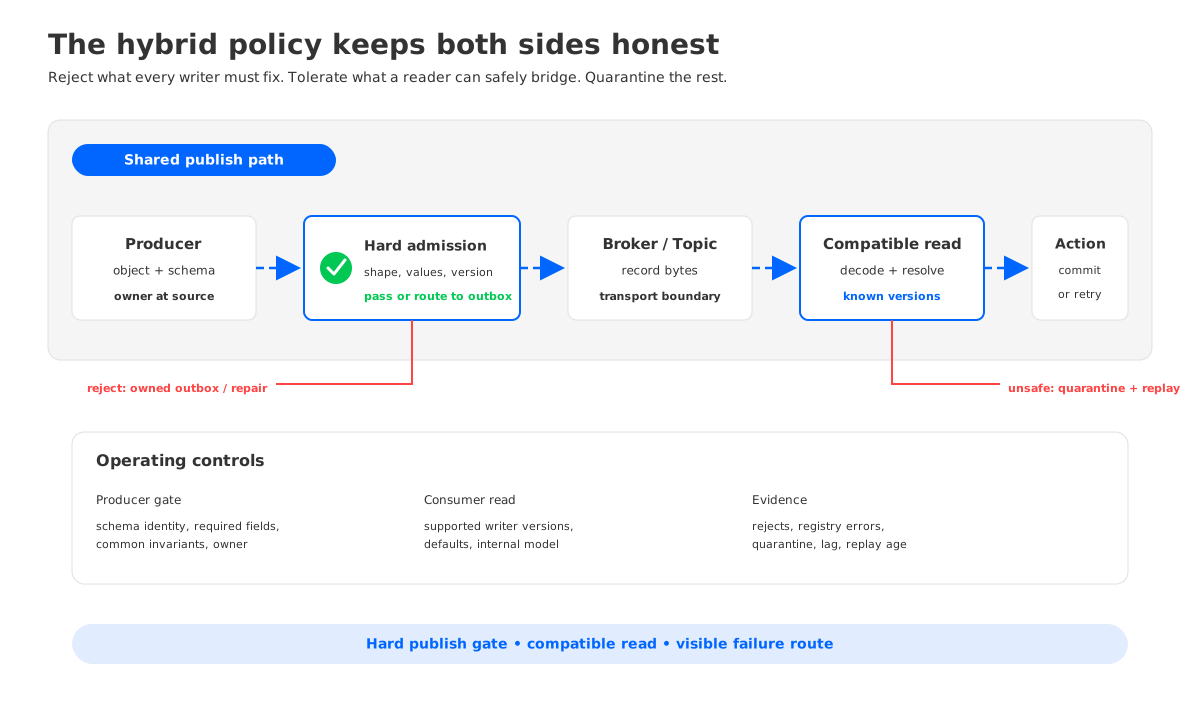
The mixed policy avoids a false choice between rejecting every change at the source and allowing every record to reach every sink. It rejects malformed or unauthorized publishes while readers bridge an intentional rollout window. The bridge is safe only when the accepted version set, quarantine behavior, and offset policy are written down.
A Consumer’s tolerance needs a ceiling. Supporting a documented optional field is compatible reading. Mapping an unknown enum to UNKNOWN may be valid for analytics and unsafe for a payment action, so expose that decision in metrics.
4Rollout notes for existing Topics
Adding enforcement to a live Topic is a migration. The existing history already contains records produced under different code paths, and the current Consumers may have undocumented tolerance. Start by describing the actual record population before changing the gate.
Use this sequence:
- Inventory the boundary. Record serializers, schema subjects, registry policies, producer error handling, Consumer deserializers, replay jobs, connectors, and sinks. Include a sample of retained records and the oldest schema version any active reader must decode.
- Separate shape from meaning. Mark which checks are structural, which are schema-evolution checks, and which are domain invariants. Put structural and common value checks in the producer gate; keep reader-specific acceptance rules in the Consumer.
- Measure before blocking. Run the proposed producer validator in observe mode or in a canary process. Count would-be rejects by producer, schema identity, field, and failure reason. Do not turn an unknown population into a production outage during the first rollout.
- Upgrade readers first when the change needs a bridge. Make Consumers able to read the retained and proposed versions, keep their quarantine and offset behavior explicit, and replay representative records before changing producers.
- Turn on hard admission with a rollback path. Reject records that violate the shared contract, route the source object or event to an owned outbox, and define how to restore the previous producer if rejection volume is unexpected.
After the gate is active, track rejected produce attempts, registry failures, deserialization failures, quarantine volume, retry age, and compatibility fallbacks. A drop in Consumer errors can mean better producer quality or a silent sink failure, so pair quality metrics with throughput and lag.
Write down the retirement rule as well: when can an old schema leave the reader set, which retained records must remain replayable, and which connector or batch job can still write the old form? A compatibility window without a close condition becomes permanent code.
The schema compatibility gate guide covers the pre-production checks around structural changes. The Kafka data contracts guide is useful when the team needs to assign meaning and ownership beyond the schema file. These are adjacent controls, not substitutes for testing the actual producer and Consumer paths.
5Where a Kafka-compatible broker fits
Once the enforcement boundary is explicit, the platform question gets smaller. A Kafka-compatible broker should preserve the client-facing record path, Topic and Partition behavior, offsets, Consumer groups, and the operational semantics your application relies on. It should not be asked to infer the business schema hidden inside a value.
That is where AutoMQ fits as a Kafka-compatible cloud-native streaming platform. A team can keep its producer and Consumer libraries, serializer and deserializer choices, and separate schema registry arrangement, then test the same hard-admission and compatible-read policy against the AutoMQ data plane. AutoMQ does not perform Avro, Protobuf, or business-value enforcement inside the broker.
The AutoMQ Kafka compatibility documentation describes the Kafka protocol boundary. That boundary lets the team evaluate storage and broker behavior separately from contract governance. The serializer still decides how application objects become bytes, the registry still governs schema identity and evolution where used, and the Consumer still decides whether a decoded value is safe for its action.
Test rejection, registry loss, cold startup, mixed-version reads, quarantine, replay, and rollback with the same fixtures on the target platform. This keeps a client, registry, application-policy, or data-plane failure assignable.
6Keep the bad record from becoming everyone’s problem
Return to settledd. The expensive part was not that one producer made a typo. It was that the record crossed the transport boundary without a declared admission rule, so every downstream system had to invent a response. A hard producer gate would have surfaced the contract failure next to the source. A compatible Consumer would still have protected its own read path when older and proposed records overlapped.
For an existing Topic, choose the shared checks that every writer must satisfy, enforce those checks before produce, and make each reader’s compatibility and quarantine policy visible. Then test the boundary with retained records, real serializers, and the failure routes you intend to operate. If you want to run that contract matrix on a Kafka-compatible cloud-native streaming platform, start an AutoMQ evaluation.


