
Table of Contents
Table of Contents
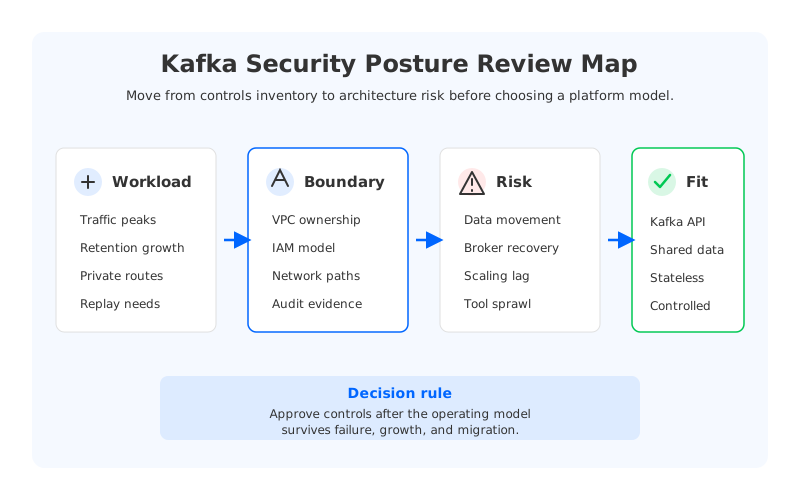
Teams search for kafka security posture when the Kafka decision has moved beyond broker configuration. Authentication and access control still matter, but the review usually starts because Kafka has become a shared production platform: payments, product analytics, operational telemetry, machine learning features, and customer-facing workflows all depend on the same streaming backbone. At that point, a security reviewer is asking more than whether TLS is enabled. They are asking who owns the data path, how failure recovery works, what evidence exists after an incident, and whether the platform can grow without quietly creating new exposure.
That is why a Kafka security posture review should not be a checklist of knobs copied from a single cluster. Kafka's controls live inside an operating model. A self-managed cluster on virtual machines, a managed service, and a Kafka-compatible shared-storage platform can all support familiar Kafka concepts, but they put durable data, administrative access, network paths, and migration risk in different places. The review has to follow those boundaries, or it will approve the familiar controls while missing the architecture risk.
1Why Teams Search for kafka security posture
The phrase sounds narrow, but the search intent is broad. Security and platform teams often arrive here after a concrete trigger: a regulatory review, a cloud migration, a new multi-tenant platform requirement, a cost audit, or a planned move from one Kafka deployment model to another. The cluster may already pass basic hardening checks, yet still feel hard to approve because the operating model is unclear.
The common failure mode is treating Kafka as an isolated service rather than as a route through which business data, credentials, schemas, operational metadata, and incident access all move. A topic carrying clickstream events and a topic carrying financial ledger updates may both be Kafka topics, but they should not have the same posture review. The difference is not just retention or throughput. It is who can produce, who can consume, where data is replicated, how operators debug incidents, and whether replay or migration can be performed without bypassing governance.
A practical review starts by separating control checks from architecture questions:
- Control checks answer whether authentication, authorization, encryption, ACLs, network isolation, logging, and key rotation are configured and testable.
- Architecture questions answer where durable data lives, which account or VPC owns the path, what happens during broker replacement, how scaling changes data placement, and how migration tools handle offsets and rollback.
- Operating questions answer who can change topics, connectors, schemas, quotas, client credentials, and emergency access during an incident.
The first category can often be audited with scripts or policy-as-code. The second and third require design review, because they depend on the platform model. A clean Kafka ACL report does not tell you whether a broker-local disk recovery plan can meet the business recovery objective, or whether a connector worker has access to secrets outside its intended boundary.
2The Production Constraint Behind the Problem
Traditional Kafka was designed around brokers that own local persistent logs. That Shared Nothing architecture is a good reason Kafka became durable and horizontally scalable, but it also creates a specific review surface. Each broker is more than compute. It is a holder of durable partition data, a participant in replication, a capacity unit, and an operational recovery target. When platform teams scale, rebalance, replace, or migrate those brokers, data placement changes with them.
This matters for security posture because data movement is governance movement. If a partition is copied across brokers, zones, disks, or clusters, the platform team needs to understand which network path carried the data, which identities had access, which logs prove the action, and how long the temporary state existed. The harder that movement is to reason about, the more a posture review turns into a pile of exceptions.
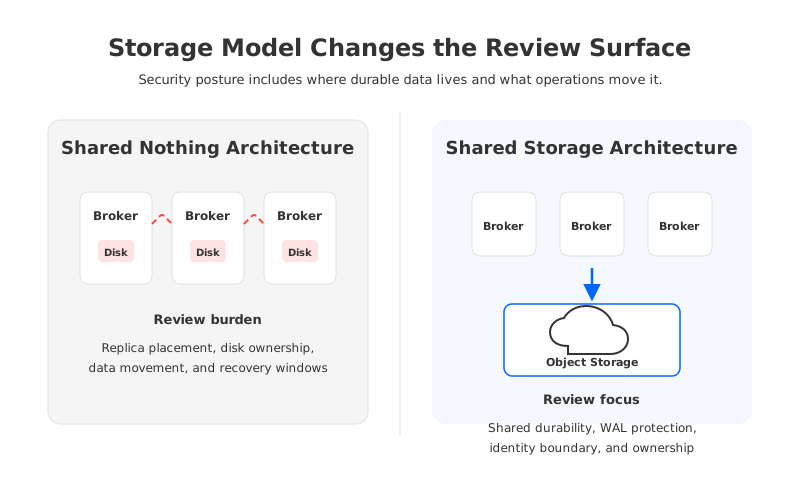
The constraint becomes sharper in shared streaming platforms. A single Kafka estate may serve many application teams, each with different data classes and operational urgency. Platform owners then have to answer questions that go well beyond broker hardening:
| Review area | What security teams ask | Why Kafka architecture affects the answer |
|---|---|---|
| Data boundary | Which account, VPC, subnet, bucket, disk, or service owns event data? | Broker-local storage, object storage, and managed-service boundaries place data in different trust zones. |
| Administrative access | Who can create topics, change ACLs, rotate credentials, or operate during incidents? | Kafka operations often span brokers, controllers, connectors, cloud IAM, and observability systems. |
| Failure recovery | Can the team recover without copying sensitive data through unreviewed paths? | Broker replacement and partition reassignment may involve durable log movement. |
| Migration | Can offsets, topics, and client cutover be validated without dual-writing indefinitely? | Migration tooling becomes part of the security boundary during transition. |
| Evidence | Can auditors reconstruct who changed what and which data paths were used? | Evidence must cover Kafka, cloud infrastructure, automation, and support access. |
The table is intentionally architectural. A security posture review that only asks "is encryption enabled?" is too shallow for a shared platform. Encryption protects data on a path, but the review still needs to know why that path exists, who controls it, and whether it expands during scaling or migration.
3Architecture Options and Trade-Offs
There are three common ways teams frame the platform decision. Self-managed Kafka gives the platform team direct control over hosts, disks, networking, and operational automation. That control is attractive for strict environments, but it also means the team owns every failure drill, patch cycle, reassignment plan, credential workflow, connector runtime, and audit integration. The posture review can be precise because everything is visible, but it can also become expensive to maintain because every control must be engineered and operated internally.
Managed Kafka services reduce that operational burden by shifting some broker operations to the provider. The trade-off is a different boundary. Security teams still need to understand customer-managed identity, private connectivity, encryption options, topic-level governance, support access, logging exports, and the limits of the managed control plane. The platform may be easier to run, but the review now depends on service documentation, account boundaries, and provider-specific behavior.
Kafka-compatible shared-storage platforms introduce a third pattern. They keep the Kafka-facing API and ecosystem surface while changing the storage model underneath. Instead of treating each broker as the durable owner of local partition data, these platforms move durable data into shared storage and make broker compute easier to replace or scale. That can reduce some broker-local recovery and reassignment risks, but it adds its own review questions around WAL (Write-Ahead Log) storage, object storage permissions, metadata consistency, cache behavior, and cloud resource ownership.
None of these options is automatically "more secure." A weakly operated shared-storage platform can fail a review, and a carefully operated self-managed cluster can pass one. The useful question is narrower: which model makes the controls you need easiest to prove under the failure modes you actually expect?
4Evaluation Checklist for Platform Teams
A useful Kafka security posture review should produce a decision record, not a vague sense that the cluster is hardened. The decision record should connect controls to operations. If a reviewer asks how a consumer credential is revoked during an incident, the answer should include the identity system, Kafka authorization behavior, client rollout path, monitoring signal, and owner for emergency action.
Use this checklist as the spine of the review:
- Compatibility and client surface. Inventory producer and consumer client versions, admin tooling, Kafka Connect usage, Kafka Streams jobs, Schema Registry dependencies, transactions, idempotent producers, and offset management. Security controls are harder to validate when the client estate is unknown.
- Authentication and authorization. Define the supported authentication mechanisms, ACL model, service identity lifecycle, topic naming policy, emergency revocation path, and ownership of privileged operations.
- Network and data boundary. Map all ingress, egress, inter-zone, connector, observability, support, and migration paths. The review should distinguish business event data from logs, metrics, and control metadata.
- Storage and recovery. Document where durable data is stored, how it is replicated or protected, how broker or node replacement works, and which identities can access the underlying storage.
- Scaling and balancing. Explain what happens to data placement when throughput, partition count, or retention grows. Reassignment is not only an operations event; it is a data movement event.
- Migration and rollback. Identify the source of truth during migration, how offsets are preserved or translated, how producer cutover works, how consumers resume, and what conditions trigger rollback.
- Observability and evidence. Tie SLOs, audit logs, infrastructure events, Kafka metrics, connector status, and incident tickets into one evidence trail.
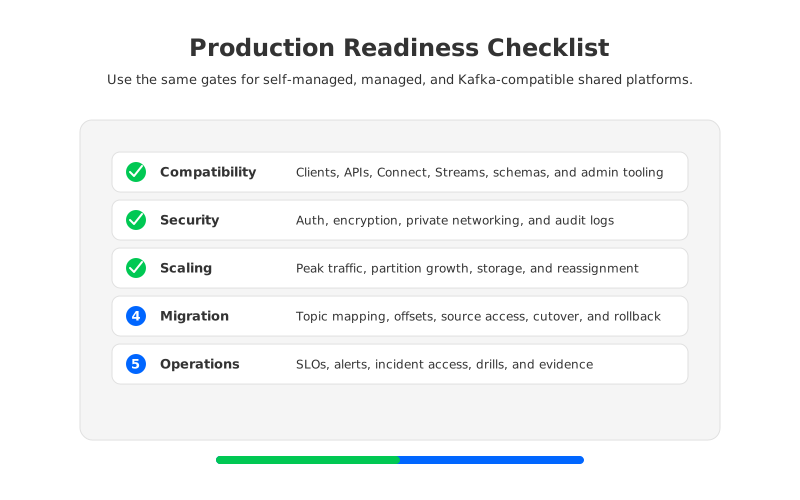
The strongest reviews make these checks boring. That is the point. If every expansion, connector rollout, or broker replacement requires a custom security exception, the platform has not really standardized Kafka. It has standardized a request queue.
5How AutoMQ Changes the Operating Model
Once the neutral review points to broker-local storage as a major source of security and operations friction, AutoMQ becomes relevant as a Kafka-compatible cloud-native streaming platform built around Shared Storage architecture. AutoMQ keeps the Apache Kafka protocol and ecosystem model, but replaces broker-local persistent log storage with S3Stream, WAL storage, and S3-compatible object storage. AutoMQ Brokers are stateless compute nodes rather than long-lived owners of local durable partition data.
That shift changes what the security posture review has to prove. Instead of spending most of the discussion on broker disk ownership and large partition data movement, the review can focus on the customer-controlled cloud boundary, object storage permissions, WAL storage choice, control plane access, observability, and migration process. In AutoMQ BYOC, the control plane and data plane run in the customer's cloud account and VPC, which keeps the review aligned with enterprise questions about network ownership, IAM, private connectivity, and data residency.
The storage design also changes scaling and recovery conversations. In a traditional Shared Nothing architecture, replacing brokers or moving partitions can imply durable data movement between broker-local storage locations. In AutoMQ's Shared Storage architecture, durable data is in shared object storage, while brokers handle Kafka-facing compute, caching, leadership, and scheduling. That does not remove the need for security controls. It gives reviewers a different and often cleaner boundary to inspect: shared storage policy, WAL durability, broker identity, controller authority, and operational automation.
Migration still needs discipline. AutoMQ's migration materials describe Kafka Linking for supported commercial migration paths, including topic replication, offset consistency, and producer cutover behavior under documented constraints. A posture review should treat the migration tool as part of the temporary production architecture. Source access protocols, ACL compatibility, migration capacity, consumer group synchronization, and rollback checkpoints all need explicit approval before the first production topic moves.
6A Practical Scorecard
The fastest way to make the review actionable is to score each platform option against the same questions. Avoid a generic red-yellow-green grid that hides trade-offs. Write down the evidence required for each answer.
| Question | Pass signal | Review risk |
|---|---|---|
| Can existing clients keep Kafka semantics? | Client versions, APIs, transactions, offsets, Connect, and Streams are tested against the target. | Hidden client incompatibility turns a security migration into an application rewrite. |
| Is the data boundary explicit? | Event data, metadata, logs, metrics, WAL storage, and object storage are mapped to accounts and identities. | Reviewers cannot tell whether sensitive data leaves the intended environment. |
| Can scaling be approved as a normal operation? | Broker replacement, partition reassignment, and traffic balancing have documented paths and evidence. | Every capacity event becomes a manual exception. |
| Is migration reversible? | Cutover batches, offset validation, source-of-truth rules, and rollback triggers are documented. | The team keeps dual systems alive because no one trusts the cutover. |
| Can incidents be audited? | Kafka, cloud, automation, and support actions are tied to timestamps and owners. | Post-incident evidence is fragmented across tools. |
This scorecard is deliberately uncomfortable. It asks for proof at the exact points where platform decisions usually rely on assumptions. That is better than discovering during an incident that the approved design never covered connector credentials, migration proxy access, or storage-layer permissions.
The opening search for kafka security posture usually starts with controls, but production approval ends with boundaries. If your review shows that broker-local storage, data movement, and migration risk are the hardest parts to prove, test a Kafka-compatible shared-storage model with one representative workload. To evaluate the customer-controlled deployment path, start with the AutoMQ Cloud Console.
7References
- Apache Kafka documentation
- Apache Kafka security documentation
- Apache Kafka KRaft documentation
- Apache Kafka Connect documentation
- Apache Kafka KIP-405: Kafka Tiered Storage
- AutoMQ architecture overview
- AutoMQ compatibility with Apache Kafka
- AutoMQ WAL storage documentation
- AutoMQ BYOC overview
- AutoMQ Kafka Linking overview
8FAQ
8.1What is a Kafka security posture review?
A Kafka security posture review is an architecture and operations review of how a Kafka or Kafka-compatible platform protects event data, client access, administrative actions, network paths, storage, migration, and incident evidence. It includes configuration checks, but it should not stop at configuration.
8.2Is Kafka security posture only about TLS, SASL, and ACLs?
No. TLS, SASL, and ACLs are core controls, but a production review also needs to cover data location, cloud account ownership, connector secrets, administrative access, observability, broker recovery, scaling behavior, and migration rollback.
8.3How does shared storage affect Kafka security reviews?
Shared storage changes the operating boundary. Broker-local durable logs are no longer the center of data ownership, so reviewers focus more on object storage policy, WAL storage, broker identity, metadata control, and cloud resource ownership. The model still needs careful review, but the questions move to different layers.
8.4Does AutoMQ replace Kafka security controls?
No. AutoMQ is Kafka-compatible, so teams still need authentication, authorization, encryption, topic governance, client controls, and operational evidence. AutoMQ changes the storage and scaling model underneath Kafka, which can make some recovery, scaling, and customer-controlled deployment questions easier to reason about.
8.5What should teams test before approving a Kafka-compatible platform?
Test client compatibility, authentication and ACL behavior, private networking, observability exports, failure recovery, scaling behavior, connector access, migration mechanics, and rollback. The test should use representative topics, clients, retention settings, and failure drills rather than a synthetic empty cluster.


