
Table of Contents
Table of Contents
Teams search for redpanda alternatives when the evaluation has moved past curiosity. Redpanda is a serious Kafka-compatible platform, and many teams look at it because they want a different implementation and operating model from classic Apache Kafka. The harder question arrives after the first proof of concept: will the candidate preserve the Kafka behaviors that applications, runbooks, dashboards, security rules, and finance models already depend on?
That question is more precise than a vendor ranking. Kafka compatibility is not one feature. It is a set of observable behaviors across producers, consumers, topic configuration, ordering, offsets, transactions where used, ACLs, failure handling, tooling, and operational ownership. A platform can accept Kafka clients and still require careful validation before it carries a production estate.
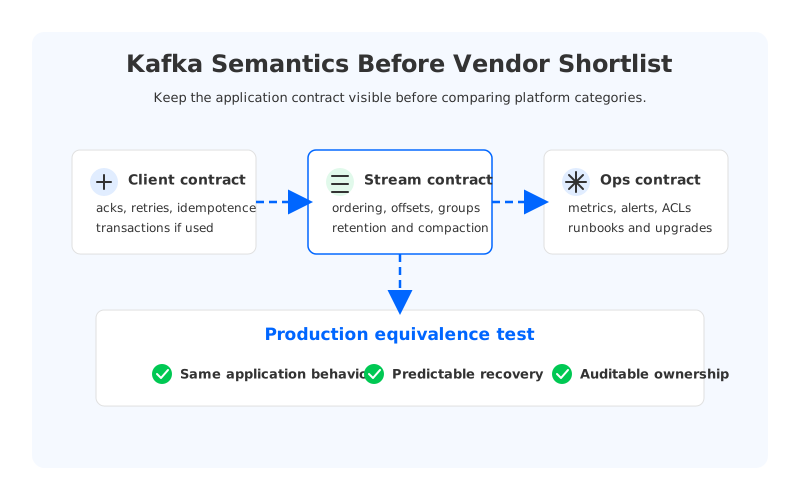
The useful way to evaluate alternatives is to write down the semantics that must survive before the shortlist becomes emotional. Redpanda, Confluent, Amazon MSK, Apache Kafka deployments, Aiven, AutoMQ, WarpStream, and other Kafka-compatible options all make different trade-offs. The platform team's job is not to find a universal winner. It is to prove which trade-offs preserve the workload contract that matters.
1Why Redpanda alternative research should start with Kafka semantics
Most teams do not begin a platform review because a comparison table looks attractive. They begin because a real constraint has appeared: local storage is growing faster than expected, cross-zone traffic is visible in the cloud bill, catch-up consumers are painful, procurement wants exit leverage, or the operating model no longer matches team capacity. Those constraints are valid reasons to compare platforms. They are also easy to blur into a generic "alternatives" search that ignores the application contract.
Kafka semantics are the application contract. Producers care when an acknowledged record is considered durable. Consumers care how group coordination, offset commits, rebalances, and reset policies behave. Platform teams care whether retention, compaction, topic automation, quotas, ACLs, metrics, and operational scripts still mean what they meant before. SREs care less about a claimed compatibility percentage than about what happens during broker loss, zone impairment, throttling, and backlog recovery.
A useful checklist starts with the behaviors that would create production incidents if they changed:
- Producer behavior. Verify acknowledgments, batching, compression, retries, idempotence, transactions if used, message size limits, timeout behavior, and backpressure under load.
- Consumer behavior. Verify group membership, offset commits, rebalance behavior, lag recovery, manual commit patterns, replay jobs, and failure during catch-up reads.
- Topic behavior. Verify partition count handling, ordering assumptions, retention, compaction, cleanup policies, quotas, and topic administration automation.
- Security behavior. Verify authentication, authorization, ACL mapping, audit logs, private networking, secret rotation, and who can access metadata during support.
- Operational behavior. Verify metrics, alert names, log access, upgrade process, scaling process, incident runbooks, and Terraform or API automation.
This is where many alternative reviews become more respectful and more useful. Redpanda may be a good fit for teams that value its implementation choices and operational model. A managed Kafka service may be a better fit when the organization wants to reduce direct broker operations. A shared-storage Kafka-compatible system may be more relevant when retained data, recovery, or elasticity is the constraint. The semantics checklist keeps the discussion about workload fit rather than vendor preference.
2Separate API compatibility from production equivalence
API compatibility answers the first question: can existing Kafka clients connect, produce, and consume without an application rewrite? Production equivalence asks a tougher question: does the platform behave predictably when the workload is inconvenient? The inconvenient cases are the ones that matter most because they are where hidden differences become operational risk.
Consider a consumer group that normally tails a topic but occasionally replays a day of events after a downstream outage. A simple smoke test may pass because the client can consume fresh records. The production question is whether replay changes latency, cache pressure, fetch behavior, network cost, and lag recovery in a way the team understands. The same pattern applies to compaction, large messages, exactly-once workflows, ACL-heavy multi-tenancy, and automated topic creation.
Apache Kafka's public documentation is useful because it exposes how wide the Kafka surface actually is: producer configuration, consumer configuration, security and ACLs, Streams APIs, Connect, tiered storage, and operational behavior are all part of the ecosystem. A candidate alternative does not need to be identical in every internal implementation. It does need to prove that the behaviors your applications use are compatible enough for production, migration, and rollback.
Use a test matrix that maps features to owners rather than to abstract checkboxes:
| Semantics area | Owner who should sign off | Evidence to collect |
|---|---|---|
| Producer guarantees | Application owner and platform team | Load test with real client settings, retry paths, idempotence, and failure injection |
| Consumer groups | Application owner and SRE | Rebalance, restart, lag recovery, replay, duplicate handling, and offset validation |
| Topic lifecycle | Platform team | Retention, compaction, partition changes, quotas, automation, and config drift checks |
| Security and governance | Security and compliance | ACL parity, audit evidence, private connectivity, secret ownership, and support access boundary |
| Operations | SRE and platform team | Metrics, logs, alert mapping, scale events, upgrades, and incident runbook drills |
The table does not assume one platform is better. It prevents a proof of concept from being too small. A candidate that passes only a happy-path produce-consume test has not yet proven production equivalence.
3Architecture still changes the semantics that teams observe
Kafka-compatible platforms can expose similar client surfaces while making very different architecture choices. Traditional Apache Kafka stores active log data on broker-attached storage and replicates across brokers for durability. Tiered storage moves older log segments to remote storage, which can reduce local storage pressure while keeping the active write path broker-centric. Shared-storage designs put object storage closer to the primary durability model and make brokers closer to stateless compute nodes, usually with a write-ahead log and cache layer to control latency.
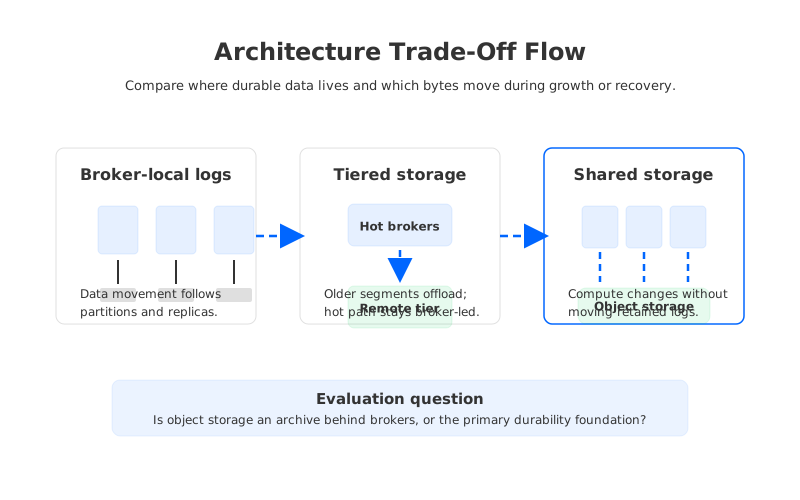
Those differences are not academic. They affect the behavior teams observe during scale-out, broker replacement, replay, and retention growth. In a broker-local architecture, retained data and partition ownership are tightly connected to broker state. In a tiered model, older data may move away from brokers, but the hot path still needs careful validation. In a shared-storage model, compute can become more elastic, but the evaluation must prove WAL latency, cache behavior, metadata correctness, and object storage access patterns.
The key is to translate architecture into testable questions:
- Where is the authoritative copy of a record after the producer receives an acknowledgment?
- Which bytes move during replication, catch-up reads, partition reassignment, scaling, and recovery?
- Does retention growth force broker capacity growth, or can storage scale independently?
- What happens to consumer lag and read latency when historical data is replayed?
- Which team owns the data plane, control plane, encryption keys, metrics, logs, and support access?
This translation matters for cost as well as reliability. AWS pricing pages separate Amazon MSK service dimensions, EC2 data transfer, PrivateLink, and S3 storage because cloud bills are built from multiple meters. A Kafka platform review should do the same. The cost model should include writes, replication or durability behavior, read fan-out, replay, retained data, private connectivity, cross-zone movement, observability, and migration overlap.
4Migration risk is a semantics problem, not only a data-copy problem
Kafka migrations often start with replication mechanics: MirrorMaker 2, connector-based copy, cluster linking where available, dual writes, or vendor-assisted movement. Those tools matter, but migration safety is mostly about semantics. If offsets, duplicates, compaction, ACLs, topic configs, or consumer restart behavior are mishandled, data can move successfully while applications still fail.
A safer migration plan defines the source of truth at each gate. During assessment, the current platform remains authoritative and the destination is observed. During shadow traffic, the destination receives data but consumers are not yet business-critical. During cutover, producers, consumers, and dashboards move under rollback rules. After closeout, the team names the point at which rollback becomes more dangerous than forward repair.
The first production workload should be representative, not heroic. It should have a known producer, meaningful consumer behavior, real ACLs, familiar lag patterns, dashboards, and an owner who will rehearse failure. A workload with no consumers proves little. A workload whose failure would trigger a company-wide incident is too large for the first gate.
One practical rule keeps the migration honest: do not accept a platform until the rollback has been tested with the same semantics checklist. Can the consumer resume from the expected position? Are duplicates detected? Can ACLs be restored? Do alerts point to the right cluster? Does the team know which system is authoritative when the runbook starts? These are not administrative details; they are the difference between a reversible migration and a hope-based cutover.
5A production scorecard for Redpanda alternatives
By the time alternatives reach architecture review or procurement, the output should be a scorecard with three possible states: pass, accepted risk, or blocked. "Accepted risk" is important because every platform makes trade-offs. A managed service may reduce direct operations while changing the control boundary. A broker-local system may be compelling for workloads that value local latency and operational familiarity. A shared-storage system may reduce broker state but requires proof around WAL, cache, and object storage behavior.
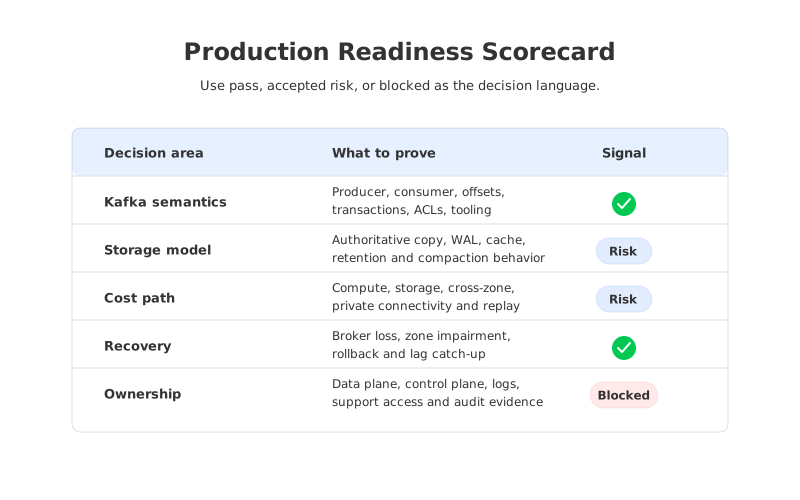
Use the same scorecard for every candidate. Changing the scoring method for the platform you prefer is how bias enters the decision.
| Decision area | Pass condition | Blocked signal |
|---|---|---|
| Kafka semantics | Critical client, topic, security, and operational behaviors are tested with production-like settings. | The proof of concept uses sample clients and assumes the rest of Kafka behavior will match. |
| Architecture fit | The target architecture addresses the constraint that triggered the search. | The team cannot explain what architectural assumption is being replaced. |
| Cost path | Current, growth, replay, failure, and migration-overlap cases are modeled from byte paths. | The business case compares only broker or subscription prices. |
| Recovery | Broker loss, zone impairment, scale events, and backlog catch-up have rehearsed runbooks. | Recovery depends on manual interpretation during an incident. |
| Governance | Data plane, control plane, keys, metrics, logs, and support access are documented. | Security review begins after procurement has selected the platform. |
This scorecard also creates room for a "do not migrate" outcome. If Redpanda or the current Kafka platform still fits the workload contract, staying may be the correct decision. If only one workload class is constrained, a split architecture may be better than a broad migration. A mature alternatives review should make those outcomes visible rather than forcing a replacement narrative.
6Where AutoMQ fits the checklist
AutoMQ belongs in the discussion after the team has separated semantics, architecture, cost paths, migration risk, and governance. It is a Kafka-compatible cloud-native streaming platform that uses S3Stream Shared Storage architecture, stateless brokers, object-storage-backed durability, and WAL storage to decouple durable stream data from broker-local disks. That places AutoMQ in a specific architectural category: Kafka-compatible shared storage rather than a broker-local Kafka implementation or a service where the storage model is largely hidden.
That distinction matters when the reason for looking at Redpanda alternatives is retained data growth, recovery behavior, elastic scaling, cloud network cost, or a requirement to keep the data plane inside the customer's cloud boundary. If brokers do not own large local logs, scaling and replacement can be less dominated by moving retained data. If the architecture is designed to reduce inter-zone traffic, FinOps teams get a different cost path to test. These claims should still be validated with the same scorecard used for every other candidate.
The fair AutoMQ evaluation is therefore straightforward: keep the Kafka semantics checklist unchanged, run representative clients, test consumer recovery, model write and read paths, verify governance boundaries, and rehearse migration rollback. AutoMQ should win only when shared-storage Kafka compatibility solves the constraint that triggered the search without introducing a larger risk somewhere else.
The search that began with redpanda alternatives should end as an engineering decision record. Name the Kafka behaviors that must survive, the architecture assumption being replaced, the byte paths that drive cost, the rollback gate that protects migration, and the team that will own the platform after cutover. If shared-storage Kafka compatibility is part of that review, start with the AutoMQ Cloud Console and run one representative workload through the same semantics, architecture, cost, recovery, and governance scorecard.
7References
- Apache Kafka documentation
- Apache Kafka Tiered Storage documentation
- Apache Kafka authorization and ACLs
- Redpanda documentation: Kafka clients
- AWS pricing: Amazon MSK
- AWS pricing: Amazon EC2 On-Demand data transfer
- AWS pricing: Amazon S3
- AutoMQ documentation: Compatibility with Apache Kafka
- AutoMQ documentation: S3Stream Shared Streaming Storage
- AutoMQ documentation: WAL storage
- AutoMQ documentation: Eliminate inter-zone traffic overview
8FAQ
8.1Are Redpanda alternatives mainly about performance?
Performance is important, but it is not enough for a production decision. Teams should also verify Kafka semantics, storage architecture, recovery behavior, cloud cost paths, governance boundaries, migration rollback, and operational ownership.
8.2Does Kafka API compatibility mean production equivalence?
No. API compatibility means existing clients can usually connect through familiar Kafka interfaces. Production equivalence must be proven with real producer settings, consumer groups, offsets, topic policies, security rules, observability, failure tests, and migration rollback behavior.
8.3Is tiered storage the same as shared-storage Kafka?
No. Tiered storage commonly offloads older log segments to remote storage while the active path remains broker-centric. Shared-storage Kafka-compatible systems make shared or object storage central to the durability model and use broker-side WAL, cache, and metadata mechanisms to preserve low-latency stream behavior.
8.4Where does AutoMQ fit among Redpanda alternatives?
AutoMQ fits when the evaluation needs Kafka-compatible APIs plus shared-storage architecture, stateless brokers, object-storage-backed durability, independent compute and storage scaling, and careful control of cloud network paths. It should still be tested with the same semantics checklist as every other candidate.
8.5What should a team document before choosing an alternative?
Document the application behaviors that must not change, the architecture constraint being solved, the cost meters that grow with traffic, the recovery runbooks, the migration rollback point, and the ownership boundary for data plane, control plane, logs, metrics, keys, and support access.


