
Table of Contents
Table of Contents
At 09:12, a consumer deployment looks healthy: pods are running, group membership is stable, and the broker reports successful fetches. Four minutes later, every member of the group is restarting: a Kafka serialization error has turned healthy fetches into an outage. The producer is still writing records, but the consumer cannot turn the bytes back into an event.
The trigger is often small. A configuration change swaps an Avro deserializer for a string deserializer, points a schema client at the wrong registry, or upgrades a serializer library without replaying an old record. The Kafka data plane keeps moving bytes, while the application fails at the boundary where bytes become objects. That is how one SerDe mistake becomes a consumer outage.
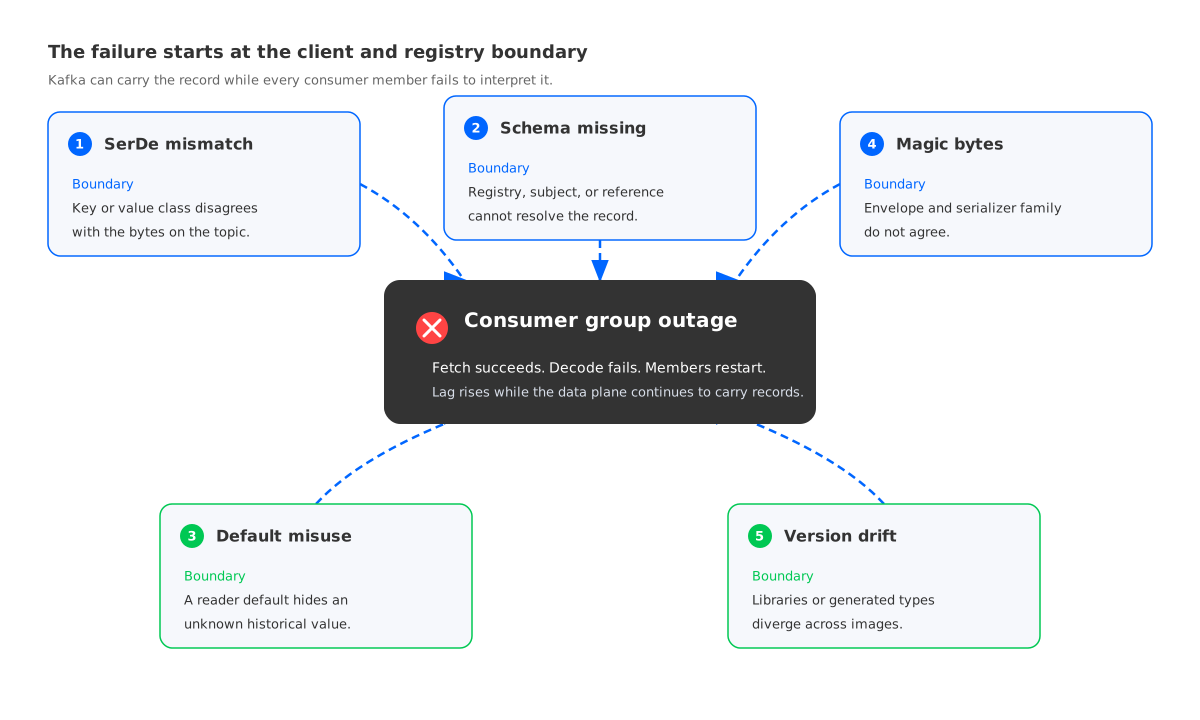
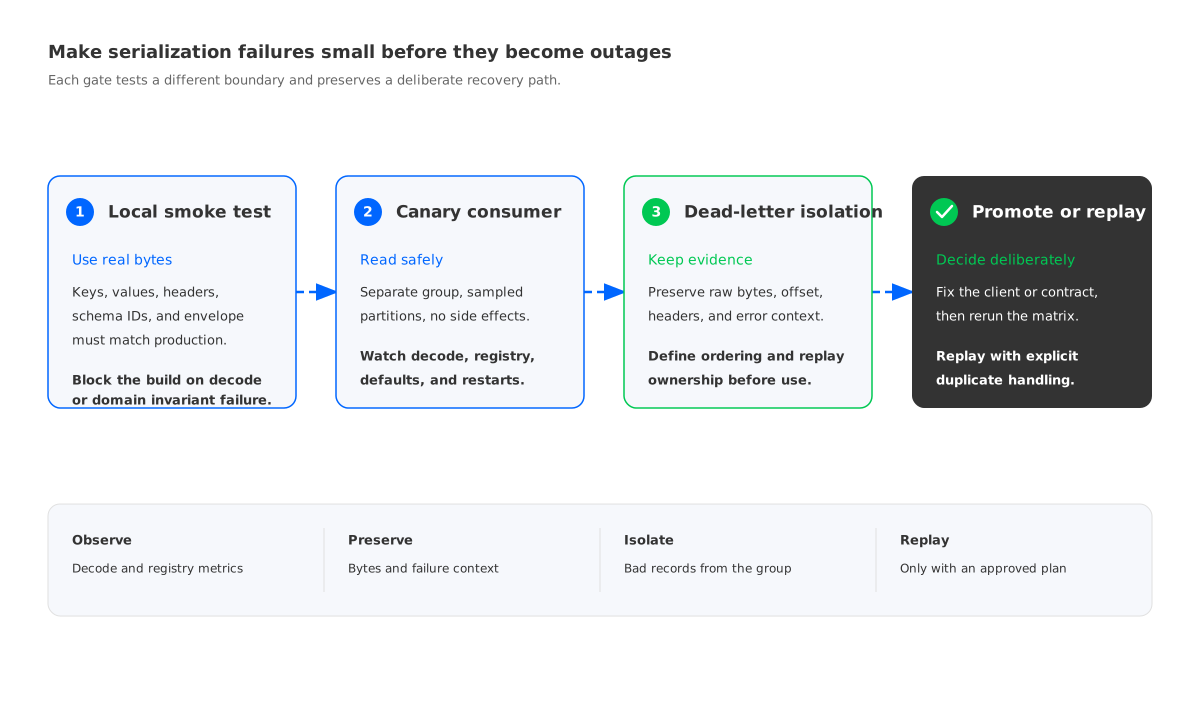
Separate transport health from decoding health. The broker can fetch a record successfully while the client or registry cannot interpret it. The five modes below lead to three deployment protections.
1One bad SerDe can stop a whole consumer group
A Kafka record contains a key, a value, and metadata such as headers, timestamp, topic, partition, and offset. The broker does not know whether the value is JSON, Avro, Protocol Buffers, a byte array, or an application-specific envelope. The producer chooses a serializer; the consumer chooses a deserializer. Those choices have to agree with the bytes actually on the topic.
Apache Kafka® exposes the producer's key.serializer and value.serializer settings, and the consumer has corresponding deserializer settings in its client configuration. A mismatch is therefore an application contract failure, even though the record can be written and fetched normally.
Consider a team that changes a value type from a string to a generated Avro class. The producer rollout succeeds, but one consumer deployment keeps StringDeserializer in its configuration. The first new record reaches the poll loop, decoding throws, the process exits, and the orchestrator restarts it. Every member receives the same partition assignment pattern and hits the same bad boundary.
The first question in a serialization incident is not “Is Kafka up?” It is “Which exact bytes did this client expect, and which bytes did it receive?”
Capture the topic, partition, offset, raw key and value, serializer and deserializer classes, schema subject and ID, client versions, and first decode exception. Lag shows impact; the byte and configuration pair shows cause.
2Five failure modes worth naming
The same outage can look like a broker problem, an application crash, or a registry incident depending on which log you read first. Naming the failure mode makes the first check more direct.
2.1SerDe mismatch: the code and the bytes disagree
A SerDe is the serializer and deserializer pair used to turn application objects into records and back. The common mistake is to change one side while assuming the topic has changed with it. A StringSerializer does not make an existing topic a string topic, and a value deserializer cannot infer an Avro or Protobuf contract from a Java class name.
The visible signals are usually immediate:
- SerializationException, ClassCastException, or an invalid payload parse during poll.
- A sharp rise in consumer restarts or failed polls immediately after deployment.
- Consumer lag increasing while broker fetch requests and producer acknowledgments remain normal.
- Only the newly deployed image failing, while the previous image can read the same partition.
Check both key and value paths separately. Teams often fix the value deserializer and miss a key mismatch, or validate a new record while an older key format is still inside the retention window. A small fixture should contain the real key bytes, value bytes, and headers from each producer version.
2.2Schema missing: a valid record cannot be resolved
Schema-based formats add another dependency. The record may carry an identifier that lets a deserializer locate the writer schema, while the consumer supplies a reader schema or generated type. If the registry is unreachable, the subject is different, a referenced schema was not registered, or the identifier belongs to another registry, the consumer has bytes but no way to resolve them.
Look for registry-specific signals rather than only Kafka client errors:
- Unknown schema ID, subject-not-found, or reference-resolution errors.
- Registry connection timeouts, TLS failures, authentication errors, or rate limits.
- A decode failure only for records produced by one application or one environment.
- A clean local parse of the schema file followed by failure in production.
A schema file in source control does not prove runtime access. Verify the registry URL, subject naming strategy, credentials, references, and the ID in the failing record. Test retained data, not only the live tail.
2.3Default value misuse: structural compatibility hides bad meaning
Defaults are useful, but they are often asked to do work they cannot do. In Avro schema resolution, a reader can supply a default when the writer record lacks a field. That default is applied while reading; it does not rewrite retained records or make an old producer start emitting the field.
The failure may therefore pass a schema check and still break a consumer's business logic. A new currency field with a default of USD can decode an old record whose currency was unknown. The consumer sees a valid string and charges, reports, or routes the event as if the value had been observed. The outage may appear later as a validation rejection, a downstream data-quality alert, or a silent semantic error.
Use both technical and domain signals:
- Defaulted-field counts rise after a reader rollout.
- Null, unknown, or fallback values increase in validation metrics.
- Replay decodes but fails invariants or produces different decisions.
Log whether a field was present in the writer record, whether a reader default was applied, and which schema versions were involved. Treat “decoded successfully” and “meaning is safe” as separate checks. If the old data does not support a truthful value, an explicit nullable or unknown state is often safer than a convenient default.
2.4Magic bytes confusion: the envelope is part of the contract
Many schema-aware serializers use a wire envelope around the payload. In one common format, the bytes begin with a magic byte followed by a schema identifier and the encoded data. Raw JSON, a different registry implementation, a custom envelope, or a payload copied from another topic may begin with a different sequence.
A consumer that assumes one envelope can fail before it reaches schema resolution. The error may mention an invalid magic byte, an unsupported wire format, an impossible schema ID, or a payload that is too short. This is different from a missing schema: the consumer has not yet established which schema to look up.
Useful signals include:
- The first bytes of a failing record differ from a known-good fixture.
- Errors cluster by topic, producer, connector, or environment boundary.
- A generic byte-array consumer can read the record while the schema-aware consumer cannot.
- Re-encoding the same logical object with a different serializer changes the prefix.
Keep the envelope decision explicit in the topic contract. Record the serializer family, wire-format version, subject naming rule, and whether keys and values use the same convention. Do not “fix” the incident by skipping records until the team knows whether the bytes are recoverable. A skip can hide a producer rollout that is still writing the wrong envelope.
2.5Version drift: compatible code is not always compatible behavior
Serialization has more versions than the application release number. A deployment may change the generated classes, serializer package, registry client, schema compiler, transitive dependencies, or subject naming configuration. Two images can both claim to support Avro or Protobuf while disagreeing about a field representation, logical type, reference, or wire envelope.
Version drift is easy to miss when the old image reads the live tail but the new image fails on replay. The error may surface after a rebalance or backfill reaches older records.
Watch for:
- Failures isolated to a build, language runtime, or generated-code version.
- Different decode results from old and new images against the same captured bytes.
- A schema or registry client change that was bundled into an unrelated dependency upgrade.
- Live consumption passing while replay, rollback, or cross-environment consumption fails.
Make the serialization matrix a release artifact. For each supported producer and consumer version, test current records, retained records, and the expected rollout direction. Pin the serializer and registry client versions where practical, and publish the version set with the application image so an incident responder can compare actual runtime state with the intended matrix.
3Detect the boundary before changing the cluster
A useful incident signal has to distinguish decoding failure from transport failure. The quickest triage compares three views of the same time window: broker fetch health, consumer process health, and serialization or registry errors.
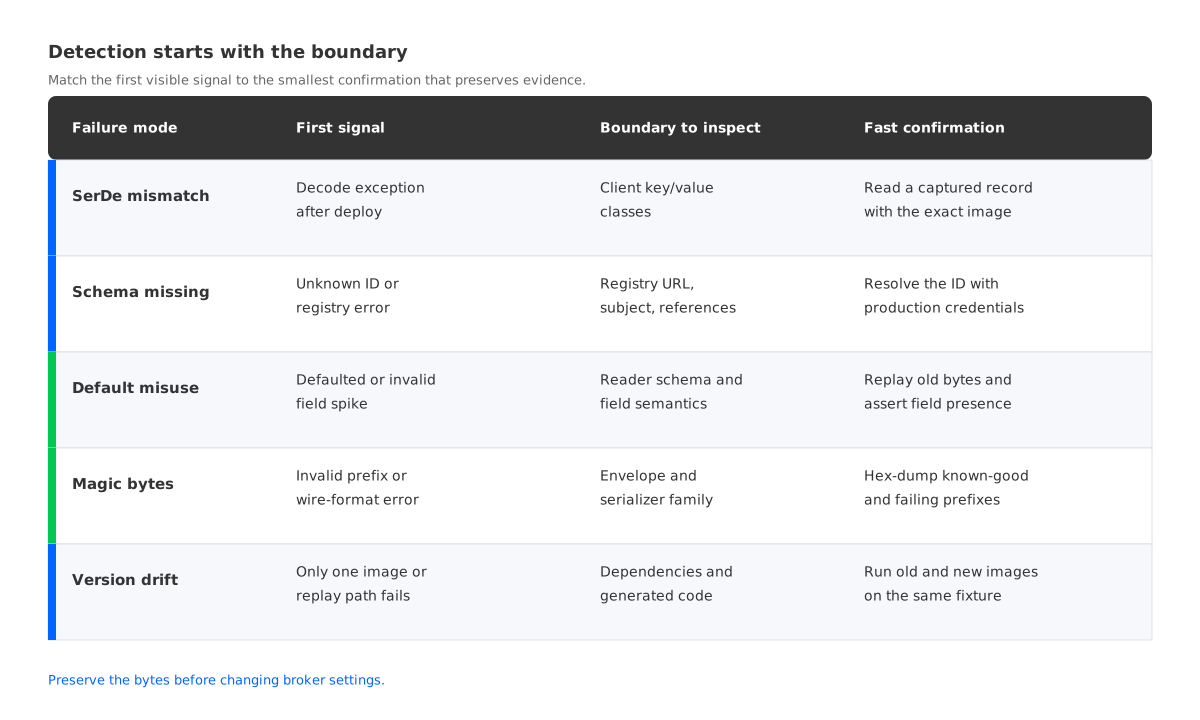
| Failure mode | First signal | Boundary to inspect | Fast confirmation |
|---|---|---|---|
| SerDe mismatch | Decode exception after deploy | Client key/value classes | Read a captured record with the exact image |
| Schema missing | Unknown ID or registry error | Registry URL, subject, references | Resolve the ID with production credentials |
| Default misuse | Defaulted or invalid field spike | Reader schema and field semantics | Replay old bytes and assert field presence |
| Magic bytes confusion | Invalid prefix or wire-format error | Envelope and serializer family | Hex-dump known-good and failing prefixes |
| Version drift | Only one image or replay path fails | Dependency and generated-code matrix | Run old and new images on the same fixture |
The table starts at the boundary. Changing broker settings first can erase evidence without changing the bytes. Preserve the failing record and compare it with one the same consumer reads.
A consumer lag alert remains valuable because it shows customer impact, but lag is downstream of the decode failure. Pair it with a counter for deserialization exceptions, registry lookup failures, consumer restarts, and records routed to isolation. If your client exposes the schema ID or serializer name, include those fields in structured logs. The goal is to identify the first boundary that disagrees, not to collect every metric the cluster emits.
4Three protections that keep one bad record contained
Detection shortens the incident. Protection changes the blast radius. The following controls work together because each closes a different gap between a code change and a production outage.
4.1Run a local smoke test against real bytes
A unit test that instantiates a serializer proves little if it never uses the same configuration and registry behavior as the deployed client. Build a small fixture with representative records from the current producer, the previous producer, and any retained format the consumer must support.
The smoke test should:
- Produce a record through the real serializer configuration, including key, value, headers, and schema registration.
- Consume the bytes with every supported reader image and deserializer configuration.
- Replay fixtures with missing fields, defaults, nulls, old schema IDs, and the expected wire envelope.
- Assert both decode success and domain invariants, such as required identity, valid units, and allowed states.
- Fail the build when a registry lookup, reference, or generated type is missing.
Store safe fixture bytes or a reproducible generator beside the test. A schema file alone does not exercise the wire format or client configuration.
4.2Add a canary consumer before the main group
A canary consumer should use the candidate image and the production serializer and registry settings, but it should not perform irreversible business actions. Give it a separate consumer group, constrain its read window or sampled partitions, and send decoded output to a verification sink or metrics path.
Monitor more than process liveness:
- Decode success rate and exception count.
- Registry lookup latency and cache misses.
- Schema IDs and serializer versions observed.
- Defaulted-field count and domain validation failures.
- Consumer restart rate and time spent behind the main group.
Promote only after the canary reads live traffic and a bounded replay sample. New records can miss retained envelopes and schema versions, while sharing the production group can hide failures by taking partitions away from protected consumers.
4.3Isolate bad records in a dead-letter path
When one record cannot be decoded, the recovery choice is not always “crash” or “skip.” A dead-letter or quarantine path can preserve the failing record for analysis while allowing the rest of the workload to continue, provided the application has a clear ordering and replay policy.
For each isolated record, retain:
- Original topic, partition, offset, timestamp, key, value, and headers when policy allows.
- Consumer image, serializer and deserializer names, schema subject and ID if available.
- The exception class, error message, and registry endpoint or environment label.
- A reason code that distinguishes mismatch, missing schema, invalid envelope, and semantic validation.
Do not silently discard bytes or advance offsets without recording the decision. Isolation changes ordering guarantees and may require a later replay after the producer or reader is fixed. That trade-off belongs in the topic runbook, alongside ownership of the quarantine topic, retention, access, and replay approval.
5Where AutoMQ fits in the investigation
The failure boundary matters when the underlying Kafka-compatible data platform changes. AutoMQ provides a Kafka-compatible data plane, so existing Kafka client behavior, serializer configuration, registry usage, and application-level tests remain the relevant compatibility surface. Its Kafka compatibility documentation describes that protocol boundary.
That boundary also sets a clear expectation. AutoMQ does not automatically repair an application that selects the wrong deserializer, cannot resolve a schema, misreads a wire envelope, or applies an unsafe default. Those failures live primarily between the client and the schema registry. The platform can carry the Kafka record; the application team still owns serialization contracts, client configuration, registry availability, and the decision to isolate or replay bad records.
This is why the smoke test and canary should run against the platform you intend to operate. If the bytes, client versions, and registry behavior pass the same matrix, a platform evaluation does not need to turn a serialization incident into a storage migration project. If they fail, the test has found an application boundary that needs repair before any rollout.
For teams evaluating architecture, AutoMQ's architecture overview explains the storage design underneath that Kafka-compatible boundary. It does not replace the client and registry checks above. Keeping those responsibilities separate makes both the test and the incident report more accurate.
6Serialization incident quick-reference
Use this sequence when a consumer group starts restarting or lagging after a client, schema, or producer change:
- Freeze the evidence. Save one failing record's raw key, value, headers, topic, partition, offset, timestamp, and the first exception.
- Compare the boundary. Confirm the deployed key and value deserializers, serializer family, schema subject, schema ID, registry endpoint, and runtime versions.
- Separate transport from decode. Check whether fetches and producer acknowledgments are healthy while deserialization, registry, or process-restart counters rise.
- Classify the failure. Use the five modes: mismatch, missing schema, default misuse, magic bytes, or version drift.
- Run the smallest confirmation. Reproduce with the exact image and captured bytes, then resolve the schema with production-like credentials.
- Protect the group. Stop a bad rollout, keep a canary isolated, and route unrecoverable records to a governed quarantine path.
- Repair and replay deliberately. Fix the contract or client, rerun the compatibility matrix, and replay only with an explicit ordering and duplicate-handling decision.
The group in the opening scene did not stop because Kafka forgot how to deliver records. It stopped because every consumer member received bytes that its application could not interpret. Treat serialization as a production boundary, test the wire contract before deployment, and keep bad records isolated enough to investigate.
If you are evaluating a Kafka-compatible platform, start with the same evidence: real client configurations, real serialized fixtures, registry lookups, retained records, canary reads, and rollback behavior. See AutoMQ in action after that test matrix is clear.


