
Table of Contents
Table of Contents
Teams do not usually search for Aiven Kafka because they are discovering Kafka for the first time. They search because Kafka is already part of a production plan, and the team needs to understand how much of that plan remains portable if the service boundary changes. Service portability asks a direct question: can the workload, configuration, network model, and operating evidence move without turning the migration into a platform rewrite?
Aiven for Apache Kafka is a managed Apache Kafka service, and Aiven also publishes Terraform provider documentation for managing services and Kafka resources as code. That combination is useful for platform teams because it surfaces the parts of Kafka ownership that often stay hidden during a product trial. Topics, ACLs, users, networks, state files, secrets, service plans, metrics, and support workflows all become part of the real portability question.
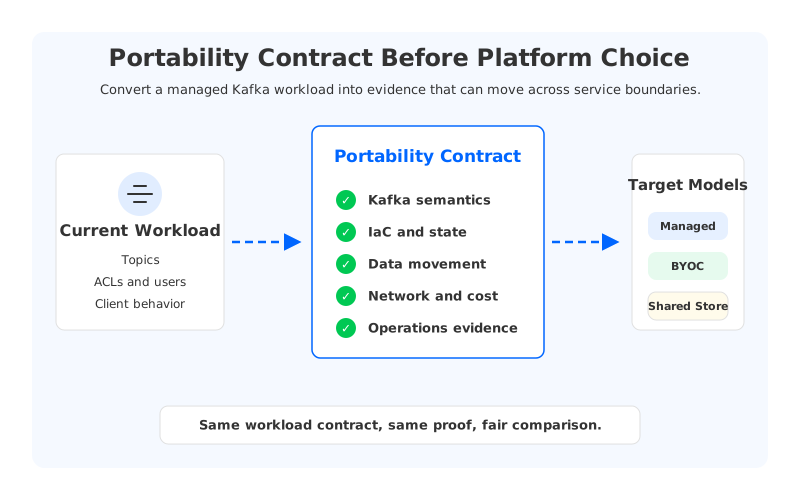
Portability is not vendor avoidance. A team may choose Aiven and stay. The discipline is to make the choice reversible enough for architecture, security, and FinOps teams to reason about it before production traffic is committed.
1Why Aiven Kafka Searches Become Portability Questions
The first layer of an Aiven Kafka evaluation is straightforward: the team wants managed Kafka capabilities without running every broker, patch, upgrade, and disk operation itself. That is a valid goal. Kafka operations can consume a large amount of engineering time, especially when the workload combines long retention, high partition count, strict security requirements, and multiple consumer groups with uneven lag patterns.
The portability question appears when the same workload becomes important enough to need an exit plan, a second deployment model, or a tighter cloud-account boundary. The team may need to move between regions, bring the data plane closer to its own network, or test a Kafka-compatible architecture that changes the storage layer. None of those moves should begin with a blank spreadsheet.
A practical portability plan starts by separating five concerns:
- Kafka semantics: producers, consumers, transactions, ACLs, topic configurations, quotas, offset behavior, and monitoring expectations.
- Infrastructure ownership: Terraform state, service resources, network attachments, secrets, cloud accounts, and change approvals.
- Data movement: retained logs, consumer lag, replay windows, replication tools, backfill paths, and rollback boundaries.
- Network and cost paths: producer ingress, consumer egress, cross-zone traffic, private connectivity, NAT, object storage, and inter-region movement.
- Operations: upgrades, alerts, incident roles, support access, SLO evidence, and post-cutover validation.
This list is intentionally broader than a Kafka feature matrix. Kafka portability fails when teams move the broker endpoint but forget that the old service also encoded security decisions, Terraform assumptions, alert names, network paths, and runbook muscle memory.
2What A Service Definition Cannot Decide For You
Public service documentation can explain supported resources, configuration fields, deployment concepts, and provider syntax. It cannot decide which parts of your Kafka estate are product defaults and which parts are business requirements. That distinction matters because a portability plan must decide what is contractual for the workload.
For example, a topic retention setting may be a technical default for one team and a legal requirement for another. A private network attachment may be convenience in development and a hard security boundary in production. A Terraform module may be a tidy wrapper, or it may be the operational source of truth for every Kafka service, user, and ACL in the company.
That is why the output of a portability review should be a workload contract, not a provider comparison table. The contract states what must remain true if the team continues with Aiven, moves to Amazon MSK, evaluates Confluent Cloud or Redpanda, returns to self-managed Apache Kafka, or tests a Kafka-compatible shared-storage platform such as AutoMQ.
| Portability layer | Evidence to collect | Decision it supports |
|---|---|---|
| Kafka API and behavior | Client versions, topic configs, ACLs, transactions, consumer offsets | Whether applications can move without semantic surprises |
| IaC and state | Terraform modules, remote state, provider versions, import/export process | Whether infrastructure ownership can be transferred cleanly |
| Data and cutover | Retention, replication path, lag catch-up, rollback window | Whether migration risk is bounded before production traffic moves |
| Network and security | VPC/VNet routes, private endpoints, DNS, keys, audit trails | Whether the target model fits existing controls |
| Operations and cost | Alerts, runbooks, support roles, cloud billing paths | Whether steady-state ownership is understood |
This table also prevents a common mistake: treating portability as a late-stage migration activity. By then, production traffic, Terraform state, and security assumptions may already be tied to one provider model.
3Terraform State Is Part Of The Architecture
Infrastructure as code gives Kafka teams a concrete way to manage service resources, but it also creates an ownership boundary. Terraform state maps configuration to real infrastructure. If the state file, provider schema, module structure, or secret handling is unclear, the Kafka service is less portable than it looks from the outside.
A service portability review should inspect the Terraform layer with the same seriousness as the broker layer. Which resources are created by provider-managed abstractions? Which are plain Kafka resources such as topics, users, and ACLs? Which values are generated by the service and later consumed by applications? Which settings are hidden in console changes that never returned to code?
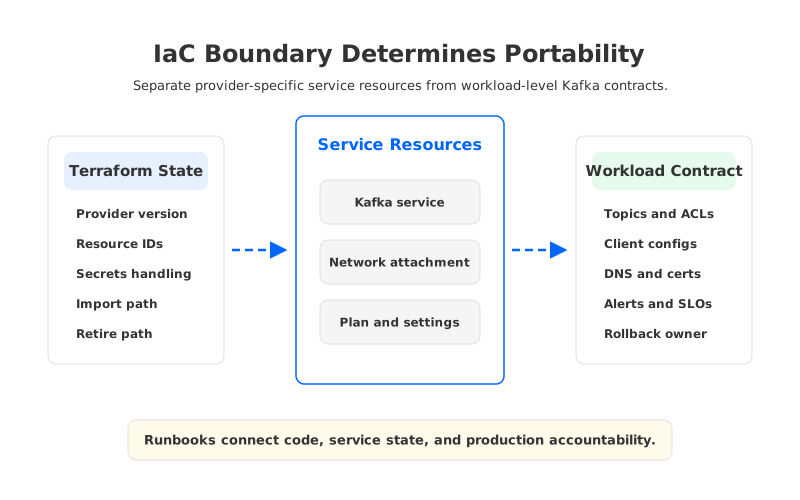
The risky part is not Terraform itself. The risky part is assuming that code equals portability. Code helps when it is modular, versioned, reviewable, and aligned with production behavior. It hurts when provider-specific assumptions leak into every environment module and no one knows which state entries must be imported, rewritten, or retired during a migration.
A useful review asks four direct questions:
- Can the team recreate the current Kafka environment from code in a clean account or project?
- Can provider-specific resources be isolated from workload-level resources such as topics, ACLs, and users?
- Can secrets, certificates, service endpoints, and DNS records rotate during cutover without application rewrites?
- Can the team retire the old service from state without leaving orphaned networks, credentials, or billing paths?
Those questions make portability concrete. They also reveal whether the migration plan is a controlled change or a manual reconstruction exercise disguised as a controlled change.
4Data Movement Is Not A Single Step
Kafka data movement has two different jobs. The first is moving historical or retained data far enough that consumers can continue within the required replay window. The second is moving live traffic without losing ordering, offset understanding, or rollback ability. Treating both as "replication" hides the operational difference.
Apache Kafka clients and ecosystem tools give teams several ways to bridge clusters, but the correct plan depends on workload shape. A topic with short retention and stateless consumers has a different portability profile from a topic used for audit replay. A high-throughput topic with many consumer groups has a different profile from a low-volume integration topic. A regulated workload may require explicit evidence that data residency, encryption, and access controls remain intact during the bridge period.
The cleanest portability plans define a cutover envelope:
- Before cutover: source topics, target topics, ACLs, schema dependencies, consumer groups, DNS, monitoring, and rollback owners are documented.
- During cutover: producers, consumers, replication, lag, error rates, and network paths are observed with agreed thresholds.
- After cutover: the team validates replay, removes stale credentials, closes temporary network routes, and confirms that cloud billing paths match the target architecture.
The envelope matters because it keeps the team from declaring success after the first successful produce-and-consume test. Kafka migrations often look healthy in a demo and then expose gaps when lag recovery, replay, schema compatibility, or consumer restart behavior meets production traffic.
5Network Cost Belongs In Portability Planning
A portable Kafka workload is not portable if the target architecture quietly changes the network bill or security posture. Cloud providers meter data movement across availability zones, regions, private connectivity, NAT gateways, and service endpoints in different ways. A Kafka service decision therefore moves bytes as well as responsibilities.
For Aiven Kafka or any managed Kafka service, map byte paths before comparing alternatives. Producers may enter through private connectivity. Consumers may read from another zone or VPC. Replication may cross regions. Monitoring agents may export telemetry. Object storage may appear in the storage path. Each path has a different cost, latency, and security implication.
The right level of detail is not a perfect bill forecast. It is a model that shows which architecture choices can change the bill under load. A platform owner should be able to explain which bytes move inside a zone, which cross a zone boundary, which leave a VPC, which touch object storage, and which are part of migration rather than steady-state operation.
That model also helps procurement. A lower service line item can be offset by transfer, private connectivity, storage requests, or operational labor. A higher service line item may still be rational if it removes toil and keeps network paths predictable. Portability planning gives FinOps comparable units.
6A Technical Evaluation Framework For Platform Teams
The strongest portability reviews are boring in the right way. They do not rely on a dramatic migration weekend or a heroic rollback plan. They reduce the decision to evidence that can be collected, reviewed, repeated, and challenged.
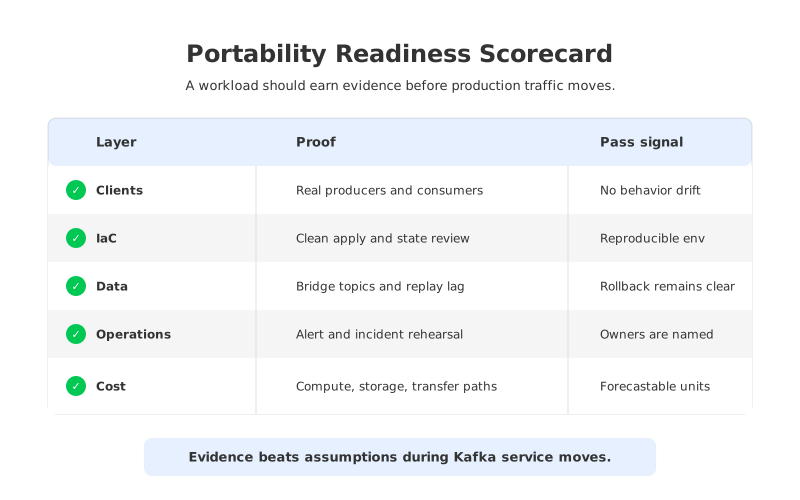
Use this framework before choosing a target model:
| Evaluation question | Proof to run | Failure signal |
|---|---|---|
| Can clients move cleanly? | Test real producer and consumer libraries, security settings, transactions, and offset behavior | Compatibility looks fine until a real client restarts |
| Can infrastructure be recreated? | Apply Terraform to a clean environment and compare resources, state, secrets, and DNS | Manual console steps are required for production parity |
| Can data move safely? | Bridge representative topics, measure lag, replay, ordering expectations, and rollback | Trial ignores retained data or consumer group behavior |
| Can operators run it? | Rehearse alerts, broker loss, quota pressure, certificate rotation, and escalation | Support boundaries are unclear during incidents |
| Can cost be forecast? | Model compute, storage, transfer, private connectivity, and migration overhead | Monthly estimates omit byte paths or temporary duplication |
The framework should be run against the current service and every serious alternative. That keeps the process respectful and factual. Aiven may be the right answer for managed Apache Kafka with a specific service boundary. Amazon MSK may fit an AWS-native standard. Self-managed Kafka may fit a team with deep Kafka operations capability and strict internal control. The point is to evaluate each option against the same workload contract.
7How AutoMQ Fits The Portability Discussion
AutoMQ becomes relevant after the portability contract is written, not before. It is a Kafka-compatible cloud-native streaming system that keeps the Kafka protocol surface while changing the storage architecture: brokers are stateless, retained data is backed by S3Stream shared storage, and a write-ahead log layer handles the hot write path before data is organized in object storage.
That architecture changes the portability conversation in a specific way. Instead of asking how much broker-local storage must be moved with each broker, the team can evaluate whether shared storage and independent compute/storage scaling fit the workload. Instead of treating cross-zone replication traffic as an unavoidable part of the Kafka durability model, the team can examine an architecture designed to reduce inter-zone traffic. Those are architectural claims that should be tested with real clients, real workload shape, and the same scorecard used for every other option.
AutoMQ is not a replacement for a portability plan. It is one target model to include when the current evaluation points toward Kafka compatibility, object-storage-backed durability, customer-side control, elastic capacity, and clearer network-cost boundaries. The more disciplined the portability contract, the easier it is to decide whether that model is a fit.
8A Practical Portability Runbook
Turn the review into a runbook before a proof of concept starts. The runbook should name the source environment, target environment, workload owners, migration owner, rollback owner, security approver, and FinOps reviewer. It should also define which metrics count as pass/fail during the bridge period.
A concise runbook usually covers seven steps: inventory Kafka resources, classify application dependencies, recreate infrastructure in code, establish private connectivity, bridge representative topics, rehearse cutover and rollback, and retire temporary access after validation. Each step should produce evidence. A screenshot of a green dashboard is not enough; the team needs commands, state changes, lag graphs, billing-path notes, and incident contacts that can survive handoff between teams.
The original Aiven Kafka search is a good signal because it means the team is already thinking beyond self-managed broker work. The stronger question is whether the workload can move across service boundaries without losing operational clarity. If your portability contract points toward Kafka-compatible shared storage, customer-side control, and independent compute/storage scaling, test the AutoMQ Cloud Console with one representative workload and compare the evidence against the same runbook.
9References
- Aiven for Apache Kafka documentation
- Aiven Terraform Provider documentation
- Aiven Kafka Terraform resource documentation
- Apache Kafka documentation
- Apache Kafka Tiered Storage documentation
- Terraform state documentation
- Amazon MSK Developer Guide
- AWS EC2 On-Demand Pricing: Data Transfer
- AWS PrivateLink pricing
- AutoMQ compatibility with Apache Kafka
- AutoMQ S3Stream shared streaming storage
- AutoMQ inter-zone traffic overview
10FAQ
10.1What does Kafka service portability mean?
Kafka service portability means the workload can move across service boundaries without losing required Kafka behavior, security controls, infrastructure ownership, data replay capability, observability, or cost visibility. It is broader than changing broker endpoints.
10.2Is service portability the same as planning to leave Aiven Kafka?
No. A portability plan can support staying with Aiven because it clarifies which requirements the service satisfies. It also protects the team if architecture, region, cost, security, or procurement requirements change later.
10.3Why does Terraform matter in a Kafka portability review?
Terraform often becomes the operational record for Kafka services, networks, users, topics, and ACLs. If modules, provider versions, state ownership, and secret handling are unclear, the workload may be harder to move than the application team expects.
10.4How should teams compare Aiven Kafka with Kafka-compatible alternatives?
Use the same workload contract for every option. Test client behavior, security, Terraform ownership, data movement, recovery, monitoring, network paths, and cost meters before comparing commercial terms or service packaging.
10.5When should AutoMQ be included in the evaluation?
Include AutoMQ when the portability plan highlights Kafka compatibility, object-storage-backed durability, customer-side control, independent compute/storage scaling, and reduced inter-zone traffic as important evaluation criteria.


