
Table of Contents
Table of Contents
Teams usually start searching for msk alternatives after Amazon MSK has already solved one problem and exposed another. Nobody wants to spend scarce platform time hand-building Kafka operations, broker patching, TLS wiring, and availability-zone placement from scratch. MSK gives teams a managed AWS path for Apache Kafka, and for many organizations that is a rational first choice. The second problem appears later, when Kafka becomes a shared platform rather than a single application dependency.
At that point the evaluation changes. The question is no longer, "Can we run Kafka on AWS?" It becomes, "Which service gives us the right control over Kafka semantics, cloud cost, scaling speed, data ownership, and operational failure modes?" That is why the phrase msk alternatives is not a simple replacement query. It is a signal that the buyer has moved from adoption to platform design.
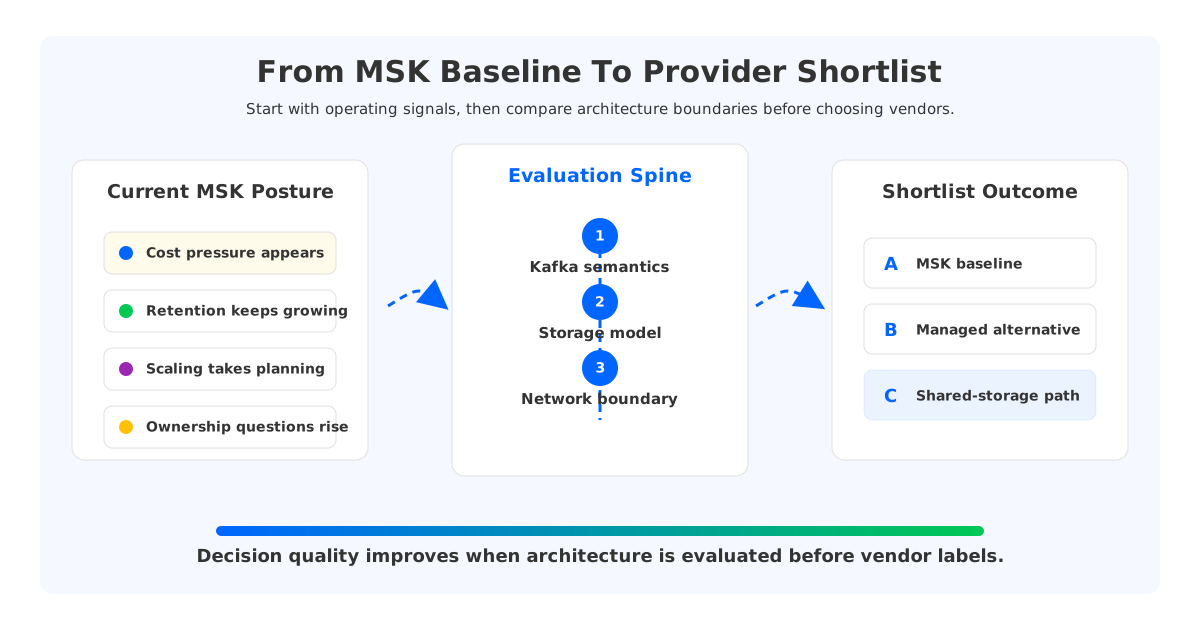
The hard part is that most comparison conversations collapse too quickly into brand names. Confluent Cloud, Redpanda, Aiven, self-managed Kafka, MSK provisioned clusters, MSK Serverless, and Kafka-compatible engines all solve different parts of the platform problem. A useful shortlist starts with architecture and operating boundaries, not vendor labels. Once those boundaries are visible, you can decide what must remain Kafka-compatible, what may change under the storage layer, what the cloud network will charge for, and who owns the recovery path.
1Why Teams Look Beyond Amazon MSK
MSK is strongest when the organization wants AWS-native managed Kafka with familiar broker concepts. It keeps the Apache Kafka operating model recognizable: brokers, storage attached to brokers, topic partitions, client compatibility, security integration, and AWS-managed lifecycle operations. That matters because Kafka is rarely isolated. It sits between databases, stream processors, lakehouse ingestion, observability pipelines, fraud systems, feature stores, and customer-facing applications.
The pressure to evaluate alternatives usually comes from one of four places:
- Cost becomes architectural, not administrative. Broker instance hours, storage, broker-to-broker replication, client traffic, PrivateLink, cross-AZ data transfer, and retention policies interact. A team can tune one line item while another grows.
- Elasticity expectations change. Application teams expect capacity to follow traffic, but Kafka partitions and broker-local storage make scaling more than an instance-count adjustment.
- Operational ownership becomes ambiguous. A managed service removes some maintenance tasks, yet the platform team still owns topic design, client behavior, retention, quotas, disaster recovery objectives, and incident communication.
- Data governance gets sharper. Procurement and security teams may require clearer answers about where data lives, who can access it, how encryption works, and whether a vendor operates inside the customer's cloud account.
None of these points make MSK a poor choice. They explain why teams that are already comfortable with MSK still run a second evaluation. A platform owner can accept AWS-native management and still ask whether broker-local storage is the right long-term architecture for high-retention, multi-AZ, high-fanout streaming workloads.
2The Evaluation Should Start With Kafka Semantics
Kafka compatibility is the first gate because the cost of changing client behavior is usually higher than the cost of changing infrastructure. Existing producers and consumers depend on protocol behavior, offset commits, partition ordering, transactions, idempotent producers, ACLs, authentication, observability conventions, and ecosystem tooling. A provider that speaks "Kafka-like" APIs but changes too many assumptions can turn an infrastructure migration into an application migration.
The compatibility review should be concrete. Do not stop at "supports Kafka clients." Test the client libraries, security mechanisms, admin APIs, connector patterns, and failure behaviors your applications use. A team with transactional producers and strict ordering guarantees has a different risk profile from a team using Kafka primarily as a telemetry buffer. A team with hundreds of consumer groups has to test offset migration, lag visibility, and rollback behavior.
This is also where Apache Kafka's own architecture matters. Kafka tiered storage, documented in Apache Kafka as a way to move older log segments to remote storage, changes retention economics without making brokers stateless. Tiered storage can reduce pressure on local disks for historical data, but the broker still owns active log serving, partition leadership, and much of the operational shape. A diskless or shared-storage Kafka-compatible design changes a deeper boundary: it reduces the amount of durable stream state tied to any single broker.
3Architecture Criteria Behind the Shortlist
Once compatibility passes the first gate, the shortlist should be organized by the architecture you are buying. A simple way to frame it is to separate the control plane, compute plane, storage plane, and network boundary. The control plane decides how clusters are created, upgraded, secured, and observed. The storage plane decides where durable log data lives. The network boundary decides whether traffic stays inside your VPC, crosses availability zones, traverses PrivateLink, or leaves your cloud account.
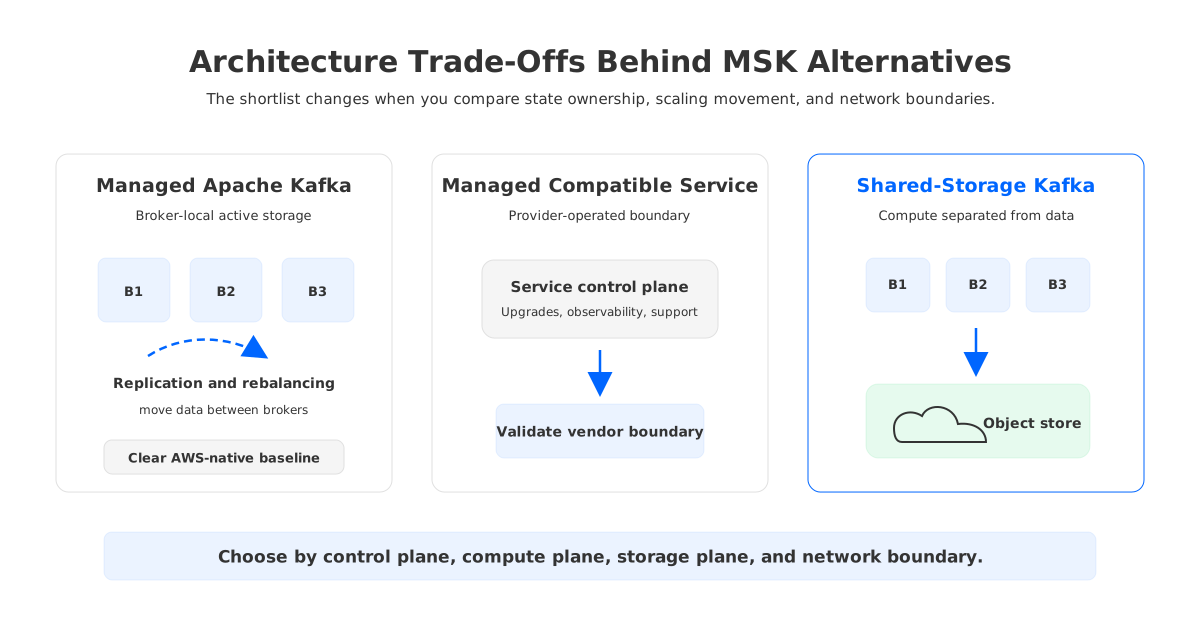
This framing keeps the conversation factual. A fully managed Kafka service may offer broad ecosystem maturity and less day-to-day administration. A self-managed Kafka deployment may offer maximum control but leaves patching, capacity planning, rebalancing, and recovery in your hands. A Kafka-compatible shared-storage platform may preserve Kafka protocol behavior while changing the storage and scaling model under the brokers.
Use the following worksheet during the first architecture pass:
| Criterion | What to verify | Why it matters |
|---|---|---|
| Kafka protocol and semantics | Client versions, transactions, ACLs, consumer groups, admin APIs, connectors | Prevents an infrastructure decision from becoming an application rewrite |
| Storage architecture | Broker-local disks, tiered storage, or shared object storage | Determines recovery speed, scaling friction, and retention economics |
| Network cost boundary | Cross-AZ traffic, PrivateLink data processing, internet egress, inter-region replication | Cloud networking can become a recurring Kafka tax |
| Elasticity model | Partition movement, broker add/remove time, storage rebalancing, traffic balancing | Determines whether capacity can follow workload shape |
| Operating model | Fully managed, BYOC, software in your Kubernetes, or self-managed | Decides who has access, who upgrades, and who responds during incidents |
| Migration path | MirrorMaker2, dual-write, cluster linking, offset handling, rollback plan | Reduces cutover risk for production systems |
The most important row is often the network boundary. In multi-AZ Kafka, data can move several times: producer writes to a leader, followers replicate across zones, consumers fetch from a different zone, and operational tools read metadata or logs. AWS publishes separate pricing pages for MSK and PrivateLink because these costs are not all part of one simple "Kafka price." Your provider evaluation should model data movement explicitly rather than treating networking as an afterthought.
4Cost Models: Instance Price Is Not TCO
The first cost spreadsheet usually compares broker instance sizes, storage price, and support tiers. That is useful but incomplete. Kafka total cost of ownership depends on write throughput, read fanout, retention duration, replication factor, cross-AZ placement, network topology, operational labor, and failure recovery. Two services can look close on hourly price and diverge once the workload starts retaining more data or serving more consumers.
For a production Kafka platform, break cost into five buckets:
- Steady compute: broker or broker-compatible compute needed for peak and baseline throughput.
- Durable storage: local disks, attached block storage, object storage, and retention growth.
- Data movement: cross-AZ replication, client fetch traffic, PrivateLink processing, inter-region replication, and egress.
- Operational work: upgrades, balancing, partition reassignment, incident response, capacity reviews, and security changes.
- Migration and exit cost: parallel running time, data sync, validation, rollback capacity, and retraining.
This approach changes how "lower cost" should be interpreted. A provider that reduces storage cost but increases operational effort may still fit a team with deep Kafka expertise. A provider that charges more for management but reduces migration risk may fit a regulated team with limited platform headcount. A provider that separates compute from storage can be compelling when retention and elasticity dominate the bill.
The strongest cost analysis is scenario-based. Model a baseline workload, a growth workload, and a failure workload. The growth scenario shows what happens when retention doubles or read fanout increases. The failure scenario shows the cost and time of recovery after losing brokers, an availability zone, or a replication link.
5Migration Risk Is Mostly About Control Points
The migration plan should be written before the provider is selected, because it reveals which promises are actually usable. For a Kafka platform, the critical control points are producer routing, consumer offsets, topic configuration, access control, schema compatibility, monitoring, and rollback. If a provider cannot give clear answers at those points, the risk is not in the final architecture; it is in the path to get there.
A practical migration design has three phases. First, mirror data and metadata into the target environment while the current MSK cluster remains the source of truth. Second, move low-risk consumers and validate lag, ordering assumptions, dashboards, alerting, and access control. Third, cut over producers with a rollback window that is long enough for real traffic, not only a synthetic smoke test. The tooling varies, but the principle does not: move observability and rollback controls before moving business-critical writes.
Procurement teams should also ask about exit paths. That question is not hostile; it is how infrastructure buyers protect the company from future uncertainty. Can the service export data using Kafka-compatible tools? Can clients move away without proprietary SDK rewrites? Can topic metadata, ACLs, and consumer progress be reconstructed?
6How AutoMQ Fits The Evaluation
After the neutral framework is in place, AutoMQ belongs in the shortlist when the team wants Kafka-compatible behavior with a cloud-native storage architecture. AutoMQ is a Kafka-compatible streaming platform that separates broker compute from durable stream storage, using object storage as the shared storage layer with a WAL design for low-latency writes. In practical terms, the architecture aims to keep Kafka clients and operating semantics familiar while reducing the amount of durable state bound to individual brokers.
That matters for the same reasons teams search for MSK alternatives. If storage is bound to brokers, scaling and recovery often involve moving partition data between machines. If durable stream data is placed in shared object storage and brokers become more stateless, scaling and replacement can become a compute-plane operation rather than a data-copying operation. This is the architectural basis behind AutoMQ capabilities such as independent compute and storage scaling, self-balancing, and reduced cross-zone replication traffic in supported deployments.
AutoMQ is not a universal answer to every Kafka decision. If your organization wants the most AWS-native managed Kafka experience and your workload fits well within MSK's operating and cost envelope, staying on MSK can be reasonable. AutoMQ becomes relevant when the pain is tied to cloud storage economics, broker statefulness, data movement, and the desire to keep deployment inside your cloud account through BYOC or software deployment options.
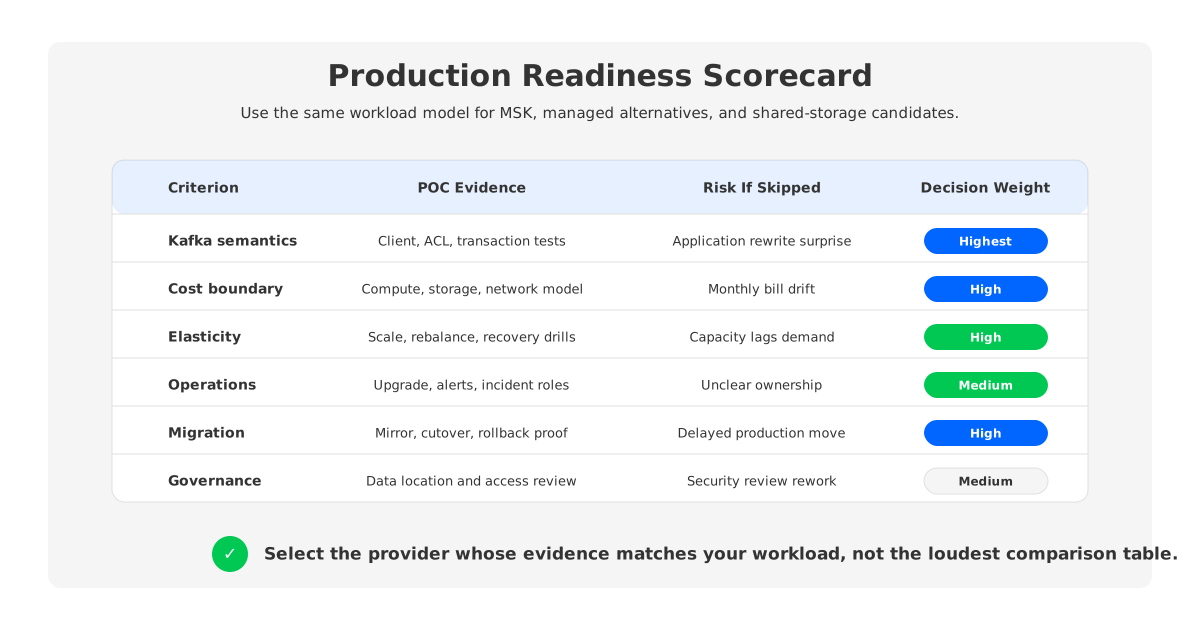
The proof of concept should reflect that positioning. Do not test only produce and consume throughput. Test scale-out, scale-in, broker replacement, catch-up reads, cross-AZ traffic visibility, client compatibility, ACL behavior, and migration tooling. The result should be a decision record that says which architecture fits your workload and why.
7A Provider Selection Checklist For Platform Owners
The final shortlist should be short enough to test seriously. Three candidates are usually plenty: the current MSK baseline, one managed alternative, and one architecture-shifting alternative. Each candidate should be evaluated against the same workload model and the same operational runbook.
Before the final decision, require written answers to these questions:
- Which Kafka client behaviors are guaranteed, which are compatible by test, and which are unsupported?
- Where does durable data live, and what happens to it when brokers are added, removed, upgraded, or replaced?
- Which traffic paths can cross availability zones, VPC boundaries, accounts, or regions?
- How does the service behave when retention grows faster than throughput?
- What operational actions remain with the customer team after the service is adopted?
- What is the rollback plan if producer cutover fails under real load?
- How will the team measure success after 180 days?
The 180-day question is useful because a Kafka provider can look good during a short benchmark and still disappoint after the first schema incident, traffic spike, retention increase, or cloud bill review. A provider that looks more complex during evaluation may be stronger after six months if it gives the platform team clearer cost boundaries and faster recovery.
If your MSK evaluation has moved from "managed Kafka" to "which architecture should carry our next five years of streaming workloads," review AutoMQ's Kafka-compatible shared-storage model in the AutoMQ documentation and test it against the same workload model you use for your MSK baseline.
8References
- Apache Kafka documentation: Tiered Storage
- AWS documentation: What is Amazon MSK?
- AWS pricing: Amazon MSK pricing
- AWS pricing: AWS PrivateLink pricing
- AutoMQ documentation: Shared Storage architecture
- AutoMQ documentation: S3Stream shared streaming storage
- AutoMQ documentation: Native compatibility with Apache Kafka
- AutoMQ documentation: Eliminate inter-zone traffic overview
9FAQ
What is the most important criterion when comparing MSK alternatives?
Kafka compatibility is the first gate, but architecture is the real decision. Verify client behavior, security, transactions, consumer groups, and admin operations first. Then compare storage design, network cost boundaries, elasticity, operating model, and migration risk.
Is tiered storage the same as a shared-storage Kafka architecture?
No. Kafka tiered storage moves older log segments to remote storage, which can help retention economics. A shared-storage Kafka-compatible architecture changes a deeper boundary by reducing broker ownership of durable stream data.
Should teams leave Amazon MSK if they are already running it successfully?
Not automatically. MSK remains a reasonable choice for AWS-native managed Kafka. Teams usually evaluate alternatives when cost, elasticity, cross-AZ traffic, retention growth, or operational ownership no longer match the platform's next phase.
Where does AutoMQ fit among MSK alternatives?
AutoMQ fits when a team wants Kafka-compatible APIs and semantics while changing the storage architecture underneath the brokers. Its shared-storage design is relevant for compute/storage separation, object-storage-backed durability, elastic scaling, and reduced inter-zone data movement.
What should a proof of concept include beyond throughput benchmarks?
Include client compatibility, ACLs, consumer offset behavior, migration tooling, scale-out and scale-in, broker replacement, catch-up reads, cross-AZ traffic monitoring, alerting, and rollback.


