
Table of Contents
Table of Contents
Kafka often enters a platform as a short buffer. It smooths a burst between services, absorbs a deployment delay, or gives a downstream job enough time to catch up. Then the buffer starts doing more serious work. Product teams want seven days of replay, security teams want event history, analytics teams want CDC streams available through the weekend, and incident responders want telemetry they can rewind after a bad release.
That shift is subtle because the Kafka API does not change. Producers still write records, consumers still read offsets, and topics still look like topics. The bill changes because Kafka storage cost is driven by retained bytes, not by the number of topic names in a cluster. Once Kafka becomes a retained operational data store, every extra day of retention turns into local disk, replicas, broker placement constraints, and recovery headroom.
The uncomfortable part is that none of those costs are bugs. They are the normal result of running a broker-local distributed log in the cloud.
1How Retention Quietly Becomes a Kafka Cost Driver
Retention feels harmless when a topic is small. Moving from 24 hours to 72 hours can look like a configuration change, especially when Kafka exposes retention through topic settings such as retention.ms, retention.bytes, and log segment rolling behavior. Apache Kafka stores records in log segments, and retention determines when old segments are eligible for deletion or compaction. The mechanism is operationally familiar, so the financial impact can hide behind a routine change request.
The cost appears when the retained stream is large enough to shape cluster sizing. Logs, CDC, telemetry, fraud events, IoT measurements, and operational audit trails have a habit of growing in two directions at once: write throughput rises, and the retention window gets longer. A team that originally needed a buffer for downstream hiccups may later depend on Kafka as the fastest replay source for data repair, backfills, and incident investigation.
For platform teams, the key question is not whether retention is valuable. It often is. The better question is where those retained bytes live and what else must scale with them. In traditional Kafka, retained data lives on broker-local disks, so storage growth is not isolated from the broker fleet that also handles compute, networking, replication, and recovery.
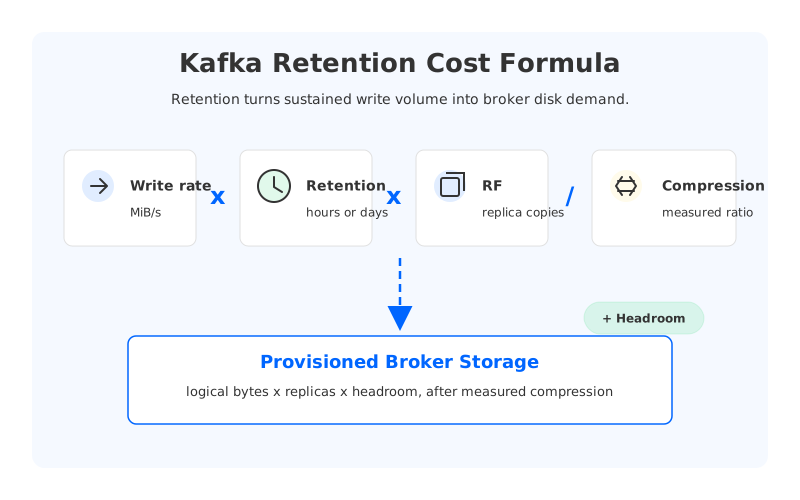
Retention is therefore a multiplier, not a single knob. Increasing retention expands the logical data set. Replication turns that logical data set into multiple physical copies. Headroom turns physical copies into provisioned capacity. Broker placement turns provisioned capacity into a topology problem.
2The Storage Formula: Throughput, Retention, Replication, and Headroom
A useful Kafka retention cost model starts with a plain workload equation:
logical_retained_data = sustained_write_rate x retention_window
physical_kafka_storage = logical_retained_data x replication_factor / compression_ratio
provisioned_broker_storage = physical_kafka_storage x headroom_factor
This formula is not a benchmark. It is a way to keep the discussion honest. If a topic receives 100 MiB/s and retains seven days of data, the logical retained data is about 57.7 TiB before compression. With replication factor 3, the physical Kafka footprint becomes about 173 TiB before compression. If the operations team keeps 30% storage headroom for segment rolling, broker failure, reassignment, and unexpected growth, the provisioned disk target rises to about 225 TiB before compression.
Compression can help a lot, but it does not remove the structure of the equation. A 2:1 compression ratio cuts the retained bytes in half; it does not change the fact that longer retention, more replicas, and more headroom scale together. That is why a retention request can be more expensive than it sounds in a budget review. The business asks for days. The cluster receives TiB, replicas, disk placement, and operational risk.
There are several inputs worth modeling separately:
- Write rate: Sustained throughput sets the baseline amount of data created per second. Peak throughput matters too, but retention cost starts with the steady stream.
- Retention window: Hours or days multiply the write rate directly. This is the most visible business lever.
- Replication factor: Kafka replication improves availability by keeping partition replicas on multiple brokers, but each replica consumes storage.
- Compression ratio: Real workloads vary by schema, payload shape, and compression codec. Use measured topic-level data rather than a generic guess when possible.
- Headroom factor: Free disk is not wasted when it protects recovery, rolling upgrades, segment churn, and reassignment work.
The public cloud price sheet should be applied after these inputs are agreed. For example, AWS EBS pricing charges provisioned block volume storage per GB-month, while AWS S3 pricing charges object storage based on storage class, size tier, request type, and other dimensions. Those pages are not interchangeable, and their values vary by region and date. The durable practice is to model bytes first, then apply the current official price for the chosen deployment.
3Why Broker-Local Disks Limit Flexibility
The deeper problem is not that disks cost money. The problem is that broker-local disks make storage a broker responsibility. A Kafka broker does not merely process requests; it owns partition replicas and the log segments for those replicas. When retained data grows, brokers become harder to move, replace, and resize because their local state has to be preserved or rebuilt elsewhere.
This coupling shows up in day-to-day operations. A broker with too much disk pressure may need partition reassignment, but moving partitions means moving data. A cluster with low CPU and high disk usage may still need larger instances or more brokers because storage cannot scale on its own. A team that wants to reduce broker count after a traffic drop may discover that retained data still pins the cluster shape.
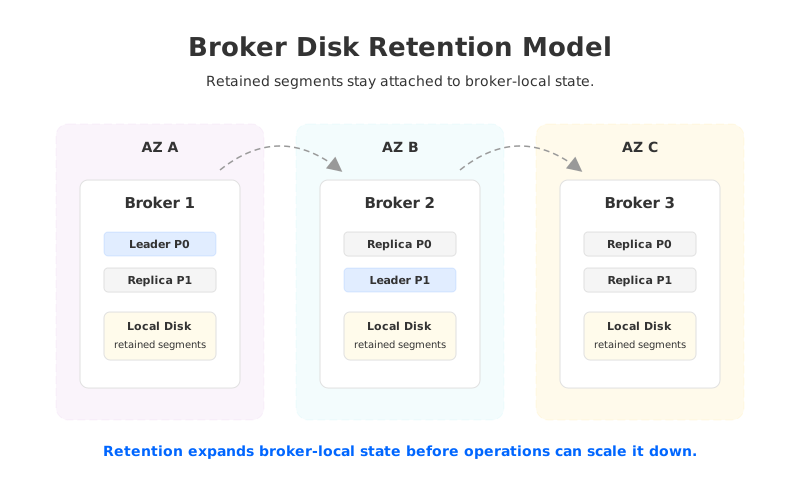
Replication makes the picture more durable, but also more expensive. Kafka's replication model keeps follower replicas on other brokers so the cluster can tolerate broker failure. In a cloud deployment spread across availability zones, that is a reasonable availability pattern. It also means every retained segment belongs to a placement plan: where the leader lives, where followers live, how much disk each broker has, and how much free space remains if one broker is lost.
The result is a storage model with several hidden constraints:
| Constraint | What It Means for Cost |
|---|---|
| Disk grows with retention | Longer retention can force larger volumes or more brokers even when CPU is stable. |
| Replicas grow with disk | Durability multiplies the local footprint before pricing is applied. |
| Free space is operational capacity | Headroom protects recovery and reassignment, so it must be budgeted. |
| Broker state slows change | Scaling down, replacing brokers, and balancing partitions can require data movement. |
These constraints are why Kafka retention cost often survives ordinary cost optimization. You can right-size instances, tune topic retention, improve compression, and clean up forgotten topics. Those are worth doing. But when the dominant driver is long-lived retained data, the architecture still asks broker disks to carry the durable tail.
4Tiered Storage vs Object-Storage-Backed Kafka
Kafka tiered storage addresses a real pain: not all retained data needs to stay on the hottest broker disks forever. Apache Kafka includes tiered storage capabilities that let older log segments move to remote storage while brokers keep a local tier for active data. For teams that operate standard Kafka and need longer retention, this can reduce pressure on broker-local disks and make catch-up reads less dependent on primary disk capacity.
Tiered storage is still a tiered design. The local broker log remains part of the storage path, and operators still need to reason about local segments, remote segments, fetch behavior, metadata, and the boundary between hot and cold data. It can reduce local disk growth, but it does not automatically make brokers stateless compute nodes. The broker remains involved in the log lifecycle and in serving data from the tiered model.
Object-storage-backed Kafka starts from a different premise. Instead of treating object storage as a secondary tier for older segments, it treats shared object storage as the primary durable storage layer. Brokers focus on request handling, protocol compatibility, caching, and coordination. Durable data is not owned by a single broker's attached disk in the same way, so storage growth no longer forces the same broker-local capacity decisions.
That distinction matters for Kafka infrastructure cost because it changes which components scale with retention:
| Model | Durable Data Owner | Broker Role | Retention Cost Shape |
|---|---|---|---|
| Broker-local Kafka | Broker disks and replicated local logs | Compute plus long-term storage owner | Retention increases local disk and replica footprint. |
| Kafka with tiered storage | Local tier plus remote tier | Compute, hot storage, and tier manager | Older data can move remote, but brokers remain stateful. |
| Object-storage-backed Kafka | Shared object storage | Compute, cache, and protocol-serving layer | Retention grows object storage more directly than broker disk. |
This is the point where the cost conversation becomes architectural. If the workload needs very short retention and is dominated by CPU, network, or request processing, storage architecture may not be the first lever. If the workload keeps days or weeks of operational history, storage architecture is often the lever that changes the slope.
5How AutoMQ Stores Kafka Data with Shared Object Storage
The natural answer to broker-disk retention cost is not "use object storage and ignore latency." Streaming systems still need low-latency writes, efficient reads, ordered log semantics, and predictable recovery. Object storage is durable and elastic, but its API and latency profile are not the same as a local log file. A credible object-storage-backed Kafka architecture needs a write path that absorbs that difference.
AutoMQ is a Kafka-compatible streaming system that replaces Kafka's broker-local storage layer with S3Stream, a shared storage layer built around object storage, WAL, and cache. The AutoMQ documentation describes S3Stream as offloading Kafka log storage to cloud storage while using WAL storage for write acceleration and recovery. In this model, object storage is the primary location for durable stream data, while the WAL handles low-latency persistence before data is uploaded to object storage.
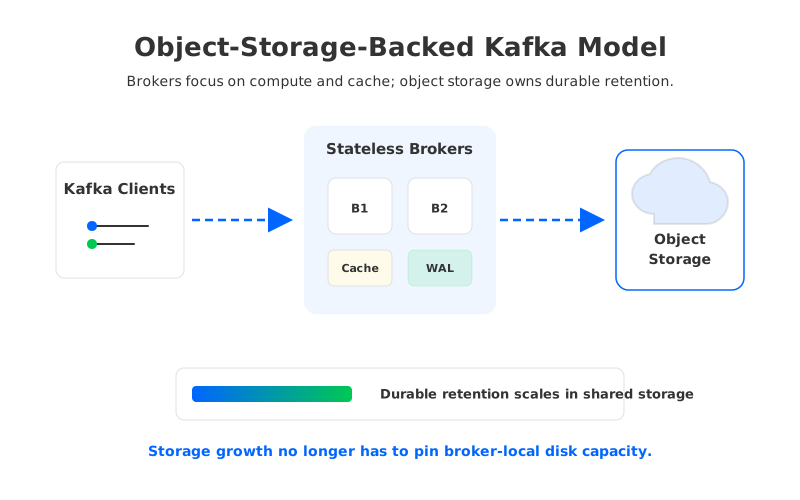
The important detail is the division of responsibilities. WAL is not positioned as a second long-term copy of the entire retained log. It is the acceleration and recovery buffer for recent writes that have not yet been uploaded, or that may be useful for recovery. Object storage carries the retained data set. Cache accelerates hot reads and selected catch-up reads, so brokers can serve common access patterns without treating all retained history as local disk state.
This architecture changes the retention model in three ways:
- Durable storage scales with object storage rather than attached broker volumes. That makes long retention closer to a storage-service decision than an instance-shape decision.
- Brokers become more stateless because partition data is offloaded to shared storage. Reassignment and scaling are less dominated by copying retained log segments from one broker disk to another.
- Cold and catch-up reads can be planned separately from the write path. Cache and prefetch behavior become performance levers instead of forcing every retained byte onto local broker disks.
This does not make cost modeling optional. Object storage has request costs, data retrieval considerations, lifecycle choices, and provider-specific behavior. WAL media choices also matter. AutoMQ Open Source supports S3-compatible storage as a WAL option, while commercial deployments can use different WAL media across cloud providers for broader workload requirements. The right comparison is not "disk versus object storage" in the abstract; it is the same workload modeled under two architectures.
For data infrastructure teams storing logs, CDC streams, telemetry, or event history for days and weeks, that comparison is usually worth doing. Start with retained bytes, replication, compression, and headroom. Then ask a sharper question: should durable retention be a property of broker-local disks, or should brokers be a compute and cache layer in front of shared object storage?
When retention is the reason the Kafka bill keeps growing, the answer often comes from changing the storage model rather than shaving one more percent off broker utilization. To test the model against your own workload, use the AutoMQ documentation and a current cloud price sheet, or start from AutoMQ with your write rate, retention window, and replay requirements in hand.
6References
- Apache Kafka Documentation: Topic Configuration
- Apache Kafka Documentation: Log Retention
- Apache Kafka 4.2 Operations: Tiered Storage
- AWS EBS Pricing
- AWS S3 Pricing
- AutoMQ Docs: S3Stream Shared Streaming Storage
- AutoMQ Docs: S3 Storage
- AutoMQ Docs: WAL Storage
- AutoMQ Docs: Difference with Tiered Storage
7FAQ
7.1What is the biggest driver of Kafka storage cost?
For long-retention workloads, the biggest driver is usually retained data multiplied by replication factor and operational headroom. Write throughput creates the data, retention keeps it, replication copies it, and headroom turns the footprint into provisioned capacity. Broker instance cost still matters, but storage-heavy clusters are often constrained by retained bytes before they are constrained by CPU.
7.2Does reducing Kafka retention always reduce cost?
Reducing retention often lowers storage pressure, but it may not be acceptable for workloads that rely on replay, audit history, CDC recovery, or operational troubleshooting. The better first step is to classify topics by retention value. Some topics need days or weeks; others may be carrying long retention because nobody revisited an old default.
7.3Is Kafka tiered storage the same as object-storage-backed Kafka?
No. Tiered storage typically keeps a local broker tier and moves older segments to remote storage. Object-storage-backed Kafka treats shared object storage as the primary durable data layer, with brokers acting more like compute and cache nodes. Both can use object storage, but they create different scaling and operational models.
7.4Does object storage make Kafka reads slower?
It depends on the read pattern and implementation. Cold reads from object storage have different latency characteristics from local disk reads, so cache, prefetch, object layout, and request batching matter. Systems such as AutoMQ use WAL and cache in front of object storage so the write path and common read paths are not treated as raw object-store calls.
7.5When should a team evaluate object-storage-backed Kafka?
Evaluate it when retained data, replay windows, disk headroom, partition reassignment, or broker scaling dominate your Kafka infrastructure cost. If your workload keeps short retention and is CPU-bound, the savings profile may be different. The cleanest test is to model the same write rate, retention window, read fanout, and availability target under both architectures.


