
Table of Contents
Table of Contents
Teams rarely search for kafka storage savings because their Kafka bill is mildly inconvenient. They search for it when retention has turned into an architectural constraint: broker disks keep growing, rebalancing windows keep getting longer, and a simple request to retain more data suddenly touches capacity planning, disaster recovery, and cloud networking. The painful part is that every stakeholder is asking for something reasonable. Security wants longer audit trails. Analytics wants replayable data. Application teams want more buffer for incidents. Finance wants the bill to stop rising faster than the workload.
That is where Kafka storage stops being a line item and becomes a platform design question. The old answer was to add broker storage, tune retention, and keep enough headroom for peak load. That still works for many clusters, but it does not scale cleanly when data retention, multi-AZ durability, and elastic cloud operations all move at different speeds.
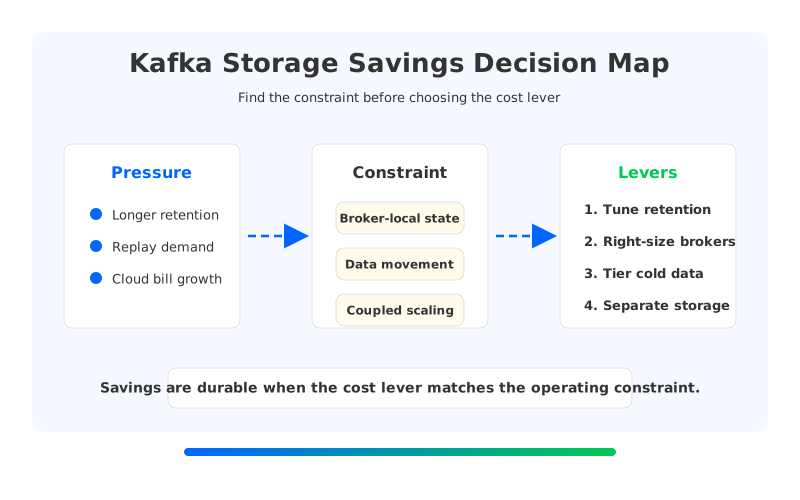
The useful question is not "How do we make Kafka storage cost less?" It is "Which part of the Kafka operating model forces us to buy storage before we need it, move data when we scale, and treat retention as a broker-local capacity problem?" Once storage savings are framed that way, the options become clearer.
1Why Teams Search for kafka storage savings
Kafka retention is attractive because it gives teams operational breathing room. A longer log means consumers can recover after downstream incidents, batch jobs can replay data, and platform teams can support new use cases without asking every producer to resend historical events. It is also one of Kafka's most visible cost multipliers because it accumulates quietly. A topic that looked harmless at 24 hours can become a different system at 7 days.
The mistake is treating this as a pure storage pricing exercise. Storage media matters, but Kafka's storage cost is shaped by several linked decisions:
- Replication policy. A production Kafka cluster commonly stores multiple copies of each record for fault tolerance. That improves availability, but it also turns every additional hour of retention into multiple hours of physical storage.
- Broker-local ownership. Traditional Kafka brokers own partition data on local or attached disks. When capacity shifts, data often has to move with the partition assignment.
- Scaling granularity. Compute, network, and storage are bought together at the broker level. If one dimension is short, the team may over-provision the others.
- Cloud topology. Multi-AZ clusters improve resilience, but replication and recovery traffic can become recurring cost.
This is why "buy lower-cost disks" only solves a slice of the problem. It can reduce the unit price of stored data, but it does not remove the coupling between retained data and broker operations.
2The Production Constraint Behind the Problem
Traditional Kafka was designed around a shared-nothing model: each broker stores its own log segments, serves reads from that local data, and participates in replication with other brokers. In a data center, that model was pragmatic. Local disks were fast, network accounting was different, and the operational goal was to build a distributed log out of machines that each owned a clear piece of the state.
Cloud infrastructure changes the economics. Durable object storage is elastic and paid by usage. Compute can be added and removed quickly. Availability zones make failure isolation part of the default architecture. Kafka's broker-local storage model can run well in that environment, but it inherits a mismatch: cloud resources scale independently, while traditional Kafka ties compute and storage together inside the broker.
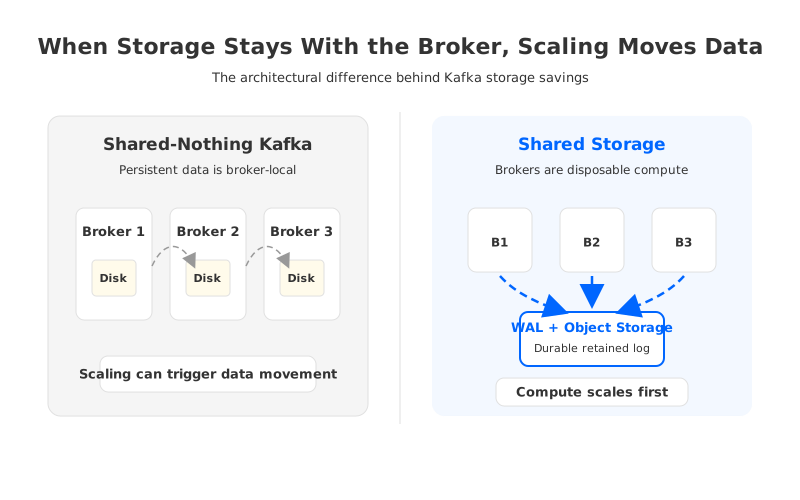
That mismatch shows up during normal production events. A team increases retention and exhausts broker disk before CPU. Another team adds brokers for throughput and then waits while partitions rebalance across disks. A platform team wants to use lower-cost ephemeral compute for elasticity, but persistent partition state keeps brokers from being disposable. These problems do not mean Kafka is broken. They mean storage architecture is carrying responsibilities that now belong to the cloud substrate.
Tiered storage improves part of this picture by moving older log segments to remote storage while retaining local broker storage for hot data. For clusters where the main problem is long historical retention, that can be meaningful. The boundary is still important: tiered storage does not make brokers stateless, and it does not erase the need to reason about hot local capacity, partition placement, and recovery behavior. Treat it as an optimization to a stateful design, not as the same thing as shared storage.
3Architecture Options and Trade-Offs
Kafka storage savings usually fall into four architectural paths. Each can be right, but each saves money in a different way and moves risk to a different place.
| Option | Where Savings Come From | What to Watch |
|---|---|---|
| Retention tuning | Reducing stored bytes and topic sprawl | Shorter replay window, more pressure on downstream recovery |
| Broker right-sizing | Better matching disk, CPU, and network to workload | Capacity work repeats as workloads change |
| Tiered storage | Moving older segments to lower-cost remote storage | Hot tier still matters; operational model remains stateful |
| Shared storage with stateless brokers | Decoupling retained data from broker-local disks | Requires careful compatibility, latency, and migration validation |
Retention tuning is the fastest lever because it does not require a new architecture. It is also the lever most likely to create hidden risk. If a consumer group is down for longer than the retention window, the storage saving becomes an incident. Shorten retention only after mapping recovery time objectives and replay requirements by topic class.
Broker right-sizing is more durable, but it depends on discipline. Teams need to separate write-heavy topics, read-heavy topics, compacted topics, and long-retention topics instead of treating the cluster as one pool. They also need to revisit the decision whenever traffic shape changes.
Tiered storage is strongest when cold retention dominates the bill and the hot working set is predictable. It lets teams keep more historical data without placing all of it on the primary broker disk. Recovery, cold-read latency, and tooling still need explicit testing because a rarely read archive topic behaves differently from a topic that triggers large incident replays.
Shared storage changes the question more fundamentally. Instead of asking how much data each broker should own, the design asks whether durable log data should be bound to brokers at all. That is the architectural shift behind diskless or Kafka-compatible systems with Stateless brokers: brokers handle compute and protocol work, while durable storage lives in an object-storage-backed layer with a write-ahead log for the immediate write path.
4Evaluation Checklist for Platform Teams
Storage savings become credible when they survive operational review. A platform team should be able to explain not only the expected cost reduction, but also what happens during broker failure, large replay, rollback, and sudden retention growth.
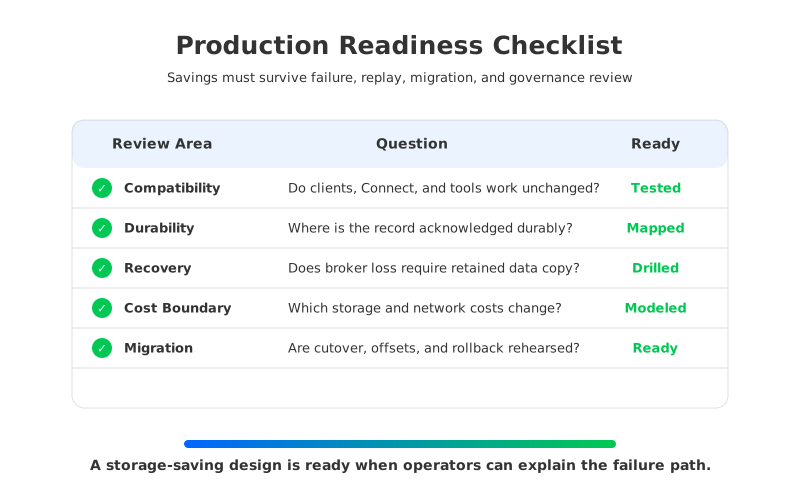
Use the checklist as a forcing function:
- Compatibility. Can existing producers, consumers, Kafka Connect jobs, Kafka Streams applications, Schema Registry integrations, and observability tools keep working without application rewrites?
- Durability path. Where is a produced record durably acknowledged? Is the hot write path clear, and is the relationship between WAL, local disk, and object storage documented?
- Recovery behavior. After broker loss, does recovery require copying retained data back to a replacement broker, or can another broker resume ownership through metadata and Shared Storage architecture?
- Cost boundary. Which costs are reduced: block storage, over-provisioned broker capacity, cross-AZ replication traffic, operational labor, or all of the above?
- Governance. Where do event data, metadata, encryption keys, logs, and diagnostics live? This matters for BYOC, private deployment, and regulated workloads.
- Migration safety. Can the team test offset preservation, cutover, rollback, and consumer lag behavior before the storage architecture changes under production traffic?
This checklist prevents a common failure mode: celebrating storage unit-price savings while ignoring the operating model that made the original bill high. If the new design makes replay, migration, or incident response harder, the savings are fragile.
5How AutoMQ Changes the Operating Model
Once the evaluation reaches architecture instead of price, AutoMQ becomes relevant as a Kafka-compatible cloud-native streaming system built around Shared Storage architecture and Stateless brokers. The architectural claim is narrow: if the cost problem is caused by broker-local persistent state, separating compute from durable storage attacks the cause instead of trimming around it.
AutoMQ keeps the Kafka protocol and ecosystem compatibility while changing the storage layer underneath. Brokers are designed to be stateless from the perspective of durable log ownership. Incoming records go through a WAL path for immediate durability and are then organized into object storage. Because retained data is not tied to local broker disk, scaling and recovery can become metadata and compute orchestration problems instead of bulk data movement projects.
That distinction matters most where retention and elasticity collide. In a traditional design, adding brokers for throughput can trigger partition data movement. In a shared-storage design, adding brokers increases compute capacity without requiring the retained log to be copied first. Broker replacement also stops being the same as rebuilding a local disk that contains the durable truth.
The cost implication has several layers:
| Cost Driver | Traditional Pressure | Shared-Storage Effect |
|---|---|---|
| Retained bytes | Replicated across broker-local storage | Stored in object storage as the durable capacity layer |
| Elastic scaling | Storage moves with partition ownership | Brokers can scale around shared durable data |
| Multi-AZ traffic | Replication and recovery can create recurring data movement | Architecture can reduce Kafka replication paths across zones in supported deployments |
| Headroom | Disk, CPU, and network often over-provisioned together | Compute and storage can be planned separately |
The most important word in that table is "can." Architecture creates the possibility of savings; production design determines whether those savings hold. Workload shape, region, object storage pricing, WAL choice, read fanout, partition count, and operational policies still matter. Benchmark representative produce latency, replay, failure recovery, and migration behavior before treating any TCO estimate as final.
6A Practical Migration Path
Changing storage architecture is not the first move. First, identify which topics create the pressure. Some clusters have a few retention-heavy topics that can be isolated. Others have many medium-sized topics whose cost comes from replication and headroom. The migration plan should follow the cost anatomy.
Start with an inventory that separates topics by retention, daily ingress, read fanout, compliance requirements, and consumer recovery tolerance. Then map each class to a target architecture. Transactional streams may care most about latency and compatibility. Audit or observability streams may care more about retention economics and replay. Analytics streams may care about cold-read throughput.
For a Kafka-compatible migration, offset behavior deserves special attention. Consumers do not care that the storage architecture is elegant if cutover forces every group to reset positions manually. Test representative consumer groups, long-running processors, connector jobs, and rollback. The safest storage-saving project is one where application teams barely notice the infrastructure changed.
Procurement should also join the technical evaluation early. Kafka storage savings touch cloud bills, managed-service boundaries, security ownership, and operational labor. A BYOC or private deployment model can be attractive when the organization wants managed operations but needs event data, object storage, and network paths to remain inside its own cloud account.
7Decision Matrix: When Storage Savings Require Architecture Change
Retention tuning is enough when the team can reduce data volume without weakening recovery or compliance. Tiered storage is worth evaluating when cold historical data dominates the bill and the team accepts a stateful broker model for the hot path. Shared Storage architecture becomes more compelling when broker-local state slows scaling, recovery, and capacity planning.
Here is a simple decision rule:
| Signal | Likely Next Step |
|---|---|
| Disk growth is isolated to a few topics | Revisit topic retention, compaction, and ownership |
| Cold data dominates but hot traffic is stable | Evaluate tiered storage with replay tests |
| Brokers are over-provisioned because storage, CPU, and network scale together | Evaluate compute-storage separation |
| Rebalancing and recovery windows are now operational risk | Evaluate stateless broker architecture |
| Governance requires customer-controlled data plane | Evaluate BYOC or self-managed deployment boundaries |
The point is to make storage savings an architecture review instead of a discount hunt. The more Kafka becomes shared infrastructure, the more expensive it is to optimize one dimension while leaving the operating model untouched.
If your team is already at the point where retention decisions affect scaling windows, failure recovery, and cloud cost reviews, evaluate the architecture before the next storage purchase. AutoMQ's documentation explains how its Kafka-compatible Shared Storage architecture works and how it differs from Apache Kafka tiered storage. To explore the product path, start with AutoMQ and validate the model against your own workload.
8References
- Apache Kafka documentation
- Apache Kafka KIP-405: Kafka Tiered Storage
- AWS S3 storage classes
- AutoMQ overview
- AutoMQ compatibility with Apache Kafka
- AutoMQ and Apache Kafka tiered storage
- AutoMQ migration overview
- AutoMQ cross-AZ traffic cost guidance
9FAQ
9.1What is the fastest way to reduce Kafka storage cost?
The fastest lever is usually retention cleanup: remove unused topics, shorten retention where recovery requirements allow it, and separate compacted or audit topics from high-throughput operational streams. That should be done with consumer recovery windows and compliance requirements in hand. Cutting retention without checking replay needs can turn a cost project into an outage risk.
9.2Is Kafka tiered storage the same as shared storage?
No. Tiered storage moves older data to remote storage while retaining a stateful broker model for hot data and partition ownership. Shared storage designs make durable log data independent from broker-local disks, usually with a WAL path for immediate durability and object storage as the retained capacity layer. Both can reduce storage pressure, but they change operations in different ways.
9.3When should a team evaluate stateless Kafka-compatible brokers?
Evaluate stateless brokers when storage cost is tied to scaling friction, long rebalancing windows, broker recovery work, or over-provisioned capacity. If the main issue is only a few over-retained topics, tuning may be enough. If the issue is the coupling of compute and storage across the platform, architecture change deserves a serious test.
9.4How should we validate Kafka storage savings before migration?
Use a representative workload, not a synthetic best case. Test produce latency, consumer replay, connector behavior, failure recovery, offset preservation, rollback, cold reads, and cloud cost under your expected retention period. Storage savings are credible only when the operational model survives those tests.


