
Table of Contents
Table of Contents
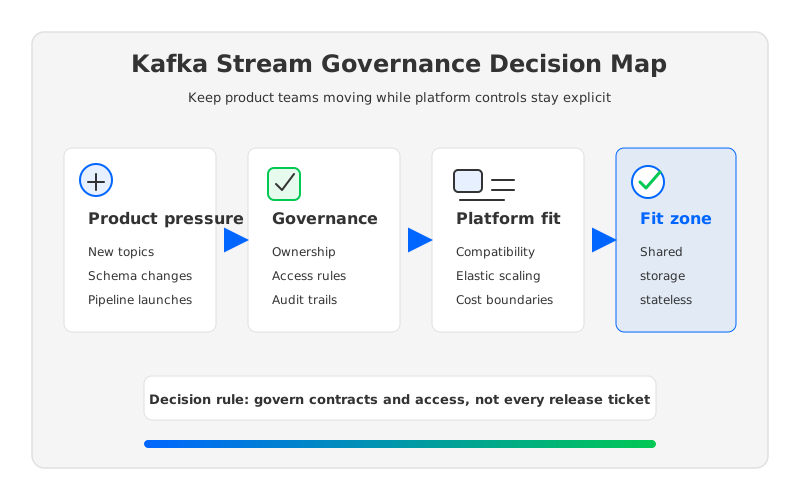
Kafka stream governance usually becomes visible at the worst possible moment: a product team needs a topic today, compliance needs proof of access control, and the platform team is already managing broker capacity, schema changes, consumer lag, and cost reviews. Nobody wants a central committee for every event stream, but nobody wants unowned topics, incompatible records, or data kept forever because deletion has no owner.
The hard part is applying controls without turning Kafka into a ticket queue. Most teams can name what they want: ownership, contracts, access, retention, auditability, migration safety, and accountability. When every topic request, ACL change, connector rollout, or partition change waits on a small platform team, product teams work around the process, and the platform loses visibility.
The useful question is architectural: which decisions should be governed centrally, delegated to domain teams, or made easier by the streaming platform itself? A mature Kafka governance model creates boundaries where teams can move quickly inside a safe operating envelope.
1Why Teams Search for Kafka Stream Governance
Searches for kafka stream governance usually come from teams that have outgrown informal Kafka operations. In the early phase, a few engineers can remember why each topic exists, who owns a consumer group, and which service can write to which stream. That memory does not survive a larger platform. Once Kafka supports payments, observability, customer profiles, fraud detection, logistics, machine learning features, and internal analytics, the cluster becomes a shared production substrate.
At that point, governance failures look like production incidents. A producer changes an event field and downstream consumers break. A topic grows faster than expected because retention was copied from another workload. A connector leaks data across an environment boundary. A consumer group falls behind, but no one knows whether the lag is acceptable because no service-level objective was attached to the stream. These are operational facts with customer impact.
Kafka stream governance has to connect four layers that are often managed separately:
- Data contracts: event names, schemas, compatibility rules, ownership, retention, and classification.
- Access control: producer permissions, consumer permissions, service identities, environment boundaries, and audit trails.
- Platform operations: partition count, replication behavior, broker capacity, scaling, recovery, cost allocation, and observability.
- Change management: migration plans, rollback paths, connector lifecycle, stream processing dependencies, and consumer offset handling.
The coordination cost is the problem. If every layer requires a different workflow, the platform team becomes the narrowest part of the system. If every layer is delegated without guardrails, the shared Kafka estate becomes difficult to reason about.
2The Governance Pressure Behind Shared Streaming Platforms
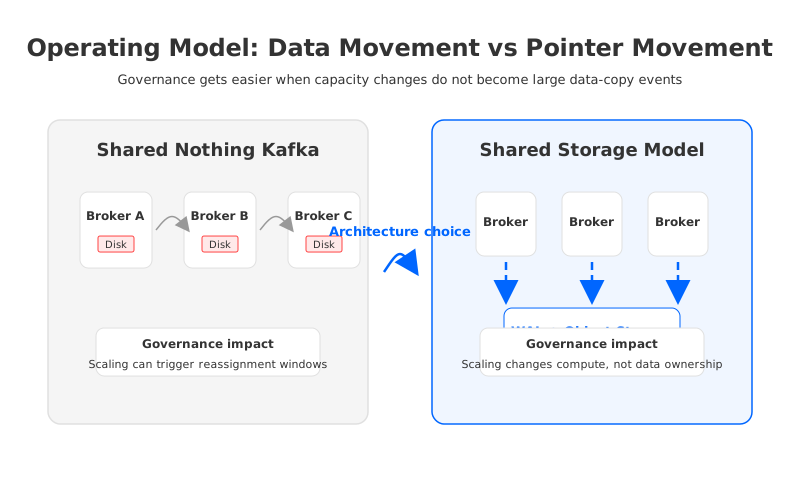
Traditional Kafka was designed around brokers that own local log storage. That design is powerful and well understood, but it shapes governance in ways that are easy to overlook. A topic is not only a logical contract; it also consumes broker disk, broker network, controller metadata, replication bandwidth, page cache, and operational attention. A retention decision is not only a data lifecycle decision; it changes how much storage must be provisioned and how much work a broker must do during recovery.
This is why governance and capacity planning become entangled. A platform team may want self-service topic creation, but self-service is risky when every additional topic can change disk pressure, partition distribution, replication traffic, and reassignment behavior. Retention classes are also hard to enforce when storage growth forces emergency broker expansion before policy review catches up.
The operating model gets especially tight during change. Partition reassignment, broker replacement, cluster expansion, and retention updates can all involve data movement. Even when the tools are mature, the team has to plan the window, watch throttles, monitor lag, and preserve rollback options. Governance becomes conservative because every structural change carries operational side effects.
That does not mean traditional Kafka is wrong. It means a governance program built on Kafka has to account for the physical behavior underneath logical streams. A topic catalog that ignores broker capacity is incomplete. An access workflow that ignores data residency is incomplete. A schema registry that ignores rollback behavior is incomplete. Kafka governance is both data governance and infrastructure governance.
3Contracts, Ownership, Access, and Audit Trade-Offs
The first layer to get right is stream ownership. Every topic should have an owning team, a business purpose, a retention class, a data classification, a schema or payload contract, and an operational contact. These fields sound bureaucratic until the first incident where a downstream system breaks and nobody knows who can approve a rollback. Ownership is the smallest useful unit of governance because it turns a nameless stream into an accountable interface.
Access control should follow ownership rather than organizational hierarchy. Producers need write permission because they own the event source, not because their department requested broad access. Consumers need read permission because they serve a declared use case, not because the data happens to be available. Kafka ACLs, identity providers, network boundaries, and approval systems can enforce access, but the durable record should explain why a service has access, not merely that it has access.
Schema governance has a similar trade-off. Strict compatibility checks protect downstream consumers, but overly rigid workflows encourage teams to bypass shared infrastructure. A practical model separates the contract surface from the release process. Platform teams define compatibility modes, naming standards, subject ownership, and review rules for sensitive data. Product teams still control the pace of their own releases as long as they stay within those rules.
The same principle applies to topic lifecycle management. A central team can define approved retention classes, compaction patterns, encryption requirements, and deletion workflows. Domain teams can choose the class that fits their workload. The platform should then make drift visible: topics without owners, inactive consumers, unreviewed breaking schema changes, and streams whose actual retention or throughput no longer matches policy.
Governance works when it is expressed as a set of product-grade interfaces:
| Governance area | Central platform decision | Delegated team decision |
|---|---|---|
| Topic creation | Naming rules, required metadata, default quotas | Business purpose, event contract, retention class |
| Access | Identity model, audit requirements, sensitive data rules | Which approved services need producer or consumer rights |
| Schema | Compatibility policy, review triggers, registry standards | Field evolution within the approved compatibility mode |
| Operations | SLO classes, observability baseline, cost allocation model | Workload criticality, alert routing, release timing |
| Migration | Cutover gates, rollback requirements, offset handling policy | Workload sequencing and validation ownership |
The table also shows why tooling alone is not enough. A topic catalog, schema registry, ACL workflow, and CI policy can enforce many decisions, but they cannot compensate for a platform that makes every capacity change painful. If stream changes keep turning into broker-level risk, governance will drift back toward manual review.
4Evaluation Checklist for Platform Teams
A useful Kafka stream governance architecture starts with failure modes, not feature names. What happens when a team creates a topic with the wrong retention class? What happens when an event contract breaks compatibility? What happens when regulated data is consumed from a non-approved environment? What happens when a broker fails during a migration, a connector replays data, or a consumer group has to be moved?
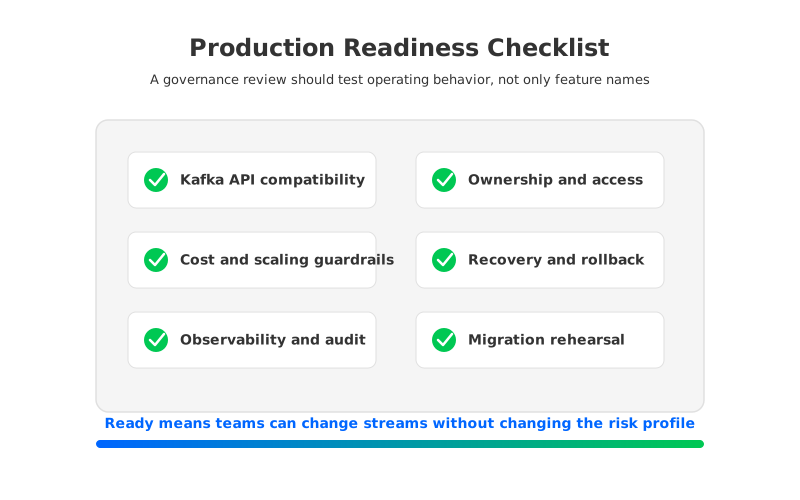
These questions should be tested against the platform, not left in a policy document. A governance-ready Kafka environment should give platform owners clear answers in six areas.
First, compatibility must be real enough for existing clients, tools, stream processors, and connectors. Kafka is an ecosystem as much as a broker protocol. Governance programs often depend on Admin APIs, consumer groups, offsets, transactions, Kafka Connect, schema registries, and monitoring integrations. If a Kafka-compatible platform changes semantics in one area, the governance model has to account for the difference.
Second, access and audit workflows need stable identities. Service accounts, ACLs, network policies, private connectivity, and approval records should line up. The goal is to answer a concrete audit question: which service consumed which class of data, through which path, under which approval, and who owns that decision?
Third, scaling should not punish compliant teams. If a domain team follows the approved topic process but still has to wait through a long storage rebalance whenever throughput grows, the platform has turned governance into a deployment bottleneck. Capacity policy should include guardrails, but the infrastructure should make the common path fast.
Fourth, cost allocation must be visible at the stream or workload level. Without cost feedback, teams treat Kafka as a shared black box. With cost feedback, retention, fan-out, replay, connector behavior, and idle topics become design choices that product owners can discuss with platform engineers.
Fifth, recovery and rollback need rehearsal. Stream governance is not credible until teams know how to reverse a bad schema change, stop an unauthorized producer, replay a connector safely, or migrate a workload without losing offset meaning.
Sixth, observability should connect policy to runtime. Broker CPU, disk, and network dashboards are necessary, but they do not answer governance questions by themselves. Reviewers also need ownership, data classification, SLO class, schema status, access state, consumer lag, and cost signals.
5How AutoMQ Changes the Operating Model
Once the governance problem is framed this way, the architecture requirement becomes clearer. The platform should preserve Kafka semantics for applications while reducing the amount of broker-local state that platform teams have to manage during scaling, recovery, and cost control. This is where shared-storage Kafka-compatible architectures become relevant.
AutoMQ is a Kafka-compatible cloud-native streaming system that keeps the Kafka protocol surface familiar while moving durable stream storage away from broker-local disks and into shared object storage. In this model, brokers behave more like stateless compute nodes over durable shared storage, with a write-ahead log path used to support low-latency writes before data is persisted in the storage layer. The governance implication is not that operations disappear. The implication is that common operations move away from large broker-to-broker data movement.
That shift matters for platform governance. Compute capacity can be treated separately from retained data. Broker replacement becomes less coupled to copying local log segments. Partition balancing can focus more on workload placement and less on moving durable bytes between brokers. Cost review can separate compute, storage, network, and managed service dimensions instead of hiding them inside a single broker fleet.
The benefit is strongest when the team already has a governance model but struggles to keep it ergonomic. A topic approval workflow still needs ownership fields and access review. A schema policy still needs compatibility rules. A regulated environment still needs private networking, encryption, audit, and data residency controls. Shared storage does not remove those responsibilities; it makes the platform layer less likely to turn each governed change into a heavy infrastructure event.
Kafka stream governance should never be reduced to a vendor feature checklist. Ask whether the platform supports the controls you need, then ask whether its operating model makes those controls usable at product-team speed. AutoMQ belongs in that evaluation when your requirements include Kafka compatibility, customer-controlled deployment boundaries, elastic compute, object-storage-backed durability, and fewer broker-local storage operations.
6A Practical Rollout Pattern
The safest rollout pattern is to start with governance metadata before changing runtime behavior. Build the topic catalog, retention classes, access review workflow, and schema rules around the Kafka estate you already run. Then pick workloads that expose different risks: one high-throughput topic, one regulated stream, and one connector-heavy pipeline.
For each workload, write down the controls and the operating events that test those controls. A high-throughput topic tests scaling and cost allocation. A regulated stream tests access, audit, and data residency. A connector-heavy pipeline tests replay, offsets, failure handling, and ownership across systems. This is better than a generic bake-off because it reflects how teams actually use Kafka.
During the evaluation, keep the scorecard small enough to act on:
- Can existing producers, consumers, connectors, and stream processors keep their expected Kafka behavior?
- Can a team request or modify a stream through a self-service workflow without bypassing governance metadata?
- Can platform engineers scale or replace capacity without turning every change into a long data movement plan?
- Can auditors trace ownership, access, data class, and runtime activity from the same control model?
- Can FinOps teams see retention, fan-out, and throughput cost drivers by workload?
- Can a migration be rehearsed with rollback and consumer progress preserved?
If your Kafka estate is already at the point where governance tickets slow product releases, the next step is not another policy meeting. Test the operating model. Start from the streams that create the most friction, map their contracts and controls, then compare how different Kafka-compatible architectures behave under scaling, recovery, and migration. To evaluate AutoMQ in that frame, use the AutoMQ console entry point and bring one real workload profile rather than a synthetic hello-world topic.
7References
- Apache Kafka documentation
- Apache Kafka producer configuration
- Apache Kafka consumer configuration
- Apache Kafka Connect documentation
- Apache Kafka KRaft documentation
- KIP-405: Kafka Tiered Storage
- Amazon S3 User Guide
- AutoMQ Kafka compatibility
- AutoMQ Continuous Self-Balancing
- AutoMQ Diskless Engine
- AutoMQ BYOC Kafka
- AutoMQ GitHub repository
8FAQ
8.1What is Kafka stream governance?
Kafka stream governance is the set of controls that makes event streams accountable in production. It covers topic ownership, schema compatibility, access control, retention, data classification, auditability, cost visibility, operational SLOs, and migration safety. The goal is not to centralize every release decision. The goal is to let teams ship within clear boundaries.
8.2How is Kafka stream governance different from schema governance?
Schema governance focuses on event structure and compatibility. Kafka stream governance includes schemas, but it also covers who owns a topic, which services can produce or consume, how long data is retained, how costs are allocated, how incidents are handled, and how migrations or rollbacks are performed.
8.3Should product teams be allowed to create Kafka topics themselves?
Self-service topic creation can work when the platform requires ownership metadata, approved retention classes, naming rules, access review, quota controls, and observability from the start. Without those guardrails, self-service often creates hidden operational debt. With them, it can reduce queueing and keep platform teams focused on higher-risk changes.
8.4Where does AutoMQ fit in a governance strategy?
AutoMQ fits when a team wants Kafka-compatible behavior while changing the storage and scaling model underneath the broker layer. Its shared-storage architecture can reduce the operational weight of broker-local data movement, which helps governance workflows stay practical as teams scale topics, retention, and workloads.
8.5What should be tested before changing Kafka infrastructure?
Test existing clients, Admin API behavior, consumer groups, offsets, schema rules, connector behavior, network boundaries, access controls, observability, cost reporting, migration sequence, and rollback. The test should use at least one real workload profile because governance risks usually appear in ownership, replay, scaling, and operational handoff details.


