
Table of Contents
Table of Contents
Someone searching for kafka tco assumptions is usually past the first Kafka success story. The platform works, teams depend on it, and the next budget review has stopped treating the cluster as a small infrastructure line item. Broker count, disk headroom, replication, retention, cross-zone traffic, monitoring, upgrades, and migration risk have started to move together. The hard question is no longer "What does a broker cost?" It is "Which assumptions are we making before we scale this system again?"
That distinction matters because Kafka cost is not a static bill. It is the financial expression of an architecture. A cluster with local broker storage turns partition placement, replication factor, retention, and failure recovery into capacity commitments. A platform team can tune each knob, but the knobs are connected. Reducing disk headroom can increase incident risk. Shortening retention can push replay cost into another system. Adding brokers can reduce pressure on one metric while increasing network paths, monitoring load, and operational surface area.
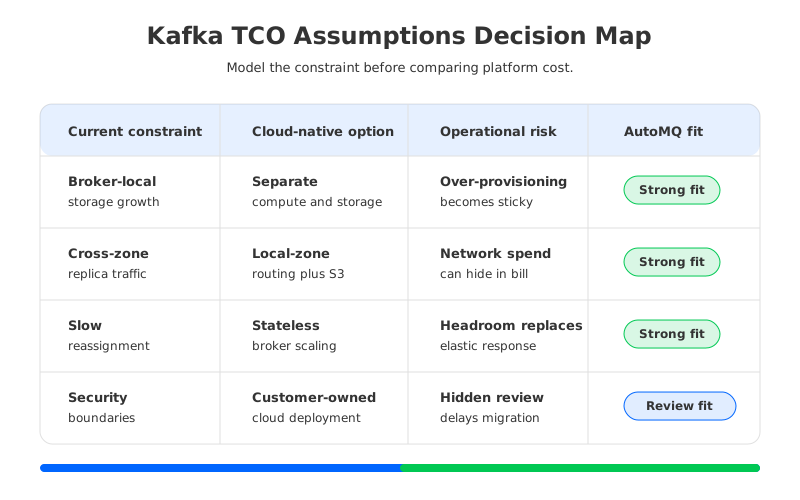
A useful TCO model starts by making those assumptions explicit. It should let FinOps, SRE, platform engineering, architecture, and procurement discuss the same system without collapsing the conversation into a vendor quote or a per-node spreadsheet.
1Why teams search for kafka tco assumptions
Most Kafka estates reach a point where historical growth is a poor guide for the next scaling decision. The first clusters may have been sized around known workloads: telemetry, transactional events, CDC pipelines, or analytics feeds. After Kafka becomes a shared service, the workload mix changes. More teams ask for longer retention, more consumer groups, more environments, and stricter recovery expectations.
The visible bill usually trails the architecture decision that created it. A finance team may see compute, block storage, data transfer, marketplace fees, support, and observability as separate categories. The Kafka team sees a single operational reality: partitions need leaders, leaders need resources, replicas need movement, consumers need stable offsets, and incidents need recovery room. Apache Kafka's own model reinforces this connection. Topics are split into partitions, consumers track progress by offset, and Consumer groups coordinate partition ownership so applications can scale consumption without losing position.
The first TCO assumption, then, is not a price. It is the unit of ownership. If durable data is owned by brokers, cost follows brokers. If durable data can be owned by a shared storage layer, cost can follow workload and retention more directly. That is the architectural fork most spreadsheet models hide.
2The production constraint behind the problem
Traditional Kafka uses a Shared Nothing architecture. Each broker manages local storage, and the cluster uses leader/follower replication to keep data available. This design made sense in environments where local disks were the primary durable medium and machine-to-machine replication was part of the application architecture. In cloud environments, the same design turns local storage and network movement into recurring infrastructure assumptions.
Four assumptions deserve special scrutiny before another capacity increase:
- Broker-local storage is a capacity floor. Each broker needs enough persistent storage for assigned partitions, replicas, retention, compaction, and recovery headroom. When workloads are uneven, the worst-placed partitions influence the whole cluster sizing plan.
- Replication is also a network model. Multi-Availability Zone deployments improve resilience, but inter-zone movement can become a major cost driver. AWS describes data transfer between Availability Zones in the same Region as a distinct charge category, so architecture determines whether Kafka creates that traffic.
- Scaling is more than adding nodes. When partitions are tied to broker-local data, scaling often involves reassignment, balancing, throttling, and careful timing. The operational cost shows up as engineering attention before it appears as cloud spend.
- Retention changes recovery economics. Longer retention may be required for replay, audits, or downstream recovery. In a local-storage-first model, the retention decision expands broker disk, compaction work, and rebalance risk unless remote storage changes the layout.
This is why generic "reduce Kafka cost" advice can disappoint. It may tell teams to right-size instances, tune retention, or compress records, all of which can help. But those tactics do not answer whether the architecture forces the team to buy capacity in the wrong unit.
3Architecture options and trade-offs
Kafka teams usually evaluate three broad paths before scaling: optimize the current cluster, adopt Tiered Storage, or move to a Kafka-compatible platform with a different storage architecture. Each path can be reasonable. The mistake is comparing them as if they change the same assumptions.
Optimizing the current cluster keeps the operational model familiar. Teams can adjust partition counts, instance families, retention policies, compaction settings, client batching, quotas, and rack awareness. This is the lowest-disruption path and often the right first move. Its limit is structural: durable data still lives with brokers, so capacity, failure recovery, and reassignment remain tied to local state.
Tiered Storage changes part of the storage cost curve by moving older log segments to remote storage while keeping the active log on brokers. It can help when long retention is the main pressure. It does not automatically make brokers stateless. Hot data, leader placement, ISR behavior, and operational balancing still matter. For TCO modeling, Tiered Storage should be treated as a retention optimization, not as a complete separation of compute and storage.
A Shared Storage architecture changes the ownership model. Persistent stream data is stored in a shared object storage layer, while brokers focus on Kafka protocol handling, leadership, caching, and request processing. This is a larger architectural change, so it deserves a stricter compatibility and migration review. The benefit is that scaling compute no longer has to mean moving the same volume of durable partition data between brokers.
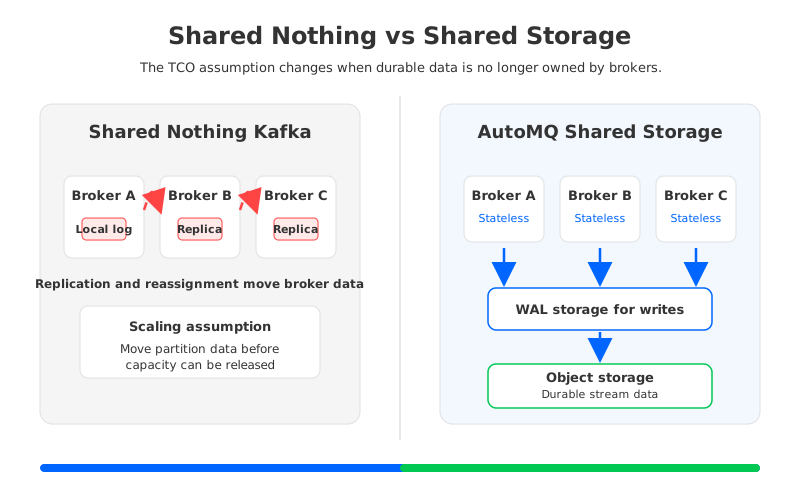
The trade-off is not "legacy versus replacement." It is "which constraints should remain in the broker?" If the team needs minimal change and the growth curve is moderate, tuning may be enough. If long retention is the largest issue, Tiered Storage may be the right incremental step. If elastic capacity, cross-zone traffic, reassignment time, and storage growth are active problems together, the model should include a Shared Storage option.
4Evaluation checklist for platform teams
A credible Kafka TCO review should separate workload assumptions from platform assumptions. Workload assumptions describe what the business needs. Platform assumptions describe how the infrastructure satisfies those needs. Mixing the two creates false savings, because it quietly changes service expectations while pretending to compare architecture.
Use this checklist before building the financial model:
| Area | Question to answer | Why it changes TCO |
|---|---|---|
| Compatibility | Which Kafka client versions, Connect workers, Streams apps, transactions, and admin tools must keep working? | Migration cost rises when application behavior changes. |
| Storage | What retention, replay, compaction, and audit windows are required? | Storage architecture determines whether retention expands broker capacity. |
| Network | Which traffic crosses Availability Zones, VPC boundaries, PrivateLink endpoints, or regions? | Network topology can be as important as broker sizing. |
| Elasticity | How fast must the platform react to workload bursts, broker failures, or tenant growth? | Slow reassignment encourages permanent headroom. |
| Operations | Who handles upgrades, balancing, incident response, quota changes, and capacity reviews? | Human time is part of TCO even when it is not in the cloud bill. |
| Governance | Where must data, metadata, control access, logs, and metrics reside? | Deployment boundaries can rule out otherwise attractive options. |
| Migration | What is the rollback path if latency, compatibility, or cost assumptions are wrong? | Reversibility reduces decision risk. |
The table is intentionally practical. A procurement team may care about annual commitment and support terms, but those terms sit on top of these engineering facts. A platform that looks cost-effective in a quote can become expensive if it forces client rewrites, weakens rollback, or moves data outside the boundary required by security review.
5How AutoMQ changes the operating model
Once the neutral model is clear, AutoMQ becomes relevant as a Kafka-compatible streaming platform built around Shared Storage architecture. It keeps Kafka protocol semantics for existing clients and ecosystem tools, while replacing broker-local persistent storage with S3Stream, WAL (Write-Ahead Log) storage, Data caching, and S3-compatible object storage.
The important TCO change is not a discount line. It is a different set of assumptions:
- Compute and storage scale independently. Brokers handle compute responsibilities, while durable data lives in shared storage. This makes broker count a response to traffic, not a proxy for retained bytes.
- Stateless brokers reduce reassignment weight. When persistent data is not bound to a broker's local disk, adding, replacing, or removing brokers does not require the same kind of bulk partition data movement.
- WAL storage absorbs the write path. AutoMQ uses WAL storage for durable low-latency writes and recovery buffering, then stores data in object storage. The right WAL type depends on product form, cloud environment, and latency requirements, so the TCO model should name the WAL assumption explicitly.
- Zero cross-AZ traffic is an architectural target. AutoMQ documentation describes local-zone routing and shared storage patterns that avoid inter-broker replica replication and reduce cross-zone read/write paths. Teams should still validate cloud routing, client configuration, and monitoring in their own environment.
- Customer-controlled boundaries remain part of the design. AutoMQ BYOC runs the control plane and Data plane in the customer's cloud account or VPC, while AutoMQ Software targets private environments. That matters when governance is as important as cost.
This does not remove the need for TCO modeling. It changes the model's center of gravity. Instead of asking how many brokers must be kept alive to protect local disks, the team can ask how much compute is needed for current traffic, how much shared storage is needed for retention, and which WAL option fits latency and recovery requirements.
6A readiness scorecard before the next scale event
Model Kafka TCO assumptions before the next emergency scale-out. Another practical window is before a renewal, migration, or retention change. The goal is not to make every team migrate. The goal is to prevent hidden assumptions from becoming expensive commitments.
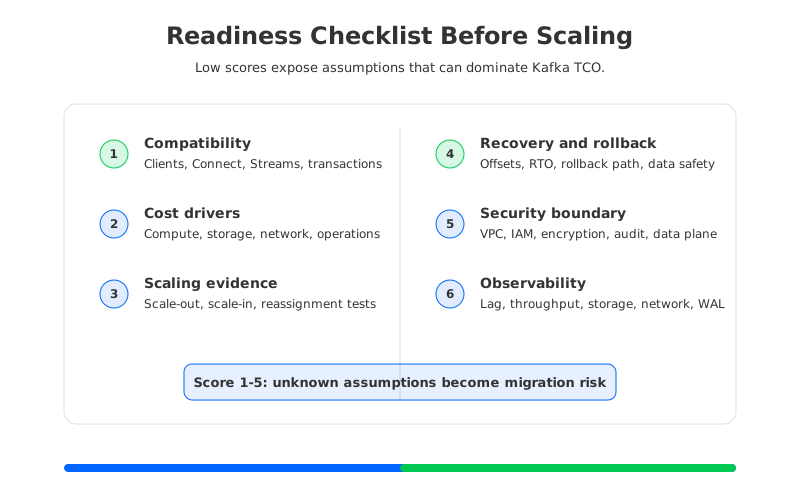
Score each item from 1 to 5, where 1 means "unknown or untested" and 5 means "measured, owned, and reviewed." Low scores do not automatically imply a platform change. They tell you where the current TCO model is guessing.
- Compatibility inventory. Client versions, transactional producers, Consumer groups, Connectors, Streams jobs, ACLs, quotas, and admin workflows are documented.
- Cost driver map. Compute, broker storage, object storage, network paths, observability, support, and engineering operations are modeled separately.
- Elasticity evidence. The team has measured scale-out, scale-in, broker replacement, and partition balancing behavior under realistic workload.
- Failure recovery plan. Recovery time, data durability, offset continuity, and rollback behavior are tested, not assumed.
- Governance boundary. Data plane location, control access, logs, metrics, encryption, IAM, and audit requirements are reviewed with security stakeholders.
- Migration runway. The team knows which topics move first, which applications can tolerate dual-write or replay, and how to stop the migration if assumptions fail.
If the scorecard exposes uncertainty, resist the urge to average it away. A single weak assumption can dominate the economics. For example, an optimistic network assumption can erase expected savings. An incomplete compatibility inventory can turn a clean infrastructure migration into an application project. A vague rollback plan can force teams to keep two systems running longer than planned.
Kafka TCO assumptions are useful because they make these trade-offs visible before the bill arrives. If your next scaling decision is forcing broker count, storage growth, and cross-zone traffic to rise together, evaluate whether the architecture still matches the cloud environment you are paying for. To test a Kafka-compatible Shared Storage path, explore AutoMQ through the product walkthrough at go.automq.com/home.
7FAQ
7.1What are Kafka TCO assumptions?
Kafka TCO assumptions are the workload, architecture, cloud, governance, and migration inputs used to estimate the total cost of running Kafka. They include broker compute, storage, replication, network paths, retention, operations, support, and risk buffers.
7.2Is broker count enough for a Kafka TCO model?
No. Broker count is visible, but it does not capture retained data, cross-zone traffic, operational labor, observability, support, migration work, or failure recovery requirements. A useful model separates these drivers before comparing platforms.
7.3Does Tiered Storage make Kafka brokers stateless?
No. Tiered Storage can move older log segments to remote storage, but brokers still manage active local log data and operational balancing. Treat it as a retention optimization unless the platform's architecture fully separates durable storage from brokers.
7.4When should AutoMQ be evaluated?
Evaluate AutoMQ when Kafka compatibility is required and the current cost pressure comes from broker-local storage, slow reassignment, cross-zone traffic, long retention, or permanent capacity headroom. It should be compared after the team documents compatibility, governance, and migration requirements.


