
Table of Contents
Table of Contents
The Kafka budget review usually begins with a number everyone can see: broker count. Finance asks why the cluster needs so many instances. Procurement compares the renewal quote with last year's run rate. Platform engineering explains peak throughput, retention, replication, and failure headroom. The conversation stalls because each group sees a different slice of the same system.
Broker count matters, but it is not Kafka TCO. A Kafka cluster converts workload choices into recurring infrastructure cost, storage footprint, replication traffic, data transfer, operational labor, incident risk, and migration tradeoffs. Some costs appear directly in a cloud bill. Others appear as engineering hours, delayed projects, weekend incident response, or conservative capacity buffers that nobody wants to remove because the cluster is business critical.
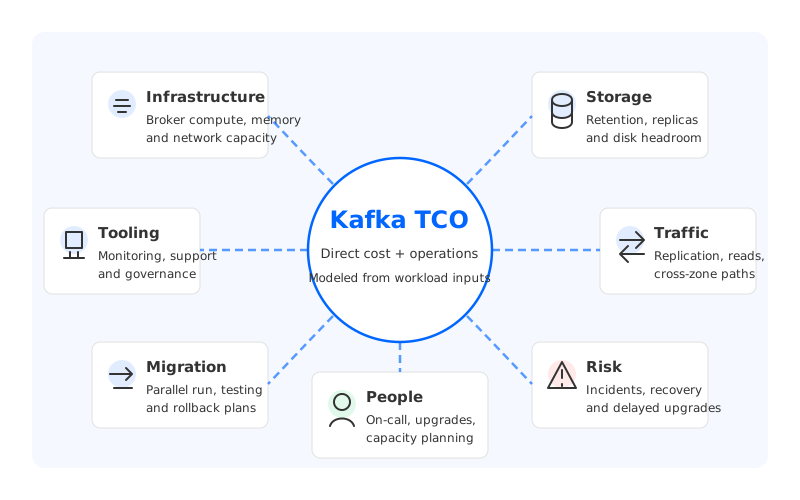
A useful Kafka TCO model gives FinOps, platform leaders, and procurement the same vocabulary. It separates direct infrastructure cost from human operational cost, ties both to measurable workload inputs, and makes the tradeoffs visible before the next renewal or migration decision.
1Why Kafka TCO Is Larger Than the Broker Bill
Kafka is a distributed log built around brokers that own partitions and store log segments. The Apache Kafka documentation describes replication as the mechanism that keeps partition replicas available across brokers, and topic retention settings define how long records remain available for replay. Those concepts also mean storage, traffic, and failure planning are embedded in the cluster topology.
Cloud bills do not expose this topology. They show categories such as virtual machine hours, attached block storage, object storage, data transfer, managed service charges, monitoring, and support. The TCO model translates between Kafka language and cloud finance language. Without that translation, a team may optimize one line item while leaving the larger cost driver untouched.
Consider a simple example. If a team reduces broker instance size but keeps the same replication factor, retention window, disk headroom, and cross-zone traffic pattern, the direct compute bill may fall while storage and transfer remain unchanged. If smaller brokers create slower recovery or tighter disk pressure, the human cost may rise. The review looks successful in one column and fragile in another.
Kafka cost optimization should not start with "How many brokers can we remove?" It should start with "Which assumptions make this cluster expensive, and which can change without weakening reliability?"
2The Seven Cost Categories to Model
Kafka TCO is easiest to manage when the model separates cost categories before adding them back together. Mixing everything into a single blended monthly number hides the source of variance, especially when traffic growth, longer retention, and staffing changes happen at different times.
| Category | Direct Infrastructure Cost | Human or Risk Cost |
|---|---|---|
| Broker compute | VM or managed broker capacity for CPU, memory, and network | Capacity reviews, instance tuning, hotspot diagnosis |
| Storage and retention | Local disks, block volumes, object storage, snapshots, retained replicas | Retention policy reviews, disk pressure incidents |
| Replication | Additional stored copies and replication traffic | ISR monitoring, leader imbalance, recovery planning |
| Data transfer | Cross-AZ, inter-region, internet egress, consumer reads | Architecture reviews to reduce expensive paths |
| Scaling headroom | Idle capacity for peaks, maintenance, replay, and failure | Slow approval cycles when growth exceeds plan |
| Operations | Monitoring, observability, managed-service fees, support | Upgrades, rebalances, on-call, incident response |
| Migration and change | Parallel environments, tooling, validation, dual writes | Application coordination, risk reviews, rollback planning |
Direct infrastructure cost is what finance can map to cloud categories and vendor invoices. Human operational cost is the engineering capacity required to keep the platform healthy. Both are real, but they behave differently. Infrastructure cost can fall with architecture changes; operational cost falls only when daily work becomes less frequent, less risky, or less complex.
3Collect Workload Inputs Before Pricing Anything
A Kafka pricing calculator is only useful if the inputs reflect the workload. The model should collect data before anyone picks instance types or compares vendors. Otherwise, the team ends up debating cloud SKUs while the most sensitive assumptions remain implicit.
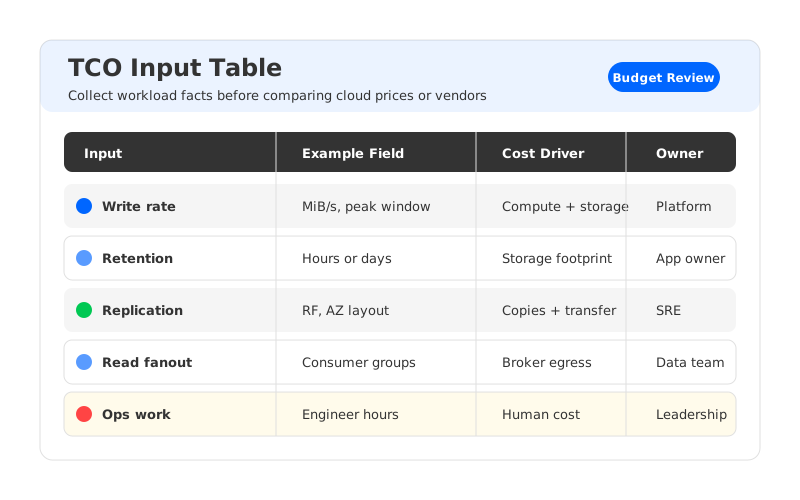
Start with workload shape:
- Sustained producer write throughput in MiB/s.
- Peak producer write throughput and peak duration.
- Average record size, compression codec, and expected compression ratio.
- Number of consumer groups and read fanout per topic family.
- Retention window by workload, including replay and compliance requirements.
- Replication factor, availability zone layout, and disaster recovery pattern.
- Partition count, topic count, and expected growth rate.
- Operational requirements such as upgrade frequency, RTO, RPO, and on-call coverage.
Then translate those inputs into cost drivers. Retained data is driven by write rate and retention. Physical storage is affected by compression, replication factor, and free-space headroom. Network cost depends on where producers, brokers, replicas, and consumers run. Compute cost depends on producer writes, consumer reads, replication work, compression, encryption, controller activity, and recovery traffic.
The model does not need perfect precision to be useful. It needs consistent assumptions. Comparing three options with the same workload inputs is more useful than applying exact prices to different hidden assumptions.
4A Practical Kafka TCO Formula
The following worksheet is a starting point, not a universal benchmark. It avoids hard-coded cloud prices because official price sheets vary by provider, region, commitment model, and date. Apply current prices after the workload assumptions are agreed.
logical_retained_data = write_throughput x retention_window

physical_storage = logical_retained_data
                 x replication_factor
                 / compression_ratio
                 x storage_headroom_factor

broker_compute_cost = broker_count
                    x instance_hour_price
                    x hours_per_month

storage_cost = provisioned_storage
             x storage_unit_price

replication_transfer_cost = billable_replication_bytes
                          x transfer_unit_price

consumer_transfer_cost = billable_consumer_bytes
                       x transfer_unit_price

operations_cost = engineer_hours
                x loaded_hourly_cost

tco = direct_infrastructure_cost
    + human_operational_cost
    + expected_risk_cost
    + migration_or_change_cost
Several inputs deserve explicit review because small changes can dominate the result. Retention often has a stronger effect than broker count when data volume is high. Read fanout can matter as much as write throughput when multiple downstream systems replay the same stream. Cross-zone traffic can become material when replication and consumers routinely cross availability-zone boundaries. Recovery time affects cost because a cluster that recovers slowly needs more defensive headroom.
This is also where procurement and platform teams should agree on the time horizon. A one-year model may favor the smallest immediate change. A three-year model may justify migration work if the architecture reduces high-sensitivity costs such as storage growth, replication traffic, and operations.
5Where Traditional Kafka Optimization Hits a Ceiling
Many Kafka cost optimization projects begin with right-sizing. That is sensible. Teams should remove abandoned topics, fix unbounded retention, tune compression, delete unused consumer paths, review partition counts, and match broker shape to workload. These are practical actions and often produce immediate savings.
The ceiling appears when the expensive part is not waste but coupling. In traditional Kafka, brokers are compute workers and storage owners at the same time. A broker fleet may need more disk because retention grew, more network because replication is heavy, more CPU because read fanout increased, or more spare capacity because recovery and reassignment are slow under pressure. The same topology has to satisfy all of those requirements.
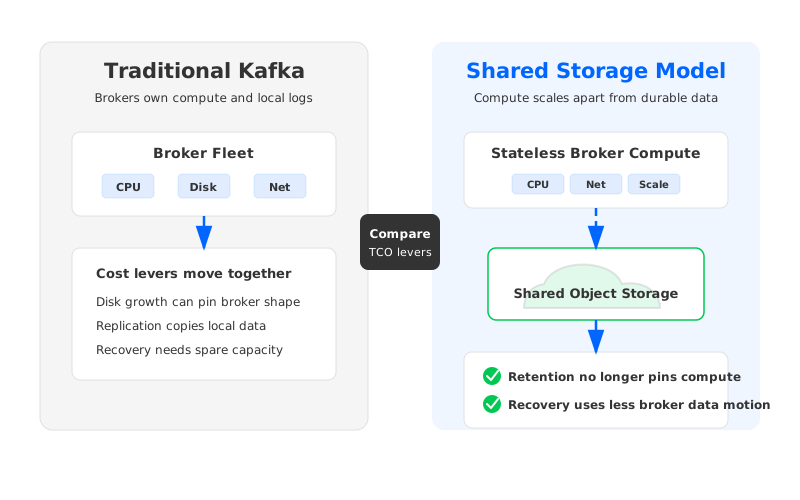
That coupling creates several budget patterns:
- Storage-heavy clusters may keep large broker instances even when CPU is underused.
- Traffic-heavy clusters may carry extra broker capacity to survive replication, replay, and rebalancing windows.
- Longer retention may increase block storage and operational risk at the same time.
- Failure recovery may require large spare capacity because data movement is tied to broker-local disks.
- Partition reassignment can become an operational project rather than a routine scaling step.
Right-sizing still helps, but it cannot fully change the slope of the cost curve if retained data, replicas, and topology-driven traffic continue to grow together. That is the point where the TCO review should shift from tuning to architecture.
6Comparing Alternatives Without Hiding Migration Cost
A credible Kafka TCO comparison should include the current platform, the optimized version of the current platform, and at least one architectural alternative. This prevents a false choice between "do nothing" and "migrate everything." The alternative should carry its own migration cost.
Use the same workload inputs for each option:
| Input Area | Current Kafka | Optimized Current Kafka | Alternative Architecture |
|---|---|---|---|
| Broker compute | Existing broker fleet | Right-sized fleet | Compute layer sized independently |
| Storage | Local replicated disks | Tuned retention and headroom | Shared or tiered storage model |
| Data transfer | Current replica and consumer paths | Reduced obvious cross-zone paths | Architecture-specific data movement |
| Operations | Current runbook and staffing | Improved automation | New operational model and training |
| Migration | None | Low | Parallel run, validation, rollout |
Migration cost belongs in the model, not outside it. Teams may need a parallel environment, data validation, client compatibility testing, cutover planning, rollback planning, and updated observability. Those costs can be worth paying, but they should be visible. A platform decision that saves infrastructure spend while consuming a year of scarce engineering time may not be a win. A migration that reduces storage growth, toil, and incident exposure over several years may be easier to justify than it looks from one budget cycle.
Expected risk cost is harder to quantify, but it should not be ignored. Slow broker recovery, repeated disk pressure, delayed upgrades, and fragile rebalances consume engineering capacity and create business risk. If the organization does not assign a dollar value to incidents, track incident frequency, engineer hours, customer impact, and delayed roadmap work.
7How AutoMQ Changes High-Sensitivity Inputs
Once the TCO model makes the cost drivers visible, the architecture question becomes clearer: which inputs are structurally hard to improve in the current design? If storage, replication traffic, scaling headroom, and recovery time are the sensitive variables, then an alternative should be evaluated by how it changes those variables rather than by whether it uses the same broker count.
AutoMQ is a Kafka-compatible cloud-native streaming system that moves durable log storage from broker-local disks to object storage while keeping Kafka protocol semantics for existing clients and ecosystem tools. In a TCO review, the relevant point is not a generic claim that one platform costs less. The point is that separating compute from storage changes the worksheet.
Object storage can change retention economics because retained data is no longer tied to large broker-local disks in the same way. Stateless broker design can reduce the pressure to over-provision compute for storage ownership. Scaling and recovery can involve less heavy data movement between brokers, which may reduce operational labor and shorten recovery windows. Depending on workload and deployment design, replication and cross-zone traffic assumptions may also change because durable data placement differs from a shared-nothing broker-local model.
Those are model inputs, not slogans. A team should test them with its own write rate, retention window, read fanout, availability design, and cloud-region prices. For a FinOps review, AutoMQ belongs in the comparison table when the current Kafka cost curve is driven by storage growth, topology-coupled scaling, and operational toil rather than by broker CPU alone.
8Budget Review Checklist
Before the next Kafka renewal or cloud spend review, ask for the following artifacts:
- A workload inventory grouped by topic family, owner, write rate, retention, and consumer fanout.
- A direct infrastructure breakdown for compute, storage, data transfer, monitoring, support, and managed-service charges.
- A human operational cost estimate for routine work, incidents, upgrades, rebalances, and capacity planning.
- A sensitivity analysis for retention, replication factor, read fanout, cross-zone paths, and growth rate.
- A migration comparison that includes parallel-run cost, validation, rollout, rollback, and training.
- A decision table that compares optimized current Kafka with an architecture that decouples compute and storage.
The output should be a model that finance can audit and engineers can defend. When the model exposes the real cost drivers, the conversation changes. The goal is no longer to cut brokers until the platform becomes fragile. The goal is to reduce Kafka cost where the architecture, workload, and operating model allow it.
For teams evaluating whether a Kafka-compatible shared-storage architecture can reduce TCO, the next practical step is to run the same workload inputs through an AutoMQ architecture and cost review using current cloud pricing for the target region.
9References
- Apache Kafka documentation: replication
- Apache Kafka documentation: retention configuration
- AWS EC2 On-Demand pricing
- AWS EBS pricing
- AWS S3 pricing
- AWS data transfer pricing
- Google Cloud Compute Engine pricing
- Google Cloud networking pricing
- Azure Virtual Machines pricing
- Azure bandwidth pricing
- AutoMQ documentation overview
- AutoMQ pricing
10FAQ
10.1What is Kafka TCO?
Kafka TCO is the total cost of running Kafka over a defined time period. It includes direct infrastructure cost such as broker compute, storage, replication, data transfer, and monitoring, plus human operational cost such as upgrades, incident response, capacity planning, and migration work.
10.2How do I reduce Kafka cost without increasing risk?
Start with workload hygiene: remove unused topics, tune retention, review compression, reduce unnecessary read fanout, and right-size brokers against measured peaks. Then test whether the remaining cost is structural. If storage growth, replication traffic, recovery time, or operational toil dominate the model, architecture changes may have more impact than another round of broker tuning.
10.3Should a Kafka cost calculator include engineering labor?
Yes. Direct infrastructure cost and human operational cost should be separate lines, but both belong in the TCO model. Engineering labor is especially important when Kafka requires frequent rebalances, manual capacity planning, complex upgrades, or repeated incident response.
10.4Why is broker right-sizing not enough for Kafka cost optimization?
Broker right-sizing addresses compute waste. It does not automatically reduce retained data, replica copies, cross-zone data movement, read fanout, or the operational headroom needed for recovery. In traditional Kafka, those costs are often coupled to broker topology.
10.5When should AutoMQ be evaluated in a Kafka TCO review?
Evaluate AutoMQ when the current Kafka cost curve is driven by storage growth, long retention, over-provisioned brokers, slow recovery, or operational labor around scaling and reassignment. The useful comparison is workload-specific: use the same throughput, retention, fanout, availability, and cloud-region assumptions for both the current Kafka model and the AutoMQ model.


