
Table of Contents
Table of Contents
Kafka cost problems rarely arrive as a single dramatic incident. They usually show up as a line item that keeps growing, a scaling operation that needs a maintenance window, or a capacity plan that assumes more brokers because that feels safer than architectural change. The Kafka bill may be clearly too high, but changing the infrastructure underneath production streaming can feel more dangerous than accepting the cost.
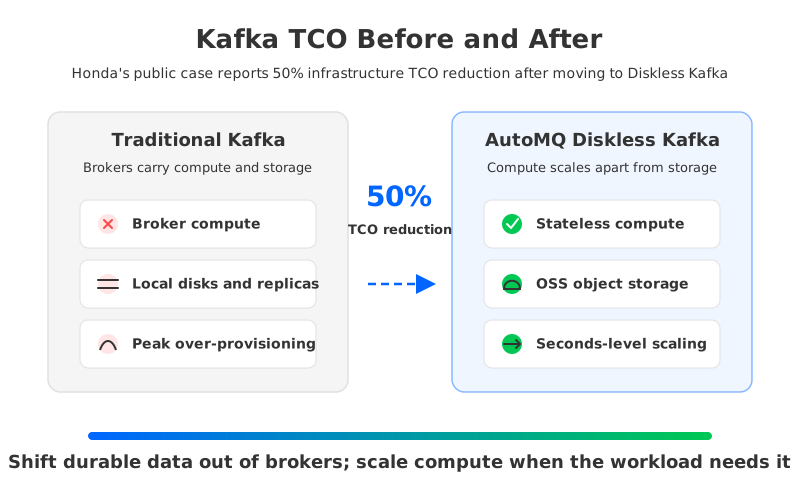
That tension is what makes Honda's migration story useful for other Kafka teams. According to the public Honda customer case, Honda used AutoMQ to cut Kafka infrastructure TCO by 50%, move scaling from hours to seconds or tens of seconds, and complete the migration with zero downtime through Kafka Linking. The interesting part is the engineering logic behind the outcome: Honda did not need a different event model. It needed Kafka-compatible infrastructure where storage economics and operational elasticity matched the cloud environment it was already running in.
1When Kafka Cost Is Obvious but Migration Feels Risky
Traditional Kafka is very good at making data durable, but it does so by binding storage, compute, and replication behavior tightly to the broker fleet. Brokers own local disks, partitions sit on those disks, and replication between brokers provides fault tolerance. The operational consequence is familiar to anyone who has run Kafka at scale: when throughput, retention, or partition count grows, the answer often becomes "add brokers," even if only one resource is constrained.
This is where TCO gets slippery. A finance review may see compute, disk, and network as separate categories, but the Kafka operator sees them as one coupled system. More retention means more disk; more disk often means more brokers; more brokers increase the surface area for balancing, monitoring, maintenance, and failure handling. A cluster can look healthy while still carrying a large amount of structural waste.
Honda's public case describes this pattern across connected vehicles, manufacturing IoT systems, and marketing analytics platforms. Multiple business lines depended on Kafka to aggregate real-time data, and the original deployment ran on ECS. As usage grew, the team faced rising costs, low CPU and disk utilization, and complex scaling operations. The workload had outgrown broker-local storage economics.
For teams in that position, the hardest question is not "can we reduce cost?" It is "can we reduce cost without creating a migration event that the business remembers for the wrong reasons?" Downtime is visible, data loss is unacceptable, and rollback planning is not a nice-to-have. Cost pressure starts the conversation, but migration risk decides whether anything actually changes.
2Honda's Streaming Workload and Constraints
Honda's public case gives enough detail to understand the shape of the problem without pretending to know every internal system. The workloads included connected-vehicle data, manufacturing IoT, and marketing analytics. Those categories push Kafka in different ways: telemetry can create bursty ingestion patterns, manufacturing systems require continuity, and analytics pipelines often increase retention pressure.
The shared constraint is reliability. A Kafka migration in this environment is not a weekend experiment where clients can be rewritten and consumers can catch up later. Clients had to remain compatible, and the migration path had to preserve service continuity while giving the platform team a way to verify the target before switching traffic.
That combination points toward a specific decision framework:
- Keep the Kafka API stable. The less application teams need to change, the less migration risk spreads across the organization.
- Separate storage economics from broker count. Retention growth should not automatically force more compute capacity.
- Make scaling operationally boring. Adding capacity should not require hours of partition movement.
- Protect rollback and validation windows. A migration plan should include checkpoints where the team can compare behavior before committing.
This is where a Diskless Kafka architecture becomes more than a cost story. If brokers no longer own durable data on local disks, the team can reason about compute capacity and storage retention separately. That changes the migration discussion from "replace a working cluster and hope" to "introduce a compatible Kafka layer, validate it, and move traffic through a controlled path."
3Where the Old TCO Pressure Came From
Kafka TCO is not one cost. It is the sum of design consequences that reinforce each other. Broker-local storage means each broker must carry enough disk for assigned partitions and replicas. Replication means the same logical data exists multiple times across the cluster. Peak and maintenance planning add extra room for backpressure, failure recovery, upgrades, and rebalancing.
In a cloud environment, that coupling becomes expensive because the unit of scaling is often too coarse. More retention may bring more broker capacity, and more throughput headroom may bring more disk capacity as a side effect. Rebalancing consumes I/O and network resources that compete with production traffic. Each decision is rational; together they produce a platform that is stable but over-provisioned.
The public Honda case calls out four pressure points that many Kafka operators will recognize:
| TCO driver | Why it hurts in traditional Kafka | What Honda's case reports after AutoMQ |
|---|---|---|
| Local broker disks | Storage capacity is tied to broker fleet size and retention growth. | Data is offloaded to OSS, reducing reliance on broker-local storage. |
| Multi-replica storage | Durability depends on storing replicated data across brokers. | Diskless architecture uses object storage as the durable storage layer. |
| Scaling operations | Adding brokers can trigger data movement and rebalancing that takes hours. | Scaling moves to seconds or tens of seconds. |
| Migration risk | Critical workloads require zero downtime and zero data loss. | Kafka Linking enabled zero-downtime migration in the public case. |
The table is not a universal calculator. Honda's 50% TCO reduction is a public customer result, not a promise that every Kafka estate will land on the same number. The useful lesson is narrower: if much of your Kafka spend comes from storage-heavy retention, over-provisioned brokers, and operational buffers around rebalancing, then a Diskless architecture attacks the cost at the mechanism level rather than through instance right-sizing alone.
4The Migration Approach: Compatibility First
The phrase "zero-downtime migration" can sound suspiciously neat, so it is worth slowing down. In production Kafka environments, zero downtime is a sequence of compatibility, replication, validation, cutover, and rollback gates. The public Honda case names Kafka Linking as the migration capability and reports zero downtime and zero data loss; it does not publish every internal step.
At the architectural level, the migration pattern is still clear. A compatible target cluster reduces application change. Linking keeps data moving while the team validates the target. Observability shows whether lag, throughput, and client behavior match expectations. A rollback gate keeps the decision reversible until the team has enough evidence to cut over.
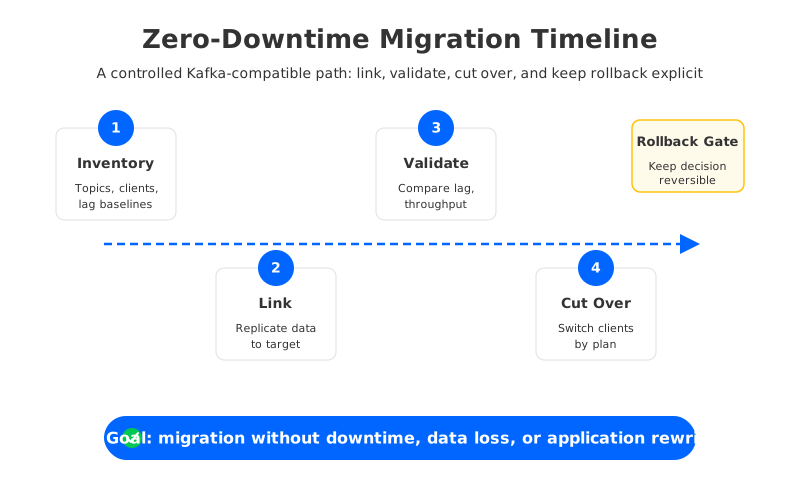
This is why Kafka compatibility matters so much in a TCO project. If a cost-reduction plan requires every producer and consumer owner to adopt a different protocol, change client libraries, or redesign topic semantics, the infrastructure team has converted a platform migration into an application migration. Honda's reported path preserved the Kafka ecosystem while moving the underlying storage architecture to AutoMQ.
Compatibility also changes the politics of migration. A platform team can make a technical argument for lower TCO, but application teams mostly care about whether their systems keep working. A Kafka-compatible migration gives those teams a smaller ask: validate behavior, monitor lag, and participate in cutover planning without rewriting the application.
5What Changed After the Move
Honda's public outcome has three parts: cost, elasticity, and migration continuity. The case reports a 50% Kafka infrastructure TCO reduction, scaling from hours to seconds or tens of seconds, and Kafka Linking-enabled migration with zero downtime and zero data loss. The three outcomes belong together: the cost project worked because the operating model changed without forcing a broad application rewrite.
When brokers are stateless from the perspective of durable log storage, scaling no longer requires the same large-scale partition data movement that makes traditional Kafka operations heavy. When storage lives in OSS, retention growth no longer has to map directly to broker-local disk expansion. When the Kafka API remains compatible, the migration can focus on infrastructure behavior.
For Honda, the result was not merely a lower bill. The public case describes a shift from reactive capacity planning and high-risk manual operations toward cloud-native operations that scale with business needs. Kafka cost projects often fail when they treat infrastructure spend as a procurement problem. Durable savings usually come from changing the operating model that created the spend.
There is a caveat here. Diskless Kafka does not remove the need for engineering discipline. Teams still need topic governance, client observability, retention policy reviews, quota management, and a sober migration plan. What changes is the set of trade-offs: instead of asking how much broker-local disk to attach for future retention, the team can ask how much compute capacity the workload needs and how object storage should serve the durability and retention layer.
6Kafka TCO Checklist for Enterprise Teams
Honda's story gives other teams a way to audit their own Kafka estate. Start with the places where Kafka's original coupling of compute and storage shows up in your operations.
Use this checklist before making an architectural decision:
- Retention pressure: Are longer retention windows forcing broker or disk expansion even when CPU is underutilized?
- Scaling time: Does adding broker capacity require partition movement, rebalancing, or maintenance windows measured in hours?
- Utilization mismatch: Are CPU, disk, and network capacity growing together even though only one resource is constrained?
- Migration blast radius: Would a platform change require application teams to rewrite clients or change Kafka semantics?
- Rollback readiness: Can you validate a target cluster and keep a rollback option open before committing production traffic?
- Cost attribution: Can you separate storage cost, compute cost, replication overhead, and operational labor in your TCO model?
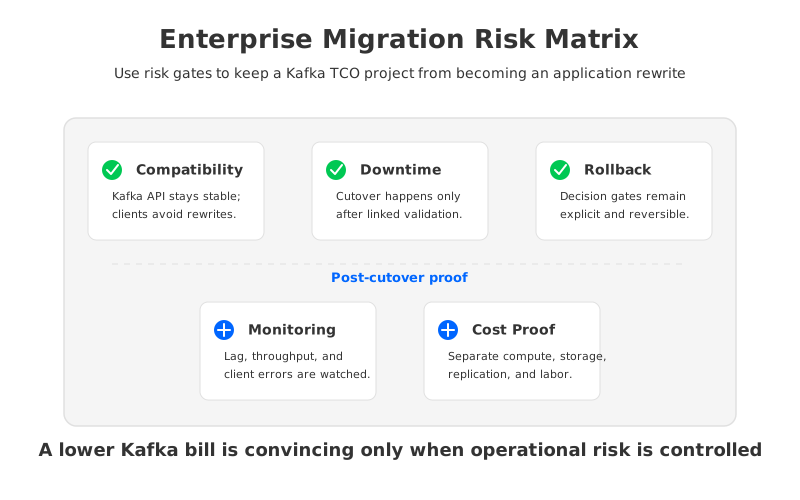
The last question is usually the hardest. A Kafka bill can be visible while the real cost drivers remain hidden inside operational habits: padding capacity to avoid rebalances, keeping retention short because disk is expensive, or postponing upgrades because the cluster is too painful to move. Honda's results point to changing those mechanics, not trimming a few instances around the edges.
For teams searching for Kafka TCO reduction, the practical takeaway is not "copy Honda." It is to inspect whether your own Kafka architecture still assumes that durable storage must live on brokers. If that assumption is driving over-provisioning, slow scaling, and risky migration planning, a Diskless Kafka architecture gives you a different path: keep Kafka compatibility, move durable data to object storage, and make compute capacity elastic enough that scaling is routine.
The uncomfortable line item that starts the conversation is still useful. It tells you where to look. The deeper question is whether the bill is a symptom of a storage model your workload has already outgrown.
7FAQ
7.1What is Kafka TCO reduction?
Kafka TCO reduction means lowering the total cost of running Kafka, including compute, storage, replication overhead, network usage, operational labor, maintenance windows, and migration risk. In Honda's public case, AutoMQ reports a 50% Kafka infrastructure TCO reduction after moving to a Diskless architecture backed by OSS.
7.2What is Diskless Kafka?
Diskless Kafka separates Kafka-compatible compute from durable storage. Brokers handle compute and I/O aggregation, while durable log data is persisted in object storage such as OSS or S3-compatible storage. This allows broker capacity to scale without moving large volumes of partition data between local disks.
7.3How did Honda migrate with zero downtime?
The public customer case says Honda used Kafka Linking to migrate production Kafka workloads with zero downtime and zero data loss. It does not publish every internal migration step, so this article describes the general engineering pattern: compatibility, linking, validation, cutover, and rollback gates.
7.4Does Honda's 50% TCO reduction apply to every Kafka deployment?
No. The 50% figure is Honda's public customer result. Other teams should build their own TCO model based on workload shape, retention, throughput, replication, object storage pricing, operational labor, and migration scope.
7.5When should a team evaluate Diskless Kafka?
Evaluate Diskless Kafka when retention growth, broker-local disk, rebalancing time, and over-provisioned capacity are major parts of your Kafka cost or operational risk. It is especially relevant when the team wants Kafka compatibility but needs cloud-native storage economics and faster scaling.
8Sources
- AutoMQ Honda customer case: Honda Case Study - AutoMQ
- AutoMQ customer collection: AutoMQ Customers


