
Table of Contents
Table of Contents
A Kafka telemetry retention strategy usually starts as a monitoring cleanup task. The metrics backend is growing too fast, log storage is noisy, dashboards are slow, or FinOps has noticed that operational data now has its own budget line. Then the team discovers the uncomfortable part: Kafka telemetry includes broker metrics, client metrics, consumer lag, controller state, audit events, logs, traces, and the incident notes that explain what those signals meant at 03:00.
Keeping everything is attractive because Kafka incidents are expensive and hard to reconstruct. Keeping everything forever turns observability into a second data platform with weak governance. The better question is "which signals still change a production decision after the first hour, week, and quarter?"
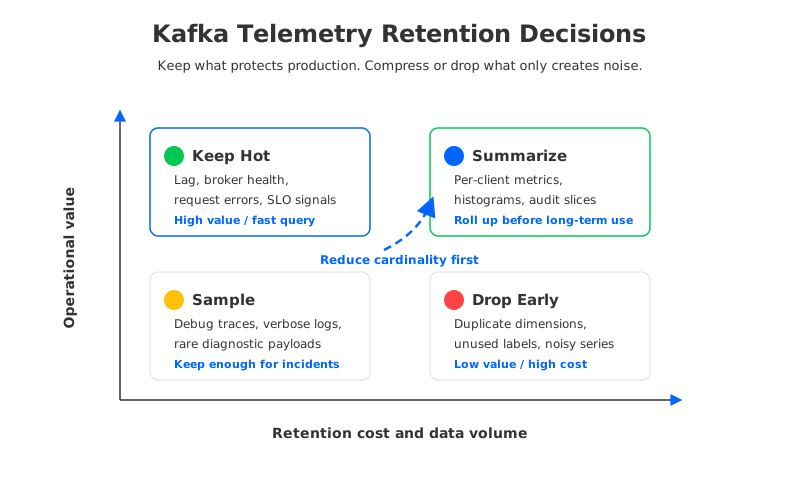
That framing matters for platform teams evaluating cloud-native Kafka or Kafka-compatible streaming platforms. Telemetry retention is part of the operating model for reliability, cost allocation, compliance evidence, and migration readiness.
1Why Kafka Telemetry Retention Strategy Matters Now
Kafka sits in the middle of systems that generate telemetry at several layers. Brokers expose JVM, network, request, controller, Topic, Partition, and replication metrics, while clients, security layers, and cloud infrastructure add their own evidence.
That telemetry has real value. Consumer lag tells you whether downstream systems are keeping up. Request latency and error rates show whether brokers are under pressure. Controller signals explain leadership movement and cluster instability. Audit logs prove who changed what. Historical telemetry answers capacity questions that live beyond a single incident: did the workload grow steadily, did a deploy change traffic shape, or did a replay create a false capacity target?
The cost side is less elegant. Metrics with high-cardinality labels expand rapidly when teams tag by client, Topic, Partition, region, tenant, pod, node, and error class. Logs become expensive when debug output stays enabled. Traces are useful during migration or latency investigations but wasteful as always-on long-term storage.
So the retention policy has to separate three ideas that are often blended together:
- Operational freshness. Some signals only matter while the incident is active. Broker request errors, lag spikes, and client retry bursts belong in a fast query path.
- Historical evidence. Some signals matter weeks later for audits, root cause analysis, migration review, or SLO reporting, but they can often be summarized.
- Discardable noise. Some labels, debug lines, and duplicate measurements do not change a decision. Dropping them is not data loss; it is system hygiene.
Apache Kafka documentation treats monitoring as an operational responsibility, including metrics exposed through JMX. Prometheus documents retention as a storage setting. Those facts are useful, but a production Kafka estate still needs a policy that maps telemetry to decisions.
2The Production Constraints Behind the Search
The phrase kafka telemetry retention strategy usually appears when the first monitoring setup has outgrown its design. More clients, tenants, Topics, Partitions, environments, and cloud accounts turn telemetry from "helpful during incidents" into "a governed dataset with cost and ownership."
Traditional Kafka architecture can make this pressure sharper because the platform is already stateful. In a Shared Nothing architecture, brokers own local persistent log replicas and use replication for durability and availability. Scaling, recovery, and maintenance involve broker-local storage, Partition placement, network traffic, and operational windows. Telemetry retention adds another dimension: enough history to understand operations without making observability harder to run than Kafka itself.
The hard constraints usually show up in five places.
| Constraint | Why it matters for telemetry retention | Bad policy smell |
|---|---|---|
| Incident response | On-call teams need fast access to recent high-fidelity signals. | Raw data is archived before engineers can query it during an incident. |
| Capacity planning | Platform owners need trend data across traffic cycles. | Only short windows exist, so every forecast starts from guesswork. |
| Cost allocation | FinOps needs to attribute growth to tenants, Topics, or workloads. | Labels are either too sparse for attribution or too detailed to afford. |
| Governance | Security and compliance teams need audit evidence. | Operational logs mix sensitive fields with long retention and unclear access. |
| Migration | Architecture teams need baselines before and after platform changes. | Old and new clusters emit different signals with no shared vocabulary. |
The design rule is simple: retention is not duration alone. It is fidelity, aggregation, access control, and cost ownership. Raw high-cardinality data can be less useful than a short window of detailed signals plus longer-lived aggregates.
3What to Measure
Start with telemetry that changes production decisions. The core set should answer whether the platform is healthy, clients are safe, storage and network paths are under pressure, and user-visible reliability is at risk.
A practical baseline includes these categories:
- Service health. Broker availability, request latency, request error rate, controller health, metadata stability, disk or storage path pressure, JVM health, and network saturation.
- Workload behavior. Produce and fetch throughput, record rates, batch behavior, Topic and Partition growth, consumer lag, rebalance frequency, and client retry patterns.
- Durability and recovery. Replication state for traditional Kafka, leader elections, failed writes, recovery time, unavailable Partitions, and storage errors when remote or shared storage is involved.
- Governance evidence. Authentication failures, authorization failures, administrative changes, ACL changes, configuration changes, and access to operational tooling.
- Platform cost drivers. Retained bytes, ingress and egress, cross-Availability-Zone traffic where applicable, object storage request volume, metrics cardinality, and log ingestion volume.
Metric names differ by distribution, deployment model, and observability stack. If a signal cannot be tied to reliability, cost, governance, capacity, migration, or customer-facing SLOs, it should not enter the long-retention path by default.
Control cardinality early. Client IDs, Topic names, Partition numbers, tenant IDs, pod names, node IDs, and error classes can all be useful. Combined without discipline, they create a series explosion. Keep labels that support routing, ownership, or diagnosis; remove the rest.
4What to Store Hot, Summarize, Archive, and Drop
Telemetry retention works best as a tiered policy, but the tiers should reflect decision value rather than storage mechanics alone. Hot retention is for active operations, summarized retention is for trend review, archive retention is for evidence, and drop rules protect the system from waste.
Hot telemetry should include signals needed during live incidents: consumer lag, broker request latency, error rates, client retries, rebalance events, controller changes, failed authentication, and storage path saturation. These signals need fast queries and useful ownership labels.
Summarized telemetry should preserve the shape of the platform. Rollups can retain throughput, retained bytes, error budgets, lag percentiles, availability, storage growth, and cost allocation dimensions. FinOps cares about whether a workload keeps changing the capacity curve.
Archived telemetry should be deliberate. Audit logs, configuration changes, incident artifacts, and migration baselines may need longer retention because they prove decisions and support investigations.
Drop duplicate labels, verbose debug logs after the debugging window closes, per-request traces without sampling policy, and metrics that have no owner.
A good Kafka telemetry policy is opinionated. It does not say "retain all metrics for 90 days." It says which questions the platform must answer and which data is allowed to answer them.
5Architecture Patterns Teams Usually Compare
There are three common patterns for Kafka telemetry retention. The first is the basic pattern: scrape metrics, ship logs, store everything in a central observability backend, and tune retention when storage pressure appears.
The second pattern is the governed observability pipeline. Metrics, logs, and traces pass through collectors or agents that apply label normalization, sampling, filtering, redaction, and routing before data reaches storage. OpenTelemetry fits this style because it gives teams a vendor-neutral collection and processing model.
The third pattern is architecture-aware retention. Kafka telemetry is interpreted together with the streaming architecture. A traditional Shared Nothing cluster needs visibility into broker-local storage, ISR state, replica movement, and cross-zone replication. Tiered Storage adds remote segment upload, remote fetch, local retention, and object storage behavior. A shared-storage Kafka-compatible system needs visibility into the Write-Ahead Log (WAL), object storage, cache, metadata ownership, and stateless broker operations.
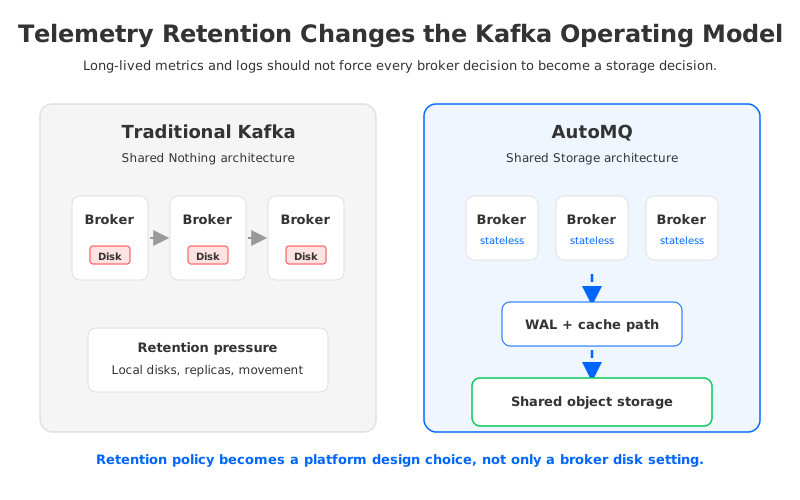
This is where architecture changes the retention policy. If brokers own local data, telemetry must explain local disk pressure, replica placement, and data movement. If brokers are stateless compute nodes over shared durable storage, telemetry must explain ownership transfer, cache effectiveness, WAL health, object storage behavior, and control-plane decisions.
6Where AutoMQ Changes the Operating Model
After the neutral evaluation is complete, AutoMQ belongs in the discussion when the team wants Kafka compatibility but is questioning broker-local storage as the long-term operating model. AutoMQ is a Kafka-compatible cloud-native streaming platform that reimplements Kafka's storage layer with S3Stream and Shared Storage architecture. Durable stream data is written through a WAL path and stored in S3-compatible object storage.
That design does not remove the need for telemetry retention. It changes what the telemetry is trying to protect. Traditional Kafka policies focus on broker-local disk, replica health, and data movement. AutoMQ shifts the durable data foundation into shared object storage and makes brokers stateless, so telemetry can focus on compute health, WAL storage, object storage, cache behavior, metadata, and traffic placement.
For a retention strategy, the practical implications are clear:
- Cost signals become more explicit. Object storage, request behavior, cache hit rates, retained bytes, and compute utilization can be reviewed as separate cost drivers instead of being hidden inside broker disk sizing.
- Scaling signals change. Because brokers are stateless in AutoMQ's architecture, capacity telemetry should focus on traffic, leadership, cache, and compute pressure rather than treating every broker operation as a local data migration event.
- Governance boundaries can be clearer in BYOC. In AutoMQ BYOC, the control plane and data plane run in the customer's cloud account, helping teams align telemetry, storage, IAM, and audit evidence.
- Migration baselines become testable. Teams can compare existing Kafka telemetry with AutoMQ telemetry during a dual-run or phased migration, watching workload behavior, compatibility, lag, throughput, and operational cost drivers.
Evaluate AutoMQ as an architecture category, not as a dashboard replacement. Existing Kafka clients, tools, and workflows still need compatibility testing. Retention policies still need owners. A shared-storage architecture gives the telemetry strategy a different shape: storage growth, broker replacement, and retained history no longer have to be governed through the same broker-local disk lens.
7Evaluation Checklist for Platform Teams
Before changing telemetry retention, write down the decisions the retained data must support. Otherwise, an incident review may find billions of samples and still fail to identify the tenant, deploy, or storage path that mattered.
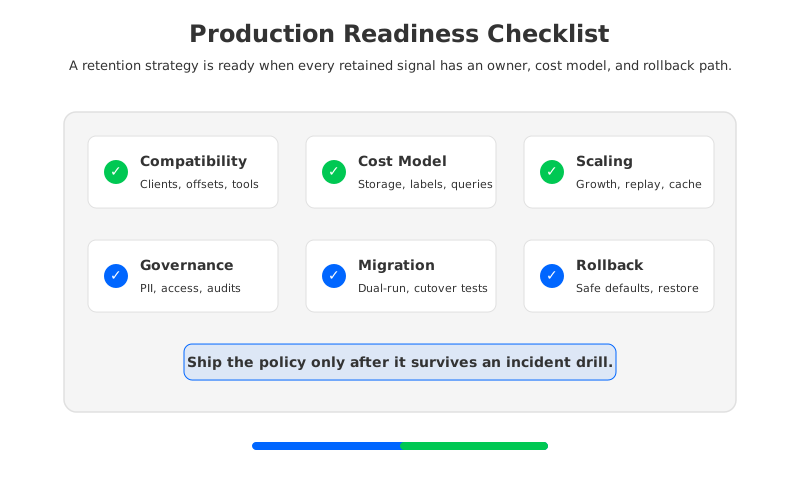
Use this checklist to pressure-test the policy:
- Define owners. Every long-retained metric, log stream, or trace class should have an owning team and a reason for retention.
- Separate hot and historical questions. Incident response, capacity planning, governance, and migration review need different fidelity.
- Set cardinality budgets. Decide which labels are allowed for long retention and which labels are limited to short debugging windows.
- Redact before archive. Remove sensitive payload fields, tokens, and unnecessary identifiers before long-term storage.
- Model cost by signal class. Track metrics, logs, traces, audit events, and storage counters separately.
- Test restore and rollback. Confirm that archived telemetry can be queried when needed and that retention changes can be reversed during an incident.
For platform comparisons, normalize the telemetry vocabulary before migration. If the old Kafka cluster and the new Kafka-compatible platform do not expose identical internals, compare at the decision layer: SLOs, lag, throughput, client errors, cost drivers, recovery behavior, and governance evidence.
8Decision Table
The right retention strategy depends on the pain you are solving. Use this table as a starting point.
| Situation | Better first move | Why |
|---|---|---|
| Metrics backend is growing because of unused labels | Drop or aggregate labels before extending retention | Long retention multiplies bad cardinality decisions. |
| Incidents cannot be reconstructed | Extend hot retention for critical signals and preserve incident artifacts | Reliability needs high-fidelity recent data, not unlimited raw history. |
| FinOps needs Kafka cost attribution | Keep summarized workload, storage, traffic, and tenant dimensions | Cost review needs trends and owners more than per-sample detail. |
| Compliance needs change evidence | Archive admin, auth, ACL, and configuration events with access controls | Governance evidence should be durable and tightly scoped. |
| Broker storage and scaling dominate operations | Evaluate architecture changes, including shared-storage Kafka-compatible systems | Telemetry policy can reveal when the operating model, not the dashboard, is the bottleneck. |
If the search began with a storage bill or a noisy metrics backend, it should end with a platform decision framework. Measure the signals that protect production. Store the data that keeps its decision value. Drop the telemetry that makes the next incident harder to see. For teams discovering that retention, scaling, and broker statefulness are connected problems, AutoMQ's Kafka-compatible Shared Storage architecture is worth evaluating with the same workload and SLOs.
9References
- Apache Kafka Documentation: Monitoring
- Apache Kafka Documentation: Topic-Level Configs
- Prometheus Documentation: Storage
- OpenTelemetry Documentation: Metrics
- AutoMQ Architecture Overview
- AutoMQ S3Stream Shared Streaming Storage
- AutoMQ Compatibility with Apache Kafka
10FAQ
10.1What is a Kafka telemetry retention strategy?
A Kafka telemetry retention strategy defines which Kafka metrics, logs, traces, audit events, and infrastructure signals are kept, summarized, archived, or dropped. It should map telemetry to incident response, capacity planning, cost allocation, governance, and migration review.
10.2Which Kafka telemetry should be kept hot?
Keep hot telemetry that engineers need during active incidents: consumer lag, broker request latency, request errors, client retries, controller changes, failed authentication, storage pressure, and workload throughput.
10.3How long should Kafka metrics be retained?
There is no universal duration. Recent high-fidelity metrics should cover incident response and debugging. Longer retention usually works better as rollups for trends, SLO review, cost allocation, and capacity planning. Audit and configuration events may need separate retention.
10.4How does cardinality affect Kafka telemetry cost?
High-cardinality labels create many time series or log dimensions. Topic, Partition, client ID, tenant, pod, and error class can be useful, but combining all of them for every signal can make storage and query cost grow quickly. Keep labels that support decisions and summarize the rest.
10.5Does AutoMQ replace Kafka observability tools?
No. AutoMQ changes the Kafka-compatible storage and broker operating model; it does not remove the need for observability tools. Teams should still use Prometheus, OpenTelemetry, logs, dashboards, alerts, and audit systems as appropriate. Telemetry should also cover AutoMQ-specific shared-storage signals such as WAL, object storage, cache, and stateless broker behavior.
10.6Why include architecture in a telemetry retention strategy?
Architecture determines which telemetry matters. Traditional Kafka needs visibility into broker-local disks, replicas, and Partition movement. Tiered Storage adds remote segment behavior. Shared-storage Kafka-compatible systems add WAL, object storage, cache, and ownership-transfer signals.


