
Table of Contents
Table of Contents
Kafka tiered storage cost is often summarized as a simple trade: move older log segments from broker disks to object storage because object storage capacity is more cost-effective per GB. That statement is directionally useful, but it is too small for a real architecture decision. A Kafka bill is a stack of broker disks, compute sizing, replication, object storage capacity, object requests, network transfer, cross-AZ traffic, recovery behavior, and operator time.
The mistake is treating tiered storage as a pure S3 capacity discount. In practice, tiered storage changes the shape of retention cost, but it may leave the most expensive parts of the Kafka operating model intact. Brokers can still be sized for peak throughput, hot local data, replica placement, page cache, partition count, and failure headroom. Network paths may grow more complex. Historical reads may introduce object storage request cost. Recovery and rebalance operations still need to be understood through the broker-local architecture.
That does not make tiered storage unattractive. It means teams should separate the costs it can reduce from the costs it does not automatically remove.
1What tiered storage changes in the Kafka bill
Apache Kafka tiered storage separates the local tier from a remote tier. Recent active log data remains on broker storage, while completed log segments can be copied to remote storage and later removed from local disks according to retention settings. KIP-405 describes this direction as remote log storage, and Kafka documentation frames it as a way to retain more data without keeping every segment on local broker disks.
For cost modeling, the most important word is "some." Tiered storage can offload older segments, but broker storage does not disappear. A Kafka cluster still needs local disk for active segments, producer writes, replication, near-tail reads, broker operations, and safety margin. The local tier may shrink from "all retained history" to "hot window plus headroom," but the cluster is still stateful.
That distinction changes the question. Instead of asking, "Is object storage cheaper than broker disk?" ask, "Which cost drivers are tied to historical retention, and which are tied to the broker-local compute model?"
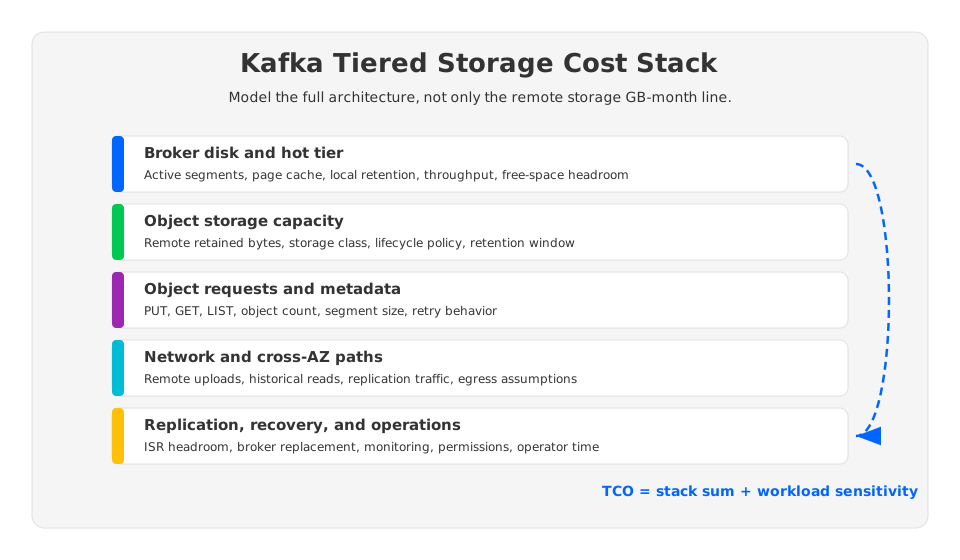
The answer usually falls into six buckets:
| Cost driver | What to model | What tiered storage can change |
|---|---|---|
| Broker disk | Hot window, active segments, page cache, write throughput, local retention, replica factor | Reduces long-retention disk pressure, not hot-path disk need |
| Object storage capacity | Remote segment bytes, retention period, storage class, lifecycle policy | Adds durable capacity cost for cold or warm history |
| Object requests | PUT, GET, LIST, metadata operations, small-object behavior | Adds request cost and operational sensitivity to segment/object layout |
| Network | Uploads to remote tier, historical reads, cross-AZ paths, client egress | May increase or reshape data transfer charges |
| Replication and recovery | ISR replicas, remote segment restore, reassignment, broker replacement | May reduce local restore size, but does not make brokers stateless |
| Operations | Tuning, monitoring, object store permissions, failure drills, capacity worksheets | Adds a second storage system to operate and observe |
This is why a tiered storage TCO worksheet should include both "what moves to object storage" and "what remains on brokers." Leaving out the second half overstates savings.
2Broker disk is smaller, not gone
Traditional Kafka local disk cost is driven by retained bytes, replication factor, write amplification, local retention settings, and free space headroom. If a topic writes 10 TB per day and keeps 30 days with replication factor 3, the raw broker-local storage requirement grows quickly before compression, segment overhead, and operational margin are even considered. Tiered storage can break that direct link between total retention and local disk capacity.
But broker disk sizing still has to cover the hot data window. That window is not only a business retention number such as "keep the last 12 hours locally." It also includes active segment behavior, follower catch-up, consumer reads near the head, unflushed or not-yet-offloaded data, operational buffer during object store issues, and enough disk throughput to avoid turning storage into the bottleneck.
Teams also need to account for the fact that disk is often purchased through instance families or volume types, not as an abstract pool. A Kafka broker may be over-provisioned because the workload needs disk throughput, network bandwidth, memory for page cache, or CPU for compression. If the instance type is selected for throughput or partition density, reducing retained bytes may not immediately reduce broker count or instance size.
This is the first place where tiered storage savings can disappoint. It reduces one reason brokers need large disks, but not necessarily the reasons brokers are over-provisioned for compute, network, memory, or headroom.
3Object storage cost has three parts
Object storage capacity is the visible line item, but object storage cost is not only GB-month. A Kafka tiered storage model should separate capacity, requests, and data movement. Capacity is usually the easiest to estimate: retained remote bytes multiplied by the selected storage class and retention period. The harder parts are request shape and access pattern.
Tiered storage turns completed log segments into remote objects. The object layout, segment size, metadata design, and fetch pattern determine how many PUT, GET, LIST, HEAD, or equivalent operations the system performs. A workload with frequent historical replay can generate a very different request profile from a workload that writes history for audit and rarely reads it. Small objects can also raise request and metadata overhead relative to stored bytes.
Lifecycle policy adds another wrinkle. Moving old data into colder classes may reduce capacity cost, but it can add retrieval fees, minimum storage duration constraints, or latency tradeoffs depending on the provider and class. That may be acceptable for compliance archives. It may be painful for Kafka use cases where replay is part of normal recovery or analytics operations.
The practical worksheet should include:
- Remote retained bytes: daily ingest, compression ratio, replication or remote copy semantics, and retention window.
- Object count: segment size, upload cadence, compaction or aggregation behavior, and topic/partition count.
- Request volume: writes to the remote tier, historical fetches, metadata lookups, and failure recovery reads.
- Storage class behavior: standard, infrequent access, archive, minimum duration, retrieval cost, and latency.
Those inputs decide whether object storage is a quiet capacity sink or an active cost center.
4Network fees can erase simplistic savings
Kafka cost discussions often underweight network because on-premises environments hide it inside fixed infrastructure. Cloud billing makes it explicit. A tiered storage architecture introduces or expands several data paths: brokers upload segments to the remote tier, consumers may read historical data through brokers, replacement brokers may restore or access remote segments, and cross-AZ traffic may appear depending on placement.
The cross-AZ part deserves special attention. Traditional Kafka already pays for replication traffic when replicas span availability zones. Tiered storage does not automatically remove that model. Remote tier uploads can add more paths, and historical reads can bring data back through a broker in a different zone from the object storage endpoint or consumer.
Not every cloud charges every path the same way, and provider-specific details must be checked against current pricing. The modeling principle is stable: draw the path before pricing the GB. If a byte is written, replicated, uploaded, fetched, and replayed across zones, the storage discount may be only one part of a larger transfer story.
5Replication and recovery still belong in TCO
Tiered storage can reduce how much historical data must live on each broker, but it does not by itself rewrite Kafka's high-availability contract. Active replicas, leader election, follower catch-up, and partition placement still matter. During broker failure, the cluster still needs healthy in-sync replicas for active partitions. During reassignment, the cluster may still move local active data or rebuild placement depending on the design and configuration.
That matters for cost because recovery is not free capacity. It consumes network, disk throughput, CPU, and operator attention at the exact moment the cluster is already under stress. If tiered storage shortens the amount of historical local data involved in recovery, that is a real benefit. But if the cluster still needs large brokers to survive a node loss, catch up replicas, and maintain performance during rebalancing, the TCO model should keep those headroom costs.
A useful way to model recovery is to ask four questions:
- How much local data must be rebuilt or copied after broker loss?
- Which data can be served from remote storage without local reconstruction?
- How much network does catch-up consume during peak traffic?
- Does a failure event require extra broker capacity or a longer maintenance window?
The answers reveal whether tiered storage solves the retention problem, the recovery problem, or only part of both.
6Operations overhead is a real cost line
Tiered storage adds a remote storage system to Kafka operations. That means bucket permissions, encryption settings, lifecycle policies, remote log metadata, quotas, request throttling, object storage latency, and backup assumptions now sit inside the Kafka reliability story. These are manageable responsibilities, but they are not zero.
Monitoring also needs to expand. Disk utilization and under-replicated partitions are no longer enough. Operators need visibility into remote copy lag, failed uploads, remote read latency, request rate, object store errors, cache hit ratio, historical fetch latency, and the cost signals that connect those metrics to the bill.
Object storage is cost-effective when used with the right access pattern and object layout. It can become expensive or operationally noisy with accidental small objects, frequent cold retrieval, cross-zone reads, or under-instrumented retry storms.
7A worksheet for tiered storage TCO
Start the TCO worksheet with workload facts rather than provider prices. Prices change; workload ratios explain why the bill exists. The minimum useful worksheet has three layers.
First, model data volume. Capture write throughput, average compression ratio, daily retained bytes, topic and partition count, total retention, local hot retention, expected historical replay frequency, and consumer fan-out. This tells you how much data belongs to the local tier and how much can move to the remote tier.
Second, model infrastructure. Capture broker count, instance family, disk type, disk size, provisioned throughput, replication factor, AZ layout, expected peak-to-average traffic ratio, and failure headroom. This tells you whether reducing local retention actually changes broker shape or only changes disk utilization.
Third, model remote tier behavior. Capture object storage class, remote retained bytes, expected object count, request rates, upload paths, historical read paths, lifecycle policy, and cross-AZ or egress assumptions. This tells you whether object storage is mostly capacity, request volume, or network movement.
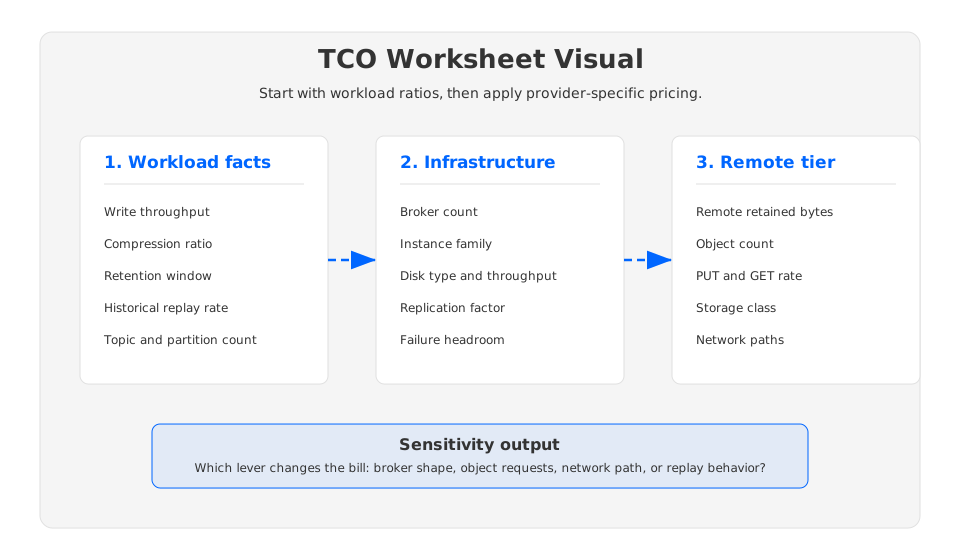
The important output is a sensitivity view. If savings depend on a tiny local hot window, colder storage class, or smaller broker shape, validate replay latency, retrieval fees, recovery behavior, and whether CPU, memory, network, or partition count still force the old instance shape.
8Where shared storage changes the model
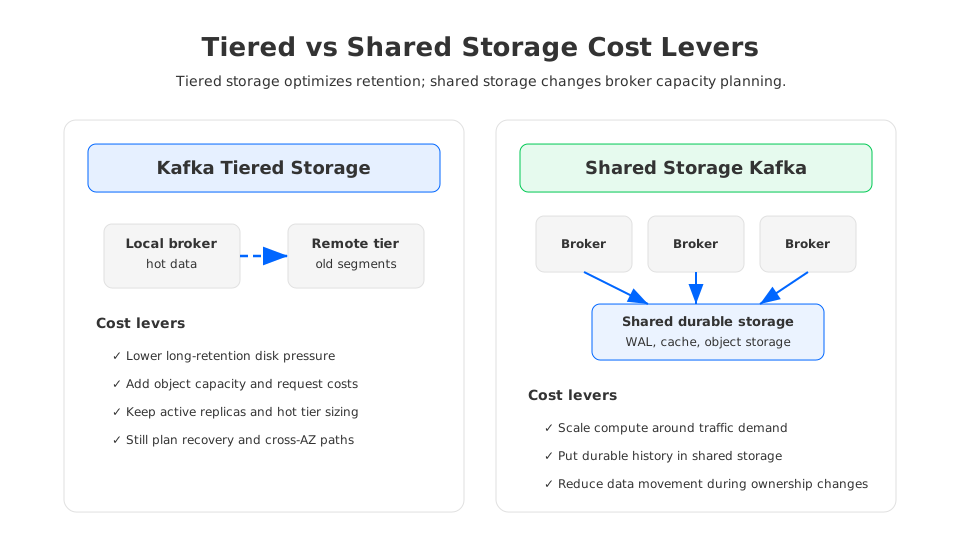
Tiered storage is best viewed as a retention offload feature. Shared storage changes a different axis: the relationship between broker compute and durable Kafka data. In a shared-storage Kafka architecture, persistent log data is externalized into a storage layer accessible under strict ownership and fencing rules. Brokers still serve Kafka clients, lead partitions, cache data, and process requests, but they are no longer the long-lived home of durable log history.
This is where AutoMQ enters the cost discussion naturally. AutoMQ is a Kafka-compatible cloud-native streaming platform that uses shared object storage through S3Stream and designs brokers as stateless compute nodes. The architecture is not merely "Kafka with older segments in S3." It separates storage and compute so capacity planning can be driven more directly by traffic, cache, and WAL needs on the broker side, while durable retained data lives in shared object storage.
That changes several cost levers: retention growth is modeled in shared storage rather than broker-local disk expansion; brokers scale around throughput and connection pressure; ownership changes can avoid large historical data copies; and broker replacement can look more like compute replacement with cache warm-up.
Shared storage does not make object storage free. It still needs WAL design, caching, metadata, request efficiency, and failure fencing. The cost model changes because the system contract changes: durable data is no longer planned as broker-local history.
9When tiered storage is enough
Tiered storage may be the right answer when the current Kafka architecture is stable and the dominant pain is long retention on expensive broker disks. If brokers are not frequently resized, failure recovery is well understood, peak-to-average traffic is modest, and the team mainly needs more historical data without buying larger disks, tiered storage can be a practical and incremental improvement.
It is less complete when the cost problem is compute and disk over-provisioning together. A cluster sized for rare peaks, partition movement, cross-AZ replication, and broker-local failure recovery may still carry much of the same fixed infrastructure. In that case, ask why durable Kafka data needs to be tied to broker capacity in the first place.
That is the decision boundary between retention optimization and architecture optimization. Tiered storage helps with the former; shared storage and stateless brokers target the latter.
10References
- Apache Kafka Tiered Storage documentation
- Apache Kafka KIP-405: Kafka Tiered Storage
- Apache Kafka documentation
- AWS S3 pricing
- AWS data transfer pricing
- AutoMQ S3Stream overview
- AutoMQ Stateless Broker documentation
11FAQ
11.1Does Kafka tiered storage eliminate broker disk cost?
No. Tiered storage can reduce how much historical data remains on broker disks, but brokers still need local storage for active segments, hot reads, replication behavior, and operational headroom. The local tier becomes smaller; it does not disappear.
11.2Is object storage capacity the main tiered storage cost?
It is only one part. A real model should include capacity, requests, storage class behavior, uploads, historical reads, cross-AZ transfer, recovery reads, and monitoring.
11.3Can tiered storage reduce Kafka TCO?
Yes, especially when long retention is the primary cost driver. The saving is less certain when broker count or instance size is driven by CPU, memory, network throughput, partition density, peak traffic, or recovery headroom rather than retained bytes.
11.4How is shared storage different from tiered storage?
Tiered storage usually offloads older completed segments while brokers remain stateful for active local data. Shared storage externalizes durable log state so brokers can be designed as replaceable compute nodes over shared persistent storage.
11.5Where does AutoMQ fit?
AutoMQ fits when the cost problem is not only long retention, but the broader coupling between broker compute and durable storage. Its Kafka-compatible shared-storage architecture uses S3Stream, WAL storage, and caching so stateless brokers can scale around workload demand while durable data resides in object storage.
11.6What should a TCO worksheet validate before adoption?
Validate local hot retention, broker sizing constraints, object request volume, replay frequency, cross-AZ paths, failure recovery, and whether reduced local disk actually changes the broker fleet.


